
AI model analysis
GPT-5.6 Luna (high) vs GPT-5 nano (high): Which Model Should Developers Choose?
A developer-focused comparison of GPT-5.6 Luna (high) and GPT-5 nano (high), covering measured capability, speed, pricing, API availability, and evidence gaps.
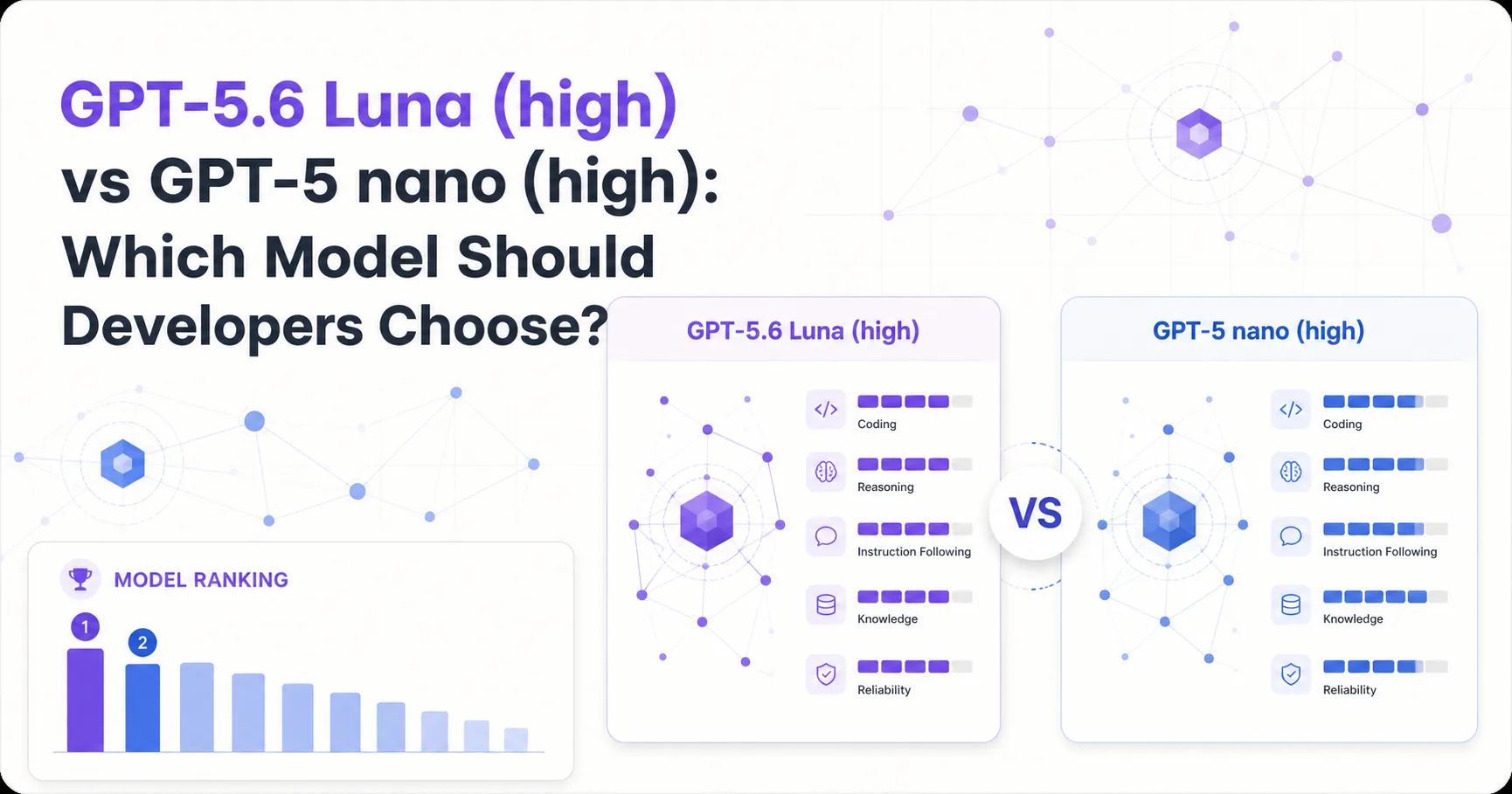
- **Winner overall:** GPT-5.6 Luna (high), with a 46.1 Artificial Analysis Intelligence Index score versus 19.9 for GPT-5 nano (high) - **Cheaper:** GPT-5 nano (high) at $0.1375 vs $0.45 per 1M blended tokens - **Faster:** GPT-5.6 Luna (high) at 164.222 median output tokens per second - **Pick GPT-5 nano (high) when:** your workload prioritizes low cost and the available 83.7 Artificial Analysis Math Index score fits the task - **Watch out:** GPT-5.6 Luna (high) is dated 2026-07-09, but its independent high API identity is not confirmed in the current official directory
GPT-5.6 Luna (high) vs GPT-5 nano (high)
GPT-5.6 Luna (high) is the safer measured choice for broad developer workloads, while GPT-5 nano (high) is the lower-cost option with a stronger documented math signal.
The comparison is complicated by a version and identity mismatch. The data snapshot names GPT-5.6 Luna (high) and GPT-5 nano (high), but the current OpenAI model directory does not independently list either high variant under those exact names. The directory lists gpt-5.6-luna for the Luna family, while the nano variant is not present in the supplied official listing. See the OpenAI model directory for the current catalog context.
The available measurements still give developers a useful decision boundary. GPT-5.6 Luna (high) records a 46.1 Artificial Analysis Intelligence Index score and a 63.3 Artificial Analysis Coding Index score. GPT-5 nano (high) records a 19.9 Intelligence Index score and an 83.7 Math Index score. These are not complete head-to-head benchmark results because the supplied data does not include a nano coding score or a Luna math score.
Data provided by Artificial Analysis.
Executive summary
GPT-5.6 Luna (high) offers the stronger measured general capability profile, but GPT-5 nano (high) costs substantially less per blended token.
| Decision factor | GPT-5.6 Luna (high) | GPT-5 nano (high) | What it means |
|---|---|---|---|
| Intelligence Index | 46.1 | 19.9 | Luna has the stronger measured broad-capability signal |
| Coding Index | 63.3 | Not provided | Luna has a measured coding result, but no direct nano comparison exists |
| Math Index | Not provided | 83.7 | Nano has a measured math result, but no direct Luna comparison exists |
| Blended price per 1M tokens | $0.45 | $0.1375 | Nano is the lower-cost choice |
| Input price per 1M tokens | $0.20 | $0.05 | Nano is cheaper for input-heavy workloads |
| Output price per 1M tokens | $1.20 | $0.40 | Nano is cheaper for generation-heavy workloads |
| Latency | 0.3 seconds | 0.3 seconds | The supplied snapshot reports a tie |
GPT-5.6 Luna (high) is the better default for applications that need broad reasoning, coding support, and predictable measured output speed. GPT-5 nano (high) is more attractive for high-volume classification, routing, extraction, or narrowly bounded generation where the lower price matters more than broad capability.
The official positioning supports Luna as a cost-sensitive, high-throughput model family, but it does not confirm that the high suffix is a separately callable model. The OpenAI model documentation describes gpt-5.6-luna, not a separately documented gpt-5-6-luna-high.
Performance and capability
GPT-5.6 Luna (high) has the stronger measured broad-capability profile, while GPT-5 nano (high) has the only reported math result in the supplied comparison.
The most meaningful result for general application design is the Intelligence Index split: 46.1 for Luna versus 19.9 for nano. That gap suggests Luna is the more defensible starting point for mixed workloads, especially when prompts combine interpretation, planning, coding, and response generation. It does not prove that Luna wins every task, because the dataset does not provide task-level error analysis or a complete paired benchmark suite.
GPT-5.6 Luna (high) also has a reported Coding Index score of 63.3. GPT-5 nano (high) has no Coding Index value in the snapshot, so developers should not treat Luna’s coding result as a measured margin over nano. The correct conclusion is narrower: Luna has evidence supporting coding use, while the supplied comparison lacks equivalent nano coding evidence.
GPT-5 nano (high) records an 83.7 Math Index score. GPT-5.6 Luna (high) has no Math Index value, so nano cannot be declared the overall math winner from this data alone. Nano may still deserve a targeted evaluation for arithmetic, symbolic reasoning, or math-heavy automation, but the evidence is incomplete.
Speed favors a different interpretation. Luna reports 164.222 median output tokens per second, while nano has no reported output-speed value. Both models show 0.3 seconds of latency in the snapshot, but equal latency does not establish equal streaming behavior, throughput under concurrency, or time to a correct answer.
The official OpenAI page says current model documentation covers text and image input, text output, multilingual capability, and vision capability for the latest model family. That statement is not proof that every capability applies to either high variant. Developers should validate the exact endpoint and feature set before implementation.
Cost and workload economics
GPT-5 nano (high) is the clear price choice, but its lower token rate only creates savings when its output remains accurate enough for the workflow.
The blended comparison lists nano at $0.1375 per 1M tokens and Luna at $0.45 per 1M blended tokens. Nano is also listed at $0.05 per 1M input tokens and $0.40 per 1M output tokens, compared with Luna at $0.20 input and $1.20 output. Those prices make nano attractive for workloads with large request volume, short prompts, simple outputs, or aggressive cost ceilings.
The cheaper model can become more expensive at the application level if it requires retries, human review, corrective post-processing, or a second model for difficult cases. The supplied data does not provide success rates, retry rates, or quality-adjusted cost, so no break-even threshold can be calculated responsibly. Developers should measure completed-task cost, not only token price.
GPT-5.6 Luna (high) may justify its higher price when a single response can replace multiple attempts or when coding and broad reasoning quality reduce downstream work. The 63.3 Coding Index score and 46.1 Intelligence Index score provide supporting signals, but they do not quantify production savings.
The official pricing page lists gpt-5.6-luna with Standard short-context pricing of $0.20 input and $1.20 output per 1M tokens. It does not list gpt-5-6-luna-high as a separate priced model. The OpenAI pricing documentation therefore supports family-level pricing context, not a confirmed high-variant billing contract.
For batch-oriented work, the brief reports that Batch and Flex pricing are the same for Luna, with short-context input at $0.10 and output at $0.60 per 1M tokens. Those figures apply to the documented Luna family context and should not be silently assigned to an unconfirmed high alias.
Recommendation by developer scenario
GPT-5.6 Luna (high) should be the default candidate for mixed coding and reasoning workflows, while GPT-5 nano (high) should be the cost-first candidate for bounded automation.
Choose GPT-5.6 Luna (high) when the application must handle varied instructions, code generation, multi-step decisions, or user-facing answers with fewer model handoffs. Its 46.1 Intelligence Index score and 63.3 Coding Index score provide the strongest available evidence for that role. Its reported 164.222 median output tokens per second also supports interactive use, although nano lacks a comparable speed measurement.
Choose GPT-5 nano (high) when request volume dominates architecture decisions and the task can be tightly constrained. Examples include routing, lightweight extraction, simple normalization, repetitive tagging, and other workflows where a lower-cost model can meet a clearly measured acceptance rule. Nano’s $0.1375 blended price per 1M tokens is the strongest economic argument in the comparison, and its 83.7 Math Index score makes it worth testing for math-focused automation.
Do not choose either name solely from the suffix high. The current official catalog does not confirm GPT-5.6 Luna (high) as an independent API entry, and the supplied official pages do not confirm GPT-5 nano as a current stable alias. The OpenAI model directory is the relevant source for availability, while the OpenAI pricing page is the relevant source for billing.
A practical selection process is to prototype with the exact production prompts, record successful task completion, measure retries and review, and then compare total cost. The supplied materials do not provide context windows, maximum output lengths, parameter limits, or reliable community failure reports. Those omissions are material for long-context codebases and structured production pipelines.
What the evidence does not answer
GPT-5.6 Luna (high) and GPT-5 nano (high) cannot be compared completely because the supplied evidence leaves several production-critical questions unresolved.
The snapshot does not provide context-window values for either model. It also does not provide maximum output lengths, exact supported parameters, tool behavior, structured-output constraints, or failure-mode analysis. The official documentation gives family-level capability language, but it does not establish that the language applies to each high variant.
Community evidence is also absent. No reliable Reddit, Hacker News, or X discussions were found for either exact model name, so there is no defensible public signal for coding ergonomics, speed perception, prompt sensitivity, or recurring production quirks.
The largest operational risk is model identity. GPT-5.6 Luna (high) is dated 2026-07-09 in the data snapshot, while the official directory documents gpt-5.6-luna rather than the exact high alias. GPT-5 nano (high) is dated 2025-08-07 in the snapshot, but the supplied official directory and pricing page do not confirm its current availability. These differences mean that an API smoke test must precede any production commitment.
Frequently asked questions
Which model should developers choose for a general-purpose application?
GPT-5.6 Luna (high) is the better starting point for general-purpose applications because it has the stronger 46.1 Intelligence Index score and a reported 63.3 Coding Index score, although exact API availability remains unconfirmed.
Which model is cheaper for large-scale production traffic?
GPT-5 nano (high) is cheaper in the supplied comparison at $0.1375 per 1M blended tokens, compared with $0.45 for GPT-5.6 Luna (high), but total workflow cost still depends on retries and review.
Is GPT-5 nano (high) faster than GPT-5.6 Luna (high)?
The supplied evidence does not establish that GPT-5 nano (high) is faster because nano has no reported output-speed value; both models have a listed latency of 0.3 seconds.
Can developers call GPT-5.6 Luna (high) directly through the OpenAI API?
Developers should verify the exact model identifier before deployment because the current official directory lists gpt-5.6-luna but does not independently confirm gpt-5-6-luna-high as a callable model.
Is GPT-5 nano (high) better for mathematics?
GPT-5 nano (high) has the only supplied math result, an 83.7 Math Index score, but GPT-5.6 Luna (high) has no corresponding math score, so the comparison cannot prove a direct winner.
Sources
- OpenAI ModelsVerifying current model names, family positioning, documented capabilities, API availability, and the absence of independently listed high variants.
- OpenAI PricingVerifying documented family pricing, pricing modes, and the absence of a separately listed GPT-5 nano or GPT-5.6 Luna high-variant price.
- Artificial AnalysisAttributing the supplied benchmark, latency, output-speed, release-date, and pricing snapshot used in the comparison.
Published: