
AI model analysis
GPT-5.6 Luna vs o3: Which OpenAI Model Should Developers Choose?
A developer-focused comparison of GPT-5.6 Luna and o3 covering measured performance, cost, availability evidence, and model-selection risk.
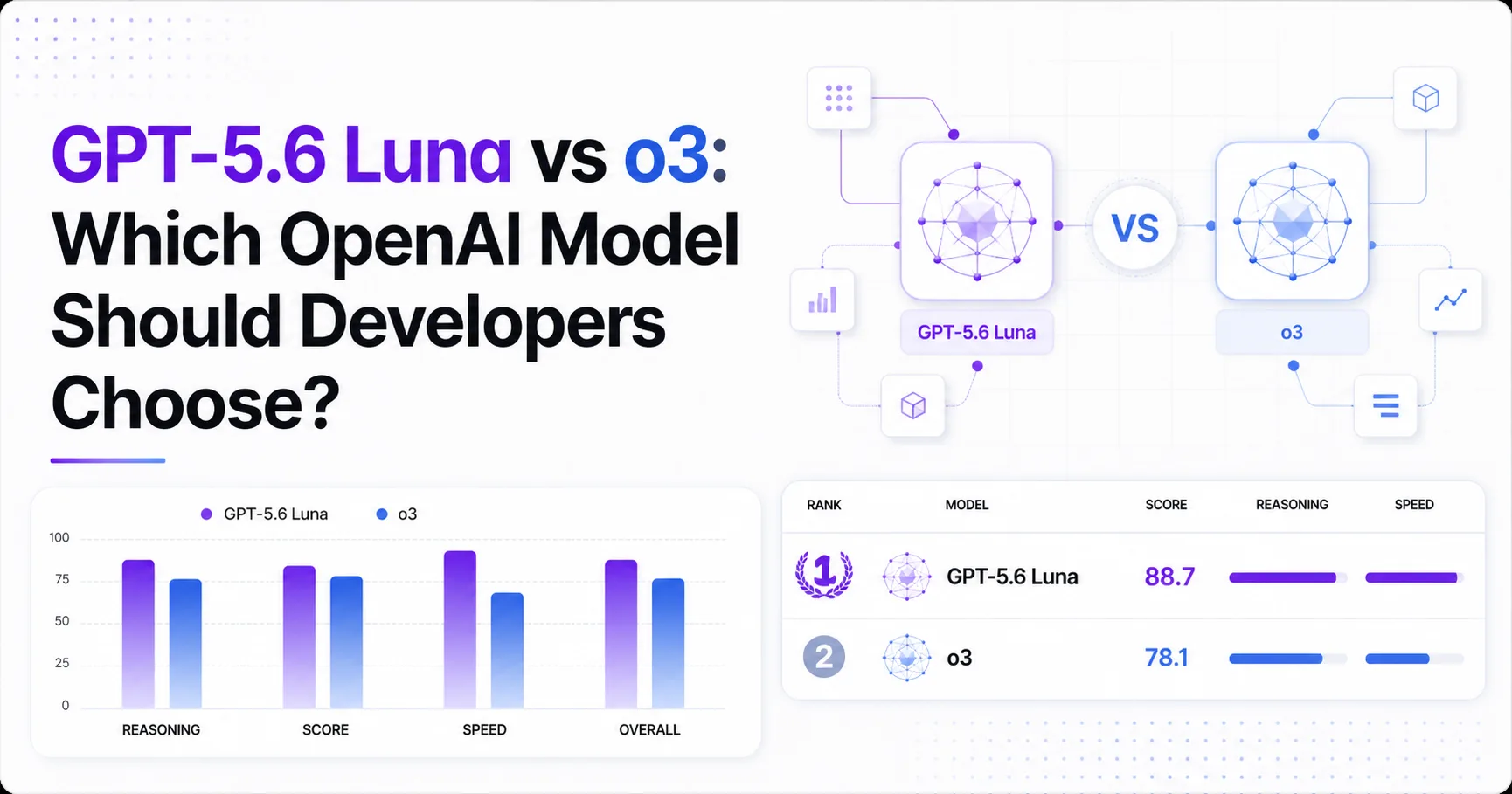
- **Winner overall:** GPT-5.6 Luna (max), with a 51.2 Artificial Analysis Intelligence Index score vs 30.4 for o3 - **Cheaper:** GPT-5.6 Luna (max) at $0.45 vs $3.5 per 1M blended tokens - **Faster:** GPT-5.6 Luna (max) at 175.726 median output tokens per second - **Pick GPT-5.6 Luna (max) when:** you need a current, cost-sensitive model for high-volume reasoning or coding workloads - **Watch out:** o3 has an 88.3 Artificial Analysis Math Index score, but the available materials do not provide a directly comparable Luna math score
GPT-5.6 Luna vs o3
GPT-5.6 Luna (max) is the stronger default for developers who need current API availability, lower measured cost, and higher observed general performance. The available evidence does not establish a complete capability winner because o3 has a reported 88.3 Artificial Analysis Math Index score, while GPT-5.6 Luna has no directly comparable math score in the data brief.\n\nOpenAI describes GPT-5.6 Luna as a reasoning model aimed at cost-sensitive, high-volume workloads. The model page lists Responses API, Chat Completions API, and Batch API support. It also lists structured outputs, function calling, file search, web search, prompt caching, and image input.\n\nThe central selection issue is therefore not simply old model versus new model. GPT-5.6 Luna has current official documentation and pricing evidence. The supplied OpenAI Models directory does not list o3, and the supplied OpenAI Pricing page does not list an o3 price. That documentation gap creates operational risk for any new integration built around o3.
Executive summary
GPT-5.6 Luna (max) wins the measurable overall comparison, but o3 remains relevant for math-sensitive workloads because the evidence covers different evaluation dimensions.\n\n| Decision area | GPT-5.6 Luna (max) | o3 | Selection meaning | | — | —: | —: | — | | Intelligence Index | 51.2 | 30.4 | Luna leads on the available general evaluation | | Coding Index | 71.4 | Not provided | Luna has a measured coding result, but no direct o3 comparison | | Math Index | Not provided | 88.3 | o3 has a measured math result, but no direct Luna comparison | | Median output speed | 175.726 tokens per second | 128.056 tokens per second | Luna produced output faster in the supplied data | | Latency | 0.3 seconds | 0.3 seconds | The measured first-response latency is tied | | Blended price | $0.45 per 1M tokens | $3.5 per 1M tokens | Luna is substantially cheaper in the supplied pricing comparison | \nGPT-5.6 Luna was released on 2026-07-09, while the data brief dates o3 to 2025-04-16. The OpenAI Changelog supports the Luna release and GPT-5.6 family positioning. The difference matters because a developer choosing a production model needs more than historical reputation. They need a model identifier, documented endpoint behavior, and a pricing path that can be checked today.\n\nThe strongest conclusion is practical: start new high-volume workloads with Luna unless a controlled evaluation shows that o3’s math behavior is essential. Do not claim that Luna is better at mathematics, because the supplied evidence does not support that conclusion.
Performance: speed helps, but benchmark coverage decides what remains unknown
GPT-5.6 Luna (max) is the faster measured model and has the only supplied coding score, but the evidence does not prove that it is better for every developer task.\n\nThe supplied measurements show Luna at 175.726 median output tokens per second and o3 at 128.056. Both models have 0.3 seconds of measured latency. For interactive coding assistants, equal latency means the request can begin responding on a similar schedule, while Luna’s higher output rate can shorten the visible time spent receiving a long explanation, patch, or generated test file. That distinction matters for user perception and concurrency.\n\nSpeed does not automatically reduce end-to-end application time. Tool calls, retrieval, queueing, streaming behavior, retries, and output length can dominate the user journey. The supplied model page confirms that Luna supports tools such as file search, web search, code interpretation, hosted shell, computer use, MCP, and patch application, but it does not provide tool-specific latency guarantees or error-recovery behavior. Developers should therefore measure the full workflow, not only token emission.\n\nThe coding comparison is asymmetric. Luna has an Artificial Analysis Coding Index score of 71.4. No o3 coding score appears in the data brief, and no official Luna benchmark score was found in the supplied research. The result supports testing Luna first for code generation and repository work, not declaring a universal coding victory.\n\nThe math comparison is also asymmetric. o3 has an Artificial Analysis Math Index score of 88.3. Luna has no corresponding math value in the supplied data. A developer building theorem-solving, symbolic reasoning, or contest-math workflows should treat the result as an open question and run matched prompts, exact-answer checks, and regression tests before switching.
Cost: Luna changes the economics of repeated reasoning
GPT-5.6 Luna (max) is the clear price choice for high-volume traffic, but long outputs, long inputs, and workflow retries can still change the real bill.\n\nThe supplied comparison prices Luna at $0.45 per 1M blended tokens and o3 at $3.5. Luna’s listed input price is $0.2 per 1M tokens, compared with $2 for o3. Its output price is $1.2, compared with $8 for o3. The practical implication is larger than a small unit-price improvement: repeated agent loops, code reviews, test repair, and retrieval-augmented prompts can become financially viable at a much lower usage level with Luna.\n\nBlended pricing is useful for a first decision, but it hides workload shape. Output-heavy applications should pay closer attention to output pricing. Applications that resend large repositories or long conversation histories should inspect input pricing and caching behavior. A model that is cheaper per blended token can become less attractive if it requires substantially more retries, produces unusable patches, or needs an additional verification model. The supplied data does not measure any of those costs.\n\nLuna’s official pricing page also documents Standard, Batch, Flex, and Fast mode options. The model page states that requests beyond 272K input tokens receive higher input and output billing multipliers. That threshold makes long-context automation a separate cost case from ordinary chat or short repository tasks. Developers should segment workloads by input length, cache hit rate, output length, and retry frequency before approving a migration.\n\nThe evidence for o3 is weaker for current procurement. The supplied pricing materials do not list a current o3 price, so $3.5 should be treated as the data-brief comparison value rather than proof of a currently purchasable official rate. Verify account-level availability and billing before committing.
Recommendation by workload
GPT-5.6 Luna (max) should be the default candidate for new developer products, while o3 deserves a narrow, evidence-driven trial for math-heavy behavior.\n\nChoose GPT-5.6 Luna (max) for production coding assistants, repository analysis, structured extraction, tool-using agents, and high-volume reasoning where documented API support and predictable cost matter. Its 71.4 Coding Index result gives developers a concrete starting signal for software tasks. Its 51.2 Intelligence Index result also exceeds o3’s 30.4 result in the supplied comparison. Those figures justify prioritizing Luna in an evaluation queue, not skipping evaluation altogether.\n\nChoose o3 only when an existing system already depends on it or when a controlled test confirms a math or reasoning behavior that Luna cannot match. The 88.3 Math Index result is meaningful evidence for investigation, but it is not a complete product recommendation. The available materials provide no current o3 model-directory entry, no official o3 pricing entry, no verified stability alias, and no direct Luna math comparison.\n\nFor a migration, keep the acceptance test small and task-specific. Compare answer correctness, patch applicability, test pass rate, tool-call completion, retry rate, and total tokens on representative prompts. Include adversarial cases and long-context cases. Do not infer model continuity from a model name. OpenAI’s documentation identifies Luna as gpt-5.6-luna, with no independent stable alias listed on its model page. The OpenAI Deprecations page does not list a Luna deprecation or shutdown plan in the supplied research, but developers should still monitor official status.\n\nThe final decision rule is simple: use Luna as the default, retain o3 only where measured task performance earns its operational and cost burden, and document every exception.
What developers should verify before choosing
GPT-5.6 Luna (max) is easier to assess from the supplied evidence, while o3 requires more verification before a new production commitment.\n\nThe first question is availability. The OpenAI Models directory currently presents GPT-5.6 Luna among the latest frontier models, while the supplied material does not show o3 in that directory. The second question is pricing. The OpenAI Pricing page provides Luna prices but no o3 listing. The third question is capability fit. Luna supports text and image input with text output, while the supplied o3 material does not provide enough official detail to compare modalities or output behavior.\n\nThe missing evidence is itself a selection factor. There are no reliable community posts in the supplied research that verify either model’s coding feel, speed perception, or failure patterns. There is also no official Luna benchmark result in the supplied research. A developer should not fill those gaps with assumptions based on release order, model naming, or reputation.\n\nA safe evaluation should test the actual application contract: prompts, tools, schemas, context size, expected output length, latency budget, and failure handling. If the application requires fresh information, account for Luna’s knowledge cutoff of 2026-02-16 and test web search or application-side data injection. The official Reasoning guide explains reasoning controls, but the supplied research does not establish every GPT-5.6 family setting as a Luna-specific guarantee.
Frequently asked questions
Is GPT-5.6 Luna better than o3 for coding?
GPT-5.6 Luna is the safer coding candidate from the supplied evidence because it has a 71.4 Coding Index score and documented current API support, while no comparable o3 coding score is provided. That evidence supports an evaluation priority, not a universal coding guarantee.
Is o3 better for mathematics than GPT-5.6 Luna?
o3 is the only model with a supplied math result, scoring 88.3 on the Artificial Analysis Math Index. GPT-5.6 Luna has no comparable math value in the data brief, so developers should test matched mathematical tasks before making a capability claim.
Which model is cheaper for production workloads?
GPT-5.6 Luna is cheaper in the supplied comparison at $0.45 per 1M blended tokens versus $3.5 for o3. Real savings can change with retries, output length, caching, long inputs, and the availability of a current official o3 price.
Which model is faster for an interactive developer tool?
GPT-5.6 Luna is faster by the supplied output-rate measurement at 175.726 median output tokens per second versus 128.056 for o3, while both show 0.3 seconds of latency. End-to-end speed still depends on tools, retrieval, queueing, streaming, and retries.
Should a team migrate an existing o3 integration immediately?
A team should migrate only after a task-specific regression test confirms that GPT-5.6 Luna preserves correctness, tool behavior, structured output, and acceptable latency. Luna is the stronger default for new work, but the supplied evidence does not cover every o3 dependency or math-heavy workflow.
Sources
- Models | OpenAI APICurrent model-directory visibility, GPT-5.6 family positioning, and the absence of o3 in the supplied current directory evidence.
- GPT-5.6 Luna Model | OpenAI APILuna model identifier, API support, tools, modalities, knowledge cutoff, pricing behavior, and documented limitations.
- Pricing | OpenAI APILuna Standard, Batch, Flex, and Fast mode pricing, plus the absence of a supplied current o3 pricing entry.
- Changelog | OpenAI APIGPT-5.6 Luna release timing, GPT-5.6 family updates, and alias context.
- Deprecations | OpenAI APIChecking the supplied evidence for a Luna deprecation or shutdown plan.
- Reasoning guide | OpenAI APIReasoning-control documentation and the limits of Luna-specific setting guarantees in the supplied research.
Published: