
AI model analysis
GPT-5.6 Luna (xhigh) vs o3: Which OpenAI Model Should Developers Choose?
A developer-focused comparison of GPT-5.6 Luna (xhigh) and o3 across measured intelligence, coding evidence, speed, pricing, API visibility, and selection risk.
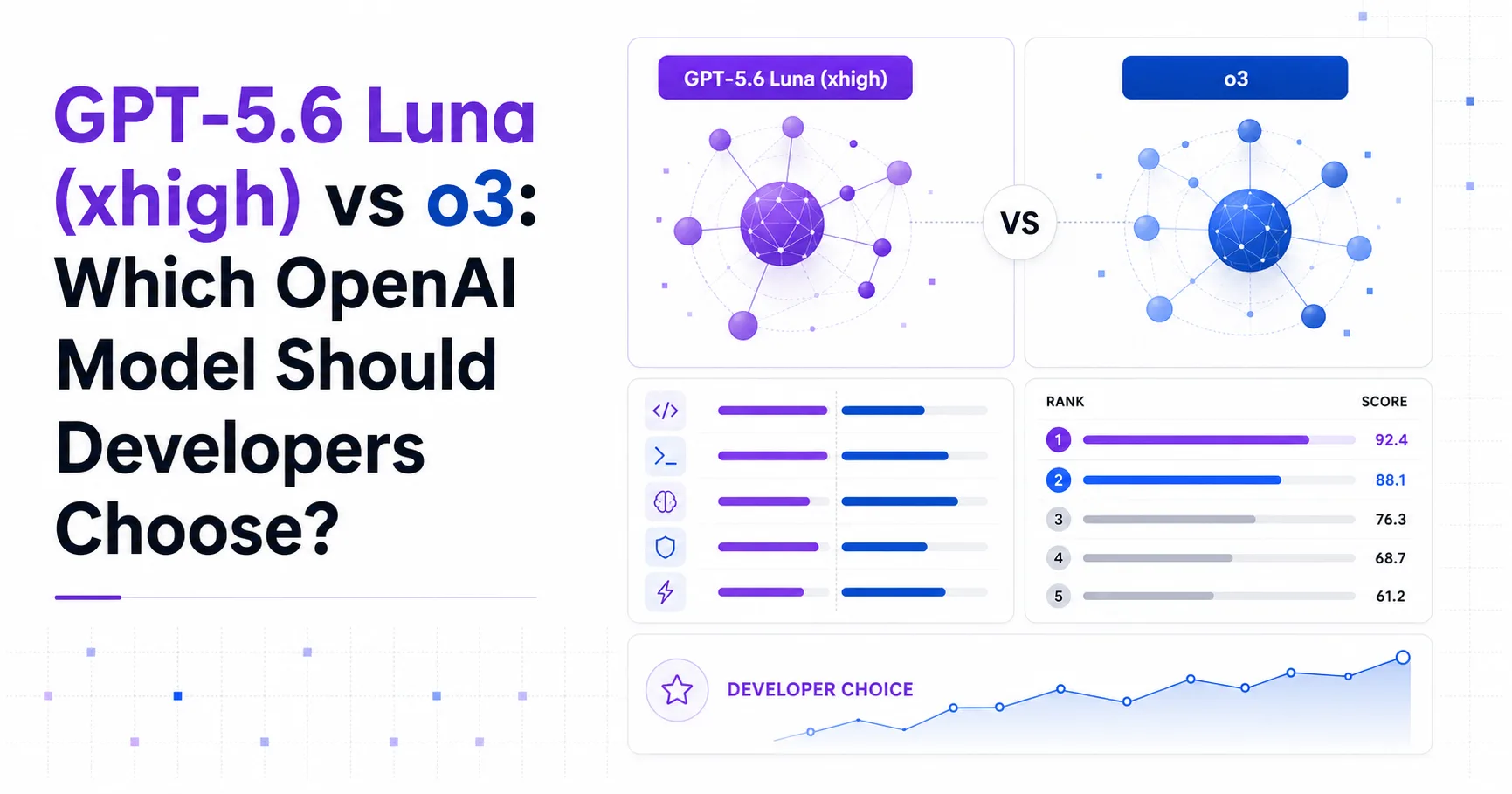
- **Winner overall:** GPT-5.6 Luna (xhigh), with an Artificial Analysis Intelligence Index of 49.1 vs 30.4 and a lower blended price of $0.45 vs $3.5 per 1M tokens - **Cheaper:** GPT-5.6 Luna (xhigh) at $0.45 vs $3.5 per 1M blended tokens - **Faster:** GPT-5.6 Luna (xhigh) at 172.255 median output tokens per second - **Pick GPT-5.6 Luna (xhigh) when:** you need a lower-cost, high-throughput model with current official API visibility - **Watch out:** o3 has an Artificial Analysis Math Index of 88.3, but the available evidence does not establish whether that advantage generalizes to your workload
GPT-5.6 Luna (xhigh) vs o3
GPT-5.6 Luna (xhigh) is the stronger default for most new developer workloads because it combines higher measured general intelligence, faster output, and much lower reported pricing. Artificial Analysis reports an Intelligence Index of 49.1 for GPT-5.6 Luna (xhigh) and 30.4 for o3. The same dataset reports median output speeds of 172.255 and 128.056 tokens per second, respectively. Both models show 0.3 seconds of measured latency. OpenAI currently lists gpt-5.6-luna in its model documentation, while the supplied current documentation does not list o3 as an available model. OpenAI Models
Executive summary for model selection
GPT-5.6 Luna (xhigh) offers the better balance of measured intelligence, throughput, and price, while o3 remains relevant only when its math result matches a validated task requirement. Artificial Analysis gives Luna an Intelligence Index of 49.1 versus 30.4 for o3, a difference reported as 18.700000000000003 points. That gap is large enough to make Luna the safer general-purpose starting point for applications that need broad reasoning performance.
GPT-5.6 Luna (xhigh) also has a reported blended price of $0.45 per 1M tokens, compared with $3.5 for o3. Its input price is $0.2 versus $2, and its output price is $1.2 versus $8. These prices make repeated inference, extraction, classification, and agentic retries materially easier to budget. The cost advantage does not prove that Luna is better for every specialized task.
o3 has the only supplied Math Index result, at 88.3, while Luna has the only supplied Coding Index result, at 68.6. The evidence therefore does not support a complete head-to-head ranking for math or coding. Developers should treat those category results as directional signals, not as proof that one model wins both domains. OpenAI’s current model page describes Luna’s text and image input, text output, multilingual, and vision capabilities, but the supplied sources do not provide equivalent current o3 details. OpenAI Models
Performance: speed is clear, capability coverage is not
GPT-5.6 Luna (xhigh) is the measured speed leader, but the available benchmark coverage is too incomplete to prove a universal quality winner. Artificial Analysis reports 172.255 median output tokens per second for Luna and 128.056 for o3. That difference matters most for long responses, interactive coding sessions, and workflows where users wait for visible output. It matters less for short requests if the application spends most of its time on network, tool, retrieval, or orchestration steps.
The measured latency is 0.3 seconds for each model, so faster token generation does not automatically mean a faster completed request. A workload that returns short answers may experience little practical difference. A workload that streams substantial outputs can benefit more from Luna’s higher generation rate. The result should therefore be interpreted as a throughput advantage, not a guarantee of lower end-to-end latency.
Quality evidence is asymmetric. Luna has a Coding Index of 68.6, while o3 has a Math Index of 88.3. The supplied dataset has no directly comparable o3 Coding Index and no directly comparable Luna Math Index. The official documentation also does not provide model-specific benchmark scores for either comparison target. OpenAI Models Developers choosing for code generation should run repository-level tests, and developers choosing for mathematical reasoning should validate representative problems. The current evidence cannot say whether o3’s math result outweighs Luna’s broader measured advantage for a particular product.
Cost: Luna changes the economics of iteration
GPT-5.6 Luna (xhigh) is the clear price choice for workloads where token volume, retries, or parallel calls dominate the bill. Artificial Analysis reports a blended price of $0.45 per 1M tokens for Luna and $3.5 for o3. The reported input prices are $0.2 and $2, while output prices are $1.2 and $8. Those differences can change architecture decisions, especially when a system needs multiple candidate generations, validation passes, or long agent traces.
The cheaper model can still become more expensive if it requires more calls to reach an acceptable result. The supplied materials do not report reliability, pass rates, correction frequency, or task success for either model. No evidence therefore shows how many additional Luna calls would erase its nominal price advantage, or whether o3 would reduce downstream review work. Teams should compare cost per successful task rather than cost per token alone.
OpenAI’s pricing page lists Luna under the stable API alias gpt-5.6-luna and provides Standard, Batch, Flex, and Fast mode prices. OpenAI Pricing The supplied official material does not list a current o3 price, stable alias, or equivalent mode pricing. OpenAI Models That visibility gap is itself a procurement concern. A model with unclear current availability is difficult to forecast, migrate, or standardize across environments.
Recommendation by developer scenario
GPT-5.6 Luna (xhigh) should be the first model developers evaluate for new production systems, while o3 deserves a targeted trial for math-heavy work. Luna has the stronger supplied general Intelligence Index, at 49.1 versus 30.4 for o3, and it costs $0.45 versus $3.5 per 1M blended tokens. Artificial Analysis Its higher output speed also favors interactive applications that stream substantial responses.
Choose Luna when the product needs high request volume, predictable current API documentation, multimodal input, or economical iteration. OpenAI describes the listed Luna alias as supporting text and image input, text output, multilingual capability, and vision through the Responses API and OpenAI Client SDK. OpenAI Models The supplied documentation does not specify Luna’s context window, maximum output, tool limits, rate limits, or dedicated xhigh lifecycle details, so those requirements remain open validation items.
Test o3 when mathematical reasoning is central and the reported Math Index of 88.3 reflects your acceptance tests. That result is not directly comparable with Luna because the supplied dataset does not include Luna’s Math Index. The current official model directory and pricing page also do not establish o3’s active API status, stable alias, or current price. OpenAI Models OpenAI Pricing Do not make o3 the default dependency until availability and task-level performance are confirmed.
What the supplied evidence cannot answer
GPT-5.6 Luna (xhigh) has stronger documented current visibility than o3, but neither model has enough supplied evidence for a complete production risk assessment. OpenAI lists Luna’s API alias as gpt-5.6-luna, yet the supplied official page does not mention gpt-5-6-luna-xhigh as a separate API model name. OpenAI Models The available material also does not provide a public announcement matching Luna’s data-snapshot release date of 2026-07-09.
The evidence is similarly limited for o3. The supplied current model page does not list o3, and the supplied official sources do not clarify whether o3 remains directly callable, has a stable alias, or has been formally replaced. OpenAI Models No reliable community discussions, reproducible test methods, failure cases, or coding and speed reports were supplied for either model.
Developers should therefore separate measured signals from unknowns. The dataset supports Luna’s advantages in reported general intelligence, output speed, and listed pricing. It supports o3’s reported math result. It does not establish reliability, context behavior, tool quality, rate limits, migration guarantees, or cost per successful task. Artificial Analysis Those unanswered questions require a workload-specific evaluation before launch.
Before you choose
GPT-5.6 Luna (xhigh) is the safer starting point when current API visibility and operating cost matter more than an unverified specialized advantage. OpenAI lists gpt-5.6-luna in its current model documentation, while the supplied official pages do not list o3 or its current price. OpenAI Models OpenAI Pricing
GPT-5.6 Luna (xhigh) should still be tested against real application tasks because the supplied evidence does not include model-specific reliability, tool behavior, context limits, or failure patterns. Artificial Analysis
Frequently asked questions
Which model should most developers choose first?
GPT-5.6 Luna (xhigh) should be the first evaluation candidate for most developers because the supplied data reports a higher Intelligence Index, faster output, and a lower blended price, while current OpenAI documentation lists its API alias. Artificial Analysis OpenAI Models
Is o3 better for mathematical reasoning?
o3 is the only model with a supplied Math Index result, at 88.3, so it deserves a targeted math evaluation; however, Luna has no comparable supplied Math Index, and the evidence cannot prove a general math advantage. Artificial Analysis
Which model is cheaper for production workloads?
GPT-5.6 Luna (xhigh) is cheaper on every supplied core pricing measure, with a $0.45 blended price per 1M tokens versus $3.5 for o3, although success rate and retry cost remain unreported. Artificial Analysis OpenAI Pricing
Which model is faster for streaming output?
GPT-5.6 Luna (xhigh) is faster in the supplied output-speed measurement, at 172.255 median output tokens per second versus 128.056 for o3, while both models have reported latency of 0.3 seconds. Artificial Analysis
Can developers safely standardize on o3 today?
Developers should confirm o3’s current API availability, stable alias, pricing, and task performance before standardizing on it because the supplied current OpenAI documentation does not establish those details. OpenAI Models OpenAI Pricing
Does Luna’s xhigh label have a confirmed standalone API model?
The supplied official documentation confirms gpt-5.6-luna as the API alias but does not confirm gpt-5-6-luna-xhigh as a separate standalone API model, so implementation teams should verify the exact request configuration. OpenAI Models
Sources
- Artificial AnalysisMeasured intelligence, math, coding, output speed, latency, pricing, and release-date data supplied for the comparison
- OpenAI ModelsCurrent model visibility, GPT-5.6 Luna API alias, stated multimodal capabilities, and missing o3 and xhigh lifecycle details
- OpenAI PricingGPT-5.6 Luna pricing modes and the absence of a supplied current o3 price
Published: