
AI model analysis
GPT-5.6 Sol (high) vs GPT-5 mini (high): Which Model Should Developers Choose?
A developer-focused comparison of GPT-5.6 Sol (high) and GPT-5 mini (high), covering capability, speed, cost, API availability, evidence quality, and practical selection criteria.
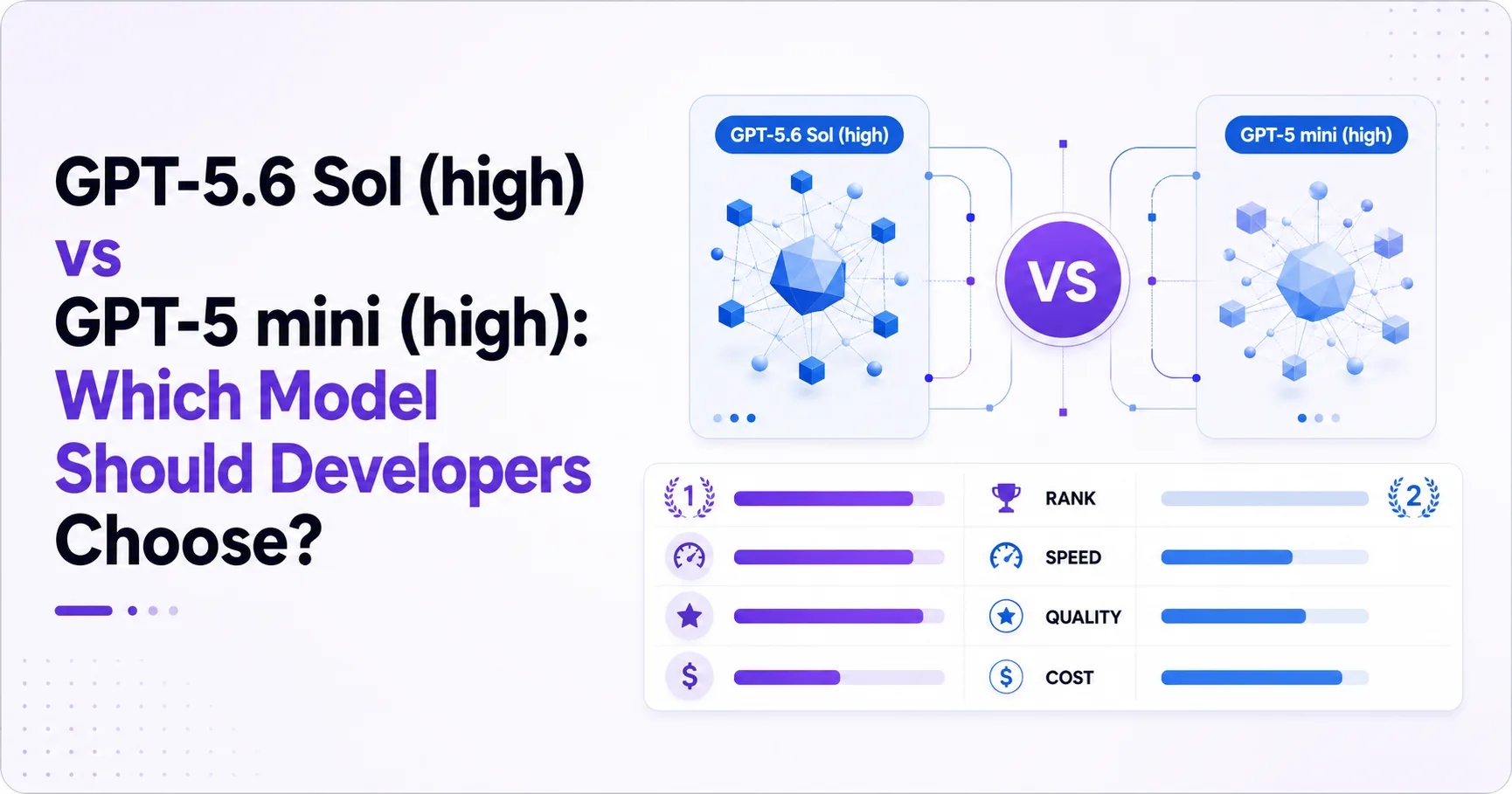
- **Winner overall:** GPT-5.6 Sol (high), with a 77.2 Artificial Analysis Coding Index versus 15.6 for GPT-5 mini (high) - **Cheaper:** GPT-5 mini (high) at $0.6875 vs $11.25 per 1M blended tokens - **Faster:** GPT-5.6 Sol (high) at 73.648 median output tokens per second, while GPT-5 mini (high) has no reported value - **Pick GPT-5 mini (high) when:** low token cost matters more than verified coding performance, and the model is available in your deployment environment - **Watch out:** GPT-5 mini (high) is not listed in the current OpenAI model or pricing directories, so its present API status and performance evidence are uncertain
GPT-5.6 Sol (high) is the stronger default for serious development work
GPT-5.6 Sol (high) is the stronger default for developers who need verified coding capability and a currently documented API path. The Artificial Analysis Coding Index is 77.2 for GPT-5.6 Sol (high), compared with 15.6 for GPT-5 mini (high). Artificial Analysis provides the comparison data.
GPT-5.6 Sol also has a reported median output speed of 73.648 tokens per second, while GPT-5 mini (high) has no reported output-speed value in the supplied data. Both models show 0.3 seconds of latency in the data brief, so the available evidence does not establish a latency advantage for either model.
The larger concern is model availability. OpenAI documents GPT-5.6 Sol through a dedicated model page, while the current directory does not list GPT-5 mini. GPT-5.6 Sol model documentation identifies the API model as gpt-5.6-sol, whereas OpenAI Models does not provide an equivalent current entry for gpt-5-mini.
The comparison is a capability-versus-certainty decision, not a simple price contest
GPT-5.6 Sol (high) wins the measurable general-purpose comparison, but GPT-5 mini (high) remains attractive only if its low listed cost and local availability can be verified.
| Decision area | GPT-5.6 Sol (high) | GPT-5 mini (high) | What it means for developers |
|---|---|---|---|
| Coding index | 77.2 | 15.6 | Sol has the stronger supplied evidence for coding tasks |
| Intelligence index | 55.9 | 25.3 | Sol has the stronger broad capability signal |
| Math index | No value supplied | 90.7 | Mini has a notable math result, but there is no directly comparable Sol value |
| Blended price | $11.25 | $0.6875 | Mini is the lower-cost option in the supplied snapshot |
| Median output speed | 73.648 tokens per second | No value supplied | Only Sol has a reported throughput figure |
| Latency | 0.3 seconds | 0.3 seconds | The supplied data shows a tie |
OpenAI positions GPT-5.6 Sol as a flagship reasoning model for complex professional work, complex reasoning, and coding. The official GPT-5.6 Sol page also documents text and image input, Responses API, Chat Completions API, Batch API, structured outputs, function calling, file search, web search, and other tools.
GPT-5 mini (high) cannot be evaluated with the same level of official documentation. The supplied OpenAI Models directory does not list a dedicated gpt-5-mini entry, and the supplied OpenAI Pricing page does not list its price. That creates a conflict between the comparison snapshot and the current official catalog. The snapshot supplies a price and benchmark values, but it does not prove that the displayed model remains directly callable.
The most important unanswered question is whether “GPT-5 mini (high)” refers to a current API model, a historical model, or a benchmark label. The supplied sources do not answer that question. Developers should treat deployment availability as a gate before treating the price advantage as actionable.
Sol’s capability lead matters most when failures create engineering work
GPT-5.6 Sol (high) is the better performance choice when a weak answer creates review, debugging, or agent-orchestration work.
The coding-index gap is 77.2 versus 15.6. That difference should not be read as a promise that Sol solves every repository task. It does indicate that the supplied benchmark evidence strongly favors Sol for coding-oriented evaluation. Artificial Analysis is the stated provider of those data points.
For a developer, the practical consequence is less about prose quality and more about downstream work. A model with stronger coding evidence may produce fewer unusable patches, fewer incorrect assumptions about a codebase, or fewer repair turns. The supplied materials do not provide task-level failure counts, so the exact effect on review time remains unknown. That missing evidence matters for agent loops, where a cheaper model can become expensive through retries and human correction.
GPT-5.6 Sol has a reported median output speed of 73.648 tokens per second. GPT-5 mini (high) has no reported value, so the data cannot establish that mini is faster despite its smaller positioning. Both models have 0.3 seconds of reported latency. Latency therefore does not separate them in this snapshot, while output throughput is only documented for Sol.
The community evidence adds caution rather than a confirmed ranking. Some Reddit users describe GPT-5.6 Sol as slow or prone to over-engineering, but the discussion lacks a standardized task set and latency methodology. The Codex Reddit discussion supports treating those reports as risk signals, not population-level measurements.
A Hacker News report describes investigation drift, overextended conclusions, and defensive code in some workflows. The author later reported better subjective results after lowering reasoning effort. The Hacker News discussion does not provide enough sample or statistical detail to determine how common that behavior is.
Another Hacker News post reports a limited rewrite test using Codex CLI and a custom agent harness. The reported test covers one task, so it can inform experiment design but cannot validate general coding superiority or infer GPT-5 mini behavior.
Mini is cheaper on paper, but Sol can be cheaper per successful outcome
GPT-5 mini (high) is the clear price winner in the supplied snapshot, but its economic advantage depends on current availability and how much correction its outputs require.
The blended price is $0.6875 for GPT-5 mini (high) and $11.25 for GPT-5.6 Sol (high). Input pricing is $0.25 versus $5, and output pricing is $2 versus $30. These figures make mini the natural candidate for high-volume classification, lightweight drafting, or exploratory calls when the model can be verified and the task tolerates weaker coding evidence.
The cost picture changes for work where a failed answer triggers another model call, a repair pass, or developer review. The supplied data does not contain retry rates, success rates, or human review costs, so it cannot prove that Sol has a lower total cost of ownership. It only shows that the direct token price favors mini.
GPT-5.6 Sol’s official pricing also depends on service tier, context length, caching, and request shape. OpenAI API pricing lists separate Standard, Batch, Flex, and Fast mode prices. The same documentation states that requests above 272K tokens receive higher long-context pricing. The Sol model page lists a maximum input of 922K tokens, so long repository context can materially alter the budget.
Reasoning tokens create another cost and reliability variable. OpenAI’s reasoning guide explains that reasoning tokens consume the context window and are billed as output tokens. A low max_output_tokens limit can produce an incomplete response before the visible answer is finished. The supplied sources do not disclose token consumption or success rates for the high reasoning configuration, so no defensible value comparison can be made beyond the listed prices.
Choose Sol for verified coding work, and choose mini only after a live availability check
GPT-5.6 Sol (high) is the recommended choice for production coding agents, complex debugging, repository changes, and high-value planning.
Sol has three decision advantages. Its coding index is 77.2, its intelligence index is 55.9, and its current official documentation identifies a concrete model ID, gpt-5.6-sol. OpenAI’s model page also documents the reasoning and tool surface needed for multi-step development workflows. The official reasoning guide explains that high effort is intended for complex debugging, deep planning, high-value coding, and long-running tasks. Reasoning models provides that configuration context.
GPT-5 mini (high) is worth considering for cost-sensitive workloads with narrow acceptance criteria. Its blended price is $0.6875, its math index is 90.7, and its coding index is 15.6. That combination suggests a possible role in inexpensive math-heavy or low-risk auxiliary work, but the supplied sources do not establish whether the displayed model is currently callable through OpenAI’s API.
The recommendation should therefore be conditional. Use Sol when correctness, tool use, and reduced engineering rework matter more than direct token price. Test mini only when its endpoint, alias, limits, and billing are confirmed in the target account. The current official directory and pricing page do not confirm those details for mini. OpenAI Models and OpenAI Pricing are the relevant verification points.
Before adoption, run the same repository tasks against the exact production configuration. Record successful completion, repair turns, output length, human review, and end-to-end cost. The supplied brief does not provide those measurements, so a local evaluation is necessary for any high-confidence procurement decision.
Questions developers should answer before switching models
GPT-5.6 Sol (high) has the clearer documented deployment path, while GPT-5 mini (high) requires verification before production use.
The questions below focus on practical uncertainties that the supplied benchmark and research materials do not fully resolve. They separate measured signals from assumptions about availability, throughput, task fit, and total cost.
Frequently asked questions
Is GPT-5.6 Sol (high) the better model for coding agents?
Yes, GPT-5.6 Sol (high) is the better-supported coding choice because its Artificial Analysis Coding Index is 77.2 versus 15.6 for GPT-5 mini (high), although local testing still matters.
Is GPT-5 mini (high) worth choosing because it is cheaper?
GPT-5 mini (high) is worth testing for cost-sensitive work because its blended price is $0.6875, but its current API availability and real-world reliability are not confirmed by the supplied official sources.
Which model is faster?
GPT-5.6 Sol (high) is the only model with a reported median output speed, at 73.648 tokens per second, while both models have reported latency of 0.3 seconds.
Does GPT-5.6 Sol have a documented API model ID?
GPT-5.6 Sol has a documented API model ID, gpt-5.6-sol, while the supplied sources do not confirm an equivalent current API identifier for GPT-5 mini (high).
Is the math result enough to choose GPT-5 mini (high)?
GPT-5 mini (high) has a supplied math index of 90.7, but that result alone does not establish coding quality, availability, output speed, or total cost for a developer workflow.
Sources
- Artificial AnalysisBenchmark, pricing, latency, and output-speed data attribution
- GPT-5.6 Sol model documentationSol model identity, API model ID, capabilities, context limits, and official availability
- OpenAI ModelsCurrent official model directory and absence of a listed GPT-5 mini entry
- OpenAI API PricingOfficial pricing catalog, service tiers, and long-context pricing rules
- Reasoning modelsReasoning effort, reasoning tokens, output limits, and incomplete-response behavior
- GPT-5.6: Frontier intelligence that scales with your ambitionOfficial GPT-5.6 positioning and published benchmark context
- GPT-5.6 Sol / Codex Release Discussion MegathreadCommunity reports about speed and over-engineering
- Ask HN: How are you productive with GPT 5.6 Sol?Community reports about investigation drift, defensive code, and reasoning-effort changes
- Is GPT-5.6 Sol Max Worth It?Limited rewrite-task test context and its methodological limitation
Published: