
AI model analysis
GPT-5.6 Sol (high) vs Kimi K3 (max): Which Model Should Developers Choose?
A developer-focused comparison of GPT-5.6 Sol (high) and Kimi K3 (max), covering coding quality, output speed, cost, API configuration, and production risks.
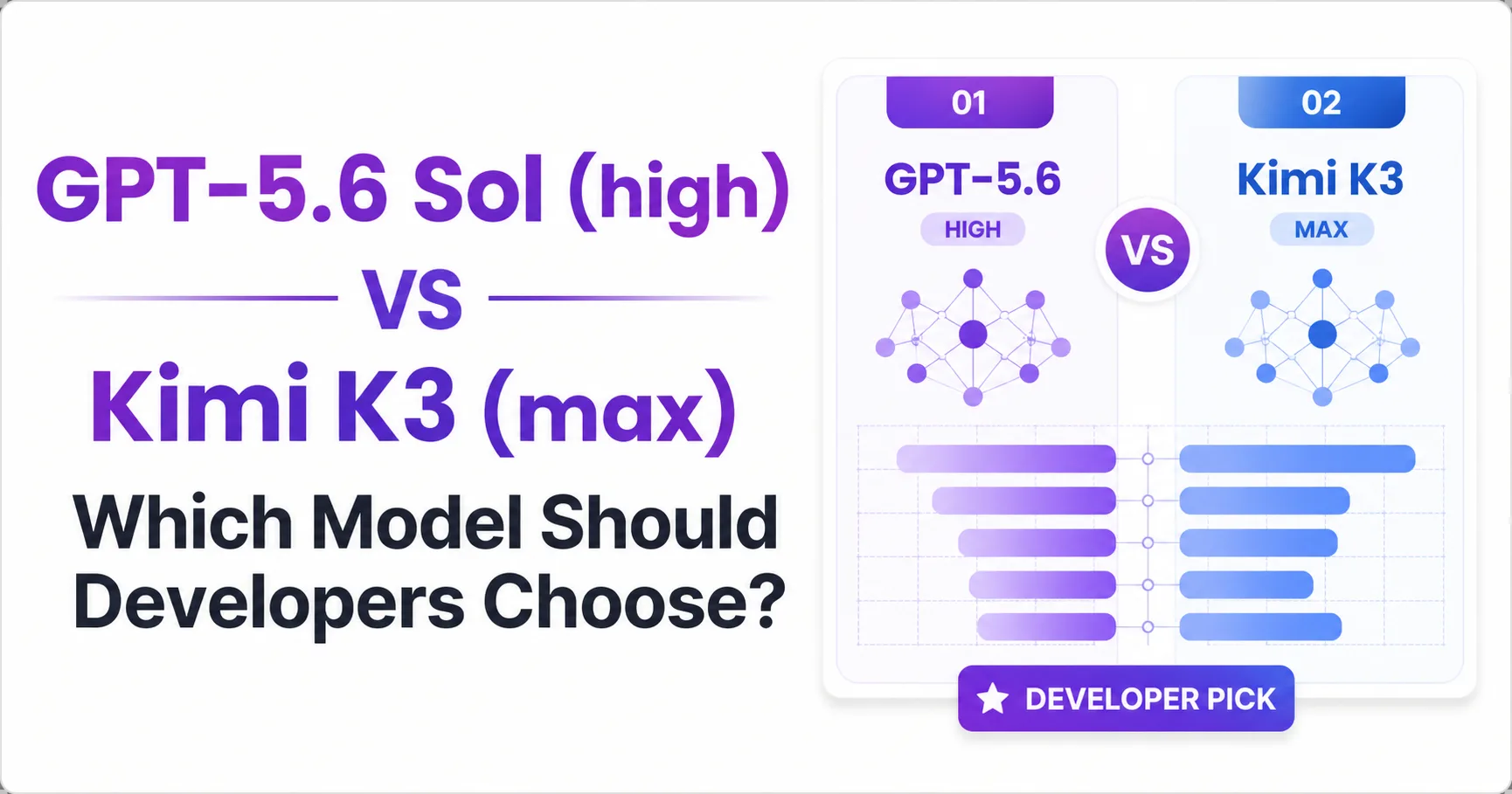
- **Winner overall:** GPT-5.6 Sol (high), its 77.2 coding index and 73.648 median output tokens per second make it the better default for demanding developer workflows - **Cheaper:** Kimi K3 (max) at $6 vs $11.25 per 1M blended tokens - **Faster:** GPT-5.6 Sol (high) at 73.648 median output tokens per second - **Pick Kimi K3 (max) when:** lower unit cost and its 57.1 intelligence index matter more than maximum coding throughput - **Watch out:** both models show 0.3-second latency, but standardized success-rate and stability evidence remains insufficient
GPT-5.6 Sol (high) vs Kimi K3 (max)
GPT-5.6 Sol (high) is the stronger default for demanding software work, while Kimi K3 (max) is the stronger value option.
The label itself needs correction before implementation. OpenAI documents gpt-5.6-sol as the callable model and describes high as a reasoning effort setting, not a separate model ID, in its model page and reasoning guide. Kimi documents kimi-k3 as the API model and max as a reasoning effort value in its Quickstart. This distinction affects routing, logging, repeatability, and rollback.
The data brief gives GPT a coding index of 77.2 and median output speed of 73.648 tokens per second. Kimi leads the general intelligence index at 57.1 versus 55.9, with a blended price of $6 versus $11.25. The result is a real tradeoff: GPT favors fast, high-value coding loops; Kimi favors lower unit cost and the stronger supplied intelligence score. Neither model has a reliable cross-model study for success rate, stability, or cost per completed task, so the final choice should include a production-shaped pilot.
Data provided by https://artificialanalysis.ai/
Executive summary
GPT-5.6 Sol (high) wins coding and output speed, while Kimi K3 (max) wins the intelligence index and blended cost.
| Decision signal | GPT-5.6 Sol (high) | Kimi K3 (max) | Selection meaning |
|---|---|---|---|
| Coding index | 77.2 | 76.2 | GPT has the supplied coding edge |
| Intelligence index | 55.9 | 57.1 | Kimi has the supplied general-intelligence edge |
| Median output speed | 73.648 tokens/s | 34.453 tokens/s | GPT produces sustained output faster |
| Median latency | 0.3 seconds | 0.3 seconds | The snapshot shows a tie |
| Blended price per 1M tokens | $11.25 | $6 | Kimi has the lower unit cost |
The table points to a split decision rather than a universal winner. A coding agent that spends much of its time waiting for streamed output will feel GPT’s speed edge. A workload dominated by high-volume prompts, repeated context, or exploratory reasoning will put more weight on Kimi’s lower blended price and index lead.
Official positioning supports this reading. OpenAI describes GPT as a flagship reasoning model for complex professional work and coding on its model page, while the Kimi K3 technical blog positions K3 for long-running coding, knowledge work, and reasoning. The OpenAI model catalog and Kimi model list show each remains available under its base model name rather than the comparison label.
The comparison is directional, not a universal rank. Index definitions, task mixtures, harnesses, and reasoning settings matter. Official OpenAI benchmark claims appear in its release announcement, while Kimi reports benchmark results in its technical blog. Neither source supplies a direct controlled head-to-head for these exact settings. Treat the scores as decision signals and validate them against your own task mix.
Performance in real developer workflows
GPT-5.6 Sol (high) is the practical speed winner, while Kimi K3 (max) stays close enough on quality to remain viable for many tasks.
The data brief’s 73.648 median output tokens per second for GPT and 34.453 for Kimi point to a material difference after generation begins. The latency figure is 0.3 seconds for each model, so the practical gap in this snapshot is sustained output rather than initial request setup. For an interactive coding agent, that difference can affect how quickly a developer sees a plan, patch, explanation, or tool result. For background jobs, speed matters less unless it controls queue time, concurrency, or review throughput.
Quality changes the interpretation. The coding index is 77.2 versus 76.2, giving GPT a narrow lead in the supplied comparison. Kimi’s slower generation is therefore not automatically justified by a large coding-quality advantage. GPT’s speed can become the deciding factor in turn-heavy workflows where the model must repeatedly propose changes and react to tool output. Kimi’s 57.1 intelligence index versus GPT’s 55.9 points the other way for broad reasoning, but that metric does not show which model completes a particular repository task more reliably.
Official benchmark evidence is not a clean tie-breaker. OpenAI’s public release announcement reports its own evaluations, and Kimi’s technical blog explains that its results use different agent harnesses. A score from one setup cannot be substituted for a score from the other. The safe reading is directional: GPT looks stronger for coding throughput in this snapshot, while Kimi remains credible for general reasoning.
Community reports add risk signals, not measurements. Users in the Codex Reddit discussion describe slow-feeling responses and over-engineering. A Hacker News discussion reports drift in complex investigations and subjective improvement after lowering reasoning effort. A separate Hacker News rewrite test describes harness-level variation, but its narrow task scope cannot establish general performance. A Kimi Hermes report describes an unfinished long coding task after token exhaustion. The research brief does not contain reliable standardized speed, success-rate, or stability data for GPT high and Kimi max, so production testing remains necessary.
Cost and the risk of false savings
Kimi K3 (max) is the clear unit-cost winner, but GPT-5.6 Sol (high) may be cheaper per completed task when waiting and rework dominate.
The supplied blended rates, $6 for Kimi and $11.25 for GPT per 1M blended tokens, establish a meaningful starting gap. That gap favors Kimi for high-volume workloads, automated review, and experiments where many attempts are acceptable. It does not settle the economics of a coding agent. Output-heavy tasks, retries, tool calls, context replay, and human correction can matter more than the listed token rate.
Workload shape can reverse operational cost. GPT could repay its premium if faster generation shortens developer wait, reduces concurrency pressure, or lets a human reject a bad plan earlier. Kimi can be more economical when prompts are high volume, review is automated, and the harness can continue long tasks without extra intervention. These are workload hypotheses, not measured findings. The brief contains no cost-per-successful-task study.
Cache and context policies deserve explicit testing. The OpenAI pricing page describes separate cache and long-context pricing, while the reasoning guide explains that reasoning tokens consume output budget. Kimi’s pricing page and Quickstart document cache-related behavior and request controls. A simple blended estimate can therefore understate spend when a task replays large context, uses many tools, or needs retries.
Operational risk is the key caveat. In the Hermes report, a user said Kimi completed substantial work but reached its token limit before the project was finished, requiring review and model switching. That report is anecdotal and does not measure a failure rate, but it shows how an inexpensive run can become expensive once human recovery enters the loop. Evidence is insufficient to declare either model cheaper per successful task.
Recommendation by workload
GPT-5.6 Sol (high) is the recommended default for high-value coding agents, while Kimi K3 (max) fits cost-sensitive workflows with controlled orchestration.
flowchart TD
    A[Start with workload] --> B{Is fast interactive output central?}
    B -->|Yes| C[Choose GPT-5.6 Sol high]
    B -->|No| D{Is unit cost the main constraint?}
    D -->|Yes| E[Choose Kimi K3 max]
    D -->|No| F{Can the harness preserve full reasoning history?}
    F -->|No| C
    F -->|Yes| G[Run a production-shaped pilot]
Use GPT when the product experience depends on fast interactive output, high-value code changes, structured tool use, or frequent developer review. OpenAI’s model documentation lists structured outputs, function calling, file search, image input, web search, and other tool integrations. Its reasoning guide also gives developers control over reasoning effort, which makes effort-level testing part of the design rather than an undocumented behavior.
Use Kimi when token economics dominate, the workload benefits from broad reasoning and multimodal input, and the team can validate its agent harness carefully. Kimi’s technical blog and Quickstart document visual input, tool calls, structured output, dynamic tool loading, and context caching. Those capabilities make Kimi attractive for context-rich workflows, but they increase the importance of request compatibility and orchestration discipline.
Kimi needs explicit guardrails. Its documentation warns that incomplete reasoning history or switching models mid-session can destabilize generation. It also recommends clearer system instructions or AGENTS.md boundaries because the model may take unrequested initiative. Its web search capability is not recommended for production workflows while the feature is being updated. GPT has a different operational caveat: reasoning tokens consume the output allowance, so a low output budget can end a response incompletely.
For a developer-facing coding product, start with GPT and benchmark Kimi as the value alternative. For a cost-sensitive agent platform, start with Kimi only after confirming harness compatibility, continuation behavior, and human recovery cost. The supplied intelligence-index lead for Kimi and coding-throughput lead for GPT make a task-specific pilot more useful than a single universal ranking.
What to validate before production
GPT-5.6 Sol (high) and Kimi K3 (max) are reasoning configurations, so model-selection tests must separate API identity from effort settings.
Call gpt-5.6-sol with high reasoning effort, and call kimi-k3 with max reasoning effort, according to the OpenAI model page, OpenAI reasoning guide, and Kimi Quickstart. Do not invent suffixed IDs. Record the exact model name, effort, prompt, harness, tool set, and stopping rules for every trial.
The biggest unanswered questions are task success, correction burden, tail latency, and cost per completed workflow. The supplied benchmark snapshot gives point metrics, but the research material does not provide a controlled comparison of those outcomes. Community posts are useful for finding failure modes, not for estimating prevalence.
Before production, test a representative software task, a long-context task, a structured-output task, and a visual-input task. Keep the harness stable. For Kimi, preserve the full reasoning history and avoid mid-session model switching, as the Kimi technical blog warns. For GPT, budget output carefully because reasoning tokens share the output allowance, as the OpenAI reasoning guide explains.
For this comparison, a pilot is mandatory because the available evidence identifies tradeoffs but does not establish cost per successful task or production stability.
Frequently asked questions
Which model should I choose for an interactive coding agent?
Choose GPT-5.6 Sol (high) for an interactive coding agent when fast streamed output and coding quality matter most. The snapshot gives GPT a 77.2 coding index and 73.648 median output tokens per second, while the research does not establish a universal success rate.
Which model is cheaper?
Choose Kimi K3 (max) when token price is the primary constraint. The supplied blended rate is $6 per 1M blended tokens versus $11.25 for GPT-5.6 Sol (high), but the research does not measure retries, human review, or cost per successful workflow.
Does Kimi K3 (max) beat GPT-5.6 Sol (high) on intelligence?
Kimi K3 (max) leads the supplied intelligence index at 57.1 versus 55.9 for GPT-5.6 Sol (high). That result supports testing Kimi for broad reasoning, but it does not prove higher completion or reliability on your application.
Which model is faster?
GPT-5.6 Sol (high) is faster in the supplied output-speed measure at 73.648 tokens per second versus 34.453 for Kimi K3 (max). Both show 0.3 seconds of latency in the snapshot, so sustained generation drives the observed difference.
Are high and max independent model names?
No. GPT-5.6 Sol (high) maps to model gpt-5.6-sol with a high reasoning setting, and Kimi K3 (max) maps to kimi-k3 with max reasoning effort. The official OpenAI reasoning guide and Kimi Quickstart should govern implementation.
What should I validate before production?
Run a production-shaped pilot before committing. Hold the harness and tools steady, preserve Kimi’s full reasoning history, avoid mid-session switching, and test completion, correction, tail latency, and spend because the supplied research does not quantify those outcomes.
Sources
- GPT-5.6 Sol model pageOpenAI model identity, capabilities, positioning, and API configuration
- Reasoning modelsReasoning effort, model configuration, token budgeting, and incomplete responses
- OpenAI API model catalogCurrent OpenAI model availability and product-line positioning
- OpenAI API pricingPricing tiers, caching, and long-context pricing behavior
- GPT-5.6: Frontier intelligence that scales with your ambitionOfficial OpenAI benchmark claims and model positioning
- GPT-5.6 Sol / Codex Release Discussion MegathreadCommunity reports about perceived speed and over-engineering
- Ask HN: How are you productive with GPT 5.6 Sol?Community reports about investigation drift and reasoning-effort changes
- Is GPT-5.6 Sol Max Worth It?Limited harness-based rewrite testing and its methodological limits
- Kimi K3 official technical blogKimi positioning, capabilities, benchmark context, and operational warnings
- Kimi K3 QuickstartKimi API identity, reasoning effort, tools, caching, input formats, and limitations
- Flagship Model Kimi K3 PricingKimi API pricing and context-related pricing information
- Kimi model listCurrent Kimi model availability and model naming
- Just tested Kimi K3 with HermesCommunity coding experience, token-limit risk, and manual recovery concerns
- Artificial AnalysisAttribution for the supplied benchmark and pricing snapshot
Published: