
AI model analysis
GPT-5.6 Sol (high) vs o3: Which OpenAI Model Should Developers Choose?
A developer-focused comparison of GPT-5.6 Sol (high) and o3 across capability evidence, speed, cost, availability, and practical model-selection risks.
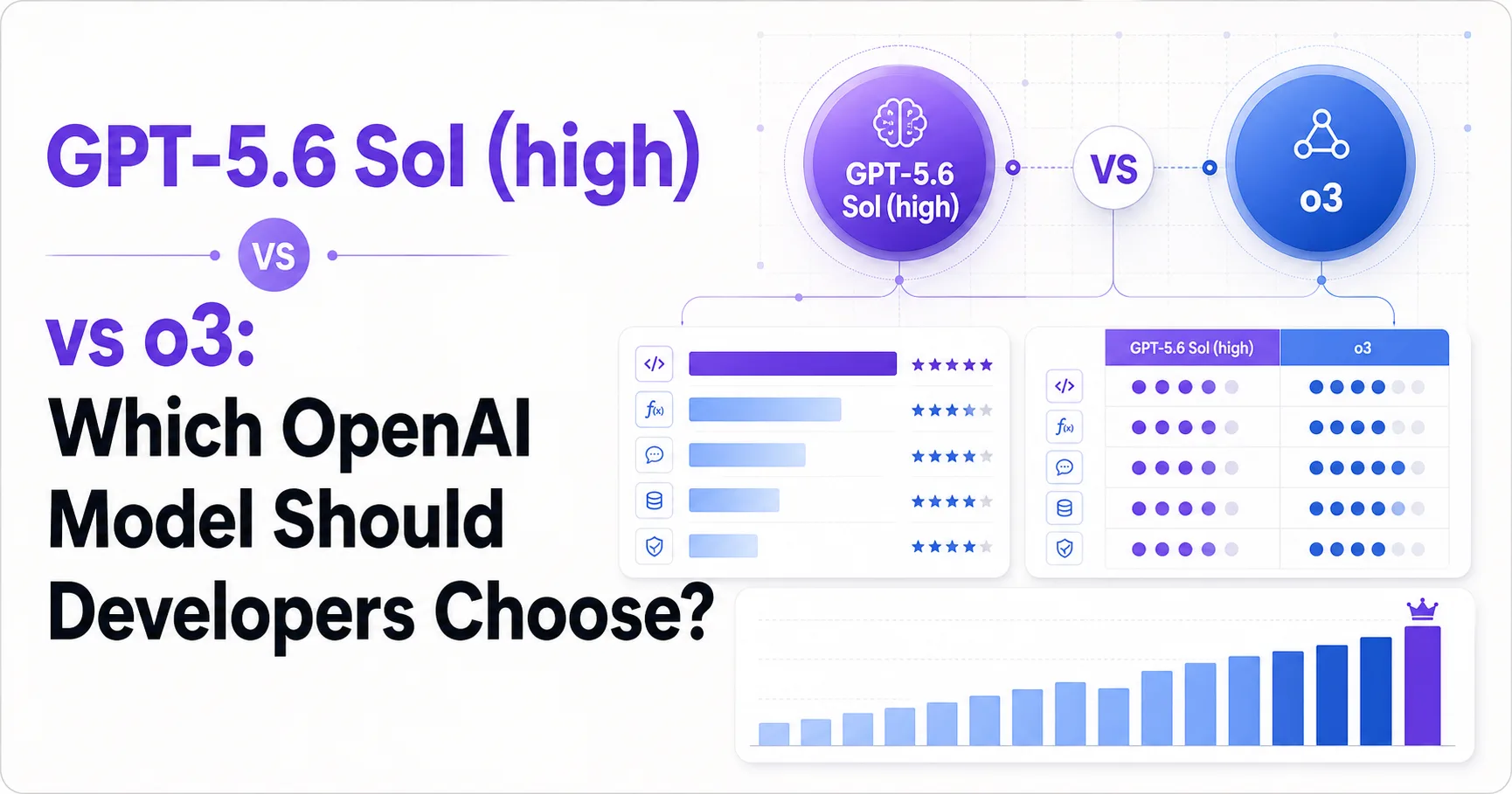
- **Winner overall:** GPT-5.6 Sol (high), with an Artificial Analysis Intelligence Index score of 55.9 vs 30.4 for o3 - **Cheaper:** o3 at $3.5 vs $11.25 per 1M blended tokens - **Faster:** o3 at 128.056 median output tokens per second - **Pick GPT-5.6 Sol (high) when:** complex coding, investigation, tool use, and long multi-step reasoning matter more than unit cost - **Watch out:** no reliable evidence establishes o3's current availability, while GPT-5.6 Sol (high) lacks a separately documented high-effort success rate
GPT-5.6 Sol (high) vs o3
GPT-5.6 Sol (high) is the stronger default for demanding development work, while o3 is substantially cheaper and faster in the supplied data. Artificial Analysis reports an Intelligence Index score of 55.9 for GPT-5.6 Sol (high) versus 30.4 for o3. The same snapshot reports $11.25 versus $3.5 per 1M blended tokens, and 73.648 versus 128.056 median output tokens per second.\n\nThat recommendation has an important operational condition: the supplied OpenAI documentation still lists GPT-5.6 Sol as a current flagship model, but it does not list o3 in the current model directory. OpenAI’s model directory also does not establish whether o3 remains directly callable, has a stable alias, or has been formally replaced. Developers should therefore separate capability preference from procurement certainty.
Executive summary for developers
GPT-5.6 Sol (high) offers the broader documented fit for complex engineering workflows, but o3 wins the available cost and speed comparison. OpenAI’s GPT-5.6 Sol model page positions the model for complex professional work, reasoning, and coding. It documents text and image input, text output, Responses API, Chat Completions API, Batch API, structured outputs, function calling, file search, web search, prompt caching, and several additional tools.\n\nThe comparison is asymmetric because the o3 brief contains far less current documentation. OpenAI’s model directory does not provide o3’s context window, output limit, API parameters, multimodal support, endpoint availability, or stable alias. That absence is not evidence that o3 lacks those properties. It means the supplied sources cannot verify them for a current purchase or deployment decision.\n\nThe strongest measured separation is the Intelligence Index: GPT-5.6 Sol (high) scores 55.9, while o3 scores 30.4. Coding evidence is incomplete because the snapshot reports 77.2 for GPT-5.6 Sol (high) but no o3 Coding Index value. Math evidence is also incomplete in the opposite direction, with 88.3 reported for o3 but no GPT-5.6 Sol (high) Math Index value.\n\nGPT-5.6 Sol (high) is therefore the evidence-backed choice for broad, complex workloads. o3 remains attractive for workloads where lower price and higher output speed dominate, but its current product status and documented operating envelope require verification before adoption.
Performance: capability breadth matters more than raw generation speed
GPT-5.6 Sol (high) is the better-supported choice for complex multi-step engineering tasks, even though o3 generates output faster. Artificial Analysis reports 73.648 median output tokens per second for GPT-5.6 Sol (high) and 128.056 for o3. Both models show 0.3 seconds of reported latency in the supplied snapshot. The practical difference is therefore sustained generation speed, not the initial latency figure.\n\nFor interactive coding, o3’s higher output rate can make long responses feel shorter. That advantage matters when the model is producing explanations, patches, or repeated agent messages. It does not establish that o3 completes a task faster overall, because the supplied data does not include tool-call counts, correction cycles, task success rates, or end-to-end completion time.\n\nGPT-5.6 Sol (high) has stronger measured evidence for general capability. Its Intelligence Index is 55.9 versus 30.4 for o3. The supplied snapshot gives GPT-5.6 Sol (high) a Coding Index score of 77.2, but gives no corresponding o3 coding score. It gives o3 a Math Index score of 88.3, but gives no GPT-5.6 Sol (high) math score. These missing cells prevent a complete domain ranking.\n\nThe official GPT-5.6 announcement reports results for coding, browsing, computer interaction, security, and agent-oriented evaluations. OpenAI’s release announcement describes those results as evidence for broad frontier capabilities, but it does not provide a separately verified score for the high reasoning setting. The reasoning guide explains that high effort is intended for complex debugging, deep planning, high-value coding, and long-running tasks.\n\nA developer choosing on task quality should prefer GPT-5.6 Sol (high) when failures are expensive or the workflow spans investigation, planning, coding, and tools. A developer choosing on response throughput should consider o3, but should test complete task trajectories rather than infer success from tokens per second.
Cost: o3 is cheaper, but workload shape can reverse the decision
o3 is the clear unit-cost winner, while GPT-5.6 Sol (high) can justify its premium when fewer failed attempts or shorter workflows matter. Artificial Analysis reports $3.5 per 1M blended tokens for o3 versus $11.25 for GPT-5.6 Sol (high). Input pricing is $2 versus $5 per 1M tokens, and output pricing is $8 versus $30 per 1M tokens.\n\nThe output price difference is especially important for agentic development. A workflow that produces large plans, patches, explanations, or repeated tool results can accumulate output charges quickly. A cheaper model can become more expensive in practice if it requires more retries, more review, or more corrective turns. The supplied data does not measure those workflow effects, so this is a decision criterion, not a demonstrated cost result.\n\nGPT-5.6 Sol also has documented pricing conditions that are absent from the o3 material. OpenAI’s pricing page states that requests above 272K input tokens use higher long-context prices. The model page documents a 1,050,000-token context window, a 922,000-token maximum input, and a 128,000-token maximum output. The reasoning guide adds that reasoning tokens consume the context window and count toward output billing.\n\nThat cost structure makes GPT-5.6 Sol (high) a poor automatic choice for high-volume, low-risk transformations. It becomes more defensible for difficult tasks where a stronger first attempt reduces human intervention. Developers should benchmark cost per completed task, but the supplied sources do not provide the retries, review time, or completion rates needed to calculate that figure here.
Recommendation by deployment scenario
GPT-5.6 Sol (high) should be the primary candidate for high-value engineering agents, while o3 should be evaluated as a low-cost and high-throughput alternative. OpenAI’s GPT-5.6 Sol model page documents support for structured outputs, function calling, file search, web search, image input, prompt caching, and several hosted tools. That combination fits applications that must inspect context, choose actions, call tools, and return structured results.\n\nChoose GPT-5.6 Sol (high) for repository-wide debugging, architecture changes, security-sensitive code review, complex investigation, and workflows where a wrong answer creates substantial downstream work. The reasoning guide specifically associates high effort with complex debugging, deep planning, high-value coding, and long-running tasks. Community reports also describe over-engineering, slow-feeling responses, investigation drift, and excessive defensive code in some workflows. A Reddit release discussion and a Hacker News discussion present these as subjective reports without standardized tasks or measurements.\n\nChoose o3 for cost-sensitive workloads where faster output and lower token prices are more important than documented capability breadth. Suitable candidates include routine generation, simple transformations, and internal experiments, provided the model is actually available through the intended API path. The current OpenAI model directory does not verify that condition.\n\nDo not treat the comparison as a complete math-versus-coding verdict. o3 has an 88.3 Math Index score, while GPT-5.6 Sol (high) has no supplied Math Index score. GPT-5.6 Sol (high) has a 77.2 Coding Index score, while o3 has no supplied Coding Index score. The evidence supports a broad-capability recommendation for GPT-5.6 Sol (high), not a universal win in every specialist domain.\n\nA practical rollout should begin with the task’s acceptance test, then compare completed-task quality, correction turns, tool errors, and total cost. Those measurements are not included in the supplied briefs, so the final choice should remain conditional until a representative evaluation exists.
What the supplied evidence cannot answer
o3 has the larger evidence gap, while GPT-5.6 Sol (high) has the clearer documented deployment surface. OpenAI’s model directory does not verify o3’s current availability, API identifier, context window, output limit, or supported capabilities. The same source keeps GPT-5.6 Sol within the current flagship product line.\n\nGPT-5.6 Sol (high) still has unresolved evidence gaps. Official material does not isolate the high-effort configuration’s latency, reasoning-token consumption, success rate, or cost per completed task. Community reports provide useful risk signals, but the limited Hacker News test covered only one rewrite task and cannot represent general coding performance.\n\nThe safest conclusion is therefore asymmetric: GPT-5.6 Sol (high) is easier to justify from current documentation, while o3 may be economically attractive if direct access and task quality are confirmed in your environment.
Frequently asked questions
Which model is better for complex coding agents?
GPT-5.6 Sol (high) is the better-supported choice for complex coding agents because its official documentation covers reasoning, coding, structured outputs, function calling, and hosted tools. The supplied data does not provide an o3 Coding Index score, so a complete coding ranking remains unproven.
Is o3 the better choice for production cost control?
o3 is the better unit-cost choice at $3.5 per 1M blended tokens versus $11.25 for GPT-5.6 Sol (high). Production cost control still depends on retries, correction turns, review time, and task success, none of which the supplied data measures.
Which model responds faster?
o3 responds faster during sustained generation, with 128.056 median output tokens per second versus 73.648 for GPT-5.6 Sol (high). Both models have 0.3 seconds of reported latency in the supplied snapshot, so the evidence does not show a difference in initial response latency.
Can developers still call o3 through the OpenAI API?
The supplied sources do not establish whether o3 remains directly callable, has a stable alias, or has been replaced. Developers should verify access in their account and target environment before designing a production integration around o3.
Does GPT-5.6 Sol (high) always produce better results?
GPT-5.6 Sol (high) should not be treated as a universal winner because the supplied evidence reports o3 at 88.3 on the Math Index, while GPT-5.6 Sol (high) has no supplied Math Index score. The broad Intelligence Index favors GPT-5.6 Sol (high), but specialist results remain incomplete.
Sources
- Artificial AnalysisAll comparison data, including capability scores, blended pricing, input and output pricing, latency, and output speed.
- GPT-5.6 Sol model pageGPT-5.6 Sol positioning, model capabilities, context limits, output limits, API support, aliases, and documented tools.
- OpenAI ModelsCurrent model-directory visibility, product positioning, and the evidence gap concerning o3 availability and specifications.
- OpenAI API PricingGPT-5.6 Sol pricing tiers, long-context pricing rules, and the absence of a supplied current o3 price listing.
- Reasoning modelsReasoning effort, reasoning modes, high-effort task positioning, reasoning-token billing, context consumption, and incomplete-response behavior.
- GPT-5.6: Frontier intelligence that scales with your ambitionOfficial GPT-5.6 benchmark announcement and broad capability positioning.
- GPT-5.6 Sol / Codex Release Discussion MegathreadSubjective community reports concerning speed, over-engineering, and workflow behavior.
- Ask HN: How are you productive with GPT 5.6 Sol?Subjective reports concerning investigation drift, defensive code, and reasoning-effort changes.
- Is GPT-5.6 Sol Max Worth It?A limited one-task test and its stated methodological limitation.
Published: