
AI model analysis
GPT-5.6 Sol (medium) vs o3: Which Model Should Developers Choose?
A developer-focused comparison of GPT-5.6 Sol (medium) and o3 across reasoning quality, coding evidence, speed, cost, availability, and operational risk.
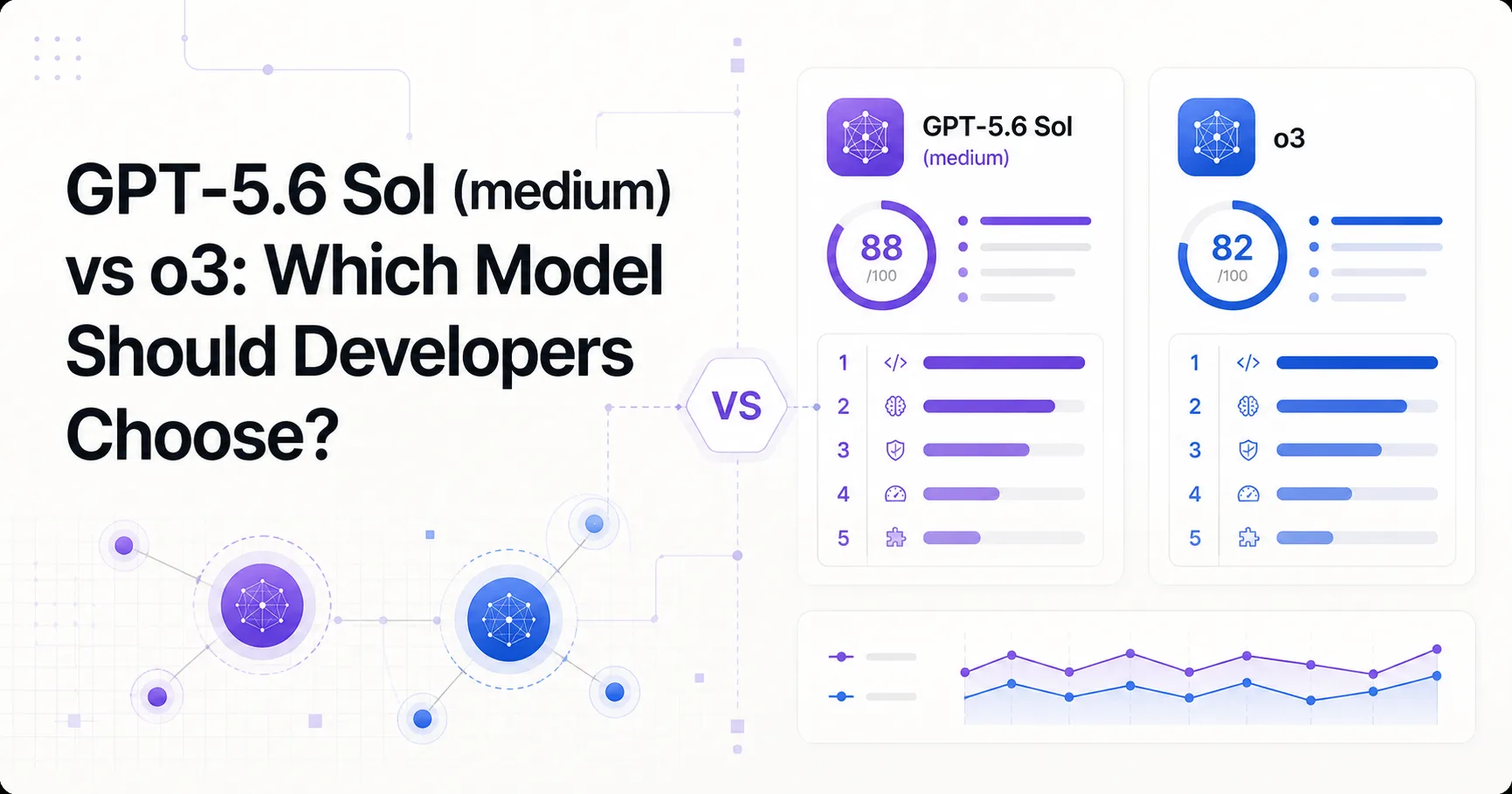
- **Winner overall:** GPT-5.6 Sol (medium), with an Artificial Analysis Intelligence Index of 53.6 vs 30.4 for o3 - **Cheaper:** o3 at $3.5 vs $11.25 per 1M blended tokens - **Faster:** o3 at 128.056 median output tokens per second - **Pick GPT-5.6 Sol (medium) when:** complex reasoning, coding, tool use, and current API support matter more than lowest cost - **Watch out:** no directly comparable coding score or reliable community test exists for o3 in the supplied evidence
GPT-5.6 Sol (medium) vs o3
GPT-5.6 Sol (medium) is the stronger documented choice for developers who need current reasoning and coding capabilities, while o3 remains cheaper and faster in the supplied data. Artificial Analysis reports an Intelligence Index of 53.6 for GPT-5.6 Sol (medium), compared with 30.4 for o3, but the datasets do not provide a directly comparable coding result for o3. Artificial Analysis provides the quantitative snapshot used in this article.
The comparison has an important asymmetry. OpenAI currently presents GPT-5.6 Sol as a flagship model for complex professional work, complex reasoning, and coding in its model directory. The supplied official material does not list o3 in that current directory. That absence does not prove that o3 is unavailable, deprecated, or replaced. It does mean that developers face more uncertainty before building a new integration around it.
The practical decision is therefore not simply quality versus price. GPT-5.6 Sol offers a better documented path for demanding workloads. o3 offers a lower measured cost and higher output speed. Teams should select based on whether operational certainty or throughput economics is the tighter constraint.
Executive summary
GPT-5.6 Sol (medium) leads the documented overall comparison because it combines the higher general intelligence result with broader, explicitly documented platform support. Its Intelligence Index is 53.6, versus 30.4 for o3. The supplied data also gives GPT-5.6 Sol a coding index of 76.3, while no comparable o3 coding index is available.
GPT-5.6 Sol is the clearer fit for applications that need structured outputs, function calling, file search, web search, image input, prompt caching, or other hosted tools. OpenAI documents those capabilities on the GPT-5.6 Sol model page. The GPT-5.6 guide also documents reasoning effort settings from none through max, with medium positioned as a balanced starting point.
o3 wins the economic and streaming-throughput comparison. Its blended price is $3.5 per 1M tokens, compared with $11.25 for GPT-5.6 Sol (medium). Its median output speed is 128.056 tokens per second, compared with 69.865. Both models show 0.3 seconds of latency in the supplied snapshot.
The evidence does not answer whether o3 is better for mathematics in a broad production workflow. o3 has a reported Math Index of 88.3, but GPT-5.6 Sol has no corresponding math score in the supplied data. That is a missing comparison, not a confirmed o3 advantage across every mathematical task.
Performance: quality, speed, and workflow fit
GPT-5.6 Sol (medium) is the safer performance choice for complex, tool-using development workflows, but o3 can deliver responses faster and at lower streaming cost. The quality evidence favors GPT-5.6 Sol on the general Intelligence Index, where its score is 53.6 versus 30.4 for o3. The supplied data gives GPT-5.6 Sol a Coding Index of 76.3, yet it provides no o3 coding score, so developers should not describe the coding comparison as a complete benchmark victory.
The speed result points in the opposite direction. o3 reaches a median output rate of 128.056 tokens per second, while GPT-5.6 Sol reaches 69.865. That difference matters for interactive coding agents, terminal feedback, and interfaces where users watch a response unfold. It may matter less when the dominant delay comes from tool execution, repository indexing, approval steps, or human review. Both models have 0.3 seconds of reported latency, so the supplied data does not show an initial-response advantage.
GPT-5.6 Sol also has a broader documented workflow surface. OpenAI lists Responses API, Chat Completions API, Batch API, structured outputs, function calling, hosted shell, computer use, MCP, and tool search on its model page. Those capabilities can reduce integration uncertainty when an application needs more than text generation.
The evidence is weaker for o3. The supplied official material does not establish its current endpoint support, API parameters, context window, output limit, or multimodal behavior. Developers choosing o3 should validate those facts directly before treating its speed advantage as a complete production advantage.
Cost: the cheaper model can still cost more operationally
o3 is the clear price winner in the supplied snapshot, but GPT-5.6 Sol (medium) can justify its higher unit cost when better task completion reduces retries and review. The blended price is $3.5 per 1M tokens for o3 and $11.25 for GPT-5.6 Sol (medium). Input pricing is $2 versus $5, while output pricing is $8 versus $30.
Those prices favor o3 for high-volume generation, lightweight classification, rapid agent feedback, and workloads where outputs are short and easy to verify. Its higher output speed also improves capacity for interactive usage. However, a unit-price comparison does not capture failed implementations, repeated prompts, manual debugging, or additional tool calls. The supplied evidence does not quantify those operational effects, so no reliable break-even point can be calculated.
GPT-5.6 Sol has a specific long-context cost risk. The GPT-5.6 Sol documentation states that requests above 272K input tokens receive higher input and output charges. That rule can materially change economics for large repositories, long conversations, and document-heavy agents. Prompt caching may reduce repeated-input cost, but the right result depends on cache behavior and request shape.
Service tier also changes the decision. OpenAI lists Standard, Batch, Flex, and Fast mode prices on its API pricing page. The supplied data does not provide equivalent current tier pricing for o3. Therefore, o3 is cheaper on the comparison snapshot, while GPT-5.6 Sol has the more fully documented pricing model for current deployment planning.
Recommendation for developer teams
GPT-5.6 Sol (medium) is the better default for a new, high-value developer product that needs documented reasoning, coding, and tool support. OpenAI describes it as a flagship model for complex reasoning and coding in its current model directory. The GPT-5.6 guide identifies medium reasoning effort as the default and balanced starting point, which makes the supplied model variant operationally understandable.
Choose GPT-5.6 Sol (medium) for repository-level coding agents, complex technical analysis, multimodal developer assistants, structured business workflows, and applications that depend on hosted tools. Its documented context window is 1,050,000 tokens, with a maximum input of 922,000 tokens and maximum output of 128,000 tokens. Those limits are relevant to large-context workflows, although requests above 272K input tokens introduce a pricing risk.
Choose o3 when throughput economics dominate, the workload is easy to validate, and the integration has already been tested. Its $3.5 blended price and 128.056 median output tokens per second make it attractive for large volumes of relatively bounded work. Its Math Index of 88.3 may also justify targeted evaluation for mathematical workloads, but the supplied evidence does not show how that result transfers to production coding or general reasoning.
Do not make a new o3 integration decision from the current supplied documentation alone. The OpenAI models page does not list o3, and the supplied material does not confirm its live endpoint, alias, limits, or replacement status. The deprecation directory is relevant to lifecycle checking, but the supplied evidence does not establish a formal o3 deprecation announcement. Teams should run a small task set against the exact endpoint they plan to use before committing.
What developers should verify before choosing
GPT-5.6 Sol (medium) is the easier model to validate from the supplied official documentation, while o3 requires more direct integration checks. OpenAI documents GPT-5.6 Sol’s model ID, alias behavior, reasoning settings, limits, tools, and pricing references across the model page, latest-model guide, and pricing page.
The community evidence does not resolve the practical disagreement around GPT-5.6 Sol. A Reddit report describes excessive output, slow task progress, and flawed coding results from one personal test. Comments in the same discussion challenge that conclusion and report different token usage and experiences. The Hacker News discussion and its corresponding comment discuss possible value from fast generation, but they do not provide reproducible independent measurements.
Developers should therefore treat the benchmark snapshot as directional evidence, not a complete production guarantee. The strongest unanswered questions concern o3’s current availability, exact API behavior, and coding performance. Those gaps deserve a direct smoke test before launch.
Frequently asked questions
Is GPT-5.6 Sol (medium) better than o3 for coding?
GPT-5.6 Sol (medium) is the better-supported coding choice because its supplied Coding Index is 76.3 and OpenAI explicitly positions it for complex coding, while no comparable o3 coding score is available.
Which model is cheaper for production API usage?
o3 is cheaper in the supplied comparison at $3.5 per 1M blended tokens, versus $11.25 for GPT-5.6 Sol (medium), with lower input and output prices as well.
Which model is faster for interactive applications?
o3 is faster during generation at 128.056 median output tokens per second, while GPT-5.6 Sol (medium) reaches 69.865; both models report 0.3 seconds of latency.
Should a team start a new integration with o3?
A team should verify o3’s live endpoint, limits, aliases, and lifecycle before starting, because the supplied current OpenAI model directory does not list o3 and the evidence confirms none of those details.
Does o3 win mathematical reasoning?
o3 has the stronger supplied mathematics result with a Math Index of 88.3, but GPT-5.6 Sol (medium) has no corresponding math score, so the evidence cannot establish a complete comparative conclusion.
Sources
- Artificial AnalysisQuantitative model snapshot, pricing, speed, latency, and evaluation values
- GPT-5.6 Sol model pageGPT-5.6 Sol positioning, limits, modalities, APIs, tools, aliases, and long-context pricing rules
- GPT-5.6 guideReasoning effort, default medium setting, aliases, safety behavior, and image input limitations
- OpenAI ModelsCurrent model directory, GPT-5.6 positioning, and o3 visibility
- OpenAI API PricingService-tier pricing documentation and pricing model comparison
- OpenAI DeprecationsLifecycle and deprecation verification context
- I spent two weeks testing GPT-5.6. Here’s what I found.Personal coding experience report and conflicting community reactions
- Previewing GPT‑5.6 Sol: a next-generation modelHacker News community discussion about GPT-5.6 Sol
- Hacker News corresponding commentDiscussion of generation speed and coding-agent workflows
Published: