
AI model analysis
GPT-5.6 Sol (max) vs GPT-5.6 Sol (high): Which Setting Should Developers Choose?
A developer-focused comparison of GPT-5.6 Sol reasoning settings across measured quality, coding, speed, pricing, and practical deployment risk.
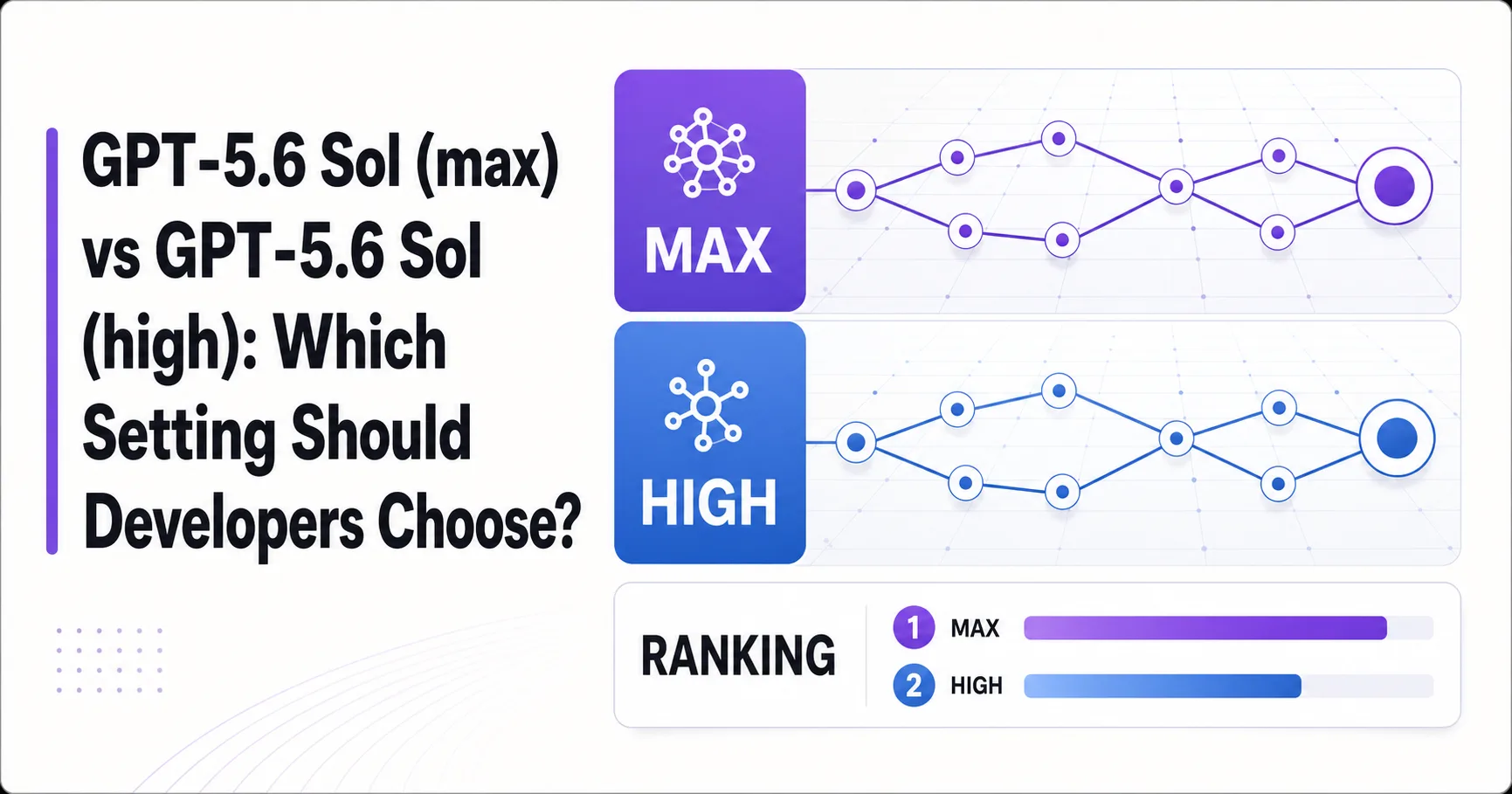
- **Winner overall:** GPT-5.6 Sol (max), with a 58.9 Intelligence Index and 77.4 Coding Index - **Cheaper:** Neither model, GPT-5.6 Sol (max) at $11.25 vs GPT-5.6 Sol (high) at $11.25 per 1M blended tokens - **Faster:** GPT-5.6 Sol (max) at 77.617 median output tokens per second vs 73.648 - **Pick GPT-5.6 Sol (max) when:** broader measured intelligence at 58.9 matters more than the 55.9 result from high - **Watch out:** Both settings show 0.3 latency in the supplied snapshot, but public evidence does not establish configuration-specific token use or success rates
The Short Answer
GPT-5.6 Sol (max) is the stronger default for developers who want the best supplied quality result at the same listed price.
The Artificial Analysis snapshot gives GPT-5.6 Sol (max) an Intelligence Index of 58.9 and a Coding Index of 77.4. GPT-5.6 Sol (high) records 55.9 and 77.2 on the same measures. Max also records a higher median output rate, at 77.617 tokens per second versus 73.648 for high.
Both settings show 0.3 seconds of latency and identical listed prices. That makes the decision less about procurement and more about whether the measured quality difference matters for your workload.
The naming also needs care. OpenAI documents gpt-5.6-sol as the API model and describes reasoning effort as a configurable control in the GPT-5.6 Sol model page and the reasoning models guide. The comparison therefore reflects two settings on the same model family, not a simple replacement-model decision.
Data provided by https://artificialanalysis.ai/.
What the Supplied Data Actually Says
GPT-5.6 Sol (max) leads the supplied snapshot on intelligence, coding, and output speed, while GPT-5.6 Sol (high) ties on latency and price.
| Measure | GPT-5.6 Sol (max) | GPT-5.6 Sol (high) | Reading |
|---|---|---|---|
| Artificial Analysis Intelligence Index | 58.9 | 55.9 | Max leads |
| Artificial Analysis Coding Index | 77.4 | 77.2 | Max leads narrowly |
| Median output tokens per second | 77.617 | 73.648 | Max leads |
| Latency seconds | 0.3 | 0.3 | Tie |
| Blended price per 1M tokens | $11.25 | $11.25 | Tie |
| Input price per 1M tokens | $5 | $5 | Tie |
| Output price per 1M tokens | $30 | $30 | Tie |
The most important distinction is the shape of the lead. Max has a clearer advantage on the Intelligence Index than on coding. The coding scores are close enough that repository-specific results could reverse the practical choice. The speed result favors max, which also challenges the common assumption that the lower reasoning setting must produce faster output.
The comparison does not establish that max will produce better pull requests, fewer tool errors, or fewer retries in every codebase. It establishes a measured ranking within the supplied snapshot. Developers should combine that ranking with a task-level evaluation before changing a production default.
OpenAI positions GPT-5.6 Sol for complex reasoning, programming, and professional work in its current model directory and release announcement. Those official descriptions support using the model for demanding work, but they do not provide a separate high-versus-max production study.
You Are Choosing Reasoning Effort, Not a New API Model
GPT-5.6 Sol (high) is a reasoning configuration of the same API model, not a separately documented gpt-5.6-sol-high model.
OpenAI identifies gpt-5.6-sol as the fixed model ID and gpt-5.6 as its stable alias in the GPT-5.6 Sol model page. The reasoning models guide explains that applications control the amount of reasoning through reasoning.effort. The high comparison label therefore maps to the same model with reasoning.effort set to high. The max label maps to the same model with reasoning.effort set to max.
That distinction changes how the comparison should be read. A model-version comparison usually asks whether a newer system replaces an older one. This comparison asks how much additional model work is useful for a given task. The API surface, supported modalities, and tool ecosystem belong to the model, while reasoning effort changes the execution profile.
The official GPT-5.6 release announcement presents GPT-5.6 Sol as a flagship model for difficult reasoning and coding work. It does not publish independent benchmark results for the high configuration. The supplied Artificial Analysis snapshot does provide configuration-level rows, so it is useful for relative selection, but it should not be mistaken for an official specification of high or max behavior.
For implementation, keep the model ID stable and vary the reasoning setting. This makes experiments easier to interpret and avoids treating a UI label as an API product boundary.
Performance: Small Coding Gap, Clearer General-Intelligence Gap
GPT-5.6 Sol (max) is the measured performance winner, but the coding difference is too narrow to justify universal victory.
The supplied chart shows max at 77.617 median output tokens per second and high at 73.648. Both settings show 0.3 seconds of latency. The practical meaning is straightforward: max has the stronger measured generation rate after response production begins, while the supplied latency measure does not distinguish request responsiveness.
That distinction matters by task shape. For streamed code explanations, long patches, or tool-assisted work that produces substantial output, the output-rate lead may improve completion time. For short edits, equal latency may dominate the user experience. The available data cannot tell us which effect matters more for a particular interface.
The Coding Index is 77.4 for max and 77.2 for high. That is a narrow separation. It supports choosing max when the goal is to maximize the measured score, but it does not prove that max will solve a specific repository better. Test coverage, tool permissions, project instructions, and the cost of reviewing generated changes can matter more than a small aggregate gap.
The Intelligence Index separates the settings more clearly, at 58.9 for max and 55.9 for high. That makes max more attractive for ambiguous planning, broad investigation, and tasks where the model must maintain a larger chain of decisions. It still does not reveal whether the extra reasoning reaches the correct conclusion efficiently.
Community evidence is less settled. A Reddit release discussion includes reports of slow-feeling responses and over-engineered solutions. A Hacker News discussion describes investigation drift and defensive code, while also reporting subjective improvement after lowering reasoning effort. Neither source uses a standardized task set. Treat these reports as operational risks to test, not as stable model properties.
Cost: There Is No Listed Price Winner
GPT-5.6 Sol (max) and GPT-5.6 Sol (high) tie on listed token prices, so actual spend depends on execution behavior.
The supplied data gives each setting a blended price of $11.25 per 1M tokens. Input pricing is $5 per 1M tokens, and output pricing is $30 per 1M tokens for each setting. The chart should carry those repeated price values. The decision point in prose is that high is not the cheaper model at list rates.
The cost risk moves inside the response. OpenAI’s reasoning models guide explains that higher reasoning effort can increase reasoning-token use, latency, and cost. Those reasoning tokens are not visible in the answer, but they still consume the request budget and are billed as generated tokens. A setting with the same published rate can therefore produce a different effective cost per completed task.
The GPT-5.6 Sol model page and OpenAI API pricing page also describe separate treatment for large-context requests, caching, and service modes. Those rules can matter more than the high-versus-max label when prompts contain large repositories, repeated instructions, or long tool traces.
The supplied comparison does not include configuration-specific token consumption. It also does not show retries, incomplete responses, tool-call failures, or review time. As a result, it cannot prove which setting has the lower cost per successful change.
The cheaper practical choice depends on your workload. High could cost less if it reaches acceptable answers with less hidden reasoning. Max could cost less per accepted result if it prevents rework. Neither claim is established by the available snapshot, so teams should measure completed-task cost rather than infer it from the identical price row.
Recommendation by Developer Workflow
GPT-5.6 Sol (max) is the safer default for high-value work, while GPT-5.6 Sol (high) fits controlled workloads that need a lighter reasoning setting.
Choose GPT-5.6 Sol (max) when the task has expensive failure modes. Examples include cross-file migrations, difficult debugging, architecture changes, security-sensitive review, and agent workflows that must plan across tools. OpenAI’s reasoning models guide describes max as appropriate for the most complex tasks. The supplied data also gives max the stronger Intelligence Index, at 58.9 versus 55.9.
Choose GPT-5.6 Sol (high) when the task is well-scoped and easy to verify. It can suit targeted edits, bounded refactors, routine test updates, and interactive work where a developer will steer the process closely. High remains a serious reasoning setting. The recommendation is not based on a lower listed price, because the supplied price is $11.25 for each configuration.
Do not select high because you assume it must be faster. The supplied snapshot records 77.617 median output tokens per second for max and 73.648 for high, with 0.3 latency for each. That result favors max on measured output speed, even though high requests less reasoning effort.
A practical rollout starts with max as the quality-oriented default. Then compare high on representative tasks from your own repositories. Track accepted changes, review corrections, tool failures, incomplete responses, output tokens, and elapsed time. The public evidence does not provide a reliable universal answer for those measures.
The final choice should follow failure cost. Use max when correctness and broad reasoning dominate. Use high when scope control and human steering dominate. Keep the same API model ID while changing only the reasoning setting, so the experiment tests the intended variable.
What the Evidence Cannot Establish
GPT-5.6 Sol (high) lacks configuration-specific public evidence for average latency, token use, success rate, or stability.
The official GPT-5.6 Sol model page documents the model and its capabilities. The reasoning models guide documents effort controls and the cost implications of additional reasoning. Neither source supplies a controlled high-versus-max study for production coding tasks.
The official release announcement reports model-level capability results, but it does not identify independent results for the high setting. The Artificial Analysis snapshot is more directly useful for this comparison because it separates the settings. It remains a snapshot, not a guarantee for every repository or agent harness.
Community reports point in different directions. Reddit users describe over-engineering and slow-feeling work in a release discussion. Hacker News users describe investigation drift, while another Hacker News test reports results from a single rewrite task. These reports lack the shared task set and measurement discipline needed to estimate general reliability.
The evidence supports a clear ranking inside the supplied data, but not a universal productivity claim. Developers should validate the settings against their own prompts, tools, repositories, and acceptance criteria before making a permanent default.
Frequently asked questions
Is GPT-5.6 Sol (high) a separate API model?
No, GPT-5.6 Sol (high) is a reasoning.effort setting on the gpt-5.6-sol API model, while the comparison label describes configuration rather than a separate model ID. See the model page and reasoning guide.
Which setting is faster?
GPT-5.6 Sol (max) is faster in the supplied snapshot, with 77.617 median output tokens per second versus 73.648 for high, while both settings show 0.3 latency. This is a measured comparison, not a universal service-level guarantee. The data is provided by Artificial Analysis.
Which setting is cheaper?
Neither setting is cheaper at the listed rates. GPT-5.6 Sol (max) and GPT-5.6 Sol (high) both cost $11.25 per 1M blended tokens, with $5 input and $30 output pricing. Actual task cost may differ because reasoning-token use, retries, and context treatment vary. See the pricing page.
Should developers use max for every coding task?
No, GPT-5.6 Sol (max) should be the default for high-value or ambiguous work, while high can fit bounded tasks with strong human verification. OpenAI recommends higher reasoning effort for harder work, but public evidence does not prove that max improves every repository or workflow. Community feedback remains mixed in the Reddit discussion and Hacker News discussion.
Do official benchmark results prove that max is always better than high?
No, GPT-5.6 Sol official results describe the model family and do not establish independent high-setting benchmark outcomes. The supplied Artificial Analysis data favors max, but developers still need task-level validation because community tests lack standardized coverage. The official context appears in the release announcement and the model documentation.
Sources
- Artificial AnalysisComparison snapshot, metric values, pricing values, and data attribution.
- Models | OpenAI APICurrent model directory and official product positioning.
- GPT-5.6 SolModel ID, stable alias, model capabilities, API identity, and model-level limitations.
- Reasoning modelsReasoning effort settings, hidden reasoning tokens, cost behavior, and configuration guidance.
- OpenAI API PricingPublished token pricing, caching, service modes, and long-context pricing rules.
- GPT-5.6: Frontier intelligence that scales with your ambitionRelease announcement and official model positioning.
- GPT-5.6 Sol / Codex Release Discussion MegathreadCommunity reports about speed and over-engineering.
- Ask HN: How are you productive with GPT 5.6 Sol?Community reports about investigation drift, defensive code, and reasoning-effort changes.
- Is GPT-5.6 Sol Max Worth It?A limited community rewrite-task test and its evidence limitations.
Published: