
AI model analysis
GPT-5.6 Sol (max) vs Kimi K3 (max): Which Model Should Developers Choose?
A developer-focused comparison of GPT-5.6 Sol and Kimi K3 across capability, speed, cost, tooling, multimodal input, and production risk.
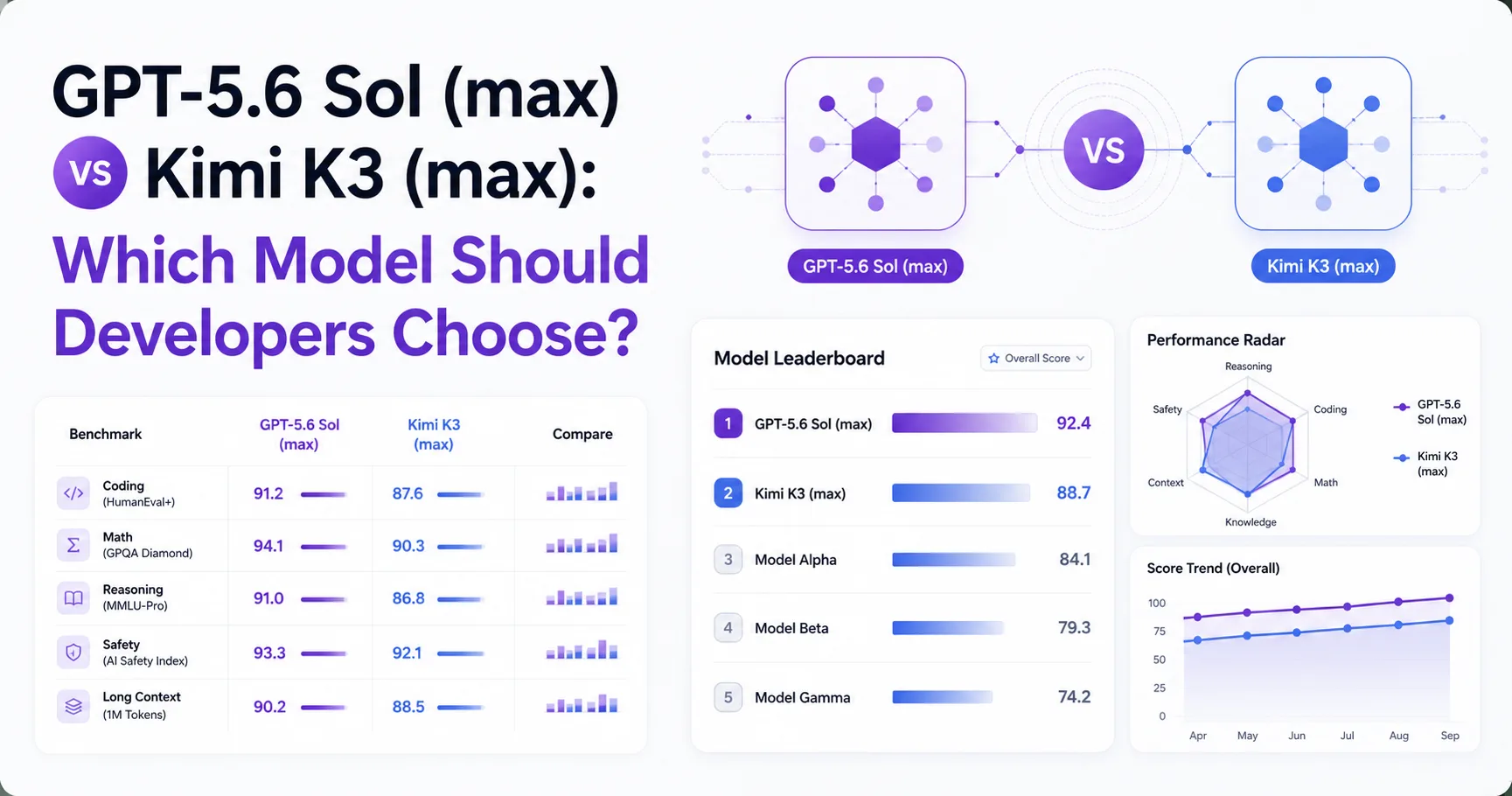
- **Winner overall:** GPT-5.6 Sol (max), with a 77.4 coding index and 58.9 intelligence index - **Cheaper:** Kimi K3 (max) at $6 vs $11.25 per 1M blended tokens - **Faster:** GPT-5.6 Sol (max) at 77.617 median output tokens per second vs Kimi K3 (max) at 34.453 - **Pick Kimi K3 (max) when:** native multimodal work and a $6 blended price matter more than maximum interactive speed - **Watch out:** Both models report 0.3 seconds latency, so output speed and completed-task reliability need separate validation
GPT-5.6 Sol vs Kimi K3 at a glance
GPT-5.6 Sol (max) is the stronger default for developers who value measured capability and interactive speed over minimum unit cost.
The data snapshot gives GPT-5.6 Sol (max) the overall edge. It leads Kimi K3 (max) on the Artificial Analysis coding index, 77.4 versus 76.2, and on the intelligence index, 58.9 versus 57.1. GPT-5.6 Sol also produces output at 77.617 median tokens per second, compared with 34.453 for Kimi K3. Kimi remains materially cheaper at $6 versus $11.25 per 1M blended tokens. Data provided by https://artificialanalysis.ai/.
The products also make different tradeoffs. OpenAI presents GPT-5.6 Sol as a flagship model for complex reasoning, programming, and professional work in the model catalog, model details, and release announcement. Kimi presents K3 as a flagship model for long-context coding, knowledge work, reasoning, and native multimodal input in its technical blog.
The official pages still show both models as available. GPT-5.6 Sol remains listed in the OpenAI model catalog, while Kimi K3 remains listed in the Kimi model list. Release timing alone therefore does not decide this comparison.
The decision summary
GPT-5.6 Sol (max) wins the default selection, while Kimi K3 (max) wins the price-sensitive selection.
| Signal | GPT-5.6 Sol (max) | Kimi K3 (max) | What it means |
|---|---|---|---|
| Artificial Analysis coding index | 77.4 | 76.2 | GPT-5.6 Sol has the measured coding lead |
| Artificial Analysis intelligence index | 58.9 | 57.1 | GPT-5.6 Sol has the measured general capability lead |
| Median output tokens per second | 77.617 | 34.453 | GPT-5.6 Sol is better suited to interactive loops |
| Latency seconds | 0.3 | 0.3 | The snapshot shows no latency separation |
| Price per 1M blended tokens | $11.25 | $6 | Kimi K3 has the lower unit cost |
The comparison points toward GPT-5.6 Sol for coding agents that spend much of their time planning, editing, testing, and repairing code interactively. The output-speed gap can shorten each visible iteration, even though the measured latency is tied. Kimi K3 is more compelling when token cost, long-context work, visual input, or video input matters more than rapid generation.
The capability gap should not be treated as a universal production guarantee. The Artificial Analysis snapshot gives GPT-5.6 Sol the lead, but it does not reveal how either model performs on a specific repository, tool protocol, test suite, or approval process. Official benchmark claims also use different evaluation setups. OpenAI reports results in its GPT-5.6 announcement, while Kimi explains in its technical blog that evaluations use different agent harnesses. A private task set remains necessary.
Performance: speed matters more than the headline gap
GPT-5.6 Sol (max) is faster in measured generation, but Kimi K3 (max) remains close enough on quality to require workload testing.
GPT-5.6 Sol reaches 77.617 median output tokens per second, while Kimi K3 reaches 34.453. That difference affects the visible rhythm of an agent. Faster generation can reduce the time spent waiting for plans, patches, test explanations, and tool-call follow-ups. The latency figure is 0.3 seconds for each model, so the dataset does not show a first-response advantage. The practical difference appears after generation begins.
The quality lead is narrower than the speed lead. GPT-5.6 Sol leads the indexed coding and intelligence measures, but the snapshot does not show whether that lead survives repository-specific constraints. A model that produces a slightly better patch but needs more retries may lose to a cheaper model that completes the same workflow cleanly. Developers should therefore measure accepted changes, test success, tool-call accuracy, and human review effort.
Official benchmark comparisons need care. OpenAI publishes results for browsing, desktop control, coding agents, and security tasks in the GPT-5.6 announcement. Kimi publishes results for coding and browsing in the Kimi K3 technical blog, but its evaluation notes describe different agent harnesses. Those figures establish useful direction, not a single shared leaderboard.
Community feedback adds a behavioral warning. A Reddit test of GPT-5.6 reports over-designed solutions and inconsistent token use, while Hacker News discussion describes investigation drift and possible improvement after lowering reasoning effort. These reports lack reproducible methods, so they should guide pilot design rather than define model behavior. Kimi’s public materials likewise warn that active behavior requires clear system prompts and boundaries.
Cost: cheaper tokens can still produce expensive workflows
Kimi K3 (max) has the lower token rate, but GPT-5.6 Sol (max) can be cheaper per completed outcome when speed and reliability reduce rework.
Kimi K3 costs $6 per 1M blended tokens in the data snapshot, compared with $11.25 for GPT-5.6 Sol. That is a meaningful advantage for large-volume generation, exploratory coding, and workloads where the model completes the task in one pass. Kimi’s official pricing page confirms that K3 is offered as a separately priced flagship API model.
Token price is only the first part of an agent budget. Reasoning tokens are invisible to users, consume context capacity, and are billed as output tokens according to OpenAI’s reasoning documentation. Higher reasoning effort can therefore increase both latency and spend. OpenAI’s API pricing documentation also describes multiple pricing modes, so the selected service mode and workload pattern affect the final bill.
The cheaper model can become more expensive when it needs additional turns. Extra planning, repeated tool calls, failed patches, test repair, and human review all create cost outside the headline token rate. A community report on Kimi K3 with Hermes describes a long coding task that reached its token limit before completion. The report does not provide a reproducible completion rate, but it shows why unfinished work belongs in the cost model.
For selection, compare cost per accepted task rather than cost per token alone. Include retries, manual review, context reuse, cache behavior, and the value of faster iteration. Kimi K3 is the obvious unit-cost winner. GPT-5.6 Sol can still justify its premium when a faster loop prevents expensive waiting or rework.
Recommendation by developer workload
GPT-5.6 Sol (max) is the better first production pilot, while Kimi K3 (max) is the better value pilot for long-context multimodal work.
Choose GPT-5.6 Sol (max) when the agent must work through complex code changes with frequent feedback. Its measured output speed is higher, and its indexed coding and intelligence results lead in the data snapshot. OpenAI’s model details describe Responses API support, structured outputs, function calling, streaming, and a broad tool surface. That combination fits agents that coordinate repository edits, tests, search, code execution, and approval steps.
Choose Kimi K3 (max) when lower token cost is central to the design. Kimi also fits applications that need native visual or video input. Its Quickstart documentation describes tool calls, JSON Schema output, dynamic tool loading, automatic context caching, and multimodal message formats. Kimi’s visual input path has a practical integration constraint: public image URLs are not accepted directly, so clients need the documented file or encoded-input format.
Treat the word max as a reasoning setting, not a common model tier. GPT-5.6 Sol uses the model identifier with a reasoning effort setting, as described in the reasoning guide. Kimi K3 exposes max as a reasoning effort value, not as an independent kimi-k3-max model, according to its Quickstart guide. Configuration parity therefore requires matching effort and harness behavior, not just matching names.
A sensible pilot keeps the harness constant. Feed each model the same repository state, tools, instructions, tests, and stopping rules. Preserve full conversation history for Kimi, because its official technical guidance warns that missing prior reasoning or switching models mid-session can destabilize output. Use clear boundaries for both models. Community reports about GPT-5.6 Sol overbuilding and Kimi K3 reaching a token limit remain evidence gaps, not guaranteed failure modes.
Questions to settle before production
Kimi K3 (max) needs more harness validation before a production commitment, especially for web search and long-running agents.
The data snapshot leaves the context-window field null for both models. Official documentation still describes very large context support for GPT-5.6 Sol in the model details and for Kimi K3 in its technical blog. Developers should test context packing, cache reuse, truncation, and recovery behavior directly.
Kimi K3 has the broader documented input modality because its Quickstart describes visual and video input. GPT-5.6 Sol supports text and image input, while its official model page excludes audio and video input. This difference matters for interface inspection, media understanding, and multimodal automation.
Kimi’s web search deserves a separate gate. The Kimi Quickstart says the feature is being updated and is not recommended for production workflows. GPT-5.6 Sol’s documented Responses API tool surface is broader, but actual search quality and operating cost still require task-level testing.
Availability is not the main risk in this comparison. The Kimi model list continues to list kimi-k3, and the OpenAI model catalog continues to list GPT-5.6 Sol. The unresolved questions concern completion quality, harness compatibility, and cost per accepted result.
Frequently asked questions
Which model should a developer choose overall?
GPT-5.6 Sol (max) is the stronger overall default because the data snapshot gives it higher coding and intelligence indexes plus faster output. Kimi K3 (max) is the better value choice when lower token cost or native video input matters. Kimi Quickstart
Which model is cheaper for API workloads?
Kimi K3 (max) is cheaper in the supplied comparison, at $6 per 1M blended tokens versus $11.25 for GPT-5.6 Sol (max). Developers should still include retries, unfinished runs, and review time in total workflow cost.
Which model is faster for interactive coding agents?
GPT-5.6 Sol (max) is faster in the data snapshot, with 77.617 median output tokens per second versus 34.453 for Kimi K3 (max). Measured latency is 0.3 seconds for each, so generation speed is the differentiator shown here.
Does Kimi K3 have a decisive long-context advantage?
Neither model has a decisive long-context advantage in this brief because the supplied context-window fields are null. Official documentation describes large context support for both, so prompt packing and cache behavior require direct validation. GPT-5.6 Sol details Kimi K3 blog
Is Kimi K3 web search ready for production?
Kimi K3 web search should not be treated as production-ready based on the supplied documentation. The Kimi Quickstart says the feature is being updated, so teams should use a separate search path until testing establishes reliability.
Are GPT-5.6 Sol (max) and Kimi K3 (max) separate model versions?
GPT-5.6 Sol (max) and Kimi K3 (max) are reasoning configurations rather than equivalent standalone model names. GPT uses a reasoning effort setting, while Kimi documents max as a parameter value. OpenAI reasoning guide Kimi Quickstart
Sources
- Artificial AnalysisSupplied comparison data for capability indexes, pricing, latency, and output speed.
- OpenAI ModelsGPT-5.6 Sol model listing, availability, positioning, and model catalog status.
- GPT-5.6 Sol model detailsGPT-5.6 Sol capabilities, modalities, APIs, tools, and model constraints.
- Reasoning modelsReasoning effort configuration, reasoning token behavior, and cost implications.
- OpenAI API pricingOpenAI pricing modes and billing context.
- GPT-5.6: Frontier intelligence that scales with your ambitionOpenAI positioning and official benchmark reporting.
- I spent two weeks testing GPT-5.6. Here’s what I found.Community reports about GPT-5.6 Sol coding behavior and token usage.
- Ask HN: How are you productive with GPT 5.6 Sol?Community reports about investigation drift and reasoning effort.
- Kimi K3 official technical blogKimi K3 positioning, multimodal capabilities, official benchmark context, and harness warnings.
- Kimi K3 QuickstartKimi K3 reasoning parameters, multimodal input, tools, structured output, caching, and web search warning.
- Flagship Model Kimi K3 PricingKimi K3 API pricing and model billing context.
- Kimi Model ListKimi K3 availability and current model status.
- Just tested Kimi K3 with HermesCommunity report about a long-running Kimi K3 coding task reaching its token limit before completion.
Published: