
AI model analysis
GPT-5.6 Sol (xhigh) vs GPT-5 mini (high): Which Model Should Developers Choose?
A developer-focused comparison of GPT-5.6 Sol (xhigh) and GPT-5 mini (high), covering capability, speed, cost, evidence quality, and practical model selection.
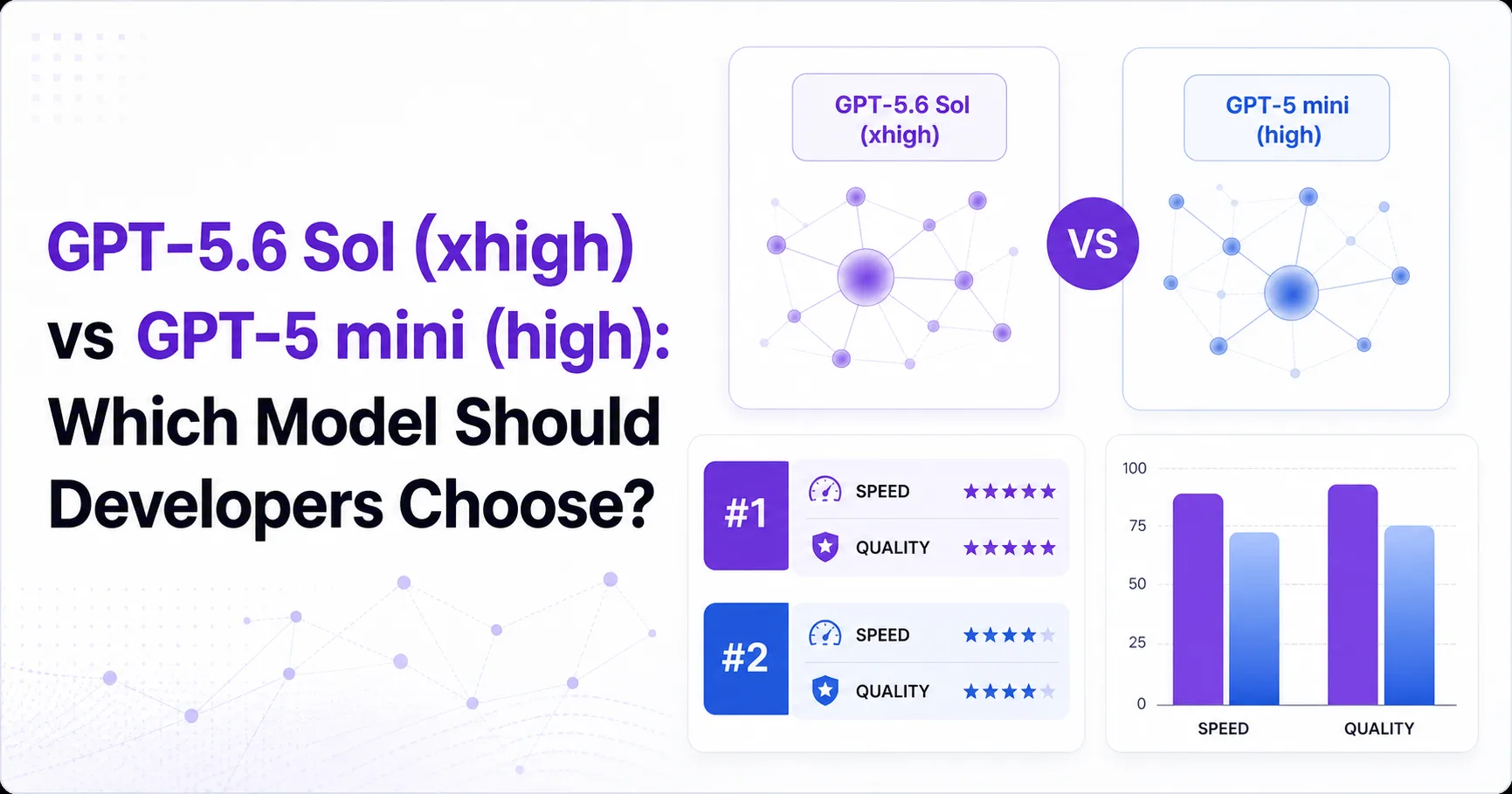
- **Winner overall:** GPT-5.6 Sol (xhigh), with an Artificial Analysis Coding Index of 78.3 vs 15.6 - **Cheaper:** GPT-5 mini (high) at $0.6875 vs $11.25 per 1M blended tokens - **Faster:** GPT-5.6 Sol (xhigh) at 73.479 (median output tokens per second) - **Pick GPT-5 mini (high) when:** low-cost experimentation matters more than verified coding capability - **Watch out:** GPT-5 mini (high) has no currently verified official model page, price listing, or independent coding evidence
GPT-5.6 Sol (xhigh) vs GPT-5 mini (high)
GPT-5.6 Sol (xhigh) is the safer choice for serious software work, while GPT-5 mini (high) is the cheaper option with much weaker verified coding results.
The comparison is unusually asymmetric. GPT-5.6 Sol has a current official model page, a documented API identity, published capability claims, and independent Artificial Analysis measurements. GPT-5 mini (high) appears in the supplied data snapshot, but the current OpenAI model directory and pricing page do not list a dedicated entry for it. The name may describe a historical model and a reasoning configuration, but the supplied sources do not establish the exact API model ID or current availability.
That distinction matters for developers. Choosing a model is not only a question of benchmark quality or token price. It is also a question of whether the model can be identified, called, priced, monitored, and supported with confidence.
Data provided by https://artificialanalysis.ai/
Executive summary
GPT-5.6 Sol (xhigh) offers the stronger verified general-purpose development profile, but GPT-5 mini (high) can be rational for workloads where cost dominates.
The data snapshot gives GPT-5.6 Sol an Artificial Analysis Intelligence Index of 57.7 and a Coding Index of 78.3. GPT-5 mini (high) records 25.3 and 15.6 on those same indexes. The coding gap is therefore the most important selection signal: the larger model is measured at 78.3, while the mini model is measured at 15.6.
GPT-5 mini (high) has one notable result that GPT-5.6 Sol does not share in the snapshot: a Math Index of 90.7. That result prevents a blanket claim that the larger model wins every specialized evaluation. However, the supplied research brief contains no official announcement or independent methodology that explains how the mini model achieved that result, and there is no matching Sol score in the data.
The official evidence also differs sharply. OpenAI lists GPT-5.6 Sol as a current flagship model, while the supplied research found no dedicated current listing for GPT-5 mini in the model directory. Developers should treat the mini model as an evidence-constrained option until its identity and availability are verified in their own account.
Performance: what the gap means in real development work
GPT-5.6 Sol (xhigh) is the better-supported performance choice for code generation, repository changes, and multi-step engineering tasks.
The Coding Index gap is large enough to change workflow design. A model measured at 78.3 is more suitable for tasks that require code interpretation, planning, implementation, and correction in one loop than a model measured at 15.6. That does not guarantee a successful patch, but it supports giving GPT-5.6 Sol broader responsibility in agentic development workflows.
The result should not be read as proof that GPT-5 mini (high) is unusable. A small model can still be appropriate for narrow transformations, simple classification, routine extraction, or an early draft that a stronger model or a human will review. The problem is that the supplied research provides no reliable community coding reports for the mini model, so its failure patterns and practical speed are unknown.
The measured latency is 0.3 seconds for each model, but the snapshot does not provide a median output speed for GPT-5 mini (high). GPT-5.6 Sol records 73.479 median output tokens per second. The equal latency therefore does not establish equal end-to-end responsiveness. A short first response and a fast sustained stream answer different developer needs.
OpenAI describes GPT-5.6 Sol as a model for complex reasoning, programming, and professional work. OpenAI also states that xhigh increases reasoning time and token consumption. The practical tradeoff is clear: Sol can justify deeper reasoning on difficult tasks, but developers should reserve xhigh for tasks where the extra work improves the result.
Cost: the cheap model can become expensive through rework
GPT-5 mini (high) is dramatically cheaper at the token level, but GPT-5.6 Sol (xhigh) can be cheaper for tasks where incorrect output creates substantial review or rework.
The blended price is $0.6875 per 1M tokens for GPT-5 mini (high), compared with $11.25 for GPT-5.6 Sol. The input prices are $0.25 and $5, while the output prices are $2 and $30. Those differences make the mini model attractive for high-volume, low-consequence processing.
Token price alone does not answer the developer’s real question: how much does a completed task cost? If a weak coding result requires repeated prompts, manual debugging, additional tests, or a second model pass, the lower unit price may not produce the lower workflow cost. The supplied materials do not provide retry rates, task-completion rates, or cost per accepted patch, so this crossover point cannot be quantified.
GPT-5.6 Sol also has pricing conditions that make careless use expensive. OpenAI’s pricing documentation distinguishes standard, Batch, Flex, and Fast mode pricing. The model documentation explains that long inputs above 272K tokens use higher input and output pricing. Developers working with large repositories should therefore control context selection, cache reusable material, and avoid sending the entire codebase by default.
The best cost decision depends on failure cost. Use GPT-5 mini (high) for cheap, bounded work when its unknown behavior is acceptable. Use GPT-5.6 Sol when correctness, repair effort, or engineering time matters more than raw token spend.
Recommendation by developer workload
GPT-5.6 Sol (xhigh) should be the default for high-value engineering tasks, while GPT-5 mini (high) belongs behind a validation boundary until its current API status is confirmed.
Choose GPT-5.6 Sol for repository-level changes, difficult debugging, architecture decisions, code review, tool-using agents, and tasks where the first implementation must be close to production quality. Its current official model page documents the gpt-5.6-sol model ID and the gpt-5.6 stable alias. The same page documents support for the Responses API and a broad set of tools, including function calling, structured output, file search, Code Interpreter, computer use, MCP, and patch-oriented workflows.
Choose GPT-5 mini (high) for low-cost drafts, repetitive preprocessing, simple routing, and experiments where a failed response is cheap to discard. The snapshot’s Math Index of 90.7 may make it worth testing for a narrow mathematical workload, but the available evidence does not show whether that result transfers to the developer’s domain or how it compares with Sol under the same test conditions.
Do not select GPT-5 mini (high) solely because its label contains high. OpenAI’s reasoning documentation explains the meaning of reasoning effort settings, but the supplied research does not confirm that high is an official configuration for this model name. Verify the model ID, response behavior, limits, and billing in the target account before building a production dependency.
Community evidence does not resolve the uncertainty. One Reddit report describes a successful Sol coding task, while another reports over-engineering, excess code, rapid quota use, and remaining bugs. The disagreement supports task-specific evaluation rather than a universal promise.
A practical selection rule
GPT-5.6 Sol (xhigh) wins whenever verified coding quality and operational certainty outweigh token price.
A useful rollout starts with task separation. Route narrow, reversible, high-volume work to GPT-5 mini (high) only after checking that its current identifier is callable and its outputs meet acceptance tests. Route repository changes and ambiguous engineering work to GPT-5.6 Sol. Keep human review or automated tests around both paths, because neither the benchmark snapshot nor the official claims provide a guaranteed task-completion rate.
The strongest reason to prefer Sol is not one isolated benchmark. It is the combination of a current official identity, documented API support, published engineering positioning, a Coding Index of 78.3, and a measured output speed of 73.479 median output tokens per second. The strongest reason to prefer mini is not proven developer quality. It is the very low blended price of $0.6875 per 1M tokens.
The evidence is insufficient to answer several questions that a buyer may reasonably ask. The supplied materials do not establish GPT-5 mini’s current availability, stable alias, context window, output limit, tool support, latency distribution, output speed, or coding failure rate. They also do not show whether the reported Math Index of 90.7 reflects a workload relevant to the buyer.
For that reason, GPT-5 mini (high) should be treated as a candidate for a controlled evaluation. GPT-5.6 Sol can serve as the baseline for acceptance tests, especially for coding tasks where a failed answer costs more than the token difference.
FAQ before you choose
GPT-5.6 Sol (xhigh) is the better default when a developer needs verified coding capability and a documented production integration.
The questions below focus on decisions the supplied evidence can support, plus the areas where it cannot provide a reliable answer.
Frequently asked questions
Is GPT-5.6 Sol (xhigh) better than GPT-5 mini (high) for coding?
GPT-5.6 Sol (xhigh) is the stronger evidenced coding choice, with a Coding Index of 78.3 versus 15.6 for GPT-5 mini (high). The result does not guarantee every repository change will succeed, but it supports using Sol for complex implementation, debugging, and agentic software tasks. GPT-5 mini (high) remains reasonable for simple or easily reviewed code work, especially when low token cost matters more than first-pass quality.
Which model is cheaper for API workloads?
GPT-5 mini (high) is cheaper by the supplied pricing data, at $0.6875 per 1M blended tokens versus $11.25 for GPT-5.6 Sol (xhigh). Its input price is $0.25 and its output price is $2, compared with $5 input and $30 output for Sol. The cheaper model can still cost more at workflow level if lower quality causes retries, reviews, or rework, but the supplied materials do not quantify that crossover.
Is GPT-5 mini (high) currently available through the OpenAI API?
The supplied research does not establish that GPT-5 mini (high) is currently available through the OpenAI API. The current OpenAI model directory and pricing page do not list a dedicated gpt-5-mini entry, and the sources do not confirm its model ID, stable alias, limits, or billing. Developers should verify availability directly in the target account before treating it as a production dependency.
Does equal latency mean the models feel equally fast?
Equal measured latency of 0.3 seconds does not prove equal perceived or sustained speed. GPT-5.6 Sol (xhigh) has a recorded median output speed of 73.479 median output tokens per second, while the supplied snapshot provides no output-speed value for GPT-5 mini (high). First-token latency, streaming speed, reasoning duration, tool calls, and response length can produce different user experiences even when the latency field matches.
Should developers use xhigh for every GPT-5.6 Sol request?
Developers should not use xhigh automatically for every GPT-5.6 Sol request. OpenAI states that higher reasoning effort can increase reasoning time and token consumption, and recommends confirming that the quality gain justifies the extra cost and delay. Use xhigh for difficult tasks after evaluation shows a meaningful benefit, and use a lower setting when the task is routine or tightly bounded.
What is the main unresolved risk in this comparison?
The main unresolved risk is the incomplete evidence for GPT-5 mini (high), not a missing benchmark score alone. The supplied materials do not verify its current API identity, availability, limits, tool support, output speed, or coding failure modes. GPT-5.6 Sol has conflicting community anecdotes as well, so developers should still validate representative tasks, but its official documentation gives a firmer operational foundation.
Sources
- Artificial AnalysisNumeric comparison data for pricing, latency, output speed, and evaluation indexes.
- GPT-5.6: Frontier intelligence that scales with ambitious goalsGPT-5.6 Sol positioning, official capability claims, release information, and evaluation caveats.
- GPT-5.6 Sol model pageGPT-5.6 Sol model identity, stable alias, API support, tools, limits, and long-context pricing behavior.
- OpenAI ModelsCurrent model-directory evidence and the absence of a dedicated GPT-5 mini listing in the supplied research.
- OpenAI API PricingOfficial pricing documentation and pricing-mode distinctions for GPT-5.6 Sol.
- Reasoning modelsReasoning effort settings, xhigh tradeoffs, incomplete-response behavior, and token usage guidance.
- 5.6 Sol finished the feature in one promptA positive Reddit coding experience report for GPT-5.6 Sol.
- I spent two weeks testing GPT-5.6. Here’s what I foundA critical Reddit coding experience report and evidence of disagreement in community feedback.
- OpenAI lists GPT-5.6 Sol as a current flagship modelEvidence cited in the article body
Published: