
AI model analysis
GPT-5.6 Sol (xhigh) vs Kimi K3 (max): Which Model Should Developers Choose?
A developer-focused comparison of GPT-5.6 Sol and Kimi K3 across coding quality, speed, cost, multimodal support, agent tooling, and production risks.
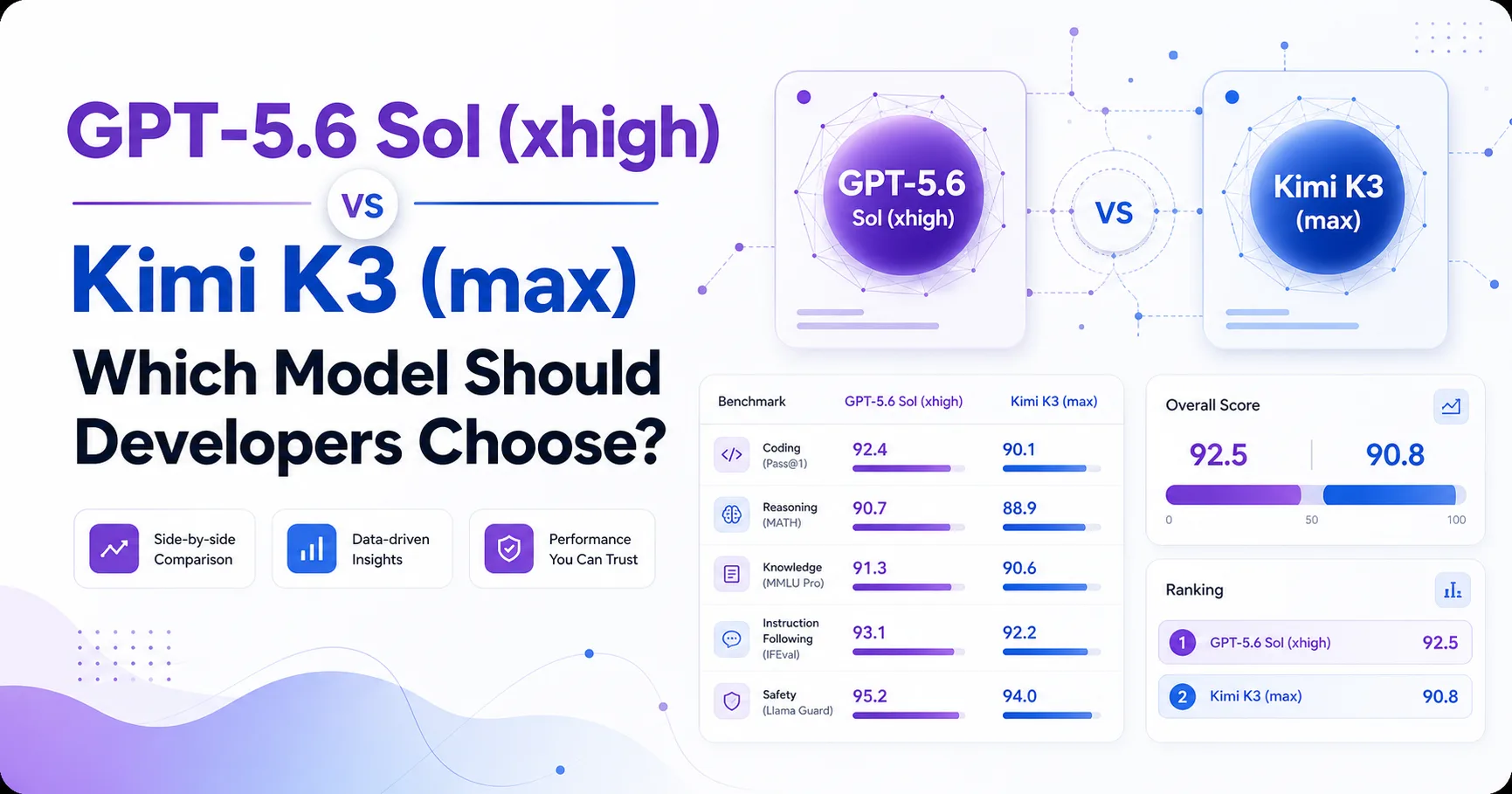
- **Winner overall:** GPT-5.6 Sol (xhigh), with a coding index of 78.3 and output speed of 73.479 tokens per second - **Cheaper:** Kimi K3 (max) at $6 vs $11.25 per 1M blended tokens - **Faster:** GPT-5.6 Sol (xhigh) at 73.479 output tokens per second vs Kimi K3 (max) at 34.453 - **Pick GPT-5.6 Sol (xhigh) when:** your coding agent values a coding index of 78.3 and faster generated output - **Watch out:** intelligence scores are close at 57.7 vs 57.1, and the supplied evidence does not establish total task reliability
The short answer
GPT-5.6 Sol (xhigh) is the better default for demanding software work, while Kimi K3 (max) is the stronger value and multimodal alternative (GPT-5.6 announcement, Kimi K3 blog). OpenAI frames GPT-5.6 Sol around complex reasoning, programming, and professional work, while Kimi presents K3 as a flagship model for long-horizon coding, knowledge work, and reasoning (GPT-5.6 Sol model page, Kimi K3 blog).
This comparison treats xhigh and max as reasoning settings, not separate model IDs. The measured data favors GPT on coding, intelligence, and output speed. The supplied research favors Kimi on multimodal breadth and token economics, but leaves reliability and completion efficiency unresolved. Developers should therefore choose by workflow, not by a single leaderboard position.
Summary of the trade-off
GPT-5.6 Sol (xhigh) wins the measured quality and speed signals, while Kimi K3 (max) wins the blended-cost signal (Artificial Analysis). Data provided by https://artificialanalysis.ai/.
| Signal | GPT-5.6 Sol (xhigh) | Kimi K3 (max) | Practical reading |
|---|---|---|---|
| Coding Index | 78.3 | 76.2 | GPT has the measured coding lead |
| Intelligence Index | 57.7 | 57.1 | The quality separation is narrow |
| Output speed | 73.479 | 34.453 | GPT produces visible output faster |
| Latency | 0.3 seconds | 0.3 seconds | The supplied snapshot shows a tie |
| Blended price per 1M tokens | $11.25 | $6 | Kimi has the cost advantage |
The raw signals describe a split decision. GPT has the clearer advantage for interactive coding because its coding score and output speed lead together. Kimi remains attractive for workloads where token spend dominates and slower generation is acceptable. The narrow intelligence gap also means the winner may change with task composition, prompt design, tool use, or evaluation harness.
The model labels need careful interpretation. OpenAI identifies gpt-5.6-sol as the model ID and gpt-5.6 as its stable alias, while xhigh is a reasoning-effort setting (GPT-5.6 Sol model page, Reasoning models). Kimi identifies kimi-k3 as the API model, while max is a reasoning_effort setting (Kimi K3 Quickstart).
The supplied evidence does not establish which model completes a full software task with fewer retries, tool errors, or human interventions. Those missing measurements matter more than small index differences for production selection.
Performance: speed changes the agent experience
GPT-5.6 Sol (xhigh) is the faster choice for long visible outputs, even though both models show 0.3-second latency (Artificial Analysis). The measured output speed is 73.479 tokens per second for GPT and 34.453 for Kimi. That difference matters in coding agents that stream plans, patches, test explanations, or repeated tool results to a developer.
Equal latency does not erase the throughput difference. It means the supplied snapshot shows no advantage at request start, while GPT has the advantage once substantial output generation begins. Developers building an interactive IDE assistant should therefore test perceived completion time, not latency alone. A short response may feel similar, but a long reasoning trace or generated patch can feel materially different.
The speed result does not settle end-to-end agent time. OpenAI documents that xhigh can increase reasoning time and token consumption, and recommends using it only when measured gains justify the additional cost and delay (Reasoning models). Kimi keeps thinking enabled and exposes low, high, and max reasoning settings, with max as the default (Kimi K3 Quickstart). The comparison is therefore specific to Kimi K3 at max, not every Kimi reasoning configuration.
Tool architecture can also change the result. GPT supports the Responses API and a broad set of hosted tools, including file search, code execution, computer use, MCP, and patch application (GPT-5.6 Sol model page). Kimi supports tool calls, JSON Schema output, partial mode, dynamic tool loading, and automatic context caching (Kimi K3 Quickstart).
Evidence is insufficient for a reliable independent speed ranking beyond the supplied snapshot. The Kimi community material does not provide reproducible latency or tokens-per-second testing, while GPT reports include both successful and negative experiences (Just tested Kimi K3 with Hermes, GPT-5.6 positive coding report, GPT-5.6 critical testing report).
Cost: token price is not total engineering cost
Kimi K3 (max) is the lower-cost default, but GPT-5.6 Sol (xhigh) can reduce engineering time when faster completion prevents retries (Artificial Analysis). Kimi costs $6 per 1M blended tokens versus $11.25 for GPT. The output prices are $15 for Kimi and $30 for GPT, which makes output-heavy agent traces especially sensitive to model choice.
The blended figure is useful for screening, but it is not a complete operating-cost estimate. Prompt reuse, cache hits, reasoning tokens, output length, tool calls, retries, and human review can all change the final bill. OpenAI documents separate service modes and cache pricing on its API pricing page, while Kimi documents cache-hit and uncached input categories on its Kimi K3 pricing page. The correct comparison depends on the traffic pattern of the application.
Reasoning configuration is another cost variable. OpenAI explains that reasoning tokens consume output capacity and incur output-token charges, while an undersized output limit can produce an incomplete response after billable work has already occurred (Reasoning models). Kimi’s automatic context caching may help repeated workflows, but its benefit depends on actual prompt reuse and cache behavior (Kimi K3 Quickstart).
The cheaper model can become more expensive when a task reaches a limit before completion. A Kimi community report describes a long coding task that required manual review and another model after reaching the token limit, although the report does not provide a reproducible success rate (Just tested Kimi K3 with Hermes). GPT can create the opposite problem when an agent over-engineers a solution or generates unnecessary code, as described in another community report (GPT-5.6 critical testing report).
Evidence is insufficient for total-cost ranking because the supplied data does not measure cost per accepted change, completed task, retry, or reviewed patch. Teams should log those measures before treating the blended price as a procurement decision.
Recommendation by developer workflow
GPT-5.6 Sol (xhigh) is the stronger primary pick for coding agents that need speed, tool breadth, and a measured quality edge. Its coding index is 78.3 versus 76.2 for Kimi, and its output speed is 73.479 tokens per second versus 34.453 (Artificial Analysis). The advantage is most useful when developers watch streamed output, iterate quickly, or expect the model to operate across files, tests, and hosted tools.
Choose GPT when the application centers on software engineering, structured tool use, or complex multi-step tasks. OpenAI documents support for Chat Completions and Responses, with Responses recommended for reasoning models. Its documented tool surface includes function calling, structured output, web search, file search, code execution, computer use, MCP, patch application, and skills (GPT-5.6 Sol model page, Reasoning models).
Choose Kimi when price, native visual input, video files, or long-running knowledge work carries more weight than output speed. Kimi documents visual input, tool calls, JSON Mode, JSON Schema output, partial mode, dynamic tool loading, and automatic context caching (Kimi K3 blog, Kimi K3 Quickstart). Its lower blended price makes it a sensible candidate for high-volume workloads that can tolerate slower generation and careful completion checks.
Version status does not create a clear reason to avoid either model. The supplied research shows GPT available in the current OpenAI model directory and Kimi available in the current Kimi model list (OpenAI model directory, Kimi model list). Neither source establishes a later replacement in the supplied material.
Community evidence argues for staged evaluation rather than a universal verdict. One GPT report describes a useful feature completed from a large instruction set, while another reports over-design and bugs. A Kimi report describes meaningful progress but an unfinished task after reaching a token limit (GPT-5.6 positive coding report, GPT-5.6 critical testing report, Kimi Hermes report). The supplied research cannot determine how common any of these outcomes are.
Checks before production selection
GPT-5.6 Sol (xhigh) and Kimi K3 (max) require workflow safeguards before production selection. Confirm the API identity first: OpenAI uses gpt-5.6-sol with gpt-5.6 as the stable alias, while xhigh is a reasoning setting (GPT-5.6 Sol model page, Reasoning models). Kimi uses kimi-k3, while max is a reasoning_effort value rather than a separate model (Kimi K3 Quickstart).
For multimodal workflows, Kimi accepts native visual input and video files, but its visual message format requires structured content and does not accept public image URLs directly (Kimi K3 Quickstart). GPT supports text and image input but does not support audio or video input (GPT-5.6 Sol model page).
For agent continuity, preserve the full reasoning history when using Kimi and avoid switching models inside an existing session, because Kimi warns that incomplete history can destabilize generation (Kimi K3 blog). Use explicit behavioral boundaries in system prompts or AGENTS.md, especially because Kimi documents a high degree of initiative. Treat Kimi web search cautiously because its Quickstart describes that feature as unsuitable for production during its update period (Kimi K3 Quickstart).
The decisive evaluation should measure accepted code changes, test pass rate, tool-call recovery, review time, token spend, and completion rate on the team’s own tasks. The supplied material does not provide those end-to-end measures.
Frequently asked questions
Which model is better for coding agents?
GPT-5.6 Sol (xhigh) is the stronger default for coding agents because it leads the supplied coding index and output-speed measurements, while Kimi K3 remains a viable lower-cost alternative. Teams should still test completion rate and review effort on their own repositories (Artificial Analysis).
Which model is cheaper to run?
Kimi K3 (max) is cheaper in the supplied pricing comparison at $6 versus $11.25 per 1M blended tokens. The final operational winner can change if slower completion causes more retries, manual review, or unfinished tasks.
Are xhigh and max separate model versions?
No, xhigh and max are reasoning settings rather than separate model versions. OpenAI documents gpt-5.6-sol as the model ID, while Kimi documents kimi-k3 as the model name and max as a reasoning-effort value (Reasoning models, Kimi K3 Quickstart).
Which model is better for multimodal applications?
Kimi K3 (max) is the better fit when the application needs native visual input or video files, because GPT-5.6 Sol supports text and images but not audio or video. Kimi still requires structured visual content rather than direct public image URLs (Kimi K3 Quickstart, GPT-5.6 Sol model page).
Can benchmark results alone determine the production choice?
No, benchmark results alone cannot determine the production choice because the supplied evidence does not measure retries, tool-call recovery, accepted changes, human review, or total task completion. Community reports also describe conflicting outcomes (GPT-5.6 critical testing report, Kimi Hermes report).
Sources
- Artificial AnalysisBenchmark, speed, latency, and pricing comparison values supplied in the data snapshot.
- GPT-5.6: Intelligence that scales with the ambition of your goalsOpenAI positioning of GPT-5.6 Sol for reasoning, programming, and professional work.
- GPT-5.6 Sol model pageOpenAI model identity, API support, modalities, tools, and capability boundaries.
- Reasoning modelsReasoning settings, xhigh behavior, token accounting, and incomplete-response constraints.
- OpenAI model directoryCurrent GPT-5.6 Sol model availability.
- OpenAI API pricingOpenAI pricing modes and cache-pricing context.
- 5.6 Sol finished the feature in one promptPositive community coding experience involving GPT-5.6 Sol.
- I spent two weeks testing GPT-5.6. Here’s what I foundCritical community experience involving over-engineering, bugs, and quota consumption.
- Kimi K3 official technical blogKimi K3 positioning, multimodal capabilities, agent guidance, and workflow limitations.
- Kimi K3 QuickstartKimi model identity, reasoning settings, multimodal input, tools, caching, and web-search limitations.
- Flagship Model Kimi K3 PricingKimi API pricing structure and cache-pricing context.
- Kimi model listCurrent Kimi K3 model availability.
- Just tested Kimi K3 with HermesCommunity coding experience involving token-limit completion failure and manual review.
Published: