
AI model analysis
GPT-5.6 Terra (high) vs GPT-5 nano (high): Which Model Should Developers Choose?
A developer-focused comparison of GPT-5.6 Terra (high) and GPT-5 nano (high), covering measured quality, speed, pricing, availability uncertainty, and practical model-selection risks.
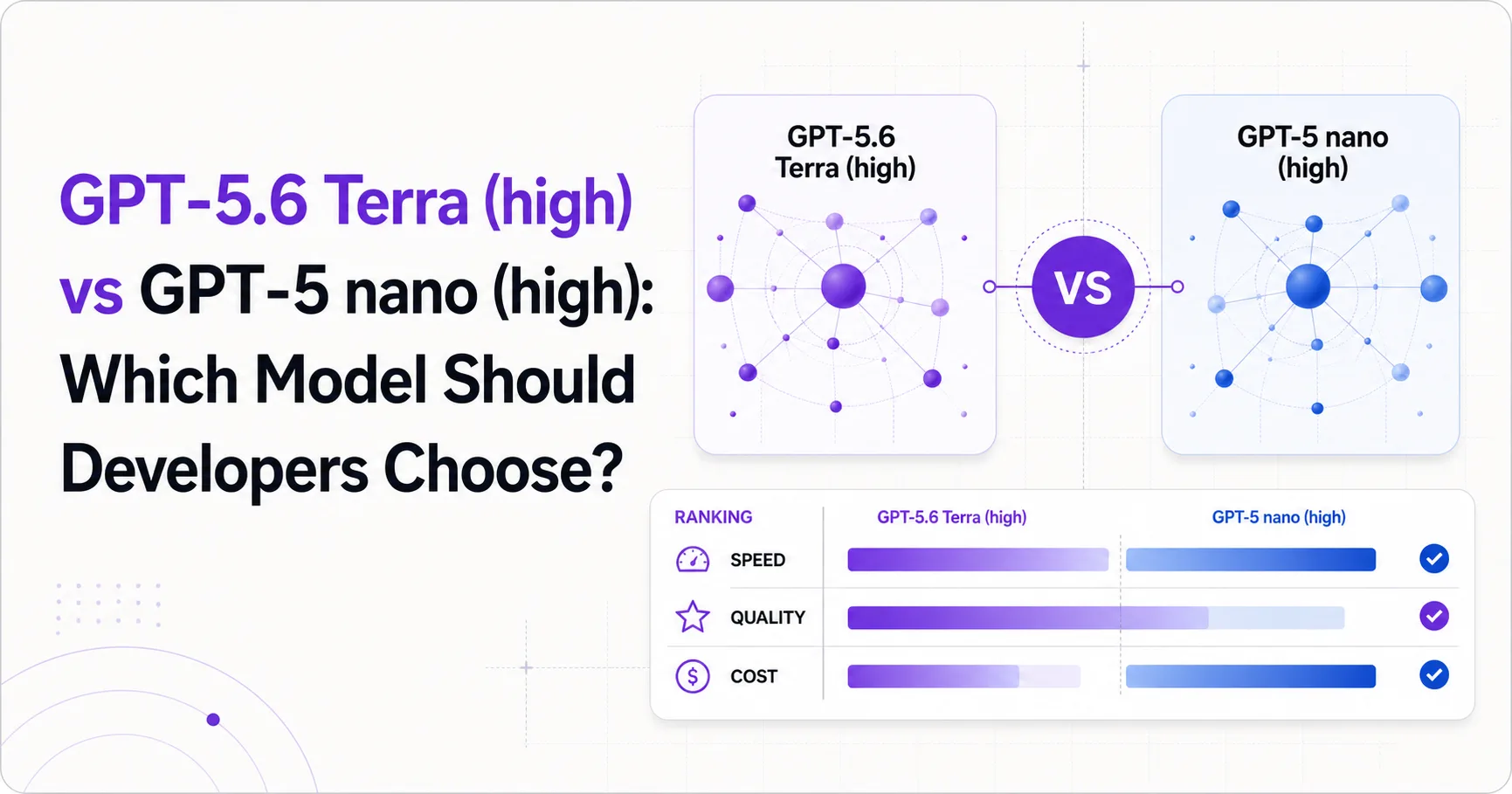
- **Winner overall:** GPT-5.6 Terra (high), with an Artificial Analysis Intelligence Index score of 49 vs 19.9 - **Cheaper:** GPT-5 nano (high) at $0.1375 vs $4.500000000000001 per 1M blended tokens - **Faster:** GPT-5.6 Terra (high) at 121.89 median output tokens per second - **Pick GPT-5 nano (high) when:** low-cost math-focused workloads can accept an Intelligence Index score of 19.9 - **Watch out:** both models show 0.3 seconds latency, but GPT-5 nano (high) has no reported output-speed measurement
GPT-5.6 Terra (high) vs GPT-5 nano (high)
GPT-5.6 Terra (high) is the safer quality choice, while GPT-5 nano (high) is the lower-cost experiment with material availability uncertainty.
The measured comparison is asymmetric. GPT-5.6 Terra (high) records an Artificial Analysis Intelligence Index of 49 and a Coding Index of 67.1. GPT-5 nano (high) records 19.9 on the Intelligence Index and 83.7 on the Math Index. The dataset does not provide a directly comparable coding score for GPT-5 nano (high), or a directly comparable intelligence score for GPT-5 nano beyond the listed index.
Artificial Analysis provides the comparison data. OpenAI’s current model directory confirms a gpt-5.6-terra alias, but it does not confirm gpt-5-6-terra-high or the listed GPT-5 nano identity as current official API model names. Developers should therefore separate benchmark selection from deployment verification.
Executive summary for developers
GPT-5.6 Terra (high) offers the stronger general-purpose evidence, while GPT-5 nano (high) offers the stronger price argument and a math-specific signal.
The central selection question is not simply which model scores higher. It is whether the application needs broad reasoning and coding evidence, or whether a narrowly defined task can tolerate incomplete evidence in exchange for much lower token cost. GPT-5.6 Terra (high) has an Intelligence Index of 49, compared with 19.9 for GPT-5 nano (high). That gap favors Terra for mixed workloads involving planning, code generation, explanation, and judgment.
GPT-5 nano (high) has a Math Index of 83.7, but the brief provides no corresponding Terra math score. Terra has a Coding Index of 67.1, but the brief provides no corresponding nano coding score. Those missing pairs prevent a complete domain-by-domain ranking.
The official-source situation also changes the recommendation. OpenAI’s model directory lists gpt-5.6-terra, not the dataset slug gpt-5-6-terra-high. The same page does not currently list GPT-5 nano. The comparison therefore supports a measured capability and cost decision, but not an assumption that either display label maps directly to a stable production endpoint.
Data provided by https://artificialanalysis.ai/
Performance: quality evidence is stronger for Terra, narrower for nano
GPT-5.6 Terra (high) is the stronger general-purpose performance candidate because its available evidence covers intelligence and coding, not only a specialized domain.
The Intelligence Index favors Terra at 49 versus 19.9 for GPT-5 nano (high), with a reported comparison difference of 29.1. For developers, that result matters most when one model must handle varied prompts without a reliable routing layer. A broader intelligence signal can reduce the need to maintain separate paths for reasoning, code assistance, and general task execution, although the brief does not prove that every production task will follow the index ranking.
GPT-5 nano (high) may still be attractive for math-centered workloads because its Math Index is 83.7. That result is not enough to establish overall superiority in mathematics, because the brief contains no Terra math score and no details about the evaluation set. It does establish a reason to test nano separately rather than dismissing it as only a cheap fallback.
Terra reports 121.89 median output tokens per second, while nano has no reported output-speed value. Both models report 0.3 seconds latency. Equal latency therefore does not imply equal user experience. Streaming completion speed, output length, prompt complexity, queue behavior, and missing nano measurement can all affect perceived responsiveness. The Artificial Analysis data supports a Terra speed claim, but not a speed ranking between the two models.
OpenAI’s model documentation does not provide model-specific official benchmark results, context limits, or output limits for these identities. Those omissions leave long-context suitability and failure boundaries unresolved.
Cost: nano wins on price, but cheap tokens can become expensive decisions
GPT-5 nano (high) is the clear cost choice, provided its quality and availability are acceptable for the workload.
The blended price is $0.1375 per 1M tokens for GPT-5 nano (high), compared with $4.500000000000001 for GPT-5.6 Terra (high). The input price is $0.05 versus $2, and the output price is $0.4 versus $12. These values make nano suitable for high-volume classification, extraction, triage, or draft-generation experiments where errors can be detected cheaply and corrected through deterministic checks.
The price advantage can reverse at the application level when nano needs more retries, additional validation calls, human review, or escalation to Terra. The brief does not provide error rates, task-level pass rates, token consumption distributions, or retry behavior, so no break-even workload can be calculated responsibly. A lower token price is therefore a procurement advantage, not proof of a lower total cost of ownership.
Terra’s higher output price may be justified when one response replaces several weaker calls, especially in workflows where incorrect code or reasoning creates downstream engineering work. The available Intelligence Index values, 49 for Terra and 19.9 for nano, support testing that hypothesis, but they do not quantify savings in developer time.
OpenAI’s pricing page lists gpt-5.6-terra but does not list gpt-5-nano. It also lists other pricing modes and a possible 10% regional-processing surcharge for eligible models, without clarifying whether Terra qualifies. Production budgets should therefore validate the actual endpoint, billing mode, and residency status before approval.
Recommendation: choose by failure cost and endpoint certainty
GPT-5.6 Terra (high) should be the default candidate for broad developer workflows, while GPT-5 nano (high) should enter through a bounded, measured pilot.
Choose Terra when the model must generate or review code, combine several instructions, explain decisions, or serve as a general assistant across changing request types. Terra has the stronger Intelligence Index evidence at 49 and a reported Coding Index of 67.1. Terra also has a measured median output speed of 121.89 tokens per second, which makes it easier to reason about interactive streaming behavior than nano.
Choose nano when unit economics dominate and the task has a narrow acceptance test. Math-heavy evaluation is the most defensible starting point because nano has a Math Index of 83.7. Other candidates include structured extraction, routing, and first-pass drafts, but the brief does not provide task-specific evidence for those uses. Keep escalation available for low-confidence outputs if the cost of an incorrect result is meaningful.
Neither model should be selected solely from its comparison slug. OpenAI’s model directory confirms gpt-5.6-terra, while the research brief finds no official listing for gpt-5-nano or gpt-5-6-terra-high. OpenAI’s pricing documentation presents the same naming gap. Verify the live API model list and complete a representative prompt test before building the integration around either label.
The practical rollout is simple: benchmark Terra and nano on the application’s own acceptance set, measure retries and escalation, then compare total workflow cost. The current materials do not reveal context windows, maximum output lengths, API parameters, failure modes, or verified community experience. Those gaps require direct testing rather than confident extrapolation.
FAQ before choosing a model
GPT-5.6 Terra (high) is the better initial default when the application needs broad capability evidence and predictable performance measurements.
The comparison cannot establish a complete winner for every domain. GPT-5 nano (high) has a Math Index of 83.7, while Terra has a Coding Index of 67.1, but the matching cross-model scores are absent. The most defensible conclusion is conditional: Terra leads on the available general intelligence signal, and nano leads on price with a promising math-specific result.
The largest deployment risk is identity mismatch. The research brief confirms no official record for the exact gpt-5-6-terra-high or gpt-5-nano slugs in the checked official pages. Developers should validate model availability through the live API before treating the dataset names as callable identifiers.
Data provided by https://artificialanalysis.ai/
Frequently asked questions
Is GPT-5.6 Terra (high) better than GPT-5 nano (high) for coding?
GPT-5.6 Terra (high) is the safer coding choice because it has a reported Coding Index of 67.1, while GPT-5 nano (high) has no directly comparable coding score in the provided data. The evidence supports Terra for coding, but it does not establish a complete task-level ranking.
Which model is cheaper for production workloads?
GPT-5 nano (high) is cheaper, with a blended price of $0.1375 per 1M tokens versus $4.500000000000001 for GPT-5.6 Terra (high). Total application cost may still differ if nano requires retries, validation, escalation, or additional human review.
Is GPT-5 nano (high) better for math?
GPT-5 nano (high) has the stronger available math signal, with a Math Index of 83.7, but the comparison cannot prove it is better than Terra because no Terra math score appears in the data brief. A task-specific evaluation remains necessary.
Which model is faster?
GPT-5.6 Terra (high) is the only model with a reported output-speed measurement, at 121.89 median output tokens per second. Both models report 0.3 seconds latency, while GPT-5 nano (high) has no reported output-speed value, so a complete speed ranking is unavailable.
Can developers call these exact model slugs today?
Developers should verify the live API before relying on either exact slug because the checked OpenAI pages confirm gpt-5.6-terra but do not confirm gpt-5-6-terra-high or gpt-5-nano. The research materials do not establish current callable availability for the dataset labels.
Sources
- OpenAI ModelsChecking official model aliases, general capability statements, API availability, context information, and the absence of confirmed exact slugs.
- OpenAI API PricingChecking official model pricing, listed aliases, pricing modes, and the possible regional-processing surcharge.
- Artificial AnalysisAttributing the supplied benchmark, latency, output-speed, release-date, and comparison-pricing data.
Published: