
AI model analysis
GPT-5.6 Terra (low) vs o3: Which Model Should Developers Choose?
A developer-focused comparison of GPT-5.6 Terra (low) and o3 across measured intelligence, coding evidence, speed, cost, availability, and deployment risk.
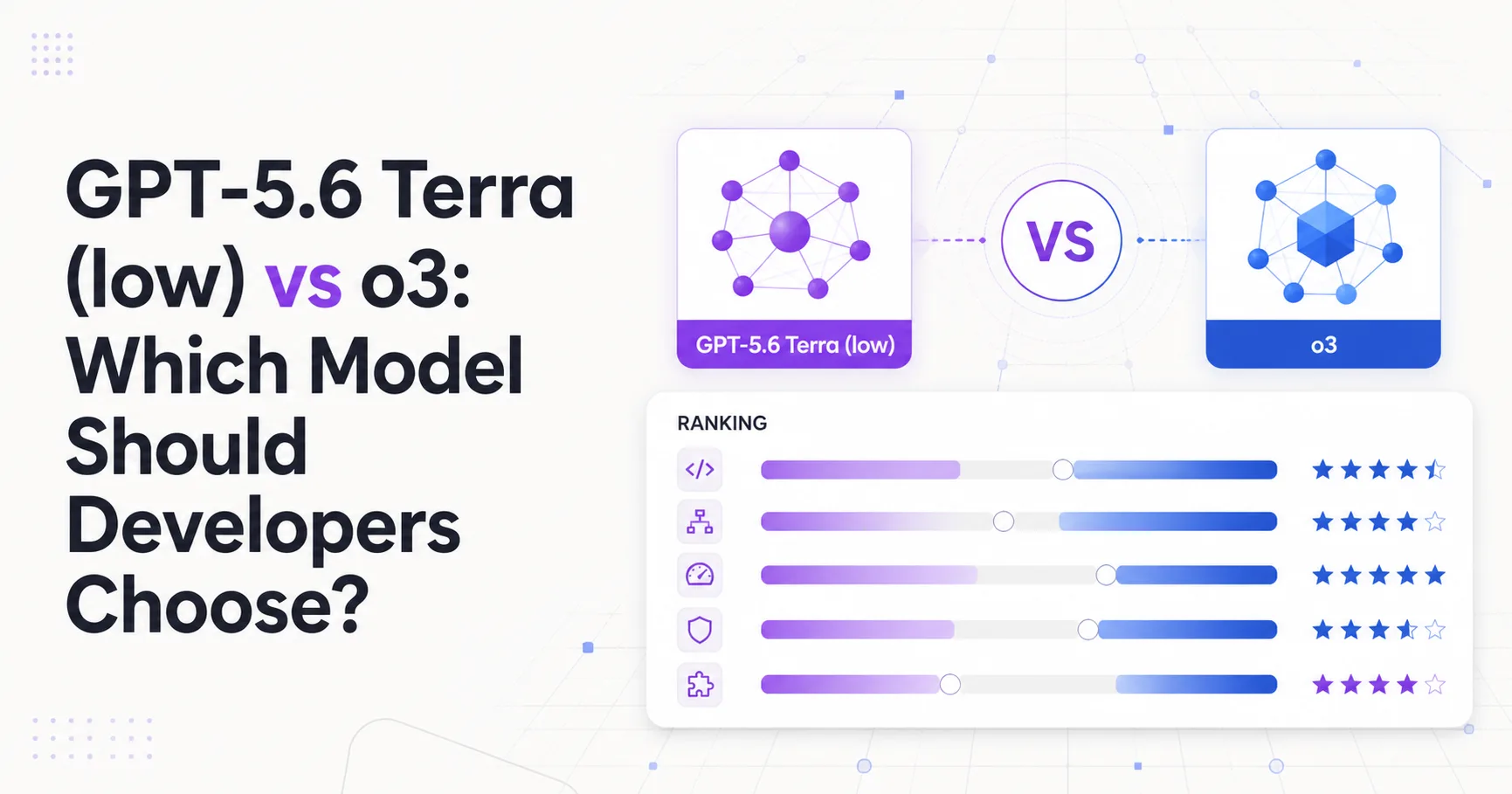
- **Winner overall:** GPT-5.6 Terra (low), with an Artificial Analysis Intelligence Index of 40.5 vs 30.4 for o3 - **Cheaper:** o3 at $3.5 vs $4.500000000000001 per 1M blended tokens - **Faster:** o3 at 128.056 median output tokens per second - **Pick GPT-5.6 Terra (low) when:** measured general intelligence matters more than output price and the model slug is confirmed in your environment - **Watch out:** Official OpenAI pages do not verify GPT-5.6 Terra (low) as a distinct model, and no comparable math or coding score exists for both models Data provided by https://artificialanalysis.ai/
GPT-5.6 Terra (low) vs o3
GPT-5.6 Terra (low) leads the available general-intelligence comparison, but o3 is the safer cost choice for developers who need a documented, familiar model identity. The measured Intelligence Index is 40.5 for GPT-5.6 Terra (low) and 30.4 for o3, according to Artificial Analysis. The same dataset reports o3 at $3.5 per 1M blended tokens, compared with $4.500000000000001 for GPT-5.6 Terra (low).\n\nThe decision is therefore not a simple quality ranking. GPT-5.6 Terra (low) has the stronger available general-intelligence signal, while o3 costs less and is marginally faster in the supplied measurement. The evidence does not establish whether gpt-5-6-terra-low is an independently supported API model, a reasoning configuration, or another alias. Developers should confirm the exact identifier before committing production traffic.
Executive summary for model selection
GPT-5.6 Terra (low) is the better measured general-purpose candidate, while o3 is the more economical candidate with a clearer historical identity. Artificial Analysis reports GPT-5.6 Terra (low) at 40.5 on its Intelligence Index, versus 30.4 for o3. That gap is large enough to justify testing Terra for broad reasoning, synthesis, and agentic workflows. It does not prove superiority for every developer task.\n\no3 has the lower blended price, at $3.5 per 1M tokens, versus $4.500000000000001 for GPT-5.6 Terra (low). Its output price is also lower, at $8 per 1M output tokens versus $12. Input pricing is tied at $2 per 1M input tokens. The lower output rate matters most for applications that generate long answers, patches, reports, or multi-step tool traces.\n\nThe available benchmark coverage is asymmetric. GPT-5.6 Terra (low) has a coding score of 58.1, but the supplied data has no comparable o3 coding score. o3 has a math score of 88.3, but the supplied data has no comparable GPT-5.6 Terra (low) math score. Neither result supports a direct winner for that category.\n\nOpenAI’s current model documentation lists GPT-5.6 Terra as a frontier model balancing intelligence and cost, but does not list GPT-5.6 Terra (low) or gpt-5-6-terra-low. The same documentation does not list o3 in the supplied current catalog. This creates an availability risk for both names, with a sharper identity problem for the Terra low variant.\n\nData provided by https://artificialanalysis.ai/
Performance: what the measurements mean in practice
o3 is marginally faster in the supplied output-speed measurement, but GPT-5.6 Terra (low) has the stronger available general-intelligence signal. Artificial Analysis reports median output speeds of 123.223 tokens per second for GPT-5.6 Terra (low) and 128.056 for o3. Both models have a measured latency of 0.3 seconds.\n\nThe speed difference is unlikely to decide a user-facing application by itself. The reported latency is tied, and the output-speed gap is small relative to the larger uncertainty around workload behavior, prompt length, tool calls, retries, and deployment configuration. A fast model can still create a slower product if it requires more corrections or produces less reliable intermediate work.\n\nThe more important practical question is whether the Intelligence Index difference transfers to your task. GPT-5.6 Terra (low) scores 40.5, while o3 scores 30.4. That result favors Terra for broad tasks represented by the index, but the supplied evidence does not identify which coding, reasoning, or agent behaviors produce the gap. It also does not establish that Terra is better at mathematics, because only o3 has the supplied math score of 88.3.\n\nThe coding evidence is equally incomplete. GPT-5.6 Terra (low) has an Artificial Analysis Coding Index of 58.1. No o3 coding score appears in the supplied dataset, so developers should not describe Terra as the coding winner. The correct conclusion is narrower: Terra has a documented coding measurement, while this comparison lacks an apples-to-apples o3 coding result.\n\nFor latency-sensitive services, benchmark the complete request path. Measure time to first token, total response time, tool-call turnaround, correction rate, and task completion. The supplied brief contains no reliable community testing for either model, so anecdotal claims about coding feel, speed feel, or behavioral quirks remain unsupported.
Cost: when the cheaper model can become more expensive
o3 is the lower-cost choice on the supplied blended and output prices, but GPT-5.6 Terra (low) can still be economically preferable if it reduces retries or human review. Artificial Analysis lists o3 at $3.5 per 1M blended tokens and GPT-5.6 Terra (low) at $4.500000000000001. Input pricing is equal at $2 per 1M tokens, while output pricing favors o3 at $8 versus $12 per 1M tokens.\n\nThe price gap matters most when output dominates usage. Code-generation agents, documentation systems, and long-form analysis can produce substantial output, so o3’s lower output rate gives it a direct operating-cost advantage. Short responses with large prompts are different because input pricing is tied. In that pattern, model quality and retry behavior may matter more than the listed token rate.\n\nA nominally cheaper model becomes more expensive when it needs additional attempts, longer corrective prompts, or manual intervention. The supplied data does not include task success rates, retry rates, or review costs, so no total-cost winner can be proven. Developers should calculate cost per accepted result, not only cost per generated token. That requires a private evaluation using representative prompts and the same output policy.\n\nOpenAI’s pricing documentation lists prices for gpt-5.6-terra, including Standard, Batch, Flex, and Fast mode variants, but it does not list a separate GPT-5.6 Terra (low) price. The documented Standard short-context price is therefore evidence about the stable Terra alias, not proof that the low variant can be purchased at that rate. The page also does not provide a current o3 price in the supplied brief.\n\nFor procurement, treat the Artificial Analysis prices as the comparison dataset and treat the official pricing page as an availability check. Confirm the exact production slug, billing class, and response behavior before forecasting spend.
Recommendation by developer scenario
GPT-5.6 Terra (low) is the better first candidate for broad quality testing, while o3 is the better first candidate for cost-sensitive production experiments. The recommendation follows the supplied evidence, not an assumption that either name is currently stable in the OpenAI catalog. Artificial Analysis gives Terra the higher Intelligence Index at 40.5 versus 30.4 for o3. o3 has the lower blended price at $3.5 and the higher measured output speed at 128.056 tokens per second.\n\nChoose GPT-5.6 Terra (low) first when your workload rewards broad reasoning quality, synthesis, or general task coverage. Its available coding score of 58.1 may also justify inclusion in a coding evaluation. However, the absent o3 coding score prevents a direct coding comparison. Run both models on accepted-patch rate, test-generation accuracy, debugging success, and reviewer edits before making a final engineering decision.\n\nChoose o3 first when output volume is high, the budget is tight, or you want to test the lower listed output price of $8 per 1M tokens. o3’s math score of 88.3 makes it important to include in mathematics-heavy evaluations. That score cannot establish a math advantage over Terra because no comparable Terra math score is supplied.\n\nFor a production rollout, neither option should pass solely on this brief. OpenAI’s model page does not list the exact Terra low identifier and does not list o3 in the current catalog described by the research brief. The evidence is insufficient to confirm current direct-call availability, stable aliases, context windows, output limits, or model-specific API parameters.\n\nThe practical choice is a two-stage evaluation: verify access first, then compare accepted outcomes under your real prompts. If Terra low cannot be called reliably, o3 becomes the operational choice by default. If both are available, let cost per accepted result decide after quality gates are met.
Questions to answer before adopting either model
GPT-5.6 Terra (low) requires an identifier and availability check before any production adoption decision. The supplied research does not verify the exact low variant in OpenAI’s official model catalog or pricing page.\n\nThe benchmark evidence also needs careful interpretation. Artificial Analysis supplies useful measurements, but the category coverage is incomplete because coding and math scores are not available for both models. Treat unmatched category scores as evaluation inputs, not direct head-to-head conclusions.\n\nThe safest adoption process is to verify the API slug, run representative tasks, and record accepted-result cost. Official documentation should establish what can be called, while the supplied dataset can guide which model deserves testing first. No reliable community evidence was found for either model’s coding experience, speed perception, or recurring failure patterns.
Frequently asked questions
Is GPT-5.6 Terra (low) better than o3 overall?
GPT-5.6 Terra (low) leads the supplied general-intelligence measurement, scoring 40.5 versus 30.4 for o3, but the evidence is insufficient to declare a universal winner across coding, mathematics, availability, and production reliability.
Which model is cheaper for API workloads?
o3 is cheaper on the supplied blended price, at $3.5 per 1M tokens versus $4.500000000000001 for GPT-5.6 Terra (low), and its output price is $8 versus $12 per 1M tokens.
Which model is faster for interactive applications?
o3 is faster in the supplied median output measurement, at 128.056 tokens per second versus 123.223 for GPT-5.6 Terra (low), while both models show latency of 0.3 seconds.
Is GPT-5.6 Terra (low) officially available through the OpenAI API?
The supplied official documentation does not confirm that GPT-5.6 Terra (low) is a distinct API model or stable alias; it documents GPT-5.6 Terra, so developers must verify the exact identifier directly.
Should developers use the coding score to choose between these models?
Developers should not use the available coding score alone because GPT-5.6 Terra (low) has a coding score of 58.1, while the supplied dataset contains no comparable o3 coding score.
Does o3 have a mathematics advantage?
o3 has the supplied math score of 88.3, but the evidence does not prove a mathematics advantage over GPT-5.6 Terra (low) because no comparable Terra math score is provided.
Sources
- Artificial AnalysisSupplied benchmark, speed, latency, release-date, and pricing comparison data.
- OpenAI ModelsOfficial model visibility, Terra positioning, supported modalities, API documentation, and the absence of a confirmed Terra low or o3 entry in the supplied research.
- OpenAI API PricingOfficial pricing-page verification for the stable GPT-5.6 Terra alias and the absence of a separate Terra low listing in the supplied research.
Published: