
AI model analysis
GPT-5.6 Terra (max) vs GPT-5 mini (high): Which Model Should Developers Choose?
A developer-focused comparison of GPT-5.6 Terra (max) and GPT-5 mini (high), covering capability, speed, cost, availability, evidence quality, and practical model selection.
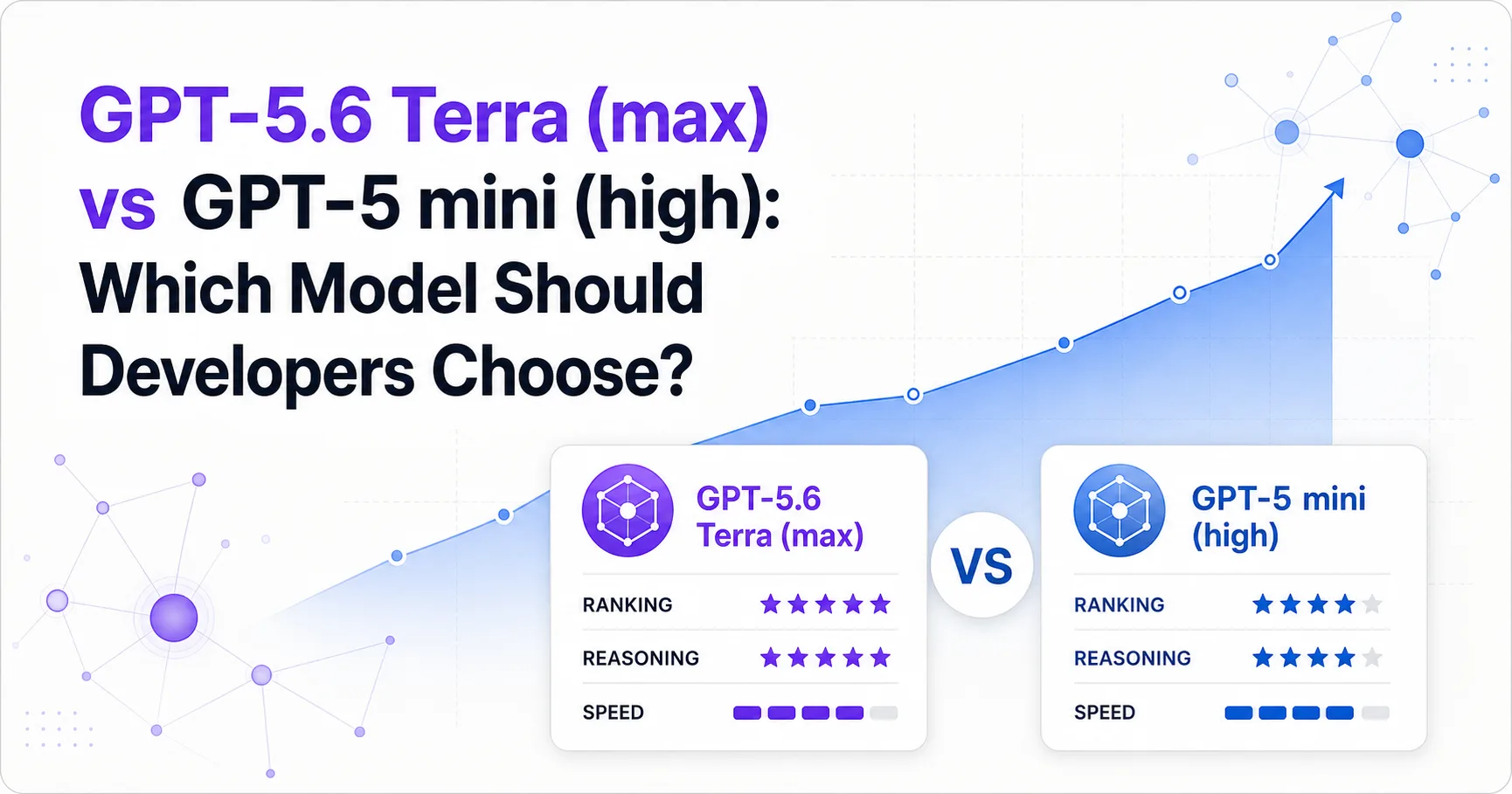
- **Winner overall:** GPT-5.6 Terra (max), with an Artificial Analysis Intelligence Index of 55 vs 25.3 - **Cheaper:** GPT-5 mini (high) at $0.6875 vs $4.500000000000001 per 1M blended tokens - **Faster:** GPT-5.6 Terra (max) at 144.252 median output tokens per second, while GPT-5 mini (high) has no reported speed value - **Pick GPT-5.6 Terra (max) when:** coding quality, broader reasoning capability, and a documented current API model matter more than minimum cost - **Watch out:** GPT-5 mini (high) leads on the reported math index at 90.7, but its current API availability and official configuration remain unverified
GPT-5.6 Terra (max) vs GPT-5 mini (high)
GPT-5.6 Terra (max) is the stronger documented choice for demanding development work, while GPT-5 mini (high) is dramatically cheaper but poorly documented today.
The comparison has an important asymmetry. GPT-5.6 Terra (max) has a current official model page, a stable model ID, published pricing, and documented reasoning behavior. GPT-5 mini (high) appears in the supplied evaluation snapshot, but the current OpenAI Models page does not list gpt-5-mini as an independent entry.
The available performance data points in one direction for coding and general intelligence. GPT-5.6 Terra (max) records an Artificial Analysis Coding Index of 76.7 and an Intelligence Index of 55. GPT-5 mini (high) records 15.6 and 25.3 on those same indexes. GPT-5 mini (high) does have a reported Math Index of 90.7, but GPT-5.6 Terra (max) has no corresponding value in the supplied dataset.
That means the practical decision is not simply “better model versus cheaper model.” It is a choice between a documented production path and a low-cost evaluation target whose present availability, API identity, and operating limits remain uncertain.
The decision in one view
GPT-5.6 Terra (max) offers the clearer production case because its capability advantage is large in coding and its API behavior is documented by OpenAI.
| Decision factor | GPT-5.6 Terra (max) | GPT-5 mini (high) | What it means for developers |
|---|---|---|---|
| Intelligence Index | 55 | 25.3 | Terra has the stronger reported general capability |
| Coding Index | 76.7 | 15.6 | Terra is the safer default for code generation and repository work |
| Math Index | No supplied value | 90.7 | Mini may suit math-focused experiments, but the comparison is incomplete |
| Blended price per 1M tokens | $4.500000000000001 | $0.6875 | Mini is the cost leader by a wide margin |
| Input price per 1M tokens | $2 | $0.25 | Large prompt-heavy workloads favor Mini if it is available |
| Output price per 1M tokens | $12 | $2 | Long generated answers are substantially cheaper with Mini |
| Median output speed | 144.252 tokens per second | No supplied value | Terra has measurable throughput evidence; Mini does not |
| Latency | 0.3 seconds | 0.3 seconds | The supplied snapshot reports a tie |
OpenAI positions GPT-5.6 Terra as a reasoning model that balances intelligence and cost. The OpenAI API Changelog identifies its release date as 2026-07-09. The supplied data lists GPT-5 mini (high) with a release date of 2025-08-07, but current official materials do not independently confirm its model entry or pricing.
The result is a confidence gap. Terra wins the documented capability and operability case. Mini wins the reported price case. Mini’s reported math result is interesting, but it should not decide a broad production migration without stronger availability and reproducibility evidence.
Performance: what the score gap means in real work
GPT-5.6 Terra (max) is the better-supported performance choice for coding workflows, although the supplied evidence cannot establish quality across every developer task.
The coding gap is the most consequential result in this comparison. Terra’s Coding Index is 76.7, while Mini’s is 15.6. A difference of that scale suggests materially different expectations for multi-step implementation, code transformation, debugging, and repository-level reasoning. It does not prove that Terra will win every prompt, because the brief does not provide benchmark names, task distributions, confidence intervals, or test methodology beyond the Artificial Analysis labels.
Terra also leads the reported Intelligence Index, at 55 versus 25.3. For developers, that broader gap may matter when a request mixes requirements discovery, architecture, implementation, and explanation. A cheaper model can become expensive in engineering time if it needs more retries, more corrective prompts, or more human review. The supplied materials do not measure those failure costs, so this is a reasoned operational implication rather than a directly observed result.
GPT-5 mini (high) has the stronger reported Math Index, at 90.7. That result prevents a blanket claim that Terra dominates every capability. However, Terra has no supplied math value, and the brief provides no task-level evidence showing whether Mini’s math result transfers to numerical programming, symbolic reasoning, or production decision support.
Terra has a reported median output speed of 144.252 tokens per second. Mini has no supplied output-speed value, so developers cannot make a defensible throughput comparison. Both models have a reported latency of 0.3 seconds, but equal latency does not imply equal completion time, especially when generated output length and reasoning behavior differ.
The strongest performance conclusion is therefore narrow: choose Terra for coding-heavy work based on the available evidence, and run a task-specific evaluation before treating Mini as a general replacement.
Cost: cheap tokens can still create expensive workflows
GPT-5 mini (high) is the clear token-price winner, but its undocumented availability can turn an apparent saving into an integration risk.
The supplied blended price is $0.6875 per 1M tokens for Mini versus $4.500000000000001 for Terra. Mini also costs $0.25 per 1M input tokens and $2 per 1M output tokens, compared with Terra at $2 and $12. For high-volume classification, lightweight transformations, or workloads with predictable prompts, that difference can dominate the business case.
Price alone is less decisive for coding agents. If a low-cost model produces weaker patches, misses repository constraints, or requires repeated repair cycles, the application may spend more tokens and more developer attention per successful task. The brief does not provide retry rates, pass rates, or total cost per accepted change, so no exact break-even point can be claimed.
Terra’s official Pricing documentation provides standard, Batch, Flex, and Fast mode prices. Its model page also states that requests above 272K input tokens receive different pricing treatment. That threshold matters for codebase analysis, long documents, and agent sessions that retain large context. A workload that looks affordable under ordinary prompt sizes can have a different cost profile once context grows beyond that boundary.
Mini’s lower reported price is useful only if the model can be called reliably under the required API contract. The supplied OpenAI Pricing page does not list gpt-5-mini, and the supplied materials do not confirm a current stable alias. Developers should therefore separate “the snapshot is cheap” from “the production endpoint is available.”
Use Mini as a cost-sensitive candidate for controlled testing. Use Terra when the cost of weaker coding output, missing documentation, or uncertain availability exceeds the token-price premium.
Recommendation by workload
GPT-5.6 Terra (max) is the default recommendation for production coding systems that need a documented model contract and stronger reported coding capability.
Choose Terra for repository-aware coding agents, complex refactoring, debugging across multiple files, architecture-sensitive implementation, and tasks where human review is costly. The recommendation rests on its 76.7 Coding Index, documented current model ID, and official support for structured outputs, function calling, file search, web search, and other tools described on the GPT-5.6 Terra Model page.
Choose GPT-5 mini (high) for experiments where token cost is the main constraint and the workload can tolerate uncertainty. Its reported blended price of $0.6875 and Math Index of 90.7 make it worth testing for narrowly defined mathematical or low-risk batch tasks. The test must first verify that the intended API model exists, accepts the required configuration, and behaves consistently in the target environment.
Do not select Mini solely because the label includes “high.” The supplied research does not verify whether that label represents a model variant, a reasoning setting, or an interface display name. The Reasoning models guide documents reasoning controls for supported models, but it does not establish that high is a valid standalone model identifier for Mini.
A sensible rollout is to benchmark both models on the team’s own accepted tasks, measuring successful completion, repair turns, review time, latency, and token cost. Those measurements are absent from the brief, so they are necessary before making a high-confidence economic decision. If the task mix is primarily coding, Terra should start as the default. If the task mix is cost-sensitive and math-focused, Mini deserves a gated trial.
Evidence gaps developers should treat as requirements
GPT-5.6 Terra (max) has stronger documentation, but neither model has enough public evidence to support claims about every production failure mode.
OpenAI has not published Terra-specific benchmark results in the supplied research, while the Artificial Analysis snapshot supplies comparative indexes without the underlying task detail. That combination supports directional selection, not a complete quality guarantee. Developers should avoid translating an index directly into expected pass rates for their own repositories.
The community evidence is also inconclusive. The brief found no reliable Reddit, Hacker News, or X discussions for the exact Terra model identifier, and no reliable community material for the exact Mini configuration. Claims about coding feel, speed feel, or recurring model quirks therefore lack support here.
Terra’s documented reasoning behavior creates an implementation consideration. The Reasoning models guide says reasoning tokens consume the available budget, and a low max_output_tokens setting can produce an incomplete response before visible text appears. Teams should test truncation handling, especially in structured-output and tool-calling flows.
The Deprecations page does not list gpt-5.6-terra in the supplied research, and no official replacement announcement was found. That improves Terra’s current deployment confidence, but it does not guarantee future availability. For Mini, the larger issue is earlier in the lifecycle: the supplied official directory does not confirm that the model is currently callable.
The evidence is sufficient to rank the options for an initial trial. It is insufficient to promise production quality, exact workflow savings, or long-term support for either model.
Frequently asked questions
GPT-5.6 Terra (max) is the stronger general recommendation, while GPT-5 mini (high) remains a lower-cost candidate that requires availability and task-fit validation.
Frequently asked questions
Which model should I choose for a coding agent?
Choose GPT-5.6 Terra (max) for a coding agent because its reported Coding Index is 76.7 versus 15.6, and its current API model identity and tool documentation are available from OpenAI.
Is GPT-5 mini (high) worth testing despite the documentation gap?
GPT-5 mini (high) is worth testing when token cost or math-focused workloads dominate, because its reported blended price is $0.6875 and its Math Index is 90.7, but availability must be verified first.
Which model is cheaper for generated output?
GPT-5 mini (high) is cheaper for generated output at $2 per 1M output tokens versus GPT-5.6 Terra (max) at $12, although total workflow cost also depends on retries and human review.
Are the two models equally fast?
The supplied snapshot reports equal latency of 0.3 seconds, but it does not establish equal overall speed because GPT-5 mini (high) has no reported median output token rate.
Does Terra win every benchmark category?
GPT-5.6 Terra (max) does not win every supplied category because GPT-5 mini (high) has a Math Index of 90.7, while Terra has no corresponding math value in the dataset.
Can I rely on GPT-5 mini (high) as a current OpenAI API model?
GPT-5 mini (high) cannot be treated as a confirmed current API model from this evidence because the supplied OpenAI directory and pricing page do not list gpt-5-mini independently.
Sources
- GPT-5.6 Terra ModelModel identity, documented capabilities, context and output constraints, input threshold pricing behavior, and supported tools.
- OpenAI ModelsCurrent model directory, product-line positioning, and the absence of an independently listed gpt-5-mini entry in the supplied research.
- OpenAI PricingPublished pricing modes for Terra and the absence of a supplied current gpt-5-mini price listing.
- OpenAI API ChangelogGPT-5.6 Terra release date, family positioning, and model alias clarification.
- Reasoning modelsReasoning controls, token-budget behavior, context retention, and incomplete-response risks.
- DeprecationsChecking whether GPT-5.6 Terra is listed as deprecated or replaced.
- Artificial AnalysisAttribution for the supplied comparative intelligence, coding, math, pricing, latency, and output-speed data.
Published: