
AI model analysis
GPT-5.6 Terra (xhigh) vs GPT-5 nano (high): Which Model Should Developers Choose?
A developer-focused comparison of GPT-5.6 Terra (xhigh) and GPT-5 nano (high), covering capability evidence, speed, pricing, availability uncertainty, and workload fit.
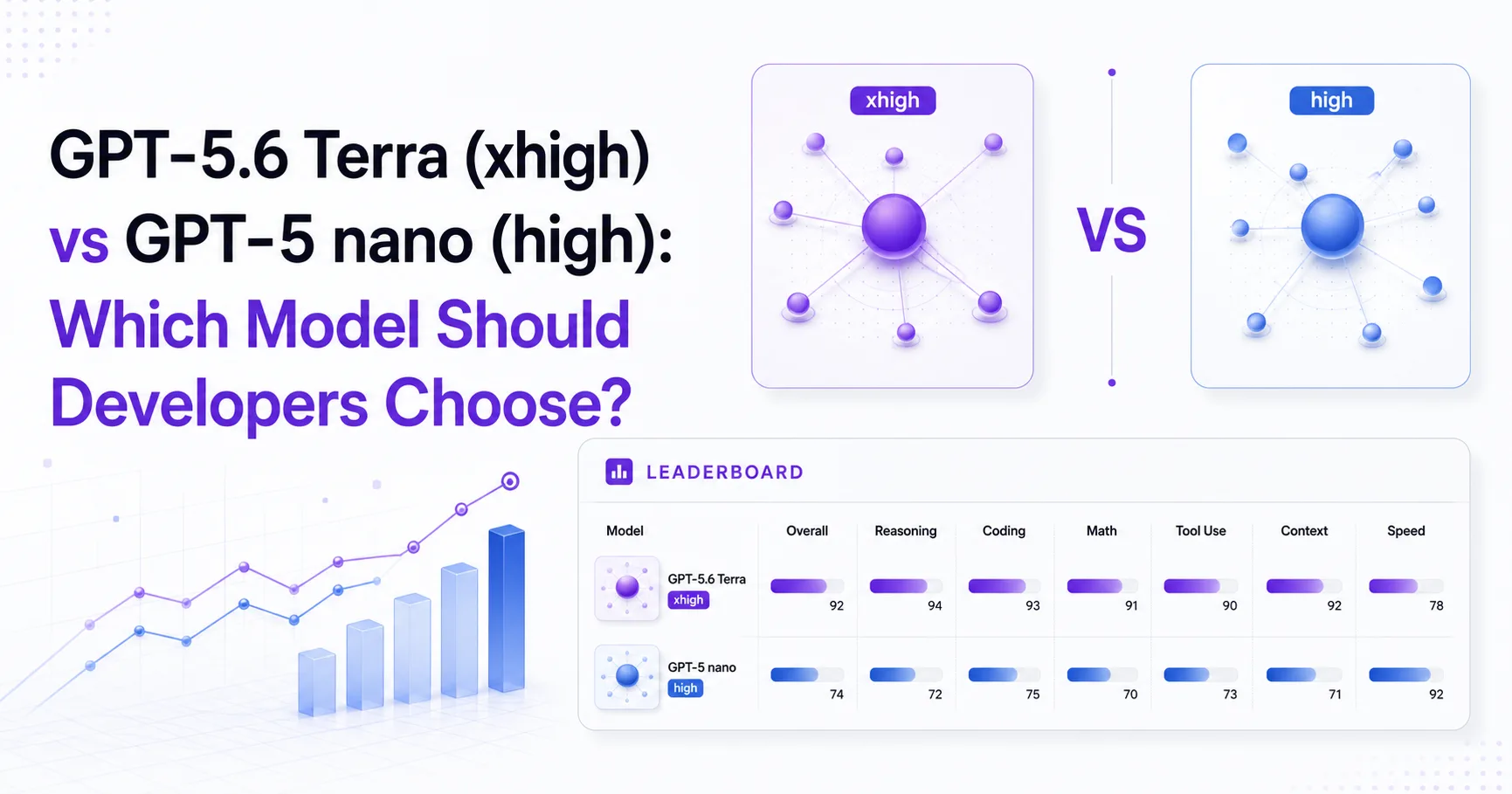
- **Winner overall:** GPT-5.6 Terra (xhigh), with an Artificial Analysis Intelligence Index of 51.6 vs 19.9 - **Cheaper:** GPT-5 nano (high) at $0.1375 vs $4.500000000000001 per 1M blended tokens - **Faster:** GPT-5.6 Terra (xhigh) at 121.137 median output tokens per second - **Pick GPT-5 nano (high) when:** high-volume workloads can accept incomplete evidence about coding and general capabilities while prioritizing $0.1375 blended cost - **Watch out:** GPT-5 nano (high) has no listed output speed, while both models show 0.3-second latency
GPT-5.6 Terra (xhigh) vs GPT-5 nano (high)
GPT-5.6 Terra (xhigh) is the safer capability choice, while GPT-5 nano (high) is the extreme cost choice for developers willing to accept documentation gaps. The available Artificial Analysis data gives Terra an Intelligence Index of 51.6, compared with 19.9 for nano. Terra also records 121.137 median output tokens per second, while nano has no reported value for that metric. Both models show 0.3-second latency in the supplied data, so the comparison is not a simple speed-versus-cost tradeoff.\n\nThe larger issue is model identity and availability. OpenAI’s current model directory does not list GPT-5 nano, while the GPT-5.6 Terra model page lists Terra as an available model. That makes Terra easier to validate in a production integration.\n\nData provided by https://artificialanalysis.ai/
Executive summary for developers
GPT-5.6 Terra (xhigh) offers the stronger documented case for complex engineering work, but GPT-5 nano (high) can be rational for inexpensive, high-volume tasks.\n\n| Decision factor | GPT-5.6 Terra (xhigh) | GPT-5 nano (high) |\n|—|—|—|\n| General capability evidence | Intelligence Index: 51.6 | Intelligence Index: 19.9 |\n| Coding evidence | Coding Index: 70.6 | No value supplied |\n| Math evidence | No value supplied | Math Index: 83.7 |\n| Median output speed | 121.137 tokens per second | No value supplied |\n| Latency | 0.3 seconds | 0.3 seconds |\n| Blended price | $4.500000000000001 per 1M tokens | $0.1375 per 1M tokens |\n\nThe evidence is asymmetric. Terra has a reported coding score, but nano does not. Nano has a reported math score, but Terra does not. Therefore, the data supports Terra as the stronger documented general-purpose option, not as a universal winner across every task.\n\nThe official documentation creates a second asymmetry. OpenAI’s model directory currently describes available models but does not list GPT-5 nano. By contrast, OpenAI’s Terra documentation documents the model and its supported API paths. The supplied research found no reproducible community posts for either model, so claims about coding feel, quirks, or failure patterns remain unverified.\n\nFor a team choosing a default model, Terra reduces uncertainty. For a team processing large volumes of simple requests, nano’s price advantage may dominate the decision if a representative evaluation confirms acceptable quality.
Performance: capability evidence matters more than raw latency
GPT-5.6 Terra (xhigh) is the better-supported performance choice for broad developer workloads, although the benchmark coverage cannot prove that it wins every task.\n\nThe clearest signal is the Artificial Analysis Intelligence Index: Terra records 51.6, while nano records 19.9. The supplied comparison reports no coding score for nano and no math score for Terra. That missing coverage prevents a direct coding comparison and a direct math comparison. Developers should treat Terra’s Coding Index of 70.6 as evidence about Terra, not as a measured margin over nano. Likewise, nano’s Math Index of 83.7 does not establish that nano is better than Terra at math.\n\nIn practical terms, Terra is easier to justify for tasks that combine planning, code generation, tool use, and multi-step decisions because its broader capability evidence is stronger and its official product documentation is current. OpenAI documents Terra as a reasoning model, and the parameter migration guide identifies xhigh as a reasoning-effort setting rather than a separate model ID. That distinction matters for reproducible deployments.\n\nTerra also reports 121.137 median output tokens per second. Nano has no supplied output-speed measurement, so developers cannot infer a throughput advantage from the lower price. Both models report 0.3-second latency, but latency alone does not describe total completion time. Reasoning work, output length, retries, tool calls, and validation can change the user-visible result.\n\nThe unanswered question is whether nano’s high reasoning setting delivers enough quality for specific coding, extraction, routing, or math workloads. The research brief contains no reproducible community evaluation and no matched benchmark coverage. A small task-specific pilot is therefore necessary before treating nano as a safe Terra replacement.
Cost: nano wins the price chart, but workload shape decides the bill
GPT-5 nano (high) is dramatically cheaper on the supplied pricing comparison, while GPT-5.6 Terra (xhigh) can be cheaper in practice when its higher quality prevents retries, reviews, or failed tool workflows.\n\nThe blended comparison lists nano at $0.1375 per 1M tokens and Terra at $4.500000000000001 per 1M tokens. Nano also has lower listed input pricing, at $0.05 versus Terra’s $2, and lower listed output pricing, at $0.4 versus Terra’s $12. Those figures make nano the natural candidate for volume-sensitive operations such as classification, lightweight transformation, first-pass extraction, and other tasks with an objectively measurable acceptance threshold.\n\nThe chart cannot show the cost of an incorrect answer. If nano requires a second model call, human review, retrieval repair, or a rerun after malformed structured output, its effective cost rises. Terra’s higher unit price may be justified when one successful call replaces several cheaper attempts. That claim is workload-dependent, and the supplied materials do not provide retry rates, task accuracy, token distributions, or production failure costs.\n\nLong prompts also deserve special testing. OpenAI’s Terra model page states that requests above 272K tokens receive higher input and output billing. This creates a reversal condition for repository analysis, large document synthesis, and tool-heavy workflows. Nano’s current official pricing and limits are not documented in the supplied research, so developers must not transfer Terra’s rules or the listed nano-family prices on OpenAI’s pricing page to GPT-5 nano.\n\nBatch processing can change the economics for Terra because OpenAI’s pricing documentation lists separate service modes. The correct choice depends on latency requirements, prompt size, output size, and the cost of an unacceptable result, not on unit price alone.
Recommendation by workload
GPT-5.6 Terra (xhigh) should be the default for high-consequence engineering workflows, while GPT-5 nano (high) should be tested as a budget route for bounded tasks.\n\nChoose Terra when the request requires sustained reasoning, code generation, repository-level context, tool orchestration, or a dependable production contract. Terra has documented support for the Responses API, Chat Completions API, Batch API, structured outputs, function calling, and several tools on its official model page. The supplied evidence also includes a Coding Index of 70.6 and a median output speed of 121.137 tokens per second.\n\nChoose nano when the task is repetitive, low-risk, easy to validate, and sensitive to per-token spend. Its blended price of $0.1375 per 1M tokens is the strongest reason to test it. Its Math Index of 83.7 is a useful signal for math-focused experiments, but it does not establish broad superiority.\n\nUse a two-tier policy when the application contains both simple and complex requests. Route routine work to nano, then escalate uncertain, failed, or high-impact cases to Terra. Define the escalation rule using task-level measurements, since the research provides no matched coding benchmark for nano, no matched math benchmark for Terra, and no reproducible community failure reports.\n\nDo not assume the name GPT-5 nano identifies a currently supported API model. OpenAI’s model directory does not list it in the supplied research. Terra has the clearer deployment story, while nano requires verification of the actual endpoint, alias, limits, and billing before production commitment.\n\nFor third-party deployment, verify capability parity separately. OpenAI’s Amazon Bedrock guidance documents deployment differences for Terra, so an API result should not automatically be treated as a Bedrock result.
Questions to answer before standardizing
GPT-5.6 Terra (xhigh) is easier to standardize today because its official model page is present, while GPT-5 nano (high) requires more identity and availability verification.\n\nThe most important unknown is not the price gap. It is whether nano’s undocumented production status and incomplete benchmark coverage fit the exact workload. Developers should verify the model ID, endpoint behavior, output limits, structured-output reliability, and billing path in a controlled pilot.\n\nOpenAI’s deprecation documentation was included in the research to check whether Terra had been replaced or deprecated. The brief found no such announcement as of the research cutoff, but the absence of an announcement is not a permanent availability guarantee.\n\nData provided by https://artificialanalysis.ai/
Frequently asked questions
Which model is better for coding?
GPT-5.6 Terra (xhigh) is the better-supported coding choice because the supplied data reports a Coding Index of 70.6 for Terra, while GPT-5 nano (high) has no coding score. That gap is evidence of incomplete comparison, not proof that nano cannot code well. Developers should run matched repository tasks before making a final routing decision.
Which model is cheaper for production?
GPT-5 nano (high) is cheaper by listed unit price, at $0.1375 per 1M blended tokens compared with $4.500000000000001 for GPT-5.6 Terra (xhigh). The effective winner can change if nano causes more retries, validation failures, escalations, or human review. The supplied research does not include those operational costs.
Is GPT-5.6 Terra (xhigh) a separate model ID?
GPT-5.6 Terra is the documented model ID, while xhigh is a reasoning-effort setting rather than a separate model suffix. OpenAI’s parameter migration guide supports using the reasoning setting with the Terra model. Developers should not assume that gpt-5-6-terra-xhigh is an official API identifier.
Does GPT-5 nano have better math performance?
GPT-5 nano (high) has the reported Math Index of 83.7, but the supplied data contains no corresponding math score for GPT-5.6 Terra (xhigh). Nano therefore has positive math evidence, not a measured win over Terra. A direct task set is needed to determine whether its math quality meets the application’s accuracy threshold.
Should developers use nano as a direct Terra replacement?
Developers should not treat GPT-5 nano (high) as a direct Terra replacement until its current API availability, limits, billing, and task quality are verified. OpenAI’s supplied model-directory research does not list nano, while Terra has a current model page. Nano is better positioned as a low-cost experimental or bounded-workload route.
Sources
- Artificial AnalysisSupplied benchmark, speed, latency, pricing, and release-date comparison data.
- GPT-5.6 Terra model pageTerra model identity, reasoning positioning, API support, tools, current documentation, and long-context billing rules.
- OpenAI model directoryCurrent model-directory coverage, product positioning, and the absence of GPT-5 nano in the supplied research.
- Latest model parameter migration guideThe distinction between the Terra model ID and the xhigh reasoning-effort setting.
- OpenAI API pricingOfficial pricing documentation, service modes, and the warning against transferring nano-family prices to GPT-5 nano.
- Amazon Bedrock support guidanceDeployment-path differences for Terra and tool-support limitations on Bedrock.
- OpenAI deprecationsChecking whether Terra had been deprecated or replaced in the supplied research.
Published: