
AI model analysis
GPT-5 Codex (high) vs o3: Which Model Should Developers Choose?
A developer-focused comparison of GPT-5 Codex (high) and o3 across benchmark results, speed, pricing, availability, and production risk.
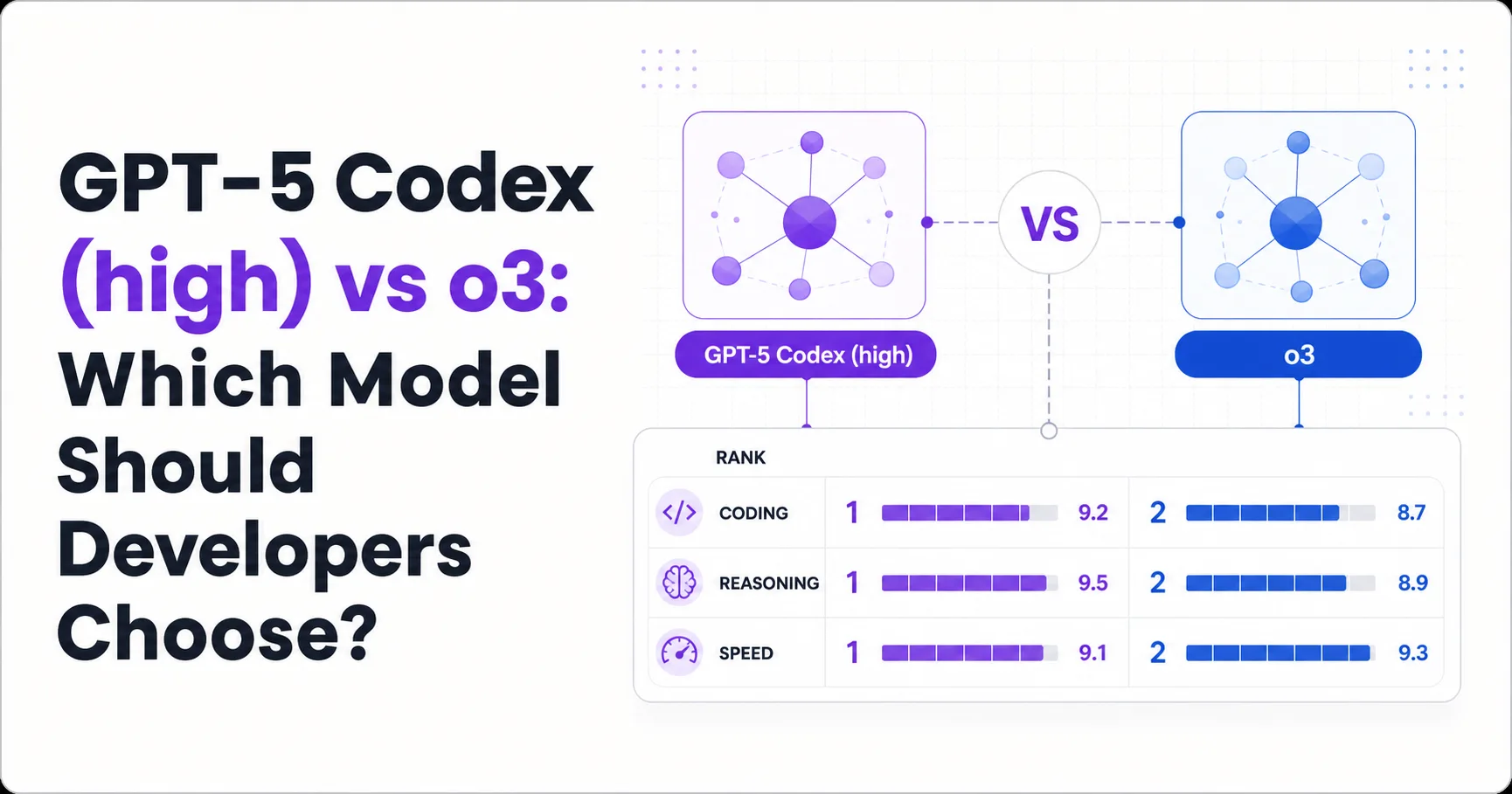
- **Winner overall:** GPT-5 Codex (high), with an Artificial Analysis Intelligence Index of 36.1 vs 30.4 and a Math Index of 98.7 vs 88.3 - **Cheaper:** GPT-5 Codex (high) at $3.4375 vs $3.5 per 1M blended tokens - **Faster:** o3 at 128.056 median output tokens per second - **Pick GPT-5 Codex (high) when:** reasoning quality and lower input cost matter more than verified output speed - **Watch out:** neither model has a clearly documented current official listing, stable alias, or verified model-specific failure profile
GPT-5 Codex (high) vs o3
GPT-5 Codex (high) is the stronger measured choice, but o3 is the safer speed choice because its output rate is documented while Codex speed is unavailable. The supplied Artificial Analysis data gives GPT-5 Codex (high) an Intelligence Index of 36.1 and a Math Index of 98.7. o3 records 30.4 and 88.3 on the same indexes. Both models show latency of 0.3 seconds in the supplied comparison. The practical decision is therefore not simply newer versus older. It is measured reasoning quality versus verified generation speed, with availability risk affecting either deployment.
Executive summary for developers
GPT-5 Codex (high) leads the available comparison, while o3 offers the only documented output-speed result and a lower output-token price. The Intelligence Index difference is 5.700000000000003 points in favor of GPT-5 Codex (high). The Math Index difference is 10.400000000000006 points in the same direction. GPT-5 Codex (high) also has the lower blended price at $3.4375 per 1M tokens, compared with $3.5 for o3. Its input price is $1.25, versus $2 for o3. o3 reverses that advantage on output, charging $8 versus $10 per 1M tokens. These results suggest a useful workload split: Codex for tasks dominated by analysis, code reasoning, and input-heavy context; o3 for workloads where generated output is large and output speed has operational value.
The evidence has a material qualification. OpenAI’s current models page does not list GPT-5 Codex (high) or o3 as independent current model entries in the supplied research. OpenAI’s pricing page lists a Codex model named gpt-5.3-codex, but not GPT-5 Codex (high) or o3. The benchmark result may therefore describe a selectable evaluation label that does not map cleanly to a currently documented production API model.
Performance: what the benchmark gap means
GPT-5 Codex (high) has the stronger measured reasoning profile, while o3 has the stronger verified output-speed profile. A Math Index of 98.7 for GPT-5 Codex (high) versus 88.3 for o3 indicates a meaningful difference on the supplied evaluation, especially for code generation that depends on formal reasoning, debugging, transformations, and constraint tracking. The Intelligence Index result points in the same direction, at 36.1 versus 30.4. Developers should treat that pattern as evidence for model selection, not as a guarantee for every repository or programming language.
The speed conclusion is narrower. o3 reports 128.056 median output tokens per second, while GPT-5 Codex (high) has no supplied output-speed value. That makes o3 easier to evaluate for interactive experiences where visible generation speed affects user perception. It does not prove that o3 completes a task faster, because completion time also depends on reasoning duration, prompt size, tool calls, retries, and output length. The supplied latency value is 0.3 seconds for each model, so the available data does not establish a latency advantage.
A key unanswered question is whether GPT-5 Codex (high)'s high reasoning score reflects a configuration, a benchmark label, or a stable deployable model identifier. The research found no reliable community posts with reproducible methods for this exact configuration. OpenAI’s model documentation also does not provide a dedicated capability boundary or failure profile for it. Developers should run repository-level tests before treating the benchmark gap as a production guarantee.
Cost: the cheaper model depends on token shape
GPT-5 Codex (high) is marginally cheaper on blended tokens, while o3 can be cheaper on output-heavy workloads. The blended comparison is $3.4375 for GPT-5 Codex (high) and $3.5 for o3 per 1M blended tokens. That difference is small enough that request composition, retries, and completion length can outweigh the headline result.
GPT-5 Codex (high) has the lower input price at $1.25 versus $2 per 1M input tokens. This favors long repository prompts, repeated file context, and workflows that send substantial instructions before receiving a comparatively compact answer. o3 has the lower output price at $8 versus $10 per 1M output tokens. That favors workloads producing long explanations, generated files, verbose test reports, or large structured responses.
The cost winner can therefore flip even though GPT-5 Codex (high) wins the blended comparison. A coding assistant that repeatedly submits large context may benefit from Codex’s input price. An agent that emits long outputs or retries because of output quality may make o3 cheaper in practice. The supplied data does not include cache behavior, retry rates, tool-call overhead, or workload-specific token distributions, so neither model has a universal total-cost advantage.
OpenAI’s pricing documentation adds another deployment concern: the currently listed Codex pricing belongs to gpt-5.3-codex, not the exact GPT-5 Codex (high) label evaluated here. The benchmark price and the currently documented product price should not be assumed interchangeable without an API verification step.
Recommendation by developer workload
GPT-5 Codex (high) is the default recommendation for quality-sensitive coding workflows, provided the evaluated identifier can be verified before deployment. Its Intelligence Index of 36.1 and Math Index of 98.7 give it the clearest measured advantage for code reasoning, algorithmic work, complex refactors, and tasks where an incorrect plan creates downstream engineering cost. Its $1.25 input price also suits context-heavy repository analysis.
o3 is the better candidate for interactive generation experiments when verified output speed matters. Its median output rate of 128.056 tokens per second is the only supplied speed measurement, and its $8 output price is lower than GPT-5 Codex (high)'s $10. Those traits can matter for user-facing assistants, long-form coding explanations, and output-heavy agent steps. The evidence does not show that o3 is better at completing whole coding tasks, because the supplied latency values are tied and no task-completion benchmark is provided.
Teams should make the final choice in two gates. First, confirm that the model identifier is callable, stable, and supported by the intended API. The research did not verify those points for either exact label. Second, replay representative repository tasks with fixed prompts, tool permissions, acceptance tests, and token accounting. Include debugging, multi-file edits, test repair, and long-context review. The available research provides no verified community failure cases for either model, so local evaluation is essential.
For a production decision today, choose GPT-5 Codex (high) if the label resolves to a supported endpoint and correctness dominates. Choose o3 if output responsiveness and lower output cost dominate, and its endpoint is confirmed. If neither identifier is available, the comparison should be treated as historical or evaluation evidence rather than an implementation recommendation.
What the evidence cannot answer yet
GPT-5 Codex (high) and o3 both require endpoint verification before a production commitment, because the supplied official documentation does not confirm either exact label as a current model entry. OpenAI’s models page does not provide dedicated context limits, maximum output, API parameters, multimodal guarantees, or failure cases for GPT-5 Codex (high). The same research does not verify those details for o3. OpenAI’s pricing page likewise does not list a current price for o3 and lists gpt-5.3-codex instead of the evaluated Codex label.
The comparison also cannot establish which model behaves better on a specific programming stack, repository size, tool protocol, or agent loop. No reliable Reddit, Hacker News, or X material was found for either exact comparison target with a reproducible testing method. Developers should avoid filling those gaps with assumptions based on model names, release labels, or unrelated discussions. The benchmark evidence is useful for prioritizing tests, but it is insufficient for certifying production behavior.
Frequently asked questions
Which model is the overall winner for coding?
GPT-5 Codex (high) is the overall winner in the supplied evidence because it leads o3 on the Intelligence Index at 36.1 versus 30.4 and on the Math Index at 98.7 versus 88.3. Developers should still verify that the evaluated label maps to a supported production endpoint.
Which model is cheaper for API workloads?
GPT-5 Codex (high) is cheaper on the blended comparison at $3.4375 versus $3.5 per 1M blended tokens, and its input price is lower at $1.25 versus $2. o3 is cheaper for output at $8 versus $10, so workload token shape can reverse the practical result.
Which model generates responses faster?
o3 is the only model with a supplied output-speed measurement, at 128.056 median output tokens per second. GPT-5 Codex (high) has no output-speed value in the data brief, while both models show latency of 0.3 seconds. The evidence therefore supports a verified speed advantage for o3, not a universal completion-time advantage.
Should a team use GPT-5 Codex (high) in production now?
A team should use GPT-5 Codex (high) in production only after confirming that the exact identifier is callable and stable in its intended API. The benchmark evidence favors its reasoning quality, but the supplied official models page does not list the exact label or document its dedicated limits and parameters.
Is o3 still a safe long-term model choice?
o3 is a reasonable candidate for speed-sensitive or output-heavy experiments, but the supplied research does not confirm its current official listing, stable alias, pricing, or replacement path. Teams should confirm endpoint availability and run representative acceptance tests before making a long-term commitment.
Sources
- OpenAI Models验证当前模型目录、模型可见性、官方通用能力说明,以及 GPT-5 Codex (high) 与 o3 的文档缺口
- OpenAI API Pricing验证当前 Codex 挂牌模型、官方价格信息,以及 o3 和 GPT-5 Codex (high) 的定价缺口
- Artificial Analysis提供 GPT-5 Codex (high) 与 o3 的基准、价格、延迟和输出速度数据归属
Published: