
AI model analysis
GPT-5 (low) vs Grok 4: Which Model Should Developers Choose?
A developer-focused comparison of GPT-5 (low) and Grok 4 across benchmark results, pricing, latency, evidence quality, and model-selection risk.
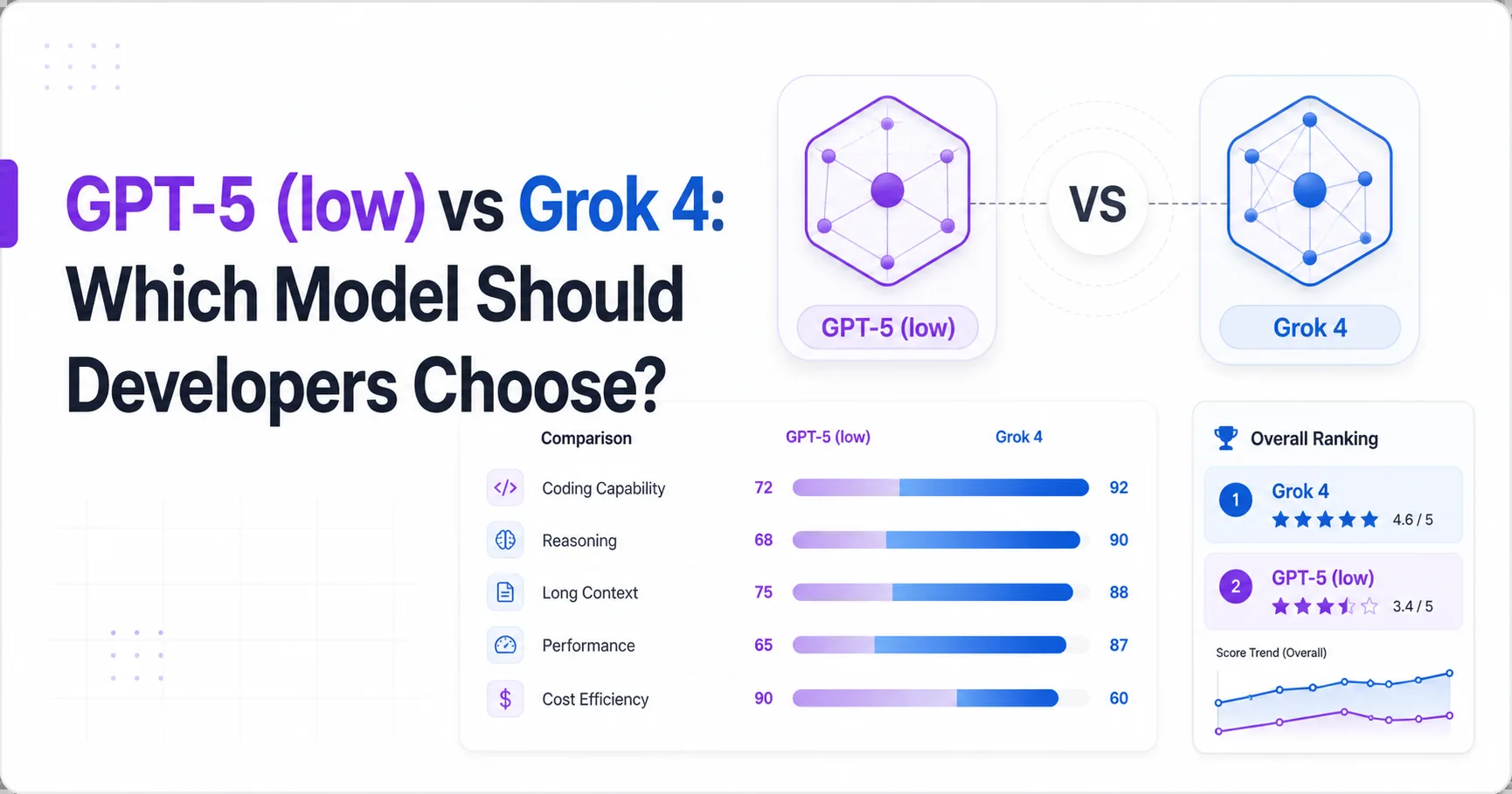
- **Winner overall:** Grok 4, with a 33.3 Artificial Analysis Intelligence Index and 92.7 Math Index - **Cheaper:** GPT-5 (low) at $3.4375 vs $6 per 1M blended tokens - **Faster:** GPT-5 (low) and Grok 4, tied at 0.3 seconds (latency) - **Pick Grok 4 when:** mathematical accuracy is more important than token cost and the model is available in your target deployment - **Watch out:** GPT-5 (low) is not listed in OpenAI’s current model or pricing pages, while no reliable official or community source was available for Grok 4 in the research brief
GPT-5 (low) vs Grok 4
Grok 4 is the stronger measured performer, while GPT-5 (low) is the lower-cost option with a serious availability risk. The Artificial Analysis comparison reports Grok 4 at 33.3 on the Intelligence Index and 92.7 on the Math Index, compared with GPT-5 (low) at 31.2 and 83. Data provided by Artificial Analysis. GPT-5 (low) costs $3.4375 per 1M blended tokens, while Grok 4 costs $6. Both models have a reported latency of 0.3 seconds, and neither has a reported median output speed in the supplied data. The central selection problem is therefore not simply quality versus price. It is measured capability versus operational certainty. OpenAI’s current model directory does not list gpt-5-low, and its pricing page does not list gpt-5-low, gpt-5, or gpt-5-2025-08-07. OpenAI’s model directory and OpenAI’s pricing page therefore leave the identity and availability of GPT-5 (low) unresolved. The research brief also contains no reliable official or community source for Grok 4. Developers should treat this comparison as a decision aid based on the supplied benchmark and pricing snapshot, not as confirmation of either model’s current production API contract.
Executive summary for developers
Grok 4 is the better capability pick, but GPT-5 (low) is the better cost pick only if its deployment path can be verified. Grok 4 leads the supplied Intelligence Index at 33.3 versus 31.2 and leads the Math Index at 92.7 versus 83. The Artificial Analysis dataset supports a consistent benchmark advantage for Grok 4, with the largest gap appearing on mathematical evaluation. That result matters most for code generation, mathematical reasoning, constraint-heavy transformations, and workflows where incorrect intermediate reasoning creates expensive downstream review. It does not prove that Grok 4 is better for every production workload. The supplied data does not include task-specific coding scores, tool-use scores, context-window values, output limits, or reliability measurements. GPT-5 (low) has a clear economic advantage in every supplied pricing view: $1.25 versus $3 for input tokens, $10 versus $15 for output tokens, and $3.4375 versus $6 for blended tokens per 1M tokens. Yet OpenAI’s current documentation does not list the compared GPT-5 identifier. OpenAI’s model directory describes current model offerings without listing gpt-5-low, while OpenAI’s pricing page omits the identifier from current prices. Grok 4 has the stronger measured result, but its research material lacks a verifiable official source. The practical summary is simple: choose Grok 4 for measured reasoning strength, choose GPT-5 (low) only after confirming access, model identity, limits, and billing.
Performance: what the benchmark gap means
Grok 4 is the measured performance leader, especially for mathematical work, but the supplied benchmark cannot establish a universal production winner. Grok 4 scores 33.3 on the Artificial Analysis Intelligence Index versus GPT-5 (low) at 31.2, and 92.7 on the Math Index versus 83. Data provided by Artificial Analysis. The important interpretation is the shape of the result. The overall intelligence difference is relatively narrow in the supplied snapshot, while the mathematics difference is more pronounced. A developer building quantitative analysis, symbolic manipulation, algorithmic explanation, or test generation should give the Math Index greater weight than a broad aggregate score. A general assistant may produce a different ordering once prompts, tools, retrieval, temperature, and output constraints are fixed. The data does not identify the benchmark tasks, test harness, sampling settings, or confidence intervals. It also does not report median output tokens per second for either model. Both models show 0.3 seconds of latency in the snapshot, so the available evidence does not support a speed-based choice. This creates an important boundary: Grok 4’s score advantage supports prioritizing it for reasoning-heavy evaluation, but it does not tell a team whether streaming, tool calls, long prompts, or structured output will behave better. Developers should run a small task set using their own acceptance tests before treating the benchmark lead as a product conclusion. The research brief supplies no reliable public community evidence that could confirm or challenge these measured results for Grok 4. It likewise supplies no reliable community evidence describing GPT-5 (low)’s coding behavior.
Cost: lower unit price does not settle the decision
GPT-5 (low) is the cheaper measured option, but its uncertain model status can turn a lower unit price into a planning risk. GPT-5 (low) is listed at $3.4375 per 1M blended tokens versus Grok 4 at $6, with input pricing of $1.25 versus $3 and output pricing of $10 versus $15. The supplied Artificial Analysis pricing snapshot provides those figures. The chart makes the price ordering clear, but it cannot show the cost of operational uncertainty. OpenAI’s current pricing page does not list gpt-5-low, so the supplied GPT-5 (low) price cannot be independently matched to a current official SKU. OpenAI Pricing also does not confirm whether the compared identifier has standard, Batch, Flex, or Fast mode pricing. The model directory does not resolve that uncertainty either. OpenAI Models lists current model offerings without listing gpt-5-low. A team can therefore save on token usage and still spend more on migration work, fallback routing, regression testing, or a later model replacement if the identifier is unavailable. Grok 4’s higher price becomes easier to justify when its higher measured Math Index reduces human review, retries, or failed task execution. The supplied evidence does not measure those downstream costs. It also does not provide token consumption by task, cache behavior, rate limits, or contract terms. Cost should therefore be evaluated as price per successful accepted result, not only price per 1M tokens. The exact break-even point is evidence-deficient because the brief provides no production success-rate data.
Recommendation by deployment scenario
Grok 4 is the default recommendation for capability-first evaluation, while GPT-5 (low) is a conditional recommendation for cost-sensitive workloads. Choose Grok 4 when mathematical reasoning, complex transformations, or higher measured benchmark performance are central to the product. Its supplied scores are 33.3 on the Intelligence Index and 92.7 on the Math Index, both ahead of GPT-5 (low) at 31.2 and 83. Artificial Analysis data supports that choice at the measurement level. The recommendation becomes weaker when the workload depends on a documented OpenAI API contract, because the research brief says no official source confirms gpt-5-low as an independently callable model or as a GPT-5 configuration with low reasoning effort. OpenAI Models does not list the identifier, and OpenAI Pricing does not list its price. Choose GPT-5 (low) only if your account, SDK, gateway, or existing benchmark environment can verify the identifier and its behavior. Its $3.4375 blended price and $1.25 input price make it attractive for high-volume workloads, prompt-heavy applications, and systems where output cost dominates less frequently than input cost. Do not choose either model solely from the supplied latency value. The reported 0.3-second latency is tied, and no median output speed is available. Do not assume Grok 4 has a documented advantage in tools, context, or reliability, because the research brief contains no reliable official or community source for those properties. The safest production process is to verify access first, then test representative tasks, then compare accepted-result cost under the same prompt and output policy.
Questions developers should answer before adoption
GPT-5 (low) and Grok 4 require verification before production adoption because the evidence base is asymmetric and incomplete. GPT-5 (low) has supplied benchmark and pricing data, but its current official listing is unresolved. Grok 4 has supplied benchmark and pricing data, but the research brief provides no reliable official or community source to validate its product details. The Artificial Analysis snapshot is therefore useful for the numerical comparison, while OpenAI Models and OpenAI Pricing are relevant only to the documented OpenAI availability gap. Neither source answers the full deployment questions around context limits, tools, structured output, rate limits, retention, or regional access. Those omissions are not minor implementation details. They can change the engineering effort, the accepted-result cost, and the ability to reproduce a benchmark in production. The research brief also says no reliable public discussion was found for either model’s coding experience, speed perception, or distinct failure modes. Developers should record the exact model identifier, API response metadata, prompt settings, tool configuration, and task-level acceptance criteria before making a long-term commitment. The comparison supports a shortlist, not a complete procurement decision.
Frequently asked questions
Which model is better for mathematical reasoning, GPT-5 (low) or Grok 4?
Grok 4 is the better mathematical-reasoning choice in the supplied benchmark, scoring 92.7 on the Math Index versus GPT-5 (low) at 83. The result supports Grok 4 for math-heavy evaluation, but the brief does not provide task methodology or production error rates.
Which model is cheaper for a high-volume application?
GPT-5 (low) is cheaper in every supplied pricing measure, at $3.4375 versus $6 per 1M blended tokens, $1.25 versus $3 for input tokens, and $10 versus $15 for output tokens. Its unresolved official availability still requires verification.
Are GPT-5 (low) and Grok 4 equally fast?
The supplied data reports a latency of 0.3 seconds for GPT-5 (low) and 0.3 seconds for Grok 4, so it shows a tie on latency. Neither model has a reported median output speed, which prevents a fuller streaming-performance conclusion.
Can developers safely use GPT-5 (low) as a current OpenAI API model?
Developers should not assume that GPT-5 (low) is currently callable as a distinct OpenAI API model. OpenAI’s current model directory does not list gpt-5-low, and its pricing page does not list the identifier, so account-level verification is required.
Does Grok 4 have a documented advantage beyond the benchmark scores?
The supplied research brief does not provide a reliable official or community source confirming Grok 4’s context window, tools, API behavior, coding experience, or failure modes. Its documented advantage in this comparison is limited to the supplied benchmark and pricing data.
Sources
- Artificial AnalysisNumerical benchmark, latency, release-date, and pricing data supplied for GPT-5 (low) and Grok 4.
- OpenAI ModelsChecking OpenAI’s current model directory, documented capabilities, and whether GPT-5 (low) is listed.
- OpenAI PricingChecking current OpenAI pricing entries and whether GPT-5 (low) has an official listed price.
Published: