
AI model analysis
GPT-5 (medium) vs o3-pro: Which OpenAI Model Should Developers Choose?
A developer-focused comparison of GPT-5 (medium) and o3-pro covering measured quality, latency, pricing, evidence gaps, and practical model selection criteria.
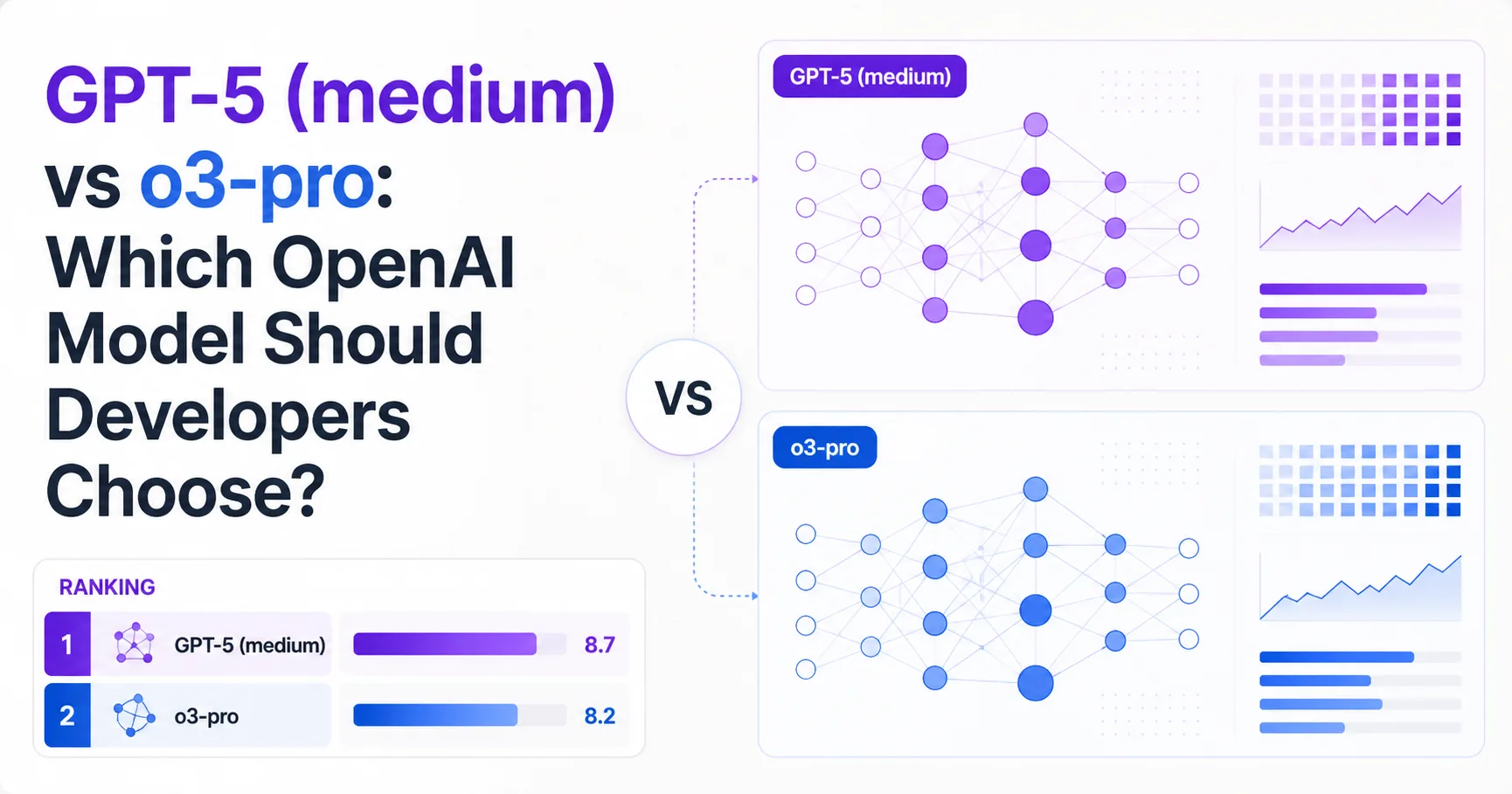
- **Winner overall:** GPT-5 (medium), with an Artificial Analysis Intelligence Index score of 33.7 vs 32.5 for o3-pro - **Cheaper:** GPT-5 (medium) at $3.4375 vs $35 per 1M blended tokens - **Faster:** GPT-5 (medium) and o3-pro tie at 0.3 seconds median latency - **Pick o3-pro when:** your workflow prioritizes extended reasoning for complex science, mathematics, or programming tasks - **Watch out:** GPT-5 (medium) has a 91.7 Artificial Analysis Math Index score, but no comparable o3-pro math score is available
GPT-5 (medium) vs o3-pro
GPT-5 (medium) is the stronger default on the available measurements, while o3-pro remains the more clearly documented choice for deliberate reasoning tasks. Artificial Analysis reports an Intelligence Index score of 33.7 for GPT-5 (medium) and 32.5 for o3-pro. The same dataset reports a Math Index score of 91.7 for GPT-5 (medium), but no comparable o3-pro value. That makes GPT-5 (medium) the practical starting point for developers who need broad capability at controlled cost.\n\nThe comparison has an important qualification: the evidence is asymmetric. The supplied OpenAI model directory does not list gpt-5-medium, and the supplied pricing page does not list it either (OpenAI Models, OpenAI API Pricing). By contrast, OpenAI documents o3-pro with the alias o3-pro and the dated version o3-pro-2025-06-10 (o3-pro Model Documentation).\n\nThe result is not a simple quality ranking. GPT-5 (medium) has the better supplied general score and far lower supplied prices. o3-pro has a clearer official positioning around longer reasoning for difficult scientific, mathematical, and programming work (Introducing o3-pro). Developers should therefore separate measured output quality, documented product status, task-specific reasoning needs, and operational cost before committing to one model.
Executive summary for model selection
GPT-5 (medium) offers the better measured value, while o3-pro offers the clearer reasoning-oriented product story.\n\n| Decision factor | GPT-5 (medium) | o3-pro | Practical reading | |—|—:|—:|—| | Artificial Analysis Intelligence Index | 33.7 | 32.5 | GPT-5 (medium) leads on the supplied broad score | | Artificial Analysis Math Index | 91.7 | Not reported | The math comparison is incomplete | | Blended price per 1M tokens | $3.4375 | $35 | GPT-5 (medium) has the lower supplied blended price | | Input price per 1M tokens | $1.25 | $20 | Large prompt-heavy workflows favor GPT-5 (medium) | | Output price per 1M tokens | $10 | $80 | Long answers are more expensive with o3-pro | | Median latency | 0.3 seconds | 0.3 seconds | The supplied latency measurement is tied | \nThe strongest selection signal is the combination of 33.7 Intelligence Index points and $3.4375 blended pricing for GPT-5 (medium). The strongest counter-signal is documentation quality. OpenAI’s current supplied directory does not establish a callable name, stable alias, context window, output limit, or dedicated capability profile for GPT-5 (medium) (OpenAI Models).\n\no3-pro is easier to place in an API architecture because OpenAI publishes both its general alias and dated version identifier (o3-pro Model Documentation). OpenAI also describes o3-pro as a reasoning model that spends more time reasoning before producing an answer (Reasoning models guide). That description supports a targeted use case, but it does not prove superior performance on every developer workload.\n\nThe evidence therefore supports GPT-5 (medium) as the default candidate, subject to availability verification. It supports o3-pro as a deliberate escalation option when reasoning depth matters more than token cost and when the documented model endpoint fits the deployment.
Performance: what the available scores mean in practice
GPT-5 (medium) leads the supplied general evaluation, but the available performance evidence does not establish a universal task winner.\n\nThe Artificial Analysis Intelligence Index is 33.7 for GPT-5 (medium) and 32.5 for o3-pro. That difference is small enough that developers should not treat it as proof that GPT-5 (medium) will win every coding, extraction, agent, or conversational workload. It does establish that the supplied broad evaluation favors GPT-5 (medium). The practical implication is that GPT-5 (medium) deserves the first benchmark slot for mixed workloads, especially when the application combines ordinary generation with structured reasoning.\n\nThe math evidence is more unusual. GPT-5 (medium) has a reported Artificial Analysis Math Index score of 91.7. o3-pro has no corresponding value in the supplied dataset. This is not a score of zero, and it is not evidence that o3-pro is weaker at mathematics. It is an evidence gap. A developer choosing a model for formal mathematics, theorem-related work, or numerical problem solving should run a matched evaluation rather than infer a ranking from missing data.\n\nThe official positioning points in a different direction. OpenAI introduced o3-pro as a model that thinks longer and provides more reliable answers for complex science, mathematics, and programming tasks (Introducing o3-pro). OpenAI’s reasoning guide says reasoning models spend longer reasoning before answering and are mainly used through the Responses API (Reasoning models guide). That supports o3-pro for tasks where verification quality matters more than conversational immediacy.\n\nNeither model has a reported median output speed in the supplied data. Both have a supplied latency of 0.3 seconds. Developers should therefore avoid claiming that o3-pro is slower or that GPT-5 (medium) streams faster. The missing output-speed values matter for interactive coding tools, where token generation can shape perceived responsiveness even when request latency is similar.
Cost: when the cheaper model is not automatically cheaper
GPT-5 (medium) is the clear cost choice in the supplied price data, but workload quality and retry behavior can change the operational decision.\n\nThe supplied blended price is $3.4375 per 1M tokens for GPT-5 (medium) and $35 for o3-pro. Input pricing is $1.25 for GPT-5 (medium) and $20 for o3-pro. Output pricing is $10 for GPT-5 (medium) and $80 for o3-pro. These figures make GPT-5 (medium) the natural candidate for high-volume generation, classification, retrieval-augmented answers, and developer tools with frequent requests.\n\nThe important question is not only the price of one successful call. A cheaper model can become more expensive if it produces more failed tool calls, incorrect patches, or human review work. The supplied data does not measure those outcomes. It also does not provide a workload-specific success rate, so no break-even calculation is justified from the brief alone.\n\nThe cost conclusion also depends on whether GPT-5 (medium) is actually available under a stable API identifier. The supplied OpenAI model directory does not list gpt-5-medium, and the supplied OpenAI pricing page does not list it (OpenAI Models, OpenAI API Pricing). The Artificial Analysis snapshot provides prices, but the official pages supplied for verification do not confirm current availability.\n\nFor o3-pro, the official pricing page supplied in the research brief lists $20 per 1M input tokens and $80 per 1M output tokens (OpenAI API Pricing). That price makes selective routing important. A sensible architecture can reserve o3-pro for difficult cases, provided the application can identify those cases reliably. The brief does not provide evidence that such a router would improve total cost, so that decision requires testing.
Recommendation: choose by deployment risk and task shape
GPT-5 (medium) is the recommended first choice for most developers who can verify its API availability and need broad quality at low measured cost.\n\nChoose GPT-5 (medium) for a general-purpose application with many calls, mixed task types, or strict token economics. Its supplied Intelligence Index score is 33.7, its Math Index score is 91.7, and its blended price is $3.4375 per 1M tokens. Those measurements make it the most attractive default in the supplied comparison. The recommendation remains conditional because the provided OpenAI directory does not confirm a dedicated model entry, stable alias, context window, output limit, or model-specific API behavior (OpenAI Models).\n\nChoose o3-pro when your application has a narrow set of high-value tasks where longer reasoning is central to the product. OpenAI positions o3-pro for complex science, mathematics, and programming, and documents the model as a reasoning model (Introducing o3-pro, Reasoning models guide). Its documented alias is o3-pro, with the dated version o3-pro-2025-06-10 (o3-pro Model Documentation). That clarity can reduce integration ambiguity even though its supplied price is much higher.\n\nDo not select o3-pro solely because its name signals deeper reasoning. The supplied benchmark does not provide an o3-pro math score, a reproducible benchmark protocol, output-speed data, or community test evidence. Do not select GPT-5 (medium) solely because it is cheaper. Its official availability and exact operational limits remain unconfirmed in the supplied research.\n\nThe safest implementation is a small task-based bake-off. Test representative prompts, tool calls, structured outputs, code edits, and failure recovery. Record correctness, retries, review time, and total tokens. The brief supports the candidate ranking, but it does not supply enough evidence to predict your application’s winner with confidence.
Questions developers should answer before switching
GPT-5 (medium) should be treated as a promising default candidate whose production status requires direct verification.\n\nThe questions below address the gaps that the benchmark numbers cannot resolve. They focus on callable identity, reasoning behavior, cost exposure, and evidence quality. Each answer distinguishes what the supplied material establishes from what it does not establish.
Frequently asked questions
Is GPT-5 (medium) better than o3-pro for developers?
GPT-5 (medium) is the better default on the supplied evidence because it scores 33.7 versus 32.5 on the Artificial Analysis Intelligence Index and costs $3.4375 versus $35 per 1M blended tokens. The result is not universal: o3-pro has clearer official positioning for extended reasoning, while the supplied data does not provide a comparable o3-pro math score or task-specific coding evaluation.
Which model is cheaper for API workloads?
GPT-5 (medium) is cheaper on every supplied token price, at $1.25 input, $10 output, and $3.4375 blended per 1M tokens, compared with o3-pro at $20 input, $80 output, and $35 blended. Total application cost can still differ if one model causes more retries, failed tool calls, or human review, and the brief does not measure those outcomes.
Is o3-pro faster than GPT-5 (medium)?
Neither model is shown to be faster in the supplied comparison because both have a median latency of 0.3 seconds. Median output speed is unavailable for both models, so the evidence cannot establish which one streams tokens faster or feels more responsive during long answers. Developers building interactive tools should measure time to first token and completion behavior in their own API workflow.
Should I use o3-pro for mathematics?
o3-pro is a reasonable mathematics candidate when extended reasoning is important because OpenAI positions it for complex science and mathematics and describes it as a reasoning model. However, the supplied dataset reports a 91.7 Artificial Analysis Math Index score for GPT-5 (medium) and no comparable o3-pro math score. The evidence therefore supports testing o3-pro, not declaring it the mathematical winner.
Can I safely deploy GPT-5 (medium) using the supplied model name?
You should verify GPT-5 (medium)'s current callable identifier before deployment because the supplied OpenAI model directory does not list gpt-5-medium or provide a dedicated model profile. The benchmark brief includes a GPT-5 (medium) snapshot and prices, but that does not independently confirm current API availability, a stable alias, context limits, output limits, or replacement status.
Sources
- OpenAI ModelsVerifying the current model directory, general model capabilities, and the absence of a dedicated gpt-5-medium entry in the supplied research.
- OpenAI API PricingVerifying the supplied OpenAI pricing-page status and the absence of gpt-5-medium in that page.
- Introducing o3-proSupporting o3-pro's release date, official positioning, and claims about longer reasoning for complex tasks.
- o3-pro Model DocumentationSupporting the o3-pro API alias and dated version identifier.
- Reasoning models guideSupporting the description of reasoning-model behavior and Responses API usage.
- OpenAI API PricingSupporting the o3-pro input and output pricing cited in the research brief.
- Artificial AnalysisAttributing the supplied benchmark, latency, release-date, and pricing snapshot.
Published: