
AI model analysis
GPT-5 mini (medium) vs Grok 4: Which Model Should Developers Choose?
A developer-focused comparison of GPT-5 mini (medium) and Grok 4 across benchmark performance, latency, pricing, evidence quality, and practical model-selection risk.
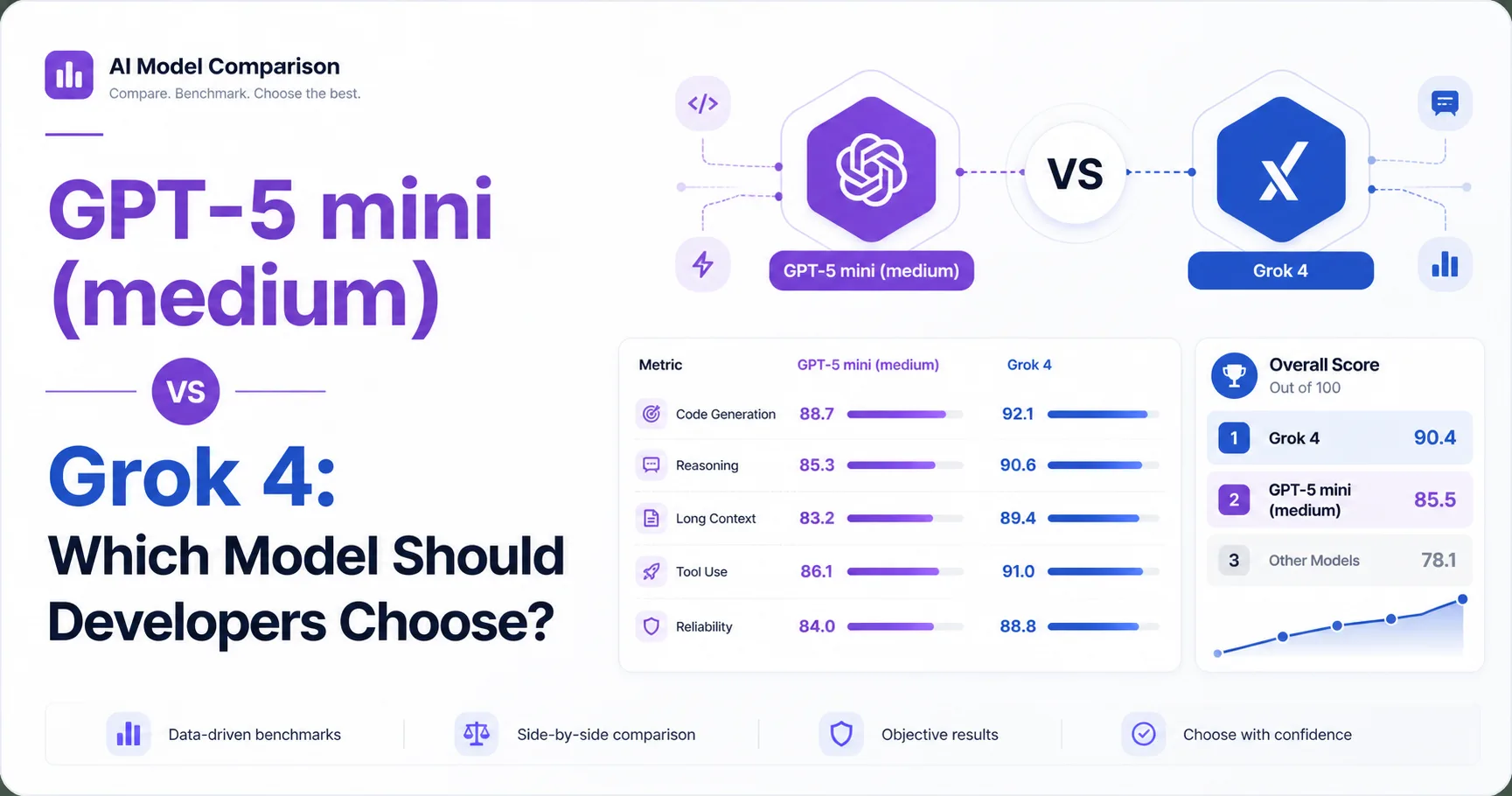
- **Winner overall:** Grok 4, with a 33.3 Artificial Analysis Intelligence Index and 92.7 Math Index - **Cheaper:** GPT-5 mini (medium) at $0.6875 vs $6 per 1M blended tokens - **Faster:** GPT-5 mini (medium) and Grok 4 tie at 0.3 seconds latency - **Pick GPT-5 mini (medium) when:** operating cost and lower input and output prices matter more than benchmark leadership - **Watch out:** GPT-5 mini (medium) is not listed in the current OpenAI model or pricing pages, while reliable official and community evidence for Grok 4 is unavailable
GPT-5 mini (medium) vs Grok 4 at a glance
GPT-5 mini (medium) is the safer cost-first choice, while Grok 4 is the stronger benchmark-first choice for developers who can verify access independently.
The data snapshot gives Grok 4 the higher Artificial Analysis Intelligence Index, at 33.3 compared with 30.9 for GPT-5 mini (medium). Grok 4 also leads the Artificial Analysis Math Index, at 92.7 compared with 85. These results make Grok 4 the performance leader in the supplied comparison, especially for workloads where mathematical reasoning is important.
GPT-5 mini (medium) has a substantially lower listed cost in the data snapshot. Its blended price is $0.6875 per 1M tokens, compared with $6 for Grok 4. Its input price is $0.25 compared with $3, and its output price is $2 compared with $15. Those differences make GPT-5 mini (medium) materially easier to justify for high-volume applications.
The practical decision is less simple because the research evidence is asymmetric. OpenAI’s current model directory does not list gpt-5-mini or gpt-5-mini-medium, and OpenAI’s current pricing page does not list the configuration either. No reliable official or community source for Grok 4 was available in the research brief. Developers should therefore treat benchmark leadership and production availability as separate decisions.
The evidence favors Grok 4 on capability, but not on procurement confidence
Grok 4 leads the supplied capability measures, but GPT-5 mini (medium) has the clearer economic case and neither model has complete public evidence for production selection.
The strongest direct comparison is quantitative. Grok 4 reaches 33.3 on the Artificial Analysis Intelligence Index, ahead of GPT-5 mini (medium) at 30.9. On the Artificial Analysis Math Index, Grok 4 reaches 92.7, ahead of GPT-5 mini (medium) at 85. The gap is more meaningful for reasoning-heavy tasks than for applications where correctness is dominated by retrieval, validation, tool design, or application-level constraints.
Latency does not separate the models in the supplied data. Both models are recorded at 0.3 seconds. Median output tokens per second is unavailable for both models, so the snapshot cannot establish which model streams generated text faster. This distinction matters for interactive coding tools, where time to first response and sustained generation speed can affect user experience differently.
The official evidence creates a procurement caveat for GPT-5 mini (medium). OpenAI’s model documentation does not confirm the model name, stable alias, context window, maximum output length, API parameters, or official benchmark results. The same source shows a newer OpenAI product line without explaining whether this configuration was renamed, replaced, or retired. Grok 4 has an even larger evidence gap in the supplied research, because no reliable source could be verified.
Performance: Grok 4 leads the measured tasks, but the gap needs workload validation
Grok 4 is the measured performance winner, with its advantage concentrated in the supplied intelligence and mathematics indexes rather than latency.
The Artificial Analysis results suggest that Grok 4 is the better first candidate for tasks requiring broad reasoning and mathematical problem solving. Its Intelligence Index is 33.3, compared with 30.9 for GPT-5 mini (medium). Its Math Index is 92.7, compared with 85. These are useful screening signals, but they do not answer whether Grok 4 will produce better pull requests, fewer tool-call errors, stronger structured output, or more reliable production decisions in a specific application.
The benchmark gap should influence evaluation priority, not replace evaluation. A developer building a coding assistant should test repository navigation, patch correctness, test preservation, and recovery from failed commands. A developer building an extraction workflow should test schema adherence, refusal behavior, and handling of incomplete documents. The supplied research contains no verified failure reports for either model, so the relative boundary between their strengths remains unproven.
Latency is tied at 0.3 seconds for both models. That tie means developers should not choose between them based on the supplied latency value alone. Output speed data is unavailable, so the snapshot cannot answer whether either model sustains a better streaming experience after the initial response. The performance conclusion is therefore conditional: Grok 4 deserves the stronger capability hypothesis, but task-level testing remains necessary.
Cost: GPT-5 mini (medium) wins high-volume economics, with output mix as the key variable
GPT-5 mini (medium) is the clear cost winner, especially for applications that send many inputs or generate long outputs.
The data snapshot lists GPT-5 mini (medium) at $0.6875 per 1M blended tokens, compared with $6 for Grok 4. The input price is $0.25 for GPT-5 mini (medium) and $3 for Grok 4. The output price is $2 for GPT-5 mini (medium) and $15 for Grok 4. These values point to the same decision: GPT-5 mini (medium) is better suited to workloads where token volume is a primary operating constraint.
The blended figure is useful for a general comparison, but it can hide the cost behavior of a particular product. An input-heavy pipeline should focus on the input prices. A response-heavy agent should focus on output prices. Long reasoning traces, verbose code explanations, repeated retries, and multi-step tool use can make output economics more important than the blended estimate. In those cases, a model with better benchmark scores can still be the wrong operational choice if its quality improvement does not reduce retries or human review.
The main cost caveat is availability. OpenAI’s pricing documentation does not list GPT-5 mini (medium) or gpt-5-mini-medium, so the data snapshot price should be validated against the actual endpoint before budgeting. No verified Grok 4 pricing source appears in the research brief beyond the supplied data snapshot. Developers should confirm billing, access, and model identity in a controlled request before committing to either cost model.
Recommendation: choose by failure tolerance, verified access, and token economics
GPT-5 mini (medium) is the practical default for cost-sensitive systems, while Grok 4 is the better candidate when measured reasoning performance justifies verification work.
Choose GPT-5 mini (medium) when the application processes substantial token volume, needs the lower listed input and output prices, or can accept a benchmark position behind Grok 4. Its 0.3-second latency matches Grok 4 in the supplied data, so the cost-first option does not carry a recorded latency penalty. This makes it a sensible candidate for classification, summarization, routing, and developer tools where application controls can catch model mistakes.
Choose Grok 4 when mathematical reasoning or the higher Artificial Analysis Intelligence Index is central to the product. The supplied scores, 33.3 versus 30.9 for intelligence and 92.7 versus 85 for mathematics, justify testing Grok 4 first for reasoning-heavy workflows. The recommendation should remain provisional because the research brief contains no verified official documentation, community reports, API details, or failure-mode evidence for Grok 4.
The biggest selection risk is not the benchmark gap. It is uncertainty about whether the named configurations can be accessed and operated as assumed. OpenAI’s current model directory does not confirm GPT-5 mini (medium), its alias, or its lifecycle. The supplied research also cannot establish Grok 4’s official availability. Before implementation, developers should verify endpoint identity, context behavior, output limits, billing, structured output support, and representative task quality. Evidence is insufficient to declare either model universally best.
Questions developers should answer before choosing
GPT-5 mini (medium) requires an availability check before development begins because the current OpenAI directory does not confirm the named model or alias. The model directory is the relevant verification source.
Grok 4 requires the same operational check from a different evidence position. The research brief found no reliable official or community source that could verify its API access, context behavior, pricing, or failure modes. Its benchmark values are available in the data snapshot, but production readiness is not established by those values alone.
The most useful next step is a small, task-specific evaluation. Keep the same prompts, inputs, tool definitions, output schema, retry policy, and human review criteria for both models. Compare successful task completion, correction effort, latency behavior, and token consumption. The current evidence is strong enough to prioritize candidates, but not strong enough to remove verification from the selection process.
Frequently asked questions
Is Grok 4 better than GPT-5 mini (medium) for developers?
Grok 4 is better on the supplied benchmark measures, scoring 33.3 on the Intelligence Index and 92.7 on the Math Index, but the evidence does not establish superior production behavior for every developer workload.
Which model is cheaper for production use?
GPT-5 mini (medium) is cheaper in the supplied data, at $0.6875 per 1M blended tokens, with lower input and output prices of $0.25 and $2.
Which model has lower latency?
Neither model has lower recorded latency in the supplied comparison because GPT-5 mini (medium) and Grok 4 are both listed at 0.3 seconds.
Can developers safely build on GPT-5 mini (medium) today?
The research brief does not provide enough official evidence to answer yes, because OpenAI’s current model and pricing pages do not list GPT-5 mini (medium) or its proposed alias.
Should a reasoning-heavy application choose Grok 4?
Grok 4 should be tested first for reasoning-heavy applications because its supplied Math Index is 92.7 versus 85, but developers must verify access and evaluate representative failures before adoption.
Sources
- OpenAI ModelsVerifying the current OpenAI model directory, model availability, API naming, documented capabilities, lifecycle context, and the absence of GPT-5 mini (medium) listings.
- OpenAI PricingVerifying the current OpenAI pricing directory and the absence of GPT-5 mini (medium) or gpt-5-mini-medium pricing listings.
Published: