
AI model analysis
GPT-5 mini (high) vs Hy3: Which Model Should Developers Choose?
A developer-focused comparison of GPT-5 mini (high) and Hy3 across benchmark evidence, speed, pricing, availability, and selection risk.
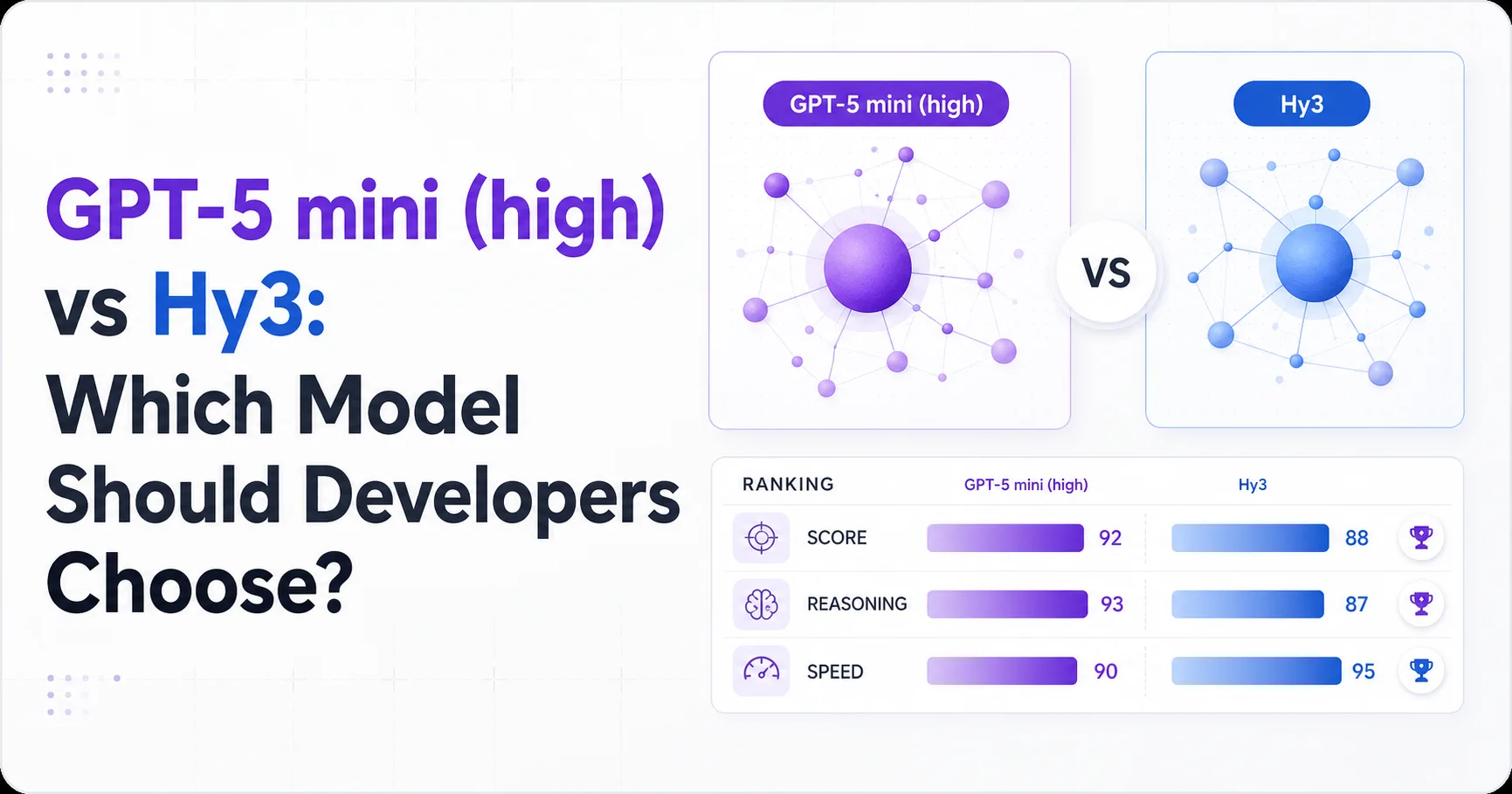
- **Winner overall:** Hy3, with a 58.8 coding index and 41.2 intelligence index versus GPT-5 mini (high) at 15.6 and 25.3 - **Cheaper:** Hy3 at $0.24125000000000005 vs $0.6875 per 1M blended tokens - **Faster:** Hy3 at 71.711 (median output tokens per second) - **Pick GPT-5 mini (high) when:** mathematical reasoning matters and the 90.7 math index is more relevant than coding breadth - **Watch out:** Hy3 has no supplied official documentation, while GPT-5 mini (high) is absent from the current OpenAI model directory
GPT-5 mini (high) vs Hy3
Hy3 is the stronger default for cost-sensitive development work, while GPT-5 mini (high) remains defensible for math-heavy tasks with a known evaluation signal.
The supplied benchmark data gives Hy3 a 58.8 coding index and a 41.2 intelligence index. GPT-5 mini (high) records 15.6 and 25.3 on those same measures. GPT-5 mini (high) also records a 90.7 math index, while Hy3 has no supplied math score.
The comparison has an important qualification: the two models do not have equivalent documentation coverage. OpenAI’s current model directory does not list gpt-5-mini or GPT-5 mini (high) as an independent entry. The supplied material contains no verified public source for Hy3.
Data provided by https://artificialanalysis.ai/.
Executive summary for developers
Hy3 offers the better measured engineering profile, but GPT-5 mini (high) has the only supplied result for mathematical reasoning.
| Decision factor | GPT-5 mini (high) | Hy3 |
|---|---|---|
| Intelligence index | 25.3 | 41.2 |
| Coding index | 15.6 | 58.8 |
| Math index | 90.7 | Not supplied |
| Blended price per 1M tokens | $0.6875 | $0.24125000000000005 |
| Input price per 1M tokens | $0.25 | $0.136 |
| Output price per 1M tokens | $2 | $0.557 |
| Median output speed | Not supplied | 71.711 tokens per second |
| Latency | 0.3 seconds | 0.3 seconds |
Hy3’s coding result is the clearest reason to choose it for code generation, repository assistance, and routine software tasks. Its intelligence index is also higher, which supports a broader default position in the supplied evidence.
GPT-5 mini (high) is not automatically disqualified. Its 90.7 math index creates a specific reason to test it for symbolic work, quantitative explanations, or workflows where mathematical accuracy dominates coding performance. That conclusion is narrow because the supplied data does not show comparable Hy3 math performance.
The official evidence does not resolve deployment risk. OpenAI’s model documentation does not confirm the current API identity, context window, output limit, tool support, or meaning of high for GPT-5 mini (high). Hy3 has no supplied official documentation at all.
Performance: benchmark separation matters more than latency
Hy3 is the better measured coding model, while GPT-5 mini (high) has an unchallenged math result that prevents a universal performance verdict.
The coding gap is large enough to change the type of work a model can handle reliably. Hy3’s coding index is 58.8, compared with 15.6 for GPT-5 mini (high). In practical selection terms, that favors Hy3 for code completion, implementation drafts, test generation, and repository-oriented assistance, subject to task-specific validation.
The intelligence index points in the same direction. Hy3 scores 41.2, while GPT-5 mini (high) scores 25.3. This supports using Hy3 as the first candidate for general developer workflows, especially when one model must cover several ordinary engineering tasks.
Latency does not separate the models in the supplied snapshot. Both are listed at 0.3 seconds. Hy3 does have a reported median output speed of 71.711 tokens per second, while GPT-5 mini (high) has no supplied value. That makes Hy3 easier to evaluate for streaming-heavy interfaces, but it does not prove that every request will feel faster.
GPT-5 mini (high) is unusual because its 90.7 math index is substantially more informative than its coding result for a specialized workload. Hy3 has no supplied math evaluation, so the evidence cannot establish whether Hy3 is better, equal, or worse on mathematical reasoning. Developers should treat this as a missing comparison, not as a win for GPT-5 mini (high).
The qualitative failure picture is also unresolved. The supplied material contains no verified community testing for either model, and OpenAI’s model directory does not provide GPT-5 mini (high)-specific failure modes.
Cost: Hy3 is cheaper, but workload shape still matters
Hy3 is the clear price leader in the supplied snapshot, especially for workflows that generate substantial output.
Hy3 costs $0.24125000000000005 per 1M blended tokens, compared with $0.6875 for GPT-5 mini (high). Its input price is $0.136 versus $0.25, and its output price is $0.557 versus $2. The output difference matters most for coding agents, long explanations, generated tests, and multi-step responses because those workloads can produce more output than a short chat request.
The cheaper model can still become the more expensive operational choice if it needs repeated retries, extra validation calls, or human correction. The supplied data does not measure task success, retry rates, or total cost per accepted code change. Therefore, the price comparison is a token-cost comparison, not a verified cost-per-outcome comparison.
GPT-5 mini (high) may justify its higher price for a narrow math-heavy workflow if its 90.7 math index translates into fewer corrections. The supplied evidence does not report correction rates, so that possibility remains a hypothesis rather than a demonstrated economic advantage.
Availability creates another cost risk. OpenAI’s current pricing page does not list gpt-5-mini, and the supplied material does not confirm whether GPT-5 mini (high) remains directly callable or has a stable alias. Hy3’s operational pricing and availability also lack official documentation in the supplied research.
Recommendation by developer scenario
Hy3 should be the first model developers test for general coding, unless mathematical reasoning is the primary acceptance criterion.
Choose Hy3 when the product needs code generation, implementation assistance, test drafting, or a lower token bill. Its 58.8 coding index, 41.2 intelligence index, $0.24125000000000005 blended price, and reported 71.711 median output tokens per second create the strongest measured profile in this comparison.
Choose GPT-5 mini (high) when the workflow is centered on mathematical reasoning and the 90.7 math index matches the task better than coding-oriented benchmarks. This choice should include an availability check because the supplied OpenAI model directory does not independently list the model name used in the benchmark snapshot.
Use a staged evaluation when the application mixes coding and math. Route representative tasks through both models, record accepted outputs, correction work, retries, and latency under the same prompt and tool conditions. The supplied materials do not provide those production-level measurements, so benchmark leadership should guide the shortlist rather than end the evaluation.
Do not select GPT-5 mini (high) solely because high sounds like a quality tier. The supplied official material does not confirm whether high is a model identifier, a reasoning setting, or a display label. Do not select Hy3 solely because it is newer or cheaper either, because the supplied research has no verified official documentation or community evidence for it.
The practical default is Hy3 for measured coding value, with GPT-5 mini (high) retained as a specialist candidate for math-heavy workloads.
Questions to answer before production
Hy3 is the safer first production candidate only after developers verify its provenance, API behavior, and task-level reliability.
The supplied research leaves several questions unanswered. Those gaps matter because model selection depends on more than benchmark rankings and token prices.
Developers should confirm the API model ID, context window, output limits, tool support, rate limits, retention policy, and versioning behavior before committing application logic. For GPT-5 mini (high), the current official OpenAI pages do not confirm these details. For Hy3, the supplied material provides no official source to inspect.
Teams should also test whether the benchmark results transfer to their own repositories, languages, test suites, and mathematical workloads. The comparison establishes a measured direction, not a guaranteed production outcome.
Frequently asked questions
Which model is better for coding?
Hy3 is better for coding in the supplied evidence because its coding index is 58.8, compared with 15.6 for GPT-5 mini (high). Developers should still validate representative repository tasks before deployment.
Which model is cheaper for API usage?
Hy3 is cheaper on every supplied token price: $0.24125000000000005 blended, $0.136 input, and $0.557 output per 1M tokens, versus GPT-5 mini (high) at $0.6875, $0.25, and $2.
Is GPT-5 mini (high) faster than Hy3?
The supplied data does not establish that GPT-5 mini (high) is faster. Both models show 0.3 seconds latency, while only Hy3 has a reported median output speed of 71.711 tokens per second.
Should developers choose GPT-5 mini (high) for math?
GPT-5 mini (high) is the only model with a supplied math result, scoring 90.7. That makes it worth testing for math-heavy work, but the evidence cannot show whether Hy3 would perform better.
Can developers safely assume GPT-5 mini (high) is currently available?
Developers should not assume current availability because the supplied OpenAI model directory does not list gpt-5-mini or GPT-5 mini (high) as an independent model entry.
Sources
- OpenAI ModelsVerifying the current model directory, general capability descriptions, and the absence of an independent GPT-5 mini entry.
- OpenAI PricingVerifying currently listed OpenAI pricing and the absence of a listed gpt-5-mini price.
- Artificial AnalysisAttribution for the supplied benchmark, pricing, latency, release, and output-speed snapshot.
Published: