
AI model analysis
GPT-5 mini (high) vs JT-4.1 Flash 236B A21B: Which Model Should Developers Choose?
A developer-focused comparison of GPT-5 mini (high) and JT-4.1 Flash 236B A21B across measured quality, latency, price, and deployment confidence.
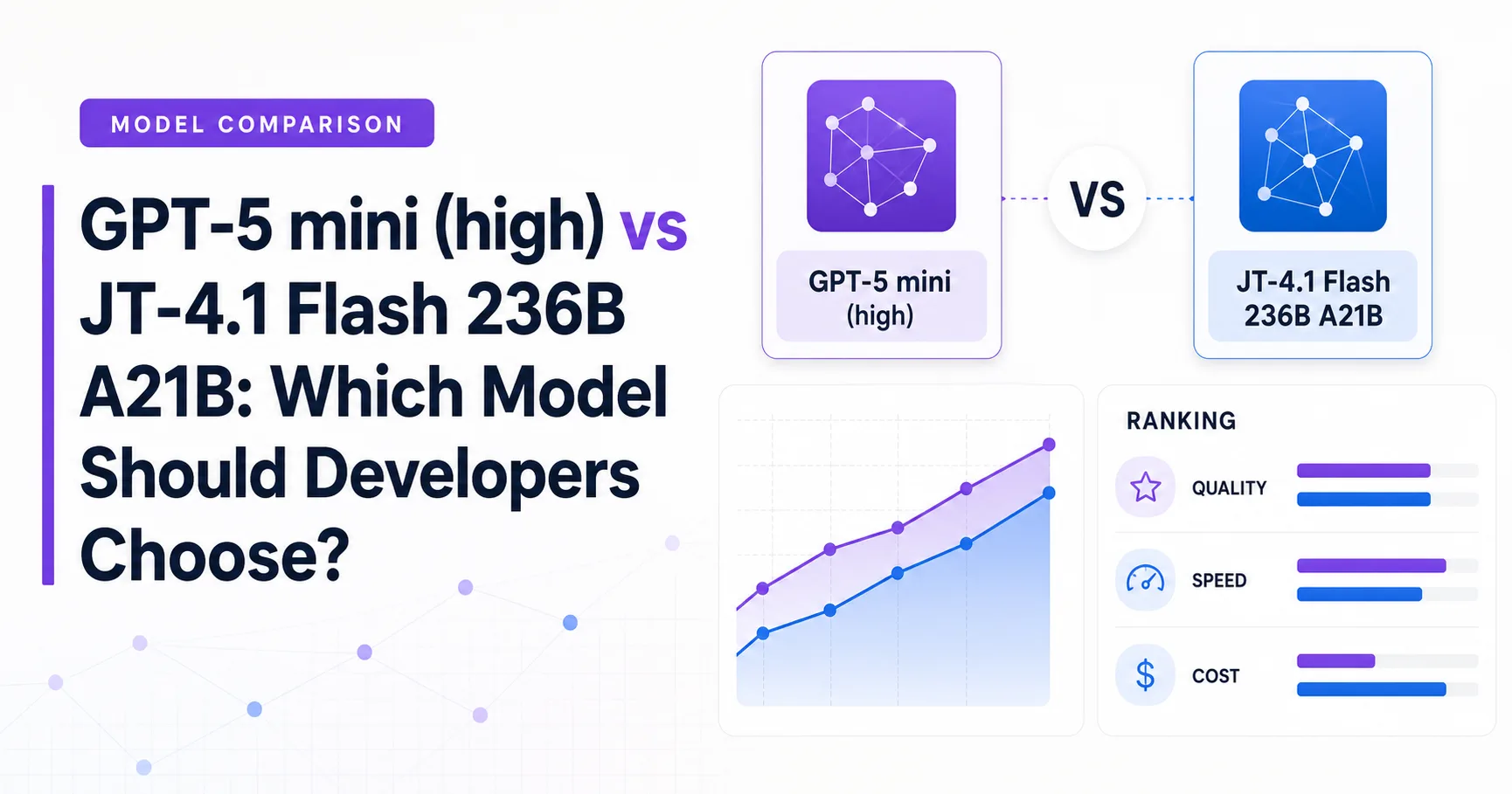
- **Winner overall:** JT-4.1 Flash 236B A21B, with a 52.4 coding index versus 15.6 for GPT-5 mini (high) - **Cheaper:** GPT-5 mini (high) at $0.6875 vs $15 per 1M blended tokens - **Faster:** GPT-5 mini (high) and JT-4.1 Flash 236B A21B tied at 0.3 seconds median latency - **Pick GPT-5 mini (high) when:** cost is the primary constraint or mathematical evaluation matters, with a 90.7 math index - **Watch out:** neither model has a reported median output speed, and official availability evidence is incomplete
GPT-5 mini (high) vs JT-4.1 Flash 236B A21B
GPT-5 mini (high) is the safer cost-oriented choice, while JT-4.1 Flash 236B A21B is the stronger measured coding model. The available comparison data gives JT-4.1 Flash 236B A21B a coding index of 52.4, compared with 15.6 for GPT-5 mini (high). GPT-5 mini (high) costs $0.6875 per 1M blended tokens, compared with $15 for JT-4.1 Flash 236B A21B. Both models show a median latency of 0.3 seconds in the supplied data.
The decision is less complete than the headline numbers suggest. Neither model has a reported median output speed, and neither model has a reported context window in the data brief. GPT-5 mini (high) also has an unusual documentation gap: the current OpenAI model directory does not list gpt-5-mini or the display name GPT-5 mini (high) as an independent entry. The supplied research found no verifiable official source for JT-4.1 Flash 236B A21B.
The comparison data is provided by https://artificialanalysis.ai/.
Executive summary for developers
JT-4.1 Flash 236B A21B leads the measured general intelligence and coding results, but GPT-5 mini (high) offers a dramatically lower listed cost. The Artificial Analysis intelligence index is 38.8 for JT-4.1 Flash 236B A21B and 25.3 for GPT-5 mini (high). The coding result is the clearest separation, with JT-4.1 Flash 236B A21B at 52.4 and GPT-5 mini (high) at 15.6.
GPT-5 mini (high) has one important counter-signal: its math index is 90.7, while no JT-4.1 Flash 236B A21B math result is supplied. That does not prove GPT-5 mini (high) is the better mathematical model overall. It shows that the comparison is incomplete for math, and the missing JT-4.1 result prevents a direct conclusion.
The release dates also complicate a simple quality ranking. The data brief lists GPT-5 mini (high) with a release date of 2025-08-07 and JT-4.1 Flash 236B A21B with a release date of 2026-07-09. The research does not establish whether the named GPT-5 mini (high) entry remains callable, whether it has a stable alias, or whether JT-4.1 Flash 236B A21B is available through a production API. Developers should therefore treat measured quality and deployability as separate decisions.
The OpenAI model directory confirms that the current catalog does not independently list gpt-5-mini, but it does not identify a replacement mapping for this comparison target. No comparable verified catalog source was found for JT-4.1 Flash 236B A21B.
Performance: what the scores mean in real development work
JT-4.1 Flash 236B A21B is the better measured choice for coding-heavy workflows, while GPT-5 mini (high) remains unproven for several operational dimensions. The coding index gap is large enough to matter for tasks such as repository changes, code generation, debugging, and multi-step implementation, assuming the benchmark reflects the workloads your team actually sends. A higher coding score does not automatically guarantee better patch quality, lower review effort, or safer production changes. Those outcomes depend on prompt structure, repository context, tool access, and evaluation criteria that the brief does not provide.
GPT-5 mini (high) should not be dismissed for mathematical or verification-oriented work. Its supplied math index is 90.7, and that result points to a potentially valuable niche for symbolic reasoning, quantitative checks, or tasks where mathematical consistency matters. The evidence is insufficient to compare that niche directly because JT-4.1 Flash 236B A21B has no supplied math score. Developers should run a task-specific bake-off before treating the math result as a decisive advantage.
Latency does not separate the models in the supplied snapshot. Both report 0.3 seconds, so the choice cannot be justified by the listed median latency alone. Median output tokens per second are missing for both models, which means streaming experience, long-answer completion time, and throughput remain unresolved. A fast first response may still produce a slower overall interaction if output generation differs, but the current evidence does not measure that difference.
The OpenAI model directory provides general statements about current OpenAI model modalities and languages, but the research could not confirm that those statements apply specifically to GPT-5 mini (high). No verified official documentation or community test report was found for JT-4.1 Flash 236B A21B, so its tool behavior, context handling, and failure modes remain unknown.
Cost: when the cheaper model is actually the better engineering choice
GPT-5 mini (high) is the clear price leader, and its lower token cost can outweigh a weaker coding score for high-volume applications. The supplied blended price is $0.6875 per 1M tokens for GPT-5 mini (high), versus $15 for JT-4.1 Flash 236B A21B. GPT-5 mini (high) also has an input price of $0.25 and an output price of $2, while JT-4.1 Flash 236B A21B has an input price of $10 and an output price of $30.
The practical question is whether the cheaper model creates enough additional engineering work to erase its token-cost advantage. If a coding assistant needs repeated retries, larger prompts, human correction, or a second model for validation, the apparent savings may not represent the full workflow cost. The brief does not include retry rates, task success rates, output lengths, or review time, so it cannot determine the total cost per successful software change.
JT-4.1 Flash 236B A21B may still be economically rational for a narrow, high-value coding workflow. A stronger coding index can reduce failed generations or reviewer intervention, but the supplied evidence does not measure either outcome. Its higher price is therefore a business tradeoff, not proof of waste. Teams should compare cost per accepted result, not token price alone, using their own prompts and acceptance criteria.
The OpenAI pricing page does not currently provide standard, Batch, Flex, or Fast mode prices for gpt-5-mini, according to the research brief. That creates a material availability and billing uncertainty. The listed comparison price may be useful for the supplied snapshot, but developers should verify that the target model and price are still callable before budgeting production traffic.
Recommendation by workload
GPT-5 mini (high) is the best first candidate for cost-sensitive workloads, while JT-4.1 Flash 236B A21B deserves a controlled trial for coding-critical workloads. Choose GPT-5 mini (high) when token volume is high, mathematical evaluation is important, and the application can tolerate uncertainty about current API availability. Its $0.6875 blended price and 90.7 math index make that case attractive in the supplied snapshot.
Choose JT-4.1 Flash 236B A21B when code generation, repository editing, or debugging quality is the dominant requirement. Its 52.4 coding index is materially stronger than GPT-5 mini (high)'s 15.6. That recommendation should remain conditional because the research found no verifiable vendor documentation, API status, stable alias, pricing page, model card, or community test material for JT-4.1 Flash 236B A21B.
For a production team, the safest selection process is staged. First, verify that the exact model identifier can be called. Next, test representative coding and math tasks with fixed prompts. Then measure accepted outputs, retries, latency, and review effort. The supplied data supports the initial hypothesis, but it does not answer those operational questions.
The main unresolved issue is not benchmark quality. It is deployment confidence. GPT-5 mini (high) has official catalog and pricing gaps documented by the OpenAI model directory and OpenAI pricing page. JT-4.1 Flash 236B A21B has no verified source in the research brief. Developers should not commit production architecture based on either name alone.
Questions to answer before choosing
GPT-5 mini (high) requires an availability check before production adoption, while JT-4.1 Flash 236B A21B requires both availability and provenance checks. The current evidence supports a useful benchmark comparison, but it does not establish a complete product comparison. The missing context windows, missing output-speed measurements, absent JT-4.1 Flash 236B A21B math result, and incomplete official documentation all limit confidence. These gaps should shape the validation plan rather than be treated as minor footnotes.
Frequently asked questions
Which model is better for coding?
JT-4.1 Flash 236B A21B is better for coding in the supplied benchmark snapshot because its coding index is 52.4, compared with 15.6 for GPT-5 mini (high).
Which model is cheaper for production API usage?
GPT-5 mini (high) is cheaper in the supplied pricing snapshot at $0.6875 per 1M blended tokens, compared with $15 for JT-4.1 Flash 236B A21B. Actual production cost still depends on retries, output volume, and availability.
Is GPT-5 mini (high) currently available through OpenAI?
The evidence is insufficient to confirm current availability because the OpenAI model directory does not list gpt-5-mini or GPT-5 mini (high) as an independent current model entry.
Does JT-4.1 Flash 236B A21B have better reasoning?
The supplied data gives JT-4.1 Flash 236B A21B a higher intelligence index of 38.8 than GPT-5 mini (high) at 25.3, but that score alone cannot establish broad reasoning quality across every developer workload.
Which model is faster?
Neither model is faster on the supplied latency measure because GPT-5 mini (high) and JT-4.1 Flash 236B A21B both report 0.3 seconds. Median output tokens per second are missing for both models, so streaming speed remains unknown.
Sources
- OpenAI ModelsVerifying the current OpenAI model catalog, general capability statements, and the absence of an independent gpt-5-mini entry.
- OpenAI PricingVerifying current OpenAI pricing listings and the absence of standard, Batch, Flex, or Fast mode prices for gpt-5-mini.
- Artificial AnalysisAttributing the supplied benchmark, latency, release-date, and pricing snapshot.
Published: