
AI model analysis
GPT-5 mini (high) vs Kimi K3 (low): Which Model Should Developers Choose?
A developer-focused comparison of GPT-5 mini (high) and Kimi K3 (low), covering measured capability, latency, price, evidence quality, and practical selection risk.
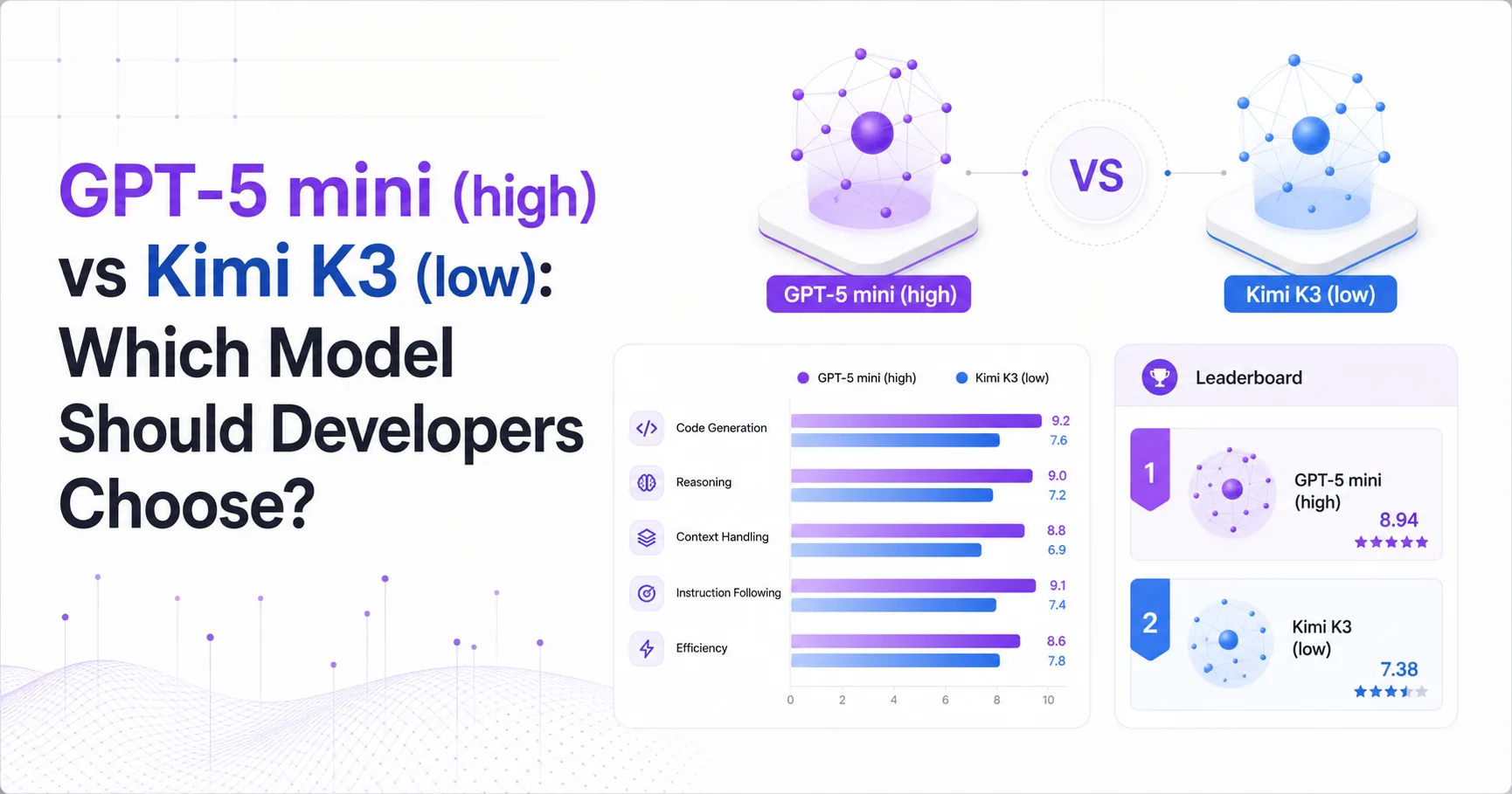
- **Winner overall:** Kimi K3 (low), with a 72 coding index and 46.6 intelligence index versus 15.6 and 25.3 - **Cheaper:** GPT-5 mini (high) at $0.6875 vs $6 per 1M blended tokens - **Faster:** Kimi K3 (low) at 35.898 median output tokens per second - **Pick GPT-5 mini (high) when:** cost and math performance matter more than coding breadth - **Watch out:** GPT-5 mini (high) is absent from the current official model directory, while Kimi K3 (low) has no verifiable public documentation
GPT-5 mini (high) vs Kimi K3 (low): The practical choice
GPT-5 mini (high) is the safer budget experiment, while Kimi K3 (low) is the stronger measured coding candidate. The comparison data gives Kimi K3 (low) a coding index of 72 and an intelligence index of 46.6. GPT-5 mini (high) records 15.6 and 25.3 on those same indexes. Those gaps are large enough to change a developer workflow, especially when the model must modify code, follow repository conventions, or handle multi-step implementation tasks.
The recommendation remains conditional because the evidence is asymmetric. GPT-5 mini (high) has listed benchmark and price data, but the current OpenAI model directory does not list gpt-5-mini or the displayed GPT-5 mini (high) name. The same directory therefore cannot confirm the model’s current API identity, context window, output limit, or tool support. Kimi K3 (low) has a higher measured capability profile in this snapshot, but the research found no publicly verifiable official documentation or pricing page for it.
For a production decision, the real question is not simply which score is higher. It is whether the model can be called reliably, whether its behavior matches the measured task, and whether the price advantage survives your workload. The available sources do not answer those operational questions completely.
Summary for developers choosing a default model
Kimi K3 (low) is the capability leader in the available comparison, but GPT-5 mini (high) is the only model with a clearly identified vendor and publicly documented vendor pages. The data snapshot shows Kimi K3 (low) ahead on the artificial intelligence index, 46.6 versus 25.3, and on the coding index, 72 versus 15.6. GPT-5 mini (high) is the only model with a math index in the snapshot, at 90.7, so the math comparison is incomplete rather than a Kimi loss.
GPT-5 mini (high) is dramatically cheaper in every listed pricing view. Its blended price is $0.6875 per 1M tokens, compared with $6 for Kimi K3 (low). Input pricing is $0.25 versus $3, and output pricing is $2 versus $15. That difference makes GPT-5 mini (high) attractive for high-volume classification, extraction, routine assistance, and workloads where a lower capability ceiling is acceptable.
Kimi K3 (low) has the only reported output speed, at 35.898 median output tokens per second. Both models show 0.3 seconds of latency, so the snapshot does not establish a latency advantage. The Artificial Analysis data is useful for directional selection, but it does not replace a task-specific evaluation.
The official evidence also differs. OpenAI’s current model documentation does not verify the exact GPT-5 mini (high) identity, while the research found no citable official Kimi source. Developers should treat both names as requiring endpoint-level verification before committing architecture.
Performance: what the score gap means in real development work
Kimi K3 (low) is the stronger measured choice for coding-oriented work, with a coding index of 72 versus GPT-5 mini (high) at 15.6. A score gap of this size can matter when a task requires several linked decisions: understanding an unfamiliar module, selecting the right edit, preserving existing behavior, and producing a coherent patch. It may also reduce the number of repair turns required after an initial answer. The data does not reveal which coding tasks produced the gap, so developers should not assume equal performance across debugging, refactoring, test generation, and code review.
Kimi K3 (low) also leads the available general intelligence index, 46.6 versus 25.3. That result supports using Kimi K3 (low) for broader reasoning-heavy developer workflows, but it does not prove better repository-level reliability. The research found no reliable Reddit, Hacker News, or X material for either model, so there is no verified community evidence about coding style, instruction following, or recurring failure patterns. Any claim about a distinctive model personality would exceed the available evidence.
GPT-5 mini (high) has a math index of 90.7, while Kimi K3 (low) has no math value in the snapshot. This creates a meaningful boundary in the comparison. Developers building symbolic checks, quantitative explanations, or math-focused tools should test GPT-5 mini (high) directly instead of inferring that Kimi K3 (low)'s coding lead extends to mathematics. The absence of a Kimi score is evidence of missing coverage, not evidence of weak math ability.
Kimi K3 (low) is the only model with a reported median output speed, 35.898 tokens per second. That figure may improve interactive streaming, but it cannot be compared cleanly with GPT-5 mini (high), whose speed value is unavailable. Both models have 0.3 seconds of reported latency, so first-response behavior is tied in this snapshot. The Artificial Analysis comparison therefore supports a capability and streaming hypothesis, not a complete user-experience conclusion.
GPT-5 mini (high) has no publicly verified dedicated failure profile in the cited OpenAI model documentation, and Kimi K3 (low) has no citable official failure documentation in the research. Before choosing either model for autonomous code changes, measure recovery after incorrect edits, tool-call correctness, long-context behavior, and adherence to repository tests.
Cost: when the cheaper model is actually cheaper
GPT-5 mini (high) is the clear cost leader, but its low price only matters if its extra correction work stays below Kimi K3 (low)'s premium. The blended price is $0.6875 for GPT-5 mini (high) and $6 for Kimi K3 (low). Output pricing widens the practical difference further, at $2 versus $15 per 1M output tokens. A coding workflow that needs repeated retries, larger explanations, or manual review can consume the apparent saving through engineering time rather than token spend.
Kimi K3 (low) can still be the economical option for tasks where capability prevents downstream work. If its coding advantage lets a developer accept the first patch more often, reduces failed tool calls, or shortens a debugging loop, the higher token price may buy a lower total task cost. The supplied data does not measure acceptance rate, retry count, review time, or defect rate, so no break-even claim can be proven.
GPT-5 mini (high) fits cost-sensitive workloads with predictable prompts and limited consequence from occasional weakness. Examples include bulk labeling, simple transformations, lightweight support, and first-pass drafting. Kimi K3 (low) fits higher-value coding requests where each successful response can replace substantial developer effort. Those are workload hypotheses, not verified product guarantees.
The OpenAI pricing page does not currently list gpt-5-mini, so the snapshot price cannot by itself confirm present-day purchaseability or billing continuity. The research also found no citable Kimi pricing page. Procurement should verify the actual endpoint, region, rate limits, and billing terms before using either price in a forecast. Artificial Analysis provides the comparison data attribution, while the vendor pages determine whether an integration can be operationalized.
Recommendation: choose by failure cost, not leaderboard position
Kimi K3 (low) is the default choice for developers prioritizing measured coding capability, while GPT-5 mini (high) is the default choice for minimizing token spend. Choose Kimi K3 (low) for repository navigation, code generation, multi-step debugging, and other workflows where an incorrect first answer creates expensive follow-up work. Its coding index of 72 gives it the strongest direct signal in this comparison.
Choose GPT-5 mini (high) for high-volume or cost-constrained workloads, especially where prompts are narrow, outputs are easy to validate, and a fallback or retry path already exists. Its blended price of $0.6875 can make experimentation and broad task coverage much easier. Its math index of 90.7 also makes it the more defensible candidate for math-sensitive workflows, although the missing Kimi value prevents a complete comparison.
Neither model should become a production default without identity verification. The OpenAI model directory does not show an exact gpt-5-mini or GPT-5 mini (high) entry, and the research found no public official Kimi documentation. That means the most important unknown is operational: whether the named model can be called under a stable identifier with the required features.
A sensible evaluation sequence is small and task-specific. Test representative coding tasks, math tasks, tool calls, streaming behavior, retries, and cost per accepted result. Record whether the response is usable without repair, not only whether it looks persuasive. Keep GPT-5 mini (high) as a price baseline and Kimi K3 (low) as a capability candidate until endpoint and documentation checks resolve the evidence gap.
Kimi K3 (low) wins the available capability comparison, but GPT-5 mini (high) may still be the better business decision for workloads dominated by volume and validation. The supplied sources do not establish a universal winner.
Evidence gaps developers should resolve before adoption
GPT-5 mini (high) and Kimi K3 (low) both require direct validation before a production commitment because neither evidence set fully describes the deployable product. For GPT-5 mini (high), the current OpenAI model directory and OpenAI pricing page do not provide an exact current listing. For Kimi K3 (low), the research found no publicly verifiable official release, developer, or pricing page.
The missing information affects architecture, not just documentation quality. Developers cannot confirm context limits, output limits, supported parameters, tool behavior, stable aliases, or replacement relationships from the supplied evidence. The research also found no reliable community testing for either model, so anecdotal expectations about speed, coding habits, or failure modes should not guide a high-consequence rollout.
The Artificial Analysis dataset supplies useful measured values, including capability indexes, prices, latency, and one output-speed value. It does not identify the exact test composition or establish that benchmark movement predicts success on a particular codebase. The comparison is therefore strong enough to prioritize experiments, but not strong enough to remove them.
Frequently asked questions
Which model should I choose for coding tasks?
Kimi K3 (low) is the stronger first candidate for coding tasks because its coding index is 72 versus 15.6 for GPT-5 mini (high), although developers still need task-specific testing and endpoint verification.
Which model is cheaper for API workloads?
GPT-5 mini (high) is cheaper, with a blended price of $0.6875 per 1M tokens versus $6 for Kimi K3 (low), but retries and manual correction can change total task cost.
Is Kimi K3 (low) faster than GPT-5 mini (high)?
Kimi K3 (low) has the only reported median output speed at 35.898 tokens per second, while both models show 0.3 seconds of latency, so the available evidence cannot prove an overall speed winner.
Is GPT-5 mini (high) better for mathematics?
GPT-5 mini (high) has a math index of 90.7, while Kimi K3 (low) has no math score in the supplied snapshot, so GPT-5 mini (high) has the stronger documented signal but not a complete head-to-head result.
Can I use either model as a production default today?
Neither model should be adopted without direct verification because GPT-5 mini (high) is absent from the current OpenAI listings and Kimi K3 (low) lacks publicly verifiable official documentation in the supplied research.
Sources
- Artificial AnalysisCapability indexes, pricing, latency, output speed, release dates, and data attribution.
- OpenAI ModelsVerification of the current OpenAI model directory, general model capability descriptions, and the absence of an exact GPT-5 mini listing.
- OpenAI PricingVerification of currently listed OpenAI pricing and the absence of a gpt-5-mini pricing entry.
Published: