
AI model analysis
GPT-5 mini (high) vs Motif 3 (Beta): Which Model Should Developers Choose?
A developer-focused comparison of GPT-5 mini (high) and Motif 3 (Beta), covering capability signals, pricing, evidence quality, and practical model-selection risks.
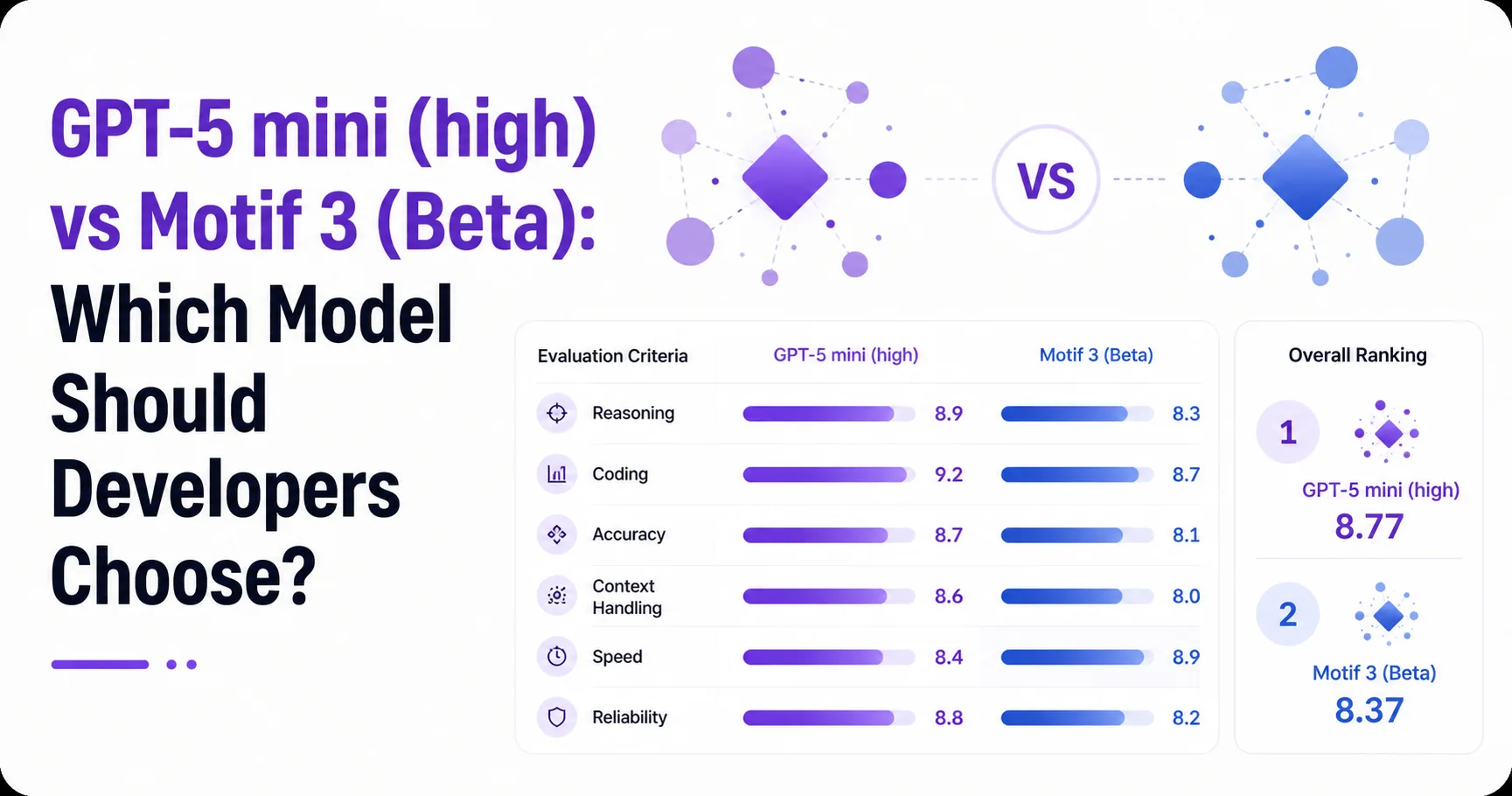
- **Winner overall:** Motif 3 (Beta), with a 62 coding index and 44.1 intelligence index versus 15.6 and 25.3 for GPT-5 mini (high) - **Cheaper:** GPT-5 mini (high) at $0.6875 vs $15 per 1M blended tokens - **Faster:** GPT-5 mini (high) and Motif 3 (Beta) tie at 0.3 seconds latency - **Pick GPT-5 mini (high) when:** operating cost matters more than the available coding and intelligence index gap - **Watch out:** Motif 3 (Beta) has no verified public documentation, pricing page, or official failure-mode evidence
GPT-5 mini (high) vs Motif 3 (Beta)
GPT-5 mini (high) is the safer cost decision, while Motif 3 (Beta) is the stronger capability bet on the available evaluation data. Motif 3 (Beta) records an Artificial Analysis coding index of 62, compared with 15.6 for GPT-5 mini (high). Its intelligence index is 44.1, compared with 25.3. GPT-5 mini (high) has a math index of 90.7, but Motif 3 (Beta) has no comparable math result in the supplied snapshot. That missing result prevents a complete capability ranking.
The commercial conclusion is clearer. GPT-5 mini (high) costs $0.6875 per 1M blended tokens, while Motif 3 (Beta) costs $15. GPT-5 mini (high) also has lower input pricing at $0.25 versus $10, and lower output pricing at $2 versus $30. The latency result is a tie at 0.3 seconds.
The central selection problem is evidence quality. OpenAI’s current model directory does not independently list GPT-5 mini or the “high” presentation name. No verifiable vendor documentation or public pricing source was found for Motif 3 (Beta). Developers should therefore treat the comparison as a decision screen, not as a complete production-readiness assessment.
Executive summary for developers
Motif 3 (Beta) leads the measured capability signals, but GPT-5 mini (high) offers the only clear and substantial economic advantage. The coding index gap is large enough to matter for code generation, repository work, debugging, and tool-mediated development workflows. The intelligence index gap also favors Motif 3 (Beta), although the snapshot does not explain task composition, variance, or evaluation coverage.
GPT-5 mini (high) remains attractive for high-volume applications. Its blended token price is $0.6875, compared with $15 for Motif 3 (Beta). That difference can dominate total operating cost when requests are frequent, prompts are large, or generated output is expensive. Lower price also makes retries, candidate generation, and background automation easier to afford.
The data does not establish a universal winner. GPT-5 mini (high) has the only supplied math index, at 90.7. Motif 3 (Beta) has no math result, so developers cannot infer that its broader intelligence score covers mathematical reliability. Neither model has a supplied output-speed measurement. The equal 0.3-second latency value says little about streaming behavior, throughput, queueing, or sustained concurrency.
Artificial Analysis is the stated provider of the quantitative snapshot. The qualitative source record is asymmetric: OpenAI pages provide current directory and pricing context, while Motif 3 (Beta) has no verified public source. That asymmetry should affect confidence in deployment decisions.
Performance: what the scores may mean in real work
Motif 3 (Beta) is the stronger measured choice for coding and general intelligence, but the evidence does not prove better production outcomes for every developer workflow. Its coding index of 62 is far above GPT-5 mini (high) at 15.6. A gap of that size suggests that Motif 3 (Beta) may produce more useful first attempts on code transformation, implementation, and debugging tasks represented by the evaluation. It does not reveal whether the model is better at your language, framework, repository scale, or tool chain.
The intelligence index points in the same direction. Motif 3 (Beta) scores 44.1 against 25.3 for GPT-5 mini (high). That supports choosing Motif 3 (Beta) for tasks requiring broader reasoning across code, specifications, and multi-step decisions, subject to validation in your own workload. The result is still incomplete because the supplied material contains no official benchmark methodology, task breakdown, confidence interval, or error analysis.
GPT-5 mini (high) has one important counter-signal: a math index of 90.7. Motif 3 (Beta) has no corresponding value. Developers building quantitative features should not treat the intelligence index as a substitute for a math evaluation. The correct conclusion is evidence insufficiency, not a math victory for either model.
The latency result is equal at 0.3 seconds. That removes a simple latency-based reason to choose one model, but it does not establish equal user experience. No median output-tokens-per-second value is supplied for either model. Streaming smoothness, time to first token, long-response completion time, rate limits, and tool-call overhead remain unanswered. OpenAI’s model documentation also does not verify the specific GPT-5 mini (high) variant or its supported parameters.
Cost: when the cheaper model may be the better system
GPT-5 mini (high) is the clear price winner, yet Motif 3 (Beta) can still be cheaper at the system level if its capability advantage materially reduces human review or repeated attempts. The blended price is $0.6875 for GPT-5 mini (high) and $15 for Motif 3 (Beta). GPT-5 mini (high) also costs $0.25 for input tokens and $2 for output tokens, compared with $10 and $30 for Motif 3 (Beta).
Those prices favor GPT-5 mini (high) for workloads with predictable quality requirements, large request volume, and limited tolerance for vendor uncertainty. They also make it easier to run fallback attempts, classification passes, test generation, and internal automation without turning every extra call into a major budget decision.
Motif 3 (Beta) may justify its premium when a stronger coding result reduces downstream work. A model that completes a difficult task in fewer attempts can offset higher token rates through lower review time, fewer failed tool calls, or fewer escalations to an engineer. The supplied data does not measure any of those outcomes. It also does not provide context-window values, output limits, rate limits, availability terms, or verified pricing conditions for Motif 3 (Beta).
Pricing confidence is therefore uneven. OpenAI’s pricing page does not currently list gpt-5-mini, so the snapshot price cannot be independently reconciled with the current public catalog. No official Motif 3 (Beta) pricing source was found. Treat both prices as comparison inputs from the supplied data, then confirm live billing and access before committing architecture or budget.
Recommendation by deployment scenario
GPT-5 mini (high) is the practical default for cost-sensitive production systems, while Motif 3 (Beta) deserves a controlled trial for quality-sensitive developer workflows. Choose GPT-5 mini (high) when the application serves high request volume, needs inexpensive retries, or has a clear evaluation gate that can reject weak outputs. Its $0.6875 blended price creates room for operational redundancy and experimentation.
Choose Motif 3 (Beta) when coding quality is the primary constraint and the organization can absorb beta-stage uncertainty. The coding index of 62 provides the strongest available reason to test it. A trial should use representative repositories, real issue descriptions, actual tool permissions, and human review criteria. The test should measure task completion, correction effort, tool-call validity, and regression risk rather than relying only on the headline index.
Use GPT-5 mini (high) as a possible math-focused candidate only because its supplied math index is 90.7. Do not assume that result transfers to financial calculations, symbolic manipulation, data analysis, or production safety without task-specific checks. Motif 3 (Beta) cannot be ranked on math from this snapshot because its corresponding value is missing.
The strongest architecture may be a staged choice rather than a permanent single-model decision. Route cheap, repetitive work to GPT-5 mini (high), and evaluate Motif 3 (Beta) on tasks where coding quality can repay its price. That design remains provisional because neither the exact GPT-5 mini (high) API identity nor Motif 3 (Beta) public availability is verified. The current OpenAI directory and pricing pages should be checked before implementation: models and pricing.
Questions to answer before adoption
GPT-5 mini (high) and Motif 3 (Beta) require live access checks before a benchmark result becomes a production decision. The supplied material identifies meaningful capability and price differences, but it does not verify several operational facts that can change the recommendation.
Developers should confirm the model identifier, access status, context behavior, output limits, rate limits, billing terms, and tool support in the intended environment. GPT-5 mini (high) is not independently listed under that name in the current OpenAI model directory. Motif 3 (Beta) has no verified public vendor documentation in the research record.
The comparison also needs workload testing. The available indices can prioritize candidates, but they cannot answer whether a model edits your codebase correctly, follows your tool protocol, or produces acceptable answers under your latency and review constraints. The missing Motif 3 (Beta) math result and missing output-speed values are especially important gaps for specialized applications.
Frequently asked questions
Which model should a developer choose overall?
Motif 3 (Beta) is the capability leader in the supplied snapshot, with a coding index of 62 and an intelligence index of 44.1. GPT-5 mini (high) is the safer economic choice because its blended price is $0.6875, compared with $15. The overall decision depends on whether coding quality or predictable cost is the binding constraint. Motif 3 (Beta) still requires live availability and reliability checks before production use.
Which model is cheaper for API workloads?
GPT-5 mini (high) is cheaper across every supplied pricing measure. Its blended price is $0.6875 per 1M tokens, input pricing is $0.25, and output pricing is $2. Motif 3 (Beta) is priced at $15 blended, $10 for input, and $30 for output. The supplied prices should still be verified against live billing because the current public OpenAI pricing page does not list gpt-5-mini, while Motif 3 (Beta) has no verified public pricing source.
Is Motif 3 (Beta) better for coding?
Motif 3 (Beta) is the stronger coding candidate in the available evaluation, with a coding index of 62 versus 15.6 for GPT-5 mini (high). That gap supports testing Motif 3 (Beta) for code generation, debugging, and repository changes. It does not prove superiority for every language, framework, or tool workflow. The research contains no verified community tests or official methodology that explains how the coding index maps to a specific development environment.
Which model is faster?
Neither model is faster on the supplied latency measure because GPT-5 mini (high) and Motif 3 (Beta) both show 0.3 seconds. The snapshot provides no median output-tokens-per-second value for either model. Developers therefore cannot infer equal streaming quality, throughput, time to first token, long-response completion time, or tool-call performance. A production trial should measure those behaviors directly under representative concurrency and response lengths.
Can GPT-5 mini (high) be trusted for mathematical tasks?
GPT-5 mini (high) is the only model with a supplied math index, at 90.7, so it is the only candidate with direct mathematical evidence in this snapshot. Motif 3 (Beta) has no comparable math value. That does not establish universal mathematical reliability for GPT-5 mini (high), and it does not show that Motif 3 (Beta) performs poorly. Specialized workloads still need task-specific accuracy and safety evaluation.
Is either model ready for production based on this comparison?
Neither model can be declared production-ready from this comparison alone. GPT-5 mini (high) is not independently listed by that name in the current OpenAI model directory, and Motif 3 (Beta) has no verified vendor documentation, pricing page, or official benchmark source in the research record. The quantitative snapshot can guide a trial, but developers must confirm access, limits, billing, tool behavior, reliability, and workload-specific quality before adoption.
Sources
- OpenAI ModelsVerifying the current OpenAI model directory, general capability statements, and whether GPT-5 mini (high) is independently listed.
- OpenAI PricingChecking current OpenAI pricing listings and whether gpt-5-mini has a publicly listed price.
- Artificial AnalysisAttributing the quantitative model comparison data, including evaluation, latency, and pricing snapshot values.
Published: