
AI model analysis
GPT-5 mini (high) vs Qwen3.7 Max: Which Model Should Developers Choose?
A developer-focused comparison of GPT-5 mini (high) and Qwen3.7 Max across benchmark evidence, latency, pricing, availability, and decision risk.
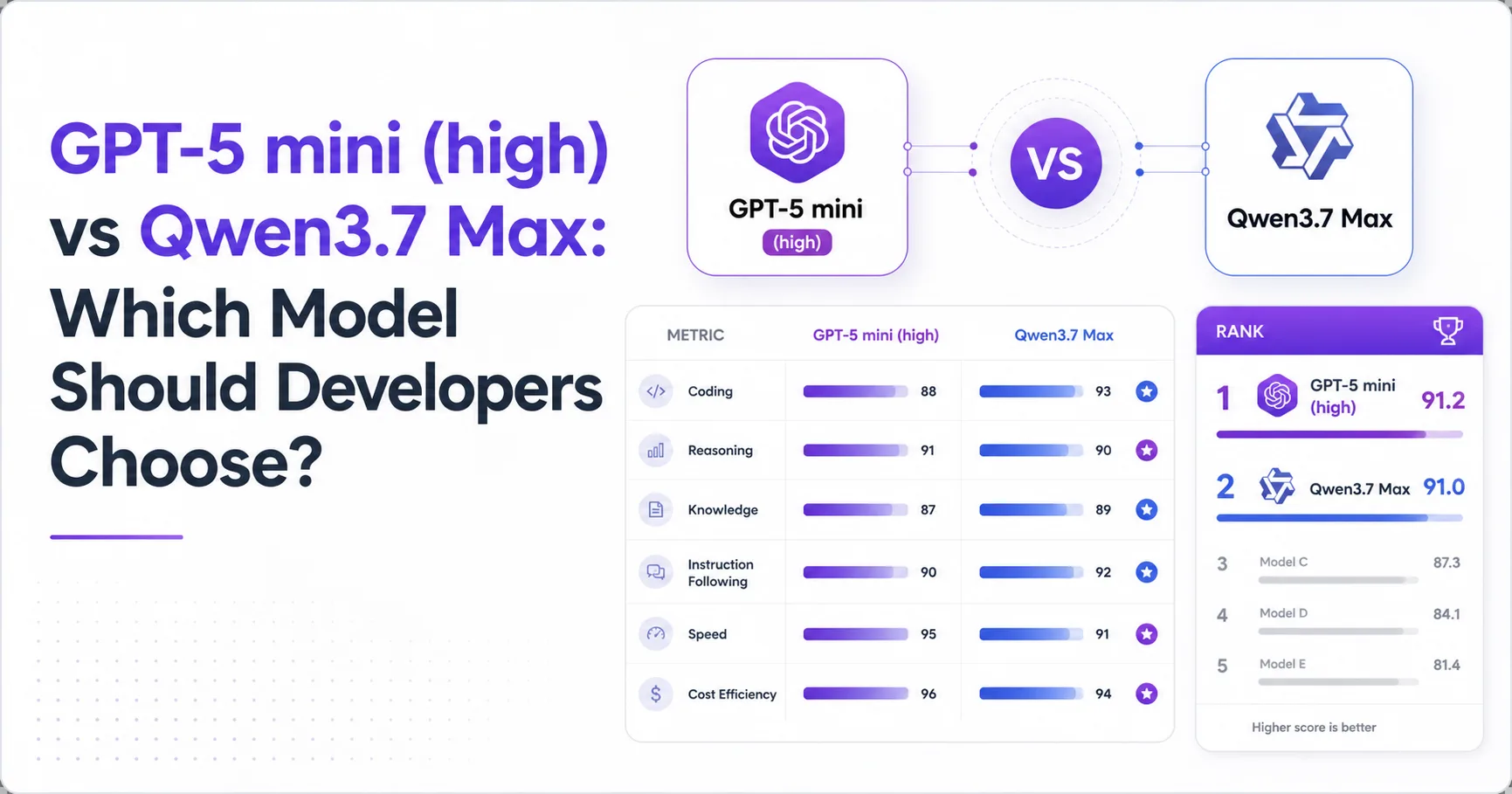
- **Winner overall:** Qwen3.7 Max, with a 66 coding index and 46 intelligence index versus 15.6 and 25.3 - **Cheaper:** GPT-5 mini (high) at $0.6875 vs $3.75 per 1M blended tokens - **Faster:** Qwen3.7 Max at 204.156 median output tokens per second - **Pick GPT-5 mini (high) when:** low cost matters most and the documented 90.7 math index fits the workload - **Watch out:** official availability, model identity, context limits, and Qwen3.7 Max’s evaluation methodology remain insufficiently documented
GPT-5 mini (high) vs Qwen3.7 Max
GPT-5 mini (high) is the cost-first choice, while Qwen3.7 Max is the stronger measured choice for coding and general intelligence tasks. The available data gives Qwen3.7 Max a coding index of 66 and an intelligence index of 46. GPT-5 mini (high) records 15.6 and 25.3 on those same indices, while its math index is 90.7. That asymmetry matters: the comparison does not identify one universal winner across every workload.\n\nThe evidence also has an important limitation. The research brief found no verifiable official announcement, developer documentation, pricing page, or community testing for Qwen3.7 Max. For GPT-5 mini (high), the current OpenAI Models page does not list an independent entry for that displayed name. The current OpenAI Pricing page also does not list standard, Batch, Flex, or Fast mode pricing for gpt-5-mini. The numerical snapshot therefore supports a practical comparison, but not a complete production-readiness judgment.
Executive summary for model selection
Qwen3.7 Max leads the measured coding and intelligence results, but GPT-5 mini (high) offers a materially lower token cost and a documented math result.\n\n| Decision factor | GPT-5 mini (high) | Qwen3.7 Max | What it means |\n|—|—:|—:|—|\n| Coding index | 15.6 | 66 | Qwen3.7 Max has the stronger measured coding signal |\n| Intelligence index | 25.3 | 46 | Qwen3.7 Max leads on the available general index |\n| Math index | 90.7 | Not provided | GPT-5 mini (high) has the only reported result |\n| Blended price per 1M tokens | $0.6875 | $3.75 | GPT-5 mini (high) is the lower-cost option |\n| Input price per 1M tokens | $0.25 | $2.5 | Input-heavy workloads favor GPT-5 mini (high) |\n| Output price per 1M tokens | $2 | $7.5 | Long answers cost more with Qwen3.7 Max |\n| Latency | 0.3 seconds | 0.3 seconds | The reported latency is tied |\n\nThe most useful conclusion is conditional. Choose Qwen3.7 Max for coding-heavy work if the evaluation is representative and the endpoint is available to your team. Choose GPT-5 mini (high) for cost-sensitive workloads, especially where math performance is more relevant than the coding index.\n\nThe evidence does not establish context windows, output limits, tool support, stable aliases, or failure modes for either model. The OpenAI Models page describes current OpenAI capabilities at a general level, but the research brief could not confirm that description for this historical or displayed model variant.
Performance: benchmark separation does not guarantee task separation
Qwen3.7 Max has the stronger measured performance profile for coding and general intelligence, but the evidence cannot show how those scores translate into your repository or agent workflow.\n\nThe coding index gap is large enough to change a first-choice model for software tasks. Qwen3.7 Max records 66, compared with 15.6 for GPT-5 mini (high). That result supports testing Qwen3.7 Max first for code generation, refactoring, debugging, and multi-step implementation. It does not prove that Qwen3.7 Max will produce fewer regressions in a particular codebase. The data brief provides no task-level examples, test protocol, or failure analysis.\n\nThe intelligence index points in the same direction, with Qwen3.7 Max at 46 and GPT-5 mini (high) at 25.3. Consistent movement across these indices makes Qwen3.7 Max the safer performance hypothesis for broad developer assistants. The result remains a hypothesis because the research brief contains no verified Qwen3.7 Max source or methodology.\n\nMath changes the shape of the decision. GPT-5 mini (high) has a reported math index of 90.7, while no Qwen3.7 Max math value is provided. That is not evidence that GPT-5 mini (high) is better overall at mathematical work. It only means the available comparison has one reported side.\n\nQwen3.7 Max reports 204.156 median output tokens per second, while GPT-5 mini (high) has no reported output-speed value. Both models have a reported latency of 0.3 seconds. The speed evidence therefore favors Qwen3.7 Max for sustained output, but it cannot establish end-to-end responsiveness, time to first token, or quality-adjusted throughput.
Cost: the cheaper model can still be more expensive operationally
GPT-5 mini (high) is the clear token-cost winner, but lower price only wins if its weaker measured coding result does not create extra work.\n\nThe blended price is $0.6875 per 1M tokens for GPT-5 mini (high), compared with $3.75 for Qwen3.7 Max. GPT-5 mini (high) also costs $0.25 per 1M input tokens and $2 per 1M output tokens, versus $2.5 and $7.5 for Qwen3.7 Max. Those differences strongly favor GPT-5 mini (high) for high-volume classification, extraction, routing, and other workloads where acceptable quality is already established.\n\nA developer workflow has a second cost layer. If GPT-5 mini (high) requires more retries, larger prompts, manual review, or fallback calls because its coding index is 15.6, its nominal token advantage may shrink. The data brief does not report retry rates, task success rates, human review rates, or total cost per completed change. No reliable break-even point can therefore be calculated.\n\nQwen3.7 Max may be economically rational for difficult coding tasks if its coding result reduces iteration time. That conclusion is not proven by the available evidence. Its higher token prices make each experiment more expensive, and its missing official pricing and availability evidence creates additional procurement uncertainty.\n\nThe practical cost test should measure completed outcomes, not tokens alone. Compare accepted patches, test-pass rates, correction turns, and total latency in a representative sample. The supplied data supports the price direction, but it does not quantify engineering productivity.
Recommendation by developer workload
GPT-5 mini (high) is the better default for cost-controlled workloads, while Qwen3.7 Max deserves priority testing for coding-intensive workflows.\n\nPick GPT-5 mini (high) when your main constraint is token spend. Its $0.6875 blended price is below Qwen3.7 Max’s $3.75, and its input and output prices are also lower. It is especially attractive when requests are numerous, prompts are large, or outputs are short enough that quality can be monitored cheaply. The reported math index of 90.7 also makes it worth evaluating for quantitative tasks, although no direct Qwen3.7 Max math comparison is available.\n\nPick Qwen3.7 Max when coding quality is the primary selection criterion. Its coding index of 66 is substantially above GPT-5 mini (high)’s 15.6 in the supplied snapshot. Its intelligence index of 46 also exceeds 25.3. These results justify a focused pilot for repository agents, code review, debugging, and implementation planning. They do not justify assuming production access, stable behavior, or superior results without a local test.\n\nUse a staged decision. First, verify that the exact model identifier can be called through the intended provider. Next, run the same repository tasks against both models. Finally, compare accepted outputs and total engineering effort against the token bill.\n\nThe largest unresolved risk is not a benchmark score. The research brief found no verifiable Qwen3.7 Max source, while the current OpenAI directory and pricing page do not independently document GPT-5 mini (high). Availability, API identity, context limits, tools, and support remain evidence gaps.
Questions to answer before adoption
GPT-5 mini (high) and Qwen3.7 Max require workload-specific validation because the supplied evidence leaves important production questions unanswered.\n\nThe numerical snapshot is useful for ranking initial experiments. It is not sufficient for approving either model as a long-term dependency. Confirm the endpoint, model identifier, pricing contract, context behavior, tool support, and evaluation method before committing application architecture.
Frequently asked questions
Which model is better for coding?
Qwen3.7 Max is the stronger measured coding choice, with a coding index of 66 versus 15.6 for GPT-5 mini (high). The available evidence does not show repository-level success rates or testing methodology.
Which model is cheaper for API workloads?
GPT-5 mini (high) is cheaper at $0.6875 per 1M blended tokens, compared with $3.75 for Qwen3.7 Max. Actual project cost may differ if quality gaps cause retries, reviews, or fallback calls.
Which model is faster?
Qwen3.7 Max has the only reported median output speed, at 204.156 output tokens per second. Both models report 0.3 seconds of latency, so the supplied data cannot establish complete user-perceived speed.
Is GPT-5 mini (high) currently available as a stable API model?
The supplied research cannot confirm stable availability or an exact API identity for GPT-5 mini (high). The current OpenAI model directory does not list an independent entry for that displayed name.
Is Qwen3.7 Max production-ready?
The supplied research cannot establish Qwen3.7 Max production readiness because it contains no verifiable official documentation, pricing page, availability information, limits, or reliable community testing for the model.
Should developers choose benchmark quality or lower price?
Developers should choose based on completed task cost, not benchmark quality or token price alone. Qwen3.7 Max leads coding results, while GPT-5 mini (high) costs less, and neither side has enough evidence to quantify the operational trade-off.
Sources
- OpenAI ModelsVerifying the current OpenAI model directory and general capability information, including the absence of an independent GPT-5 mini (high) entry.
- OpenAI PricingVerifying the current OpenAI pricing directory and the absence of listed gpt-5-mini pricing.
- Artificial AnalysisData attribution for the supplied benchmark, pricing, latency, release-date, and output-speed snapshot.
Published: