
AI model analysis
GPT-5 nano vs Grok 4.5: Which Model Should Developers Choose?
A developer-focused comparison of GPT-5 nano and Grok 4.5 across measured quality, speed, cost, API availability, and production risk.
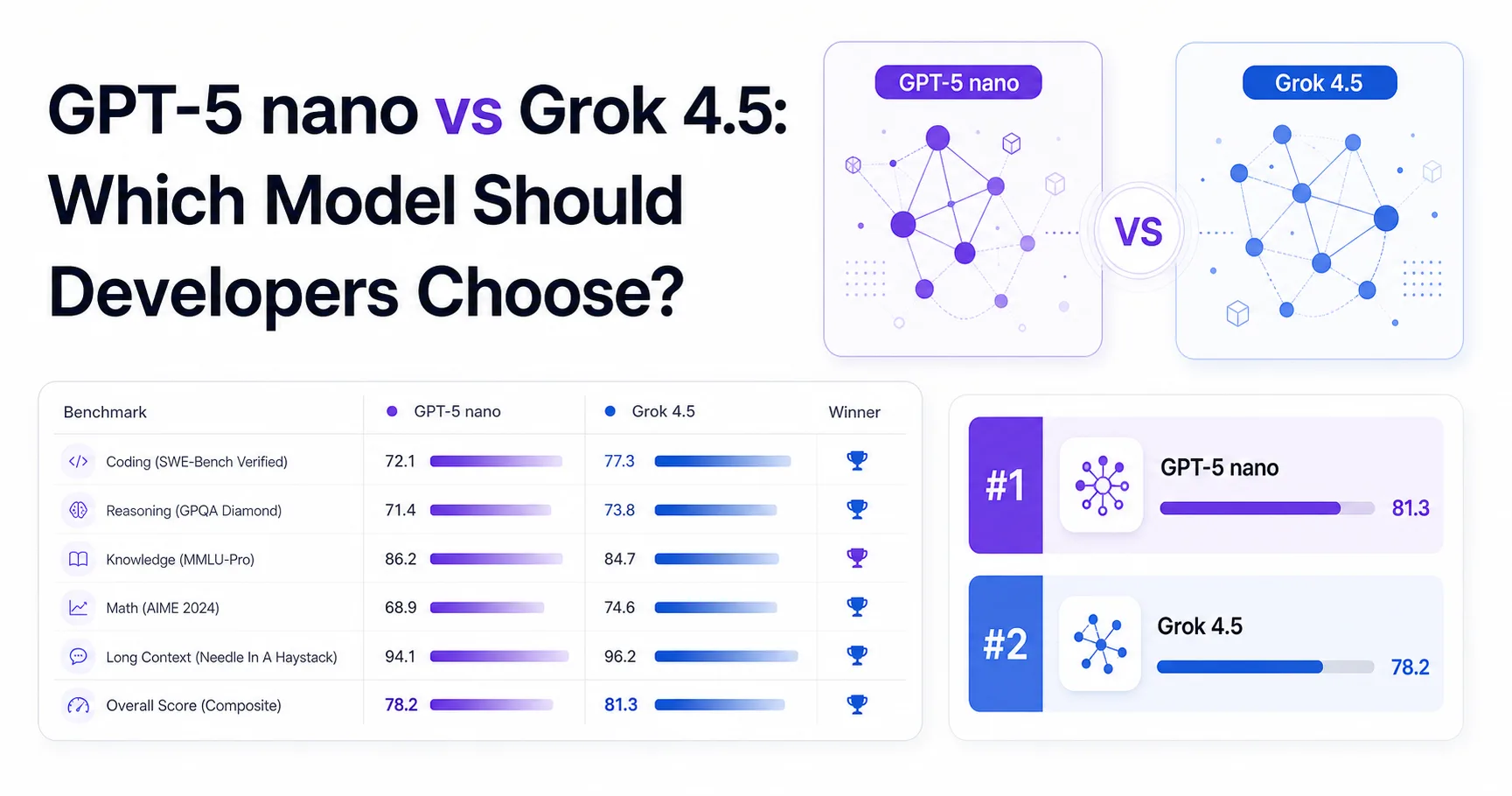
- **Winner overall:** Grok 4.5 (high), with an intelligence index of 53.8 vs 19.9 for GPT-5 nano - **Cheaper:** GPT-5 nano at $0.1375 vs $3 per 1M blended tokens - **Faster:** Grok 4.5 at 61.802 median output tokens per second - **Pick GPT-5 nano when:** low-cost math workloads matter most, with a math index of 83.7 and 0.3-second latency - **Watch out:** GPT-5 nano has 0.3-second measured latency, but its current official availability and limits remain unconfirmed
GPT-5 nano vs Grok 4.5
Grok 4.5 is the stronger documented production choice, while GPT-5 nano is the lower-cost option with unresolved availability risk.
The measured results point in different directions. Grok 4.5 records an Artificial Analysis intelligence index of 53.8, compared with 19.9 for GPT-5 nano. GPT-5 nano records a math index of 83.7, while no comparable Grok 4.5 math score appears in the data brief. Grok 4.5 also records 61.802 median output tokens per second, while GPT-5 nano has no reported value for that metric.
The largest practical distinction is not only quality. Grok 4.5 has current first-party documentation, a stable model name, documented tools, and published pricing. The current OpenAI model directory does not list GPT-5 nano or its API aliases. OpenAI’s model directory therefore cannot confirm whether the model remains directly callable.
Data provided by https://artificialanalysis.ai/
Executive summary for developers
Grok 4.5 offers the safer default for general engineering work because its API contract and capabilities are documented by the provider.
Grok 4.5 is officially documented as grok-4.5, with high representing a reasoning_effort value rather than a separate model. The provider documents text and image input, text output, Responses API access, Chat Completions, Function Calling, Structured Outputs, Web Search, X Search, and Code Execution. These capabilities make it easier to design an agent or coding workflow around an explicit interface. The Grok 4.5 developer documentation provides the relevant API details.
GPT-5 nano has a compelling measured price profile. Its blended price is $0.1375 per 1M tokens, compared with $3 for Grok 4.5. Its input price is $0.05, compared with $2, and its output price is $0.4, compared with $6. That gap can dominate infrastructure decisions when requests are frequent, outputs are short, and the model can complete the task reliably.
The quality evidence is asymmetric. Grok 4.5 leads the available intelligence index at 53.8 versus 19.9. GPT-5 nano leads only in the available math-specific evidence because its math index is 83.7 and Grok 4.5 has no corresponding value. The data does not establish a direct coding winner, since GPT-5 nano has no coding index while Grok 4.5 records 72.4.
Third-party catalog evidence also lists Grok 4.5 as x-ai/grok-4.5, with the same $2 input and $6 output pricing. OpenRouter’s model page supports the model identity and catalog presence, but it does not resolve GPT-5 nano’s current status.
Performance: what the scores mean in real workloads
Grok 4.5 is the better-supported choice for broad engineering and agent tasks, but the benchmark evidence does not prove superiority in every developer workload.
The intelligence index gap is substantial: Grok 4.5 scores 53.8, while GPT-5 nano scores 19.9. For developers, that result is most relevant when a request mixes planning, interpretation, tool selection, and error recovery. A higher general intelligence result can reduce the number of corrective turns required in an agent loop. It can also matter when prompts are underspecified and the system must infer the intended implementation.
Grok 4.5 has a coding index of 72.4, which is useful evidence for software work. However, GPT-5 nano has no coding index in the data brief. The correct conclusion is therefore that Grok 4.5 has positive coding evidence, not that the comparison proves a coding win against GPT-5 nano. Artificial Analysis records Grok 4.5 (high) as an API provider variant, while the supplied data does not provide a matched GPT-5 nano coding result.
The official Grok announcement describes the model as aimed at coding, agent tasks, engineering, and knowledge work. It reports DeepSWE 1.0 at 62.0%, DeepSWE 1.1 at 53%, SWE Marathon pass@1 at 29.0%, Terminal Bench 2.1 at 83.3%, and SWE-Bench Pro at 64.7%. These are vendor-reported results, so they should guide test selection rather than replace an evaluation on the developer’s own repository. The official Grok announcement supplies that positioning and those benchmark claims.
Grok 4.5 also records 61.802 median output tokens per second. GPT-5 nano has no reported output-speed value, so the data cannot establish a speed comparison. Both models record 0.3-second latency, which suggests similar measured request responsiveness in this snapshot, but it says nothing about streaming quality, queueing, tool-call overhead, or long agent runs.
Grok 4.5’s documented tool surface makes it more suitable for workflows that need structured actions. The provider also warns that long-running agent loops may require Context Compaction. GPT-5 nano’s current official pages do not provide equivalent model-specific limits or failure guidance. The OpenAI model directory does not list a dedicated GPT-5 nano entry, leaving its production behavior insufficiently documented.
Cost: the cheaper model can still be expensive operationally
GPT-5 nano is dramatically cheaper on token price, but Grok 4.5 can be cheaper overall when its stronger responses prevent retries and orchestration work.
GPT-5 nano costs $0.1375 per 1M blended tokens, compared with $3 for Grok 4.5. The input difference is $0.05 versus $2, and the output difference is $0.4 versus $6. Those figures make GPT-5 nano the obvious candidate for high-volume classification, lightweight transformations, and bounded math tasks, provided the model is actually available under a stable API identity.
Token price is only one part of application cost. A weaker response may require another prompt, an external validator, a repair pass, or a fallback model. Those extra operations can erase a nominal price advantage. The supplied data does not measure retry rates, task completion cost, or quality-adjusted cost for GPT-5 nano, so no definitive total-cost winner can be established.
Grok 4.5 has a documented cache input price of $0.30 and warns that requests without prompt_cache_key may miss the cache and receive full input pricing. That implementation detail can materially change recurring workloads with repeated system instructions or repository context. The Grok 4.5 developer documentation explains the cache behavior.
The provider also states that requests beyond the documented context threshold enter a higher pricing tier, but the exact higher-tier amount is not supplied in the research brief. Developers should therefore treat very large prompts as a cost risk rather than assume the base rate applies. The Grok 4.5 model details page provides the model’s official pricing and context-related warning.
GPT-5 nano presents the opposite risk. Its data snapshot contains attractive prices, but the current OpenAI pricing page does not list gpt-5-nano. The page lists gpt-5.4-nano, which must not be treated as the same model. OpenAI’s API pricing page confirms that the current official catalog does not validate GPT-5 nano pricing.
Recommendation by application type
Grok 4.5 should be the default shortlist choice for production coding agents, while GPT-5 nano should be tested for cost-sensitive narrow tasks.
Choose Grok 4.5 for repository-scale coding assistance, multi-step agents, structured tool use, web-connected research, and workflows where recovery quality matters more than minimum token price. Its documented API supports the core mechanisms needed to build those systems, and its intelligence index of 53.8 is materially higher than GPT-5 nano’s 19.9. The official model page identifies grok-4.5 as available and provides the aliases grok-4.5-latest and grok-build-latest. The official Grok model page supports those availability and identity details.
Choose GPT-5 nano for experiments where the workload is narrow, the output can be validated cheaply, and token economics dominate. Its math index of 83.7 makes it worth testing for mathematical transformations, scoring, and other bounded reasoning tasks. Its $0.1375 blended price is also attractive for volume-sensitive pipelines. The unresolved issue is deployment confidence: the current OpenAI directory does not list the model, and the research brief contains no confirmed context window, maximum output, supported parameters, or model-specific failure modes.
Use a staged decision. First, test representative tasks from the actual application. Then measure accepted outputs, retries, tool errors, and end-to-end spend. Finally, verify that the selected model name remains callable in the target provider account. This process matters especially for GPT-5 nano because the data snapshot and current official catalog do not align clearly.
A Reddit report describes unexpected API usage and routing behavior in a Cursor coding scenario involving Grok 4.5. The report lacks a reproducible benchmark and should not be treated as evidence of a model defect. The original Reddit report is best used as a prompt to audit routing, billing, and fallback configuration.
Questions to answer before choosing
GPT-5 nano is worth considering only after its live API identity and operational limits are verified.
The evidence supports a clear shortlist, but it does not answer every production question. Developers should confirm availability, output limits, context behavior, tool support, retry behavior, and billing rules in the exact account and API surface they plan to use. Grok 4.5 has stronger public documentation, while GPT-5 nano has stronger token economics and a recorded math result.
The missing evidence is important. No direct GPT-5 nano coding comparison is present. No matched Grok 4.5 math result is present. No reliable community testing establishes long-term coding behavior for either model. The available Reddit report concerns routing and billing experience, not a reproducible evaluation of model quality.
The safest selection is therefore workload-specific. Use Grok 4.5 as the documented general-purpose candidate. Treat GPT-5 nano as a low-cost candidate that requires an availability check and a focused validation set before production adoption.
Frequently asked questions
Which model is better for general development work?
Grok 4.5 is the stronger general development candidate because it has a 53.8 intelligence index, a 72.4 coding index, documented tools, and a currently documented API identity.
Which model is cheaper for high-volume applications?
GPT-5 nano is cheaper by token price, with $0.1375 per 1M blended tokens versus $3 for Grok 4.5, although retry and validation costs remain unmeasured.
Is GPT-5 nano currently safe to adopt in production?
GPT-5 nano requires additional verification before production adoption because the current official model directory does not list it, and its context, output, parameter, and failure limits are unconfirmed.
Does Grok 4.5 win every benchmark category?
Grok 4.5 does not win every documented category because GPT-5 nano has an 83.7 math index, while no comparable Grok 4.5 math score appears in the supplied data.
Should developers trust the Reddit report about Grok 4.5 billing?
Developers should treat the Reddit report as a configuration-audit signal rather than proof of a model defect because it describes one user experience without a reproducible testing method.
Sources
- Artificial AnalysisData attribution for the comparison snapshot and measured model metrics.
- OpenAI ModelsChecking GPT-5 nano availability, official model listings, documented capabilities, and missing model-specific limits.
- OpenAI API PricingChecking the current OpenAI pricing catalog and confirming that gpt-5-nano is not listed.
- Grok 4.5 Developer DocumentationAPI identity, reasoning effort, supported tools, cache behavior, agent context guidance, and pricing notes.
- Grok 4.5 Model DetailsOfficial availability, aliases, pricing, and context-related pricing warnings.
- Introducing Grok 4.5Official positioning and vendor-reported coding and agent benchmark claims.
- SpaceXAI: Grok 4.5Third-party catalog confirmation of the Grok 4.5 model identity and base pricing.
- Grok 4.5 (high) API Provider Benchmarking & AnalysisArtificial Analysis provider record for the Grok 4.5 high variant.
- Grok 4.5 triggered API usage instead of First Party ModelsAnecdotal community evidence about routing and unexpected API usage in a coding workflow.
Published: