
AI model analysis
GPT-5 nano vs MiniMax-M3: Which Model Should Developers Choose?
A developer-focused comparison of GPT-5 nano and MiniMax-M3 covering measured quality, speed, pricing, evidence gaps, and practical model-selection risks.
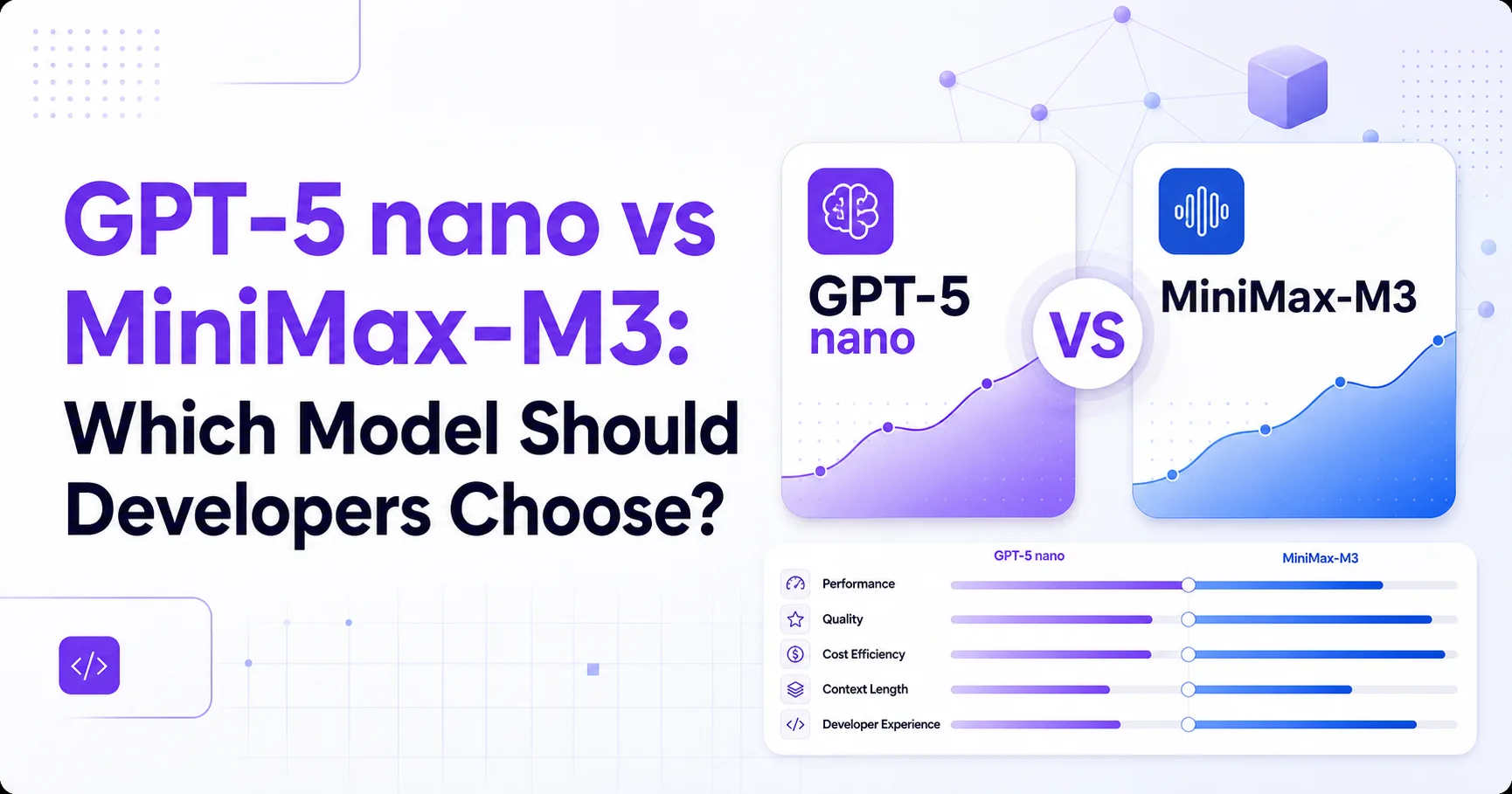
- **Winner overall:** MiniMax-M3, with a 44.4 Artificial Analysis Intelligence Index score vs 19.9 for GPT-5 nano - **Cheaper:** GPT-5 nano at $0.1375 vs $0.525 per 1M blended tokens - **Faster:** MiniMax-M3 at 87.089 (median output tokens per second) - **Pick GPT-5 nano when:** predictable low token cost and math-oriented evaluation coverage matter most - **Watch out:** neither model has a verified context window or complete official documentation in the supplied research
GPT-5 nano vs MiniMax-M3
GPT-5 nano is the lower-cost choice, while MiniMax-M3 has the stronger measured general intelligence score and the only reported output-speed result. This comparison therefore favors GPT-5 nano for cost-sensitive workloads and MiniMax-M3 for broader measured capability, but neither recommendation is fully production-safe because the supplied research cannot verify either model’s current API status, context window, or output limits. The data layer reports GPT-5 nano at a $0.1375 blended price per 1M tokens, compared with $0.525 for MiniMax-M3. MiniMax-M3 also records an Artificial Analysis Intelligence Index score of 44.4, compared with 19.9 for GPT-5 nano. Its median output speed is 87.089 tokens per second, while GPT-5 nano has no reported value. Both models have a reported latency of 0.3 seconds. Data provided by Artificial Analysis.
Executive summary for developers
MiniMax-M3 leads the measured general capability comparison, but GPT-5 nano remains the safer economic choice when request volume dominates the architecture. The measured Intelligence Index favors MiniMax-M3 at 44.4 versus 19.9 for GPT-5 nano. That gap is large enough to matter for tasks that require broad reasoning, instruction following, or varied knowledge work. However, the supplied benchmark snapshot does not provide a coding score for GPT-5 nano or a math score for MiniMax-M3. The available evidence is therefore asymmetric rather than a complete capability ranking. GPT-5 nano has a reported math index of 83.7, but there is no matching MiniMax-M3 math result. MiniMax-M3 has a reported coding index of 58.6, but there is no matching GPT-5 nano coding result. Developers should not turn either isolated score into a universal winner. OpenAI’s current model documentation does not list GPT-5 nano, and the supplied research found no verifiable official documentation for MiniMax-M3. The current OpenAI pricing page lists gpt-5.4-nano rather than gpt-5-nano, so that newer listing cannot be treated as GPT-5 nano evidence. The practical conclusion is conditional: MiniMax-M3 has the better measured general score, while GPT-5 nano has the better measured price position and a stronger available math result.
Performance: measured quality is incomplete
MiniMax-M3 is the measured quality leader on the shared Intelligence Index, but the missing head-to-head evaluations prevent a complete performance verdict. MiniMax-M3 scores 44.4, while GPT-5 nano scores 19.9, making MiniMax-M3 the stronger documented option for broad capability within this snapshot. That result can influence model selection for assistants handling mixed tasks, especially when quality failures create review work or user-visible corrections. It does not prove that MiniMax-M3 wins coding or mathematical workloads. The coding comparison contains only MiniMax-M3’s 58.6 result. The math comparison contains only GPT-5 nano’s 83.7 result. Those missing counterpart measurements are evidence gaps, not zero scores. A developer building a coding assistant should treat MiniMax-M3 as the only model with direct coding evidence here, while still requiring an application-specific test against GPT-5 nano. A quantitative workflow should treat GPT-5 nano similarly because its math coverage is not matched by MiniMax-M3. MiniMax-M3 is also the only model with a reported median output speed, at 87.089 tokens per second. GPT-5 nano has no reported output-speed value, so the speed chart cannot establish a winner. The reported latency is 0.3 seconds for each model, which suggests no measured latency advantage in this dataset. Real user experience can still diverge because streaming behavior, queueing, output length, provider routing, and workload shape are not described. The official OpenAI model page does not provide GPT-5 nano-specific benchmarks or limits. The research also found no verifiable MiniMax-M3 benchmark documentation. Developers should validate representative prompts, structured-output reliability, tool calls, refusal behavior, and long-context handling before treating the measured index as a deployment decision.
Cost: GPT-5 nano has the stronger economic case
GPT-5 nano is materially cheaper on every reported token-price measure, but MiniMax-M3 can still be economically preferable if its quality advantage reduces retries, review, or downstream processing. GPT-5 nano costs $0.1375 per 1M blended tokens under the supplied 3-to-1 mix, compared with $0.525 for MiniMax-M3. Its input price is $0.05 versus $0.3, and its output price is $0.4 versus $1.2. The chart already shows the price spread, so the important selection question is what the price buys. GPT-5 nano is attractive for high-volume classification, extraction, routing, lightweight generation, and other workloads where a low unit cost matters more than broad measured capability. MiniMax-M3 may justify its higher price when a weaker answer causes a human review, a second model call, a retry, or a failed workflow. The supplied data does not quantify any of those operational costs, so that tradeoff remains unproven. Output-heavy workloads deserve particular attention because MiniMax-M3’s reported output price is $1.2 per 1M tokens, while GPT-5 nano’s is $0.4. Conversely, an application that sends large prompts and produces short answers will feel the input-price difference more directly. Neither model has a verified context window in the supplied material, so developers cannot safely infer whether one model will require more chunking or summarization. The current OpenAI pricing directory does not list gpt-5-nano, and its gpt-5.4-nano entry cannot substitute for the supplied GPT-5 nano price. Treat the Artificial Analysis values as comparison data, then confirm live provider billing before launch.
Recommendation by workload
GPT-5 nano is the default pick for cost-sensitive production pipelines, while MiniMax-M3 is the better candidate for quality-first experiments that can tolerate documentation uncertainty. Choose GPT-5 nano when the workload runs at high request volume, has narrow task boundaries, benefits from the reported math index of 83.7, or needs the lowest reported blended price of $0.1375 per 1M tokens. That choice is strongest when outputs are easy to validate and failures are cheap to recover from. Choose MiniMax-M3 when broad measured capability matters more than token price, especially because its Intelligence Index is 44.4 and its reported coding index is 58.6. The case is stronger when the application can test its API access, monitor availability, and absorb the higher blended price of $0.525 per 1M tokens. MiniMax-M3 is also the only model with a reported median output speed, at 87.089 tokens per second, but the missing GPT-5 nano measurement prevents a speed comparison. Teams should avoid making either model the sole dependency until the provider identity, stable model alias, context window, output limit, supported parameters, and failure behavior are verified. The research explicitly found no current official directory entry for GPT-5 nano, and no verifiable official documentation for MiniMax-M3. OpenAI’s model documentation describes current model capabilities at a general level, but does not establish GPT-5 nano support. The final decision should therefore combine the measured snapshot with a small, task-specific acceptance set. If that test is unavailable, GPT-5 nano offers the clearer price case, while MiniMax-M3 offers the stronger measured general-capability signal.
What to verify before production
GPT-5 nano and MiniMax-M3 both require provider verification before a production commitment because the supplied research leaves core integration facts unresolved. The official OpenAI model directory does not list GPT-5 nano, and the research found no verifiable MiniMax-M3 documentation. Developers should confirm the callable model identifier, API endpoint, authentication method, context window, maximum output, supported parameters, rate limits, data handling terms, and deprecation policy. They should also test the exact workload rather than relying on one aggregate index. The supplied snapshot provides useful directional evidence, but it cannot answer whether either model will behave consistently under the application’s prompts and operational constraints.
Frequently asked questions
Which model is better overall for developers?
MiniMax-M3 is better on the shared Intelligence Index at 44.4 versus 19.9, but GPT-5 nano is cheaper and has the only reported math result at 83.7, so the overall choice depends on workload priorities and verification results.
Which model is cheaper for API workloads?
GPT-5 nano is cheaper across every supplied token metric, costing $0.1375 per 1M blended tokens versus $0.525 for MiniMax-M3, with lower input and output prices as well.
Is MiniMax-M3 faster than GPT-5 nano?
MiniMax-M3 has the only reported output-speed measurement at 87.089 median output tokens per second, while both models show 0.3 seconds latency, so the supplied evidence cannot prove an overall speed winner.
Should developers use GPT-5 nano for coding?
Developers should not make that decision from this snapshot alone because MiniMax-M3 has a reported coding index of 58.6, while GPT-5 nano has no matching coding measurement or verified model-specific documentation.
Should developers use MiniMax-M3 for mathematical tasks?
Developers should validate MiniMax-M3 independently because GPT-5 nano has a reported math index of 83.7, while MiniMax-M3 has no matching math result in the supplied data.
Can the current OpenAI nano pricing page confirm GPT-5 nano’s price?
The current OpenAI pricing page cannot confirm GPT-5 nano’s price because the supplied research says it lists gpt-5.4-nano, not gpt-5-nano, so the comparison price must remain attributed to the supplied data snapshot.
Sources
- Artificial Analysis提供模型价格、延迟、输出速度和能力指数数据
- OpenAI Models核查 GPT-5 nano 的当前模型目录、能力概述、可用性、API 信息和官方基准资料
- OpenAI API Pricing核查 OpenAI 当前定价目录,并确认现行页面未列出 gpt-5-nano
Published: