
AI model analysis
GPT-5 nano (high) vs Qwen3.7 Max: Which Model Should Developers Choose?
A developer-focused comparison of GPT-5 nano (high) and Qwen3.7 Max based on available pricing, latency, evaluation data, and evidence gaps.
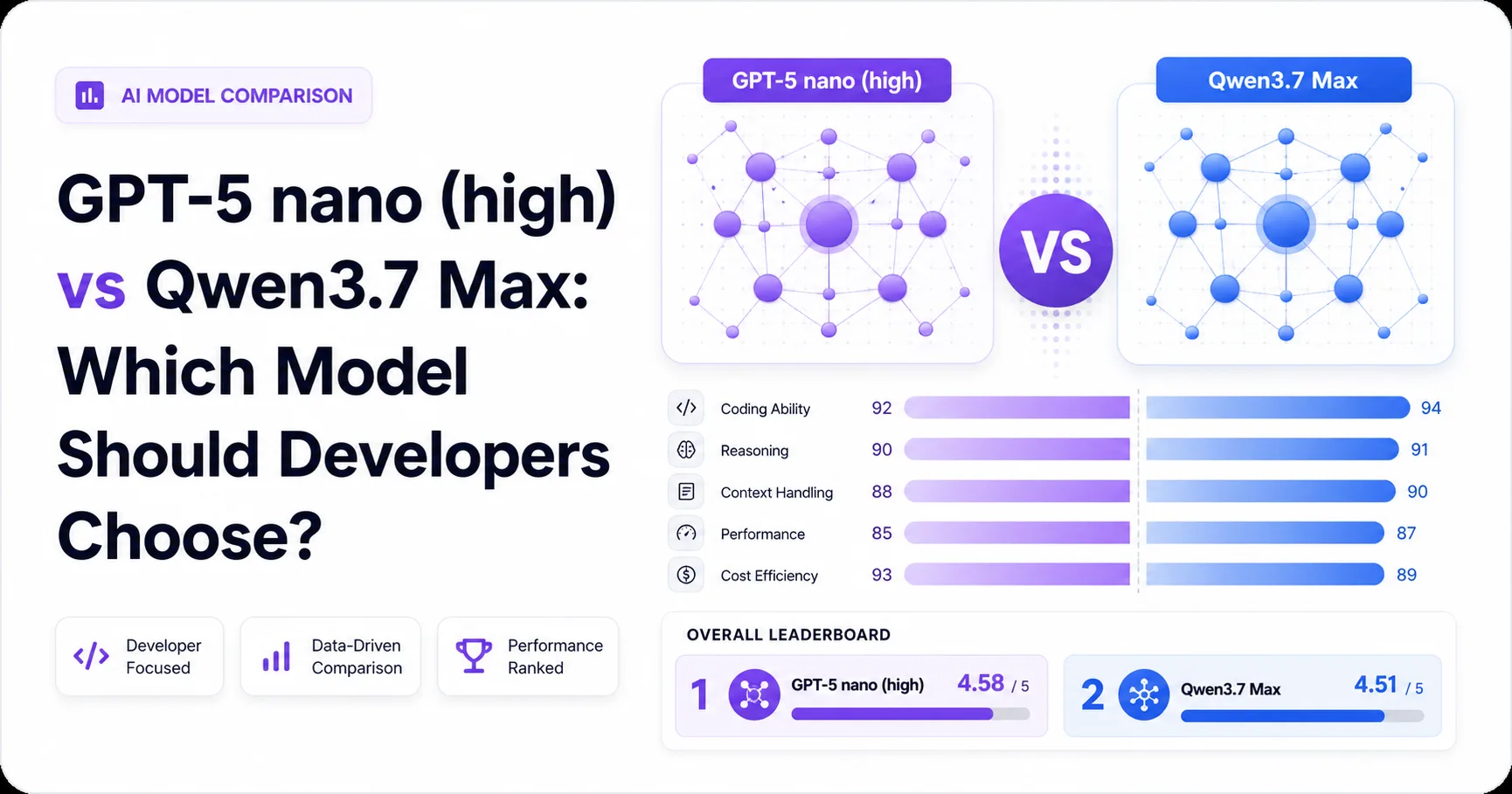
- **Winner overall:** Qwen3.7 Max, with an Artificial Analysis Intelligence Index score of 46 vs 19.9 - **Cheaper:** GPT-5 nano (high) at $0.1375 vs $3.75 per 1M blended tokens - **Faster:** Qwen3.7 Max at 204.156 (median output tokens per second) - **Pick GPT-5 nano (high) when:** low operating cost matters most and the required task fits the available evidence - **Watch out:** GPT-5 nano (high) lacks a current official model listing, while Qwen3.7 Max lacks verifiable official documentation
GPT-5 nano (high) vs Qwen3.7 Max
Qwen3.7 Max is the stronger provisional choice on the available intelligence evaluation, while GPT-5 nano (high) is dramatically cheaper and easier to justify for cost-sensitive workloads.
The comparison has an unusual constraint: the two models do not have equivalent documentation. The data brief reports an Artificial Analysis Intelligence Index of 46 for Qwen3.7 Max and 19.9 for GPT-5 nano (high). It also reports a coding index of 66 only for Qwen3.7 Max, and a math index of 83.7 only for GPT-5 nano (high). Those missing counterpart scores prevent a complete capability ranking.
Pricing creates a much clearer separation. GPT-5 nano (high) costs $0.1375 per 1M blended tokens, compared with $3.75 for Qwen3.7 Max. The reported latency is 0.3 seconds for each model. Qwen3.7 Max has a reported median output speed of 204.156 tokens per second, while GPT-5 nano (high) has no reported output-speed value.
The practical decision is therefore not simply “best model versus cheapest model.” It is a choice between stronger measured general intelligence with limited product evidence, and lower cost with incomplete current documentation. Artificial Analysis provides the comparison data used in this article.
Executive summary for developers
GPT-5 nano (high) offers the better economic default, while Qwen3.7 Max offers the better measured capability signal.
Qwen3.7 Max leads the available Artificial Analysis Intelligence Index by a reported 46 to 19.9. That result supports testing Qwen3.7 Max first for tasks where broad reasoning quality, coding quality, or complex instruction following could justify higher spend. The same brief reports a coding index of 66 for Qwen3.7 Max, but no comparable coding value for GPT-5 nano (high).
GPT-5 nano (high) has the stronger reported math signal, at 83.7, but Qwen3.7 Max has no math value in the supplied data. This is a data gap, not proof that GPT-5 nano (high) is better at mathematics overall. Developers should avoid turning one-sided benchmarks into a universal conclusion.
The product-status evidence points in opposite directions. The current OpenAI model directory does not list GPT-5 nano, gpt-5-nano, or gpt-5-nano-2025-08-07. No verifiable official release, documentation, pricing, or stable alias was found for Qwen3.7 Max. As a result, neither model has a fully documented production story in the supplied research.
For a production shortlist, select GPT-5 nano (high) when cost, input volume, and output volume dominate. Select Qwen3.7 Max when the intelligence and coding signals justify a validation budget. Treat both selections as conditional until API availability and model identity are confirmed.
Performance: what the reported scores mean in practice
Qwen3.7 Max has the stronger reported general capability signal, but the evidence does not establish a complete task-level performance winner.
A 46 Intelligence Index score for Qwen3.7 Max versus 19.9 for GPT-5 nano (high) suggests a meaningful difference in the tested intelligence composite. For developers, that gap may matter in tasks that require planning, multi-step reasoning, ambiguous requirements, or robust instruction interpretation. It does not directly predict success on a specific codebase, agent workflow, retrieval system, or structured-output contract.
The coding evidence is one-sided. Qwen3.7 Max has a reported coding index of 66, while GPT-5 nano (high) has no reported coding value in the supplied brief. That makes Qwen3.7 Max the only model with a coding result here, but it does not quantify the advantage over GPT-5 nano (high). A team choosing a coding model should run its own repository tasks, including edits, tests, debugging, and tool calls.
The math evidence has the same limitation in reverse. GPT-5 nano (high) has a reported math index of 83.7, while Qwen3.7 Max has no reported math value. The available data cannot show whether the math result transfers to symbolic manipulation, quantitative business logic, or production-grade numerical explanations.
Speed is also incomplete. Qwen3.7 Max reports 204.156 median output tokens per second, but GPT-5 nano (high) has no output-speed value. Both models report 0.3 seconds of latency, which suggests no latency distinction in this snapshot. Developers should still measure end-to-end latency, because provider routing, prompt length, tool execution, and streaming behavior are not represented by a single latency field.
Cost: the cheaper model can still be the wrong choice
GPT-5 nano (high) is the clear price leader, but Qwen3.7 Max can be economically rational when better outputs reduce downstream work.
The supplied pricing data places GPT-5 nano (high) at $0.1375 per 1M blended tokens, versus $3.75 for Qwen3.7 Max. GPT-5 nano (high) is also listed at $0.05 per 1M input tokens and $0.4 per 1M output tokens. Qwen3.7 Max is listed at $2.5 per 1M input tokens and $7.5 per 1M output tokens. These figures make GPT-5 nano (high) the natural candidate for high-volume classification, extraction, routing, summarization, and other workflows where quality thresholds are already met.
Price alone does not determine total cost. A cheaper model becomes more expensive in practice if it requires retries, human review, longer prompts, extra validation calls, or a second model to repair its output. The available data does not report task success rates, retry rates, or operational overhead, so it cannot calculate total cost of ownership.
Qwen3.7 Max may justify its higher token price when each successful response replaces substantial engineering or review effort. The reported Intelligence Index of 46 and coding index of 66 provide reasons to test it on difficult tasks. They do not prove that the model will reduce costs for a particular application.
The sensible cost decision is workload-specific. Benchmark representative requests at the same quality threshold, record retries and review time, and then compare spend. Until that evidence exists, GPT-5 nano (high) wins on token price, while Qwen3.7 Max remains a potentially cheaper system-level choice for demanding tasks.
Evidence gaps that should change the buying decision
GPT-5 nano (high) has a serious current-availability evidence gap, while Qwen3.7 Max has a broader documentation gap.
The current OpenAI model directory does not list GPT-5 nano, gpt-5-nano, or gpt-5-nano-2025-08-07. The research therefore cannot confirm whether GPT-5 nano (high) remains directly callable, has a stable alias, or has been replaced. The directory gives a general overview of recent OpenAI model capabilities, including text and image input, text output, multilingual support, Responses API access, and official SDK access, but the supplied research does not establish that those statements specifically cover GPT-5 nano (high).
The current OpenAI pricing page lists gpt-5.4-nano with standard short-context prices of $0.20 per 1M input tokens, $0.02 per 1M cached input tokens, and $1.25 per 1M output tokens. Those values must not be substituted for GPT-5 nano (high). The data brief supplies a separate price snapshot for GPT-5 nano (high), but the official page does not verify it.
Qwen3.7 Max has an even more basic gap in the supplied research. No verifiable official announcement, developer documentation, product page, stable alias, pricing page, availability statement, limitation description, or community discussion was found. The data brief still reports evaluation, speed, latency, and pricing values, but it does not provide a public provenance trail for Qwen3.7 Max.
Neither model has reliable community evidence in this brief. No verifiable Reddit, Hacker News, or X posts were found for either model. Developers should treat deployment status, API compatibility, limits, and failure behavior as open questions.
Recommendation by workload
GPT-5 nano (high) is the recommended first test for high-volume applications, while Qwen3.7 Max is the recommended first test for difficult reasoning and coding workloads.
Choose GPT-5 nano (high) when the application processes many tokens, has a strict cost ceiling, or uses a fallback path for uncertain outputs. Its reported blended price of $0.1375 per 1M tokens makes experimentation inexpensive. Its reported math index of 83.7 also makes it worth testing for numerical tasks, although the absence of a Qwen3.7 Max math score prevents a direct ranking.
Choose Qwen3.7 Max when a response must handle complex instructions, code generation, or difficult reasoning before human review. Its reported Intelligence Index of 46 and coding index of 66 are the stronger available signals for those uses. Its reported median output speed of 204.156 tokens per second may also help interactive workloads, but no equivalent GPT-5 nano (high) speed value is available.
Use a two-stage architecture only if evaluation supports it. A low-cost model can handle routine requests, while a stronger model reviews uncertain or high-impact cases. The supplied evidence does not show that this routing strategy will improve quality or cost, so teams must measure it rather than assume it.
Before committing, verify that each model is callable under a stable identifier, confirm context and output limits, test structured outputs and tool use, and measure quality on real developer tasks. The supplied research found no context-window value for either model. That omission is material for long-code and long-document workflows.
The final recommendation is conditional: prioritize GPT-5 nano (high) for cost-led deployment, and prioritize Qwen3.7 Max for capability-led evaluation. Do not make a permanent production choice until the documentation gaps are resolved.
FAQ before you choose
Developers should resolve availability, capability, and workload-fit questions before treating either model as production-ready.
The available evidence supports a cautious shortlist, not a definitive universal ranking. Qwen3.7 Max leads the reported intelligence signal, and GPT-5 nano (high) leads pricing. Missing benchmarks and missing official product evidence limit stronger conclusions.
Frequently asked questions
Which model is better overall for developers?
Qwen3.7 Max is the better provisional overall choice because its reported Intelligence Index is 46 versus 19.9 for GPT-5 nano (high), but the comparison lacks complete coding, math, availability, and documentation evidence.
Which model is cheaper for production workloads?
GPT-5 nano (high) is cheaper by the supplied pricing snapshot, at $0.1375 per 1M blended tokens, compared with $3.75 for Qwen3.7 Max, although retry and review costs remain unmeasured.
Which model should I choose for coding?
Qwen3.7 Max is the stronger evidence-based coding candidate because it has a reported coding index of 66, while GPT-5 nano (high) has no coding score in the supplied data.
Is GPT-5 nano (high) currently available through OpenAI?
The supplied research cannot confirm current availability because the official OpenAI model directory does not list GPT-5 nano, gpt-5-nano, or gpt-5-nano-2025-08-07.
Is Qwen3.7 Max officially documented?
The supplied research found no verifiable official announcement, developer documentation, product page, stable alias, pricing page, or availability statement for Qwen3.7 Max.
Which model is faster?
The available data does not establish a complete speed winner: Qwen3.7 Max reports 204.156 median output tokens per second, GPT-5 nano (high) has no output-speed value, and both report 0.3 seconds latency.
Should I use the official gpt-5.4-nano price for GPT-5 nano (high)?
No, developers should not substitute gpt-5.4-nano pricing for GPT-5 nano (high), because the official pricing page lists a different model and the research explicitly treats them as separate.
Sources
- Artificial AnalysisAll benchmark, latency, output-speed, release-date, and pricing values supplied in the data brief.
- OpenAI ModelsChecking GPT-5 nano listing status, OpenAI capability documentation, API information, and missing model limits.
- OpenAI API PricingChecking current OpenAI pricing listings and distinguishing gpt-5.4-nano from GPT-5 nano.
Published: