
AI model analysis
GPT-5 vs GPT-5.2 (medium): Which Model Should Developers Choose?
A developer-focused comparison of GPT-5 (high) and GPT-5.2 (medium), covering measured quality, cost, API evidence, version risk, and selection guidance.
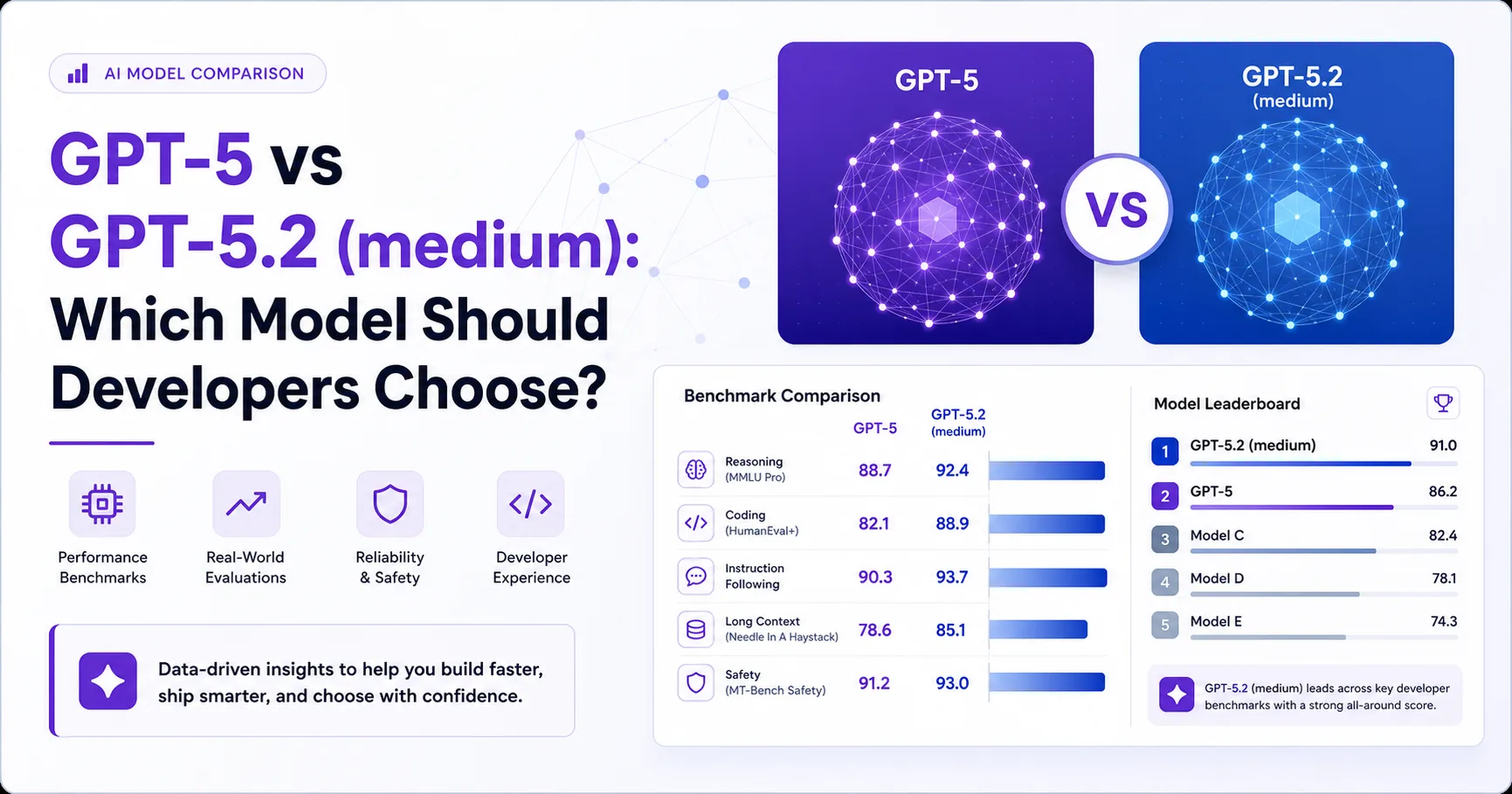
- **Winner overall:** GPT-5.2 (medium), with a 38 intelligence index and 96.7 math index, although its API status is not officially verified - **Cheaper:** GPT-5 (high) at $3.4375 vs $4.8125 per 1M blended tokens - **Faster:** Tie, with both models at 0.3 seconds latency - **Pick GPT-5 (high) when:** You need a documented OpenAI API model, coding evidence, structured tool use, and lower operating cost - **Watch out:** No official model entry, pricing, coding score, or community evidence was found for GPT-5.2 (medium)
GPT-5 vs GPT-5.2 (medium)
GPT-5 (high) is the safer production choice, while GPT-5.2 (medium) is the stronger measured-quality candidate with substantially weaker public evidence. The available comparison data gives GPT-5.2 (medium) an intelligence index of 38 and a math index of 96.7. GPT-5 (high) records 34.7 and 94.3 on those measures. Those results make GPT-5.2 (medium) attractive for reasoning-heavy workloads, but they do not establish a complete engineering winner because its coding score, API identity, pricing status, and operating behavior remain unverified.
GPT-5 has a documented OpenAI API identity, supported endpoints, reasoning controls, structured outputs, function calling, streaming, and text and image input support according to GPT-5 for developers and the GPT-5 model documentation. The documentation also identifies a fixed GPT-5 snapshot as Deprecated and recommends a newer model family, which creates migration risk for applications that pin versions.
The central selection question is therefore not simply which score is higher. It is whether a developer can validate GPT-5.2 (medium) in the intended deployment environment. The research brief found no official entry, release announcement, technical report, or reproducible community test for that exact label. Until that gap closes, GPT-5 offers the clearer contract even when GPT-5.2 (medium) appears better on the available evaluations.
Executive summary
GPT-5.2 (medium) leads the available intelligence and math measurements, but GPT-5 leads on documented deployability, coding evidence, and price. The data brief reports GPT-5.2 (medium) at 38 on the intelligence index versus 34.7 for GPT-5 (high). It also reports 96.7 versus 94.3 on the math index. The coding comparison has no GPT-5.2 (medium) value, so no coding winner can be supported.
| Decision factor | GPT-5 (high) | GPT-5.2 (medium) | Selection meaning |
|---|---|---|---|
| Public API evidence | Documented model and alias | No dedicated official entry found | GPT-5 is easier to validate |
| Intelligence index | 34.7 | 38 | GPT-5.2 (medium) leads the available measure |
| Math index | 94.3 | 96.7 | GPT-5.2 (medium) leads the available measure |
| Coding index | 37.8 | No value available | Evidence favors GPT-5 only because it is measured |
| Blended price | $3.4375 | $4.8125 | GPT-5 has the lower listed comparison price |
| Latency | 0.3 seconds | 0.3 seconds | The supplied data shows a tie |
The official OpenAI Models directory does not list GPT-5.2 (medium) or gpt-5-2-medium. The official OpenAI Pricing page also does not list that identifier. This means the apparent quality advantage is useful as a test hypothesis, not as a complete procurement conclusion.
Performance: what the scores mean for real development work
GPT-5.2 (medium) is the measured quality leader for general intelligence and mathematics, but GPT-5 (high) is the only model with direct coding evidence in this comparison. The intelligence gap suggests that GPT-5.2 (medium) may deserve evaluation for tasks requiring multi-step judgment, quantitative reasoning, or difficult answer selection. The math result strengthens that case, especially where incorrect intermediate reasoning creates expensive downstream work.
The result does not prove that GPT-5.2 (medium) writes better software. Its coding index is unavailable, while GPT-5 (high) has a coding index of 37.8. The missing value is not a low score. It is an evidence gap. Developers should not convert that gap into either a positive or negative coding conclusion.
The supplied latency data shows both models at 0.3 seconds. That tie makes application architecture more important than model branding. User-visible responsiveness will still depend on prompt size, output length, retries, tool execution, streaming behavior, and application orchestration. The available data does not provide output-token speed, so it cannot answer which model produces long responses faster.
OpenAI positions GPT-5 for coding, reasoning, and agentic tasks, with reasoning effort and verbosity controls documented in GPT-5 for developers. A community post reports useful results for small bug fixes, but also describes weaker completion and design detail in complete applications and possible incorrect changes in complex repositories. That account is an uncontrolled individual experience, so it should guide test design rather than serve as a benchmark. See Tried GPT-5 Here Are My First Impressions.
Cost: the cheaper model can still cost more in practice
GPT-5 (high) is the lower-cost option in the supplied pricing comparison, but GPT-5.2 (medium) could justify its premium if it materially reduces retries, human review, or tool failures. GPT-5 costs $3.4375 per 1M blended tokens compared with $4.8125 for GPT-5.2 (medium). The input prices are $1.25 and $1.75, while output prices are $10 and $14. The comparison therefore favors GPT-5 for predictable high-volume workloads where both models achieve similar task completion.
The chart cannot show whether a quality improvement changes total task cost. A model that solves a difficult coding or reasoning task in one attempt may be cheaper than a lower-priced model that needs repeated prompts, corrective edits, or additional validation. The research brief does not provide retry rates, token consumption by task, success rates, or human review costs. No break-even conclusion can be calculated from the supplied evidence.
GPT-5.2 (medium) also lacks a confirmed official price. The comparison values are useful for the supplied model dataset, but the official pricing page does not list gpt-5-2-medium. Developers should treat the displayed GPT-5.2 (medium) cost as a comparison input, then verify whether the identifier is callable and billable through an authorized route before budgeting.
GPT-5 has documented input, cached-input, and output pricing in the GPT-5 model documentation. Its lower blended comparison price makes it the rational default for broad workloads, provided its documented version and migration status fit the deployment plan.
Recommendation by workload
GPT-5 (high) should be the default shortlist choice for production systems, while GPT-5.2 (medium) should be a controlled experiment for reasoning-heavy workloads. GPT-5 has the stronger evidence package: an official model page, a stable gpt-5 alias, documented tool capabilities, a coding measurement, and a lower blended comparison price. That combination reduces the risk of building around an identifier that cannot be independently verified.
Choose GPT-5 (high) when the system needs software engineering assistance, repository changes, structured tool calls, predictable API integration, or cost-sensitive scaling. Its documented reasoning controls also let developers test different effort settings against task quality and latency. The fixed snapshot risk still matters. OpenAI marks gpt-5-2025-08-07 as Deprecated, so teams should avoid treating the snapshot as permanently available and should maintain a migration path. This status is documented in the GPT-5 model documentation.
Test GPT-5.2 (medium) when mathematical accuracy, broad reasoning quality, or difficult judgment tasks dominate the workload. Start with a private evaluation that measures task success, correction rate, output length, tool-call validity, and reviewer effort. Do not promote it based only on the intelligence index or math index. The research brief found no official model entry, price listing, dedicated benchmark report, or reliable community evaluation for this exact model label in OpenAI Models and OpenAI Pricing.
Neither model should be selected as a direct audio or video API solution. GPT-5 supports text and image input with text output, but the supplied research found no equivalent verified modality profile for GPT-5.2 (medium).
What developers should verify before switching
GPT-5.2 (medium) requires identity and access validation before any production decision. The available sources do not confirm whether gpt-5-2-medium is an official callable identifier, a provider-specific label, an internal evaluation label, or an unavailable model name. That uncertainty affects authentication, billing, rate limits, retention, model behavior, and migration planning.
GPT-5 also requires version planning despite its clearer documentation. The current documentation lists the gpt-5 alias while marking the fixed snapshot as Deprecated. Teams should record the exact identifier used in tests, compare alias behavior with pinned behavior, and define a fallback before launch. The research does not provide enough evidence to state how long the alias will preserve behavior.
A useful evaluation should compare the models on the developer’s own workload. Include repository edits, test repair, tool selection, structured output, mathematical tasks, long-context tasks, and failure recovery. Record successful completion and review burden separately. The available brief does not provide enough information to predict those outcomes for GPT-5.2 (medium), and the community evidence for GPT-5 is anecdotal.
The decision can remain simple: use GPT-5 when documented integration and cost control matter most, and investigate GPT-5.2 (medium) when its measured quality advantage maps to a business-critical task. The evidence currently supports experimentation, not an unconditional replacement.
Frequently asked questions
Is GPT-5.2 (medium) officially available through the OpenAI API?
GPT-5.2 (medium) is not officially verified in the supplied research because OpenAI’s current model directory does not list that exact model or a confirmed gpt-5-2-medium identifier. Developers should verify access, billing, and documentation directly before implementation.
Which model is better for coding?
GPT-5 (high) is the only model with a supplied coding index, recorded at 37.8, so it has stronger coding evidence rather than a proven universal coding advantage. GPT-5.2 (medium) has no comparable coding value.
Which model is cheaper for production workloads?
GPT-5 (high) is cheaper in the supplied comparison at $3.4375 per 1M blended tokens versus $4.8125 for GPT-5.2 (medium). Actual total cost may change if one model needs more retries, review, or corrective tool calls.
Which model is faster?
Neither model is faster in the supplied latency data because both are listed at 0.3 seconds. Output-token speed is unavailable, so the comparison cannot determine which model streams long answers faster.
Should developers replace GPT-5 with GPT-5.2 (medium)?
Developers should not replace GPT-5 unconditionally because GPT-5.2 (medium) has stronger available intelligence and math scores but lacks verified API identity, pricing, coding evidence, and reproducible community testing.
Can either model handle audio and video directly?
GPT-5 should not be treated as a direct audio or video solution because the supplied documentation describes text and image input with text output. The research does not establish a verified modality profile for GPT-5.2 (medium).
Sources
- GPT-5 for developersGPT-5 positioning, reasoning controls, tool calling, structured outputs, and official benchmark context
- GPT-5 model documentationGPT-5 API identity, capabilities, pricing, modality limits, endpoint availability, and Deprecated snapshot status
- OpenAI ModelsVerification of the current model directory and the absence of a dedicated GPT-5.2 (medium) entry
- OpenAI PricingVerification of current pricing listings and the absence of gpt-5-2-medium pricing
- Tried GPT-5 Here Are My First ImpressionsAnecdotal community evidence about bug fixing, complete application generation, and complex repository changes
Published: