
AI model analysis
GPT-5 vs GPT-5.5: Which Model Should Developers Choose?
A developer-focused comparison of GPT-5 and GPT-5.5 across coding quality, reasoning, cost, latency, tooling, lifecycle risk, and production fit.
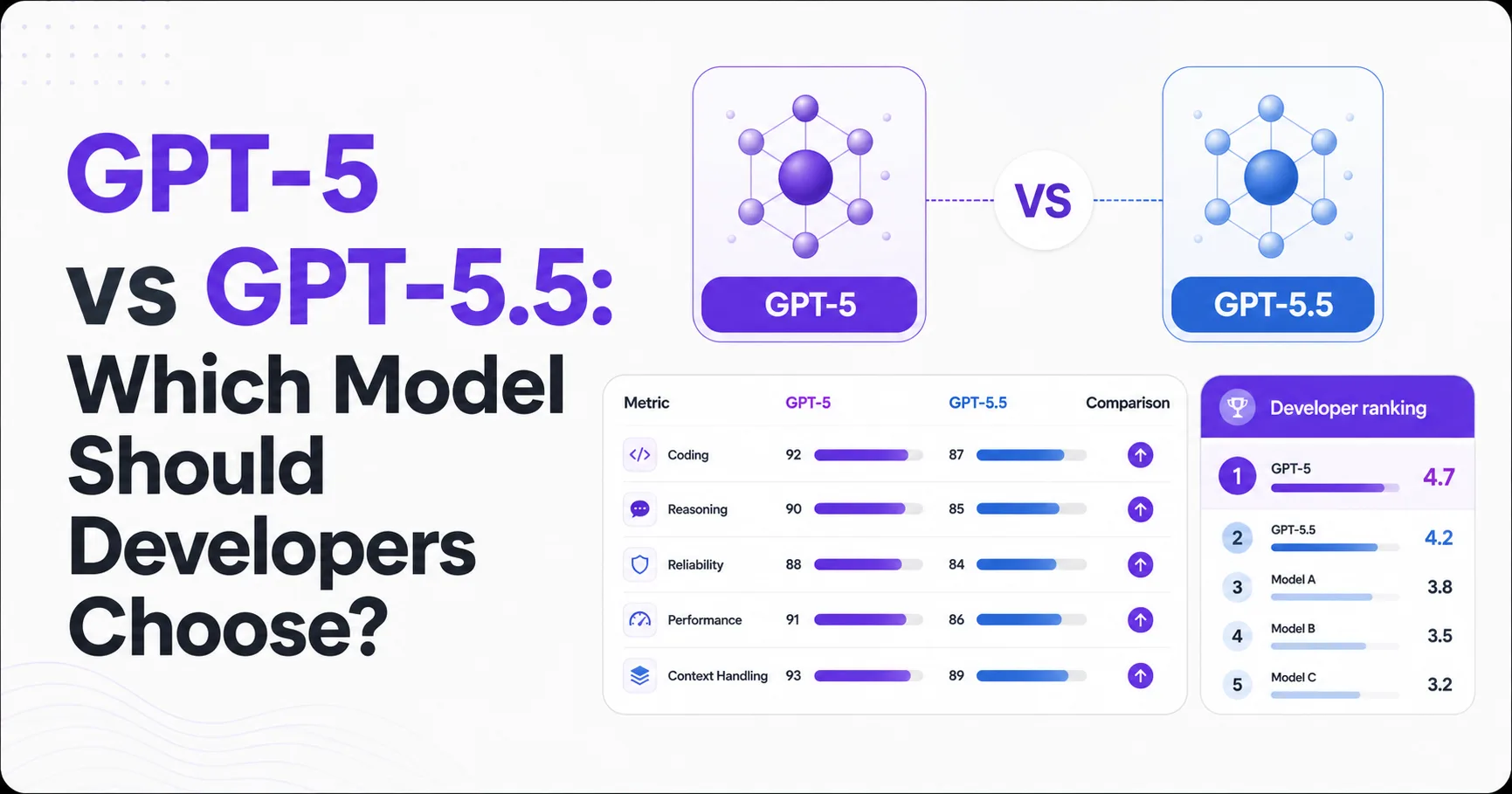
- **Winner overall:** GPT-5.5 (xhigh), with an Artificial Analysis Intelligence Index of 54.8 and Coding Index of 74.9 - **Cheaper:** GPT-5 (high) at $3.4375 vs $11.25 per 1M blended tokens - **Faster:** GPT-5 (high) and GPT-5.5 (xhigh) tie at 0.3 seconds latency - **Pick GPT-5 when:** cost control, mathematical reasoning, or a lower-priced production default matters more than maximum coding capability - **Watch out:** GPT-5.5 has no directly comparable Artificial Analysis math score, while GPT-5.5’s higher reasoning effort can add cost and latency without guaranteeing better results
GPT-5 vs GPT-5.5 for Developers
GPT-5.5 (xhigh) is the stronger default for difficult software work, while GPT-5 (high) remains the safer choice when cost and lifecycle simplicity dominate.
The data brief gives GPT-5.5 a 74.9 Coding Index and a 54.8 Intelligence Index. GPT-5 records 37.8 and 34.7 on those respective measures. That gap points toward GPT-5.5 for repository-scale coding, architecture, tool use, and multi-step technical work.
GPT-5 still has a meaningful advantage in price. Its blended cost is $3.4375 per 1M tokens, compared with $11.25 for GPT-5.5. The models also tie on measured latency at 0.3 seconds, while the brief provides no output-speed value for either model. Artificial Analysis supplies the comparison data.
The product context changes the decision. OpenAI describes GPT-5 as a reasoning model for coding, reasoning, and agentic tasks in its GPT-5 developer announcement. OpenAI positions GPT-5.5 for complex professional work, tool-heavy agents, long-context retrieval, and higher execution quality in Using GPT-5.5.
Executive Summary
GPT-5.5 (xhigh) wins capability-oriented selection, but GPT-5 (high) wins the economic case by a wide margin.
| Decision factor | Better choice | Why it matters |
|---|---|---|
| Coding capability | GPT-5.5 (xhigh) | The Coding Index is 74.9 for GPT-5.5 and 37.8 for GPT-5. |
| General intelligence | GPT-5.5 (xhigh) | The Intelligence Index is 54.8 for GPT-5.5 and 34.7 for GPT-5. |
| Mathematical evidence | GPT-5 (high) has the only reported value | GPT-5 records 94.3, while the brief does not provide a GPT-5.5 comparison. |
| Blended cost | GPT-5 (high) | GPT-5 costs $3.4375 per 1M blended tokens versus $11.25 for GPT-5.5. |
| Latency | Tie | Both models are listed at 0.3 seconds latency. |
| Current lifecycle confidence | GPT-5.5 (xhigh) | The GPT-5 fixed snapshot is marked Deprecated, while no GPT-5.5 deprecation statement was found. |
The model IDs also matter. GPT-5 uses the stable alias gpt-5, while “high” refers to the reasoning_effort=high setting rather than a separate gpt-5-high API model. GPT-5.5 uses gpt-5.5, while xhigh is a reasoning setting rather than an independent model ID. These details come from the GPT-5 model documentation and GPT-5.5 model documentation.
The evidence does not establish a universal winner for every task. GPT-5.5 has no reported Artificial Analysis math score in this brief, and neither model has a reported median output-token speed. A team choosing on mathematical accuracy or streaming throughput needs its own evaluation.
Performance: What the Gap Means in Real Work
GPT-5.5 (xhigh) is the better candidate for repository-scale coding and tool-heavy workflows, but the available benchmark evidence does not prove superiority in every technical domain.
The Coding Index gap is large enough to change workflow design. A developer evaluating a feature across unfamiliar modules, tests, configuration, and deployment scripts should expect GPT-5.5 to be the more credible first candidate. Its official positioning also emphasizes complex professional work, long-context retrieval, tool-intensive agents, and converting product specifications into plans. Those capabilities fit tasks where the model must preserve constraints across many decisions, not merely produce an isolated function.
GPT-5 remains attractive for narrower work. OpenAI presents it as a model for coding, reasoning, and agentic tasks, and its reported math value is 94.3. That result cannot be compared directly with GPT-5.5 because the data brief contains no GPT-5.5 math value. The absence is important: a team building symbolic, quantitative, or verification-heavy workflows should not infer a GPT-5.5 math advantage from its broader intelligence or coding score.
The official GPT-5 results also require careful interpretation. OpenAI reports SWE-bench Verified at 74.9% and says the evaluation excluded 23 of 500 problems that could not pass reliably on its infrastructure. OpenAI reports Aider polyglot at 88% using high reasoning effort. These are useful signals, but they are not a controlled head-to-head comparison with the Artificial Analysis scores in the data brief. See GPT-5 for developers.
GPT-5.5 supports a broader tool surface, including web search, file search, Code Interpreter, hosted shell, computer use, skills, and MCP. That breadth can reduce application-side orchestration, but it also increases the need for permissions, stop conditions, and tests. OpenAI explicitly warns that xhigh can produce over-searching, added latency, higher cost, or quality regressions when instructions conflict or tools are too open. See Using GPT-5.5.
Cost: The Cheaper Model Can Still Be More Expensive
GPT-5 (high) is the clear unit-cost winner, but GPT-5.5 (xhigh) can be economically better when stronger first-pass work reduces retries, review, and orchestration.
The blended price is $3.4375 per 1M tokens for GPT-5 and $11.25 for GPT-5.5. GPT-5 also costs $1.25 per 1M input tokens and $10 per 1M output tokens, compared with $5 and $30 for GPT-5.5. The visible price gap therefore favors GPT-5 for high-volume classification, short transformations, routine extraction, and tasks with predictable outputs.
That comparison becomes less decisive when a request requires several repair cycles. A cheaper model that produces fragile patches, misses repository conventions, or needs repeated tool calls can consume more engineering time and more total tokens. Community reports suggest GPT-5.5 can help with architecture, debugging direction, code review, planning, and long project sessions, but those reports have no reproducible benchmark or sample design. See Codex GPT-5.5 + cheap coding models is honestly the best workflow I’ve used so far.
GPT-5.5’s pricing also has a context-dependent risk that the chart alone may hide. The official documentation says inputs above 272K tokens trigger higher input and output multipliers for Standard, Batch, and Flex usage. That makes long-context agent workflows especially sensitive to prompt history, retrieved files, and repeated tool transcripts. The relevant rules appear in the GPT-5.5 model documentation and OpenAI API pricing.
The practical cost decision is therefore workload-specific. Choose GPT-5 when requests are numerous, bounded, and easy to validate. Choose GPT-5.5 when the cost of a wrong architectural decision, failed migration, or repeated repair loop exceeds the model-price difference. The supplied data does not include total task cost, retry rates, or token consumption by workflow, so this crossover point cannot be calculated from the brief.
Recommendation by Developer Scenario
GPT-5.5 (xhigh) should be the primary choice for complex coding agents, while GPT-5 (high) should remain in the stack for cost-sensitive and mathematically oriented workloads.
Pick GPT-5.5 for repository-scale changes when the model must understand project structure, preserve requirements across files, use multiple tools, and produce a plan before editing. Its Coding Index of 74.9 versus GPT-5’s 37.8 supports that choice, although the scores should guide testing rather than replace it. OpenAI recommends explicit reuse rules, delegation instructions, test expectations, acceptance criteria, and stopping conditions for coding agents. That guidance is in Using GPT-5.5.
Pick GPT-5 for high-volume developer operations where cost is the main constraint and each result has a cheap validation path. Its blended price is $3.4375 per 1M tokens, and the brief reports a math score of 94.3. That combination makes it worth testing for structured transformations, test generation with strong checks, quantitative reasoning, and bounded maintenance tasks.
Use a tiered policy when the product includes both classes of work. Route routine requests to GPT-5. Escalate architectural ambiguity, difficult debugging, multi-file refactors, and tool-heavy tasks to GPT-5.5. Keep human review around changes that affect security, data integrity, migrations, or public behavior. Community feedback remains mixed: one discussion reports strong results for architecture and debugging, while another reports overly abstract answers, fragile code, and monolithic refactors without strict constraints. See What types of users are getting good results from GPT 5.5?.
Do not hard-code the GPT-5 fixed snapshot without a migration plan. The official model page marks gpt-5-2025-08-07 as Deprecated. GPT-5.5 has no deprecation statement in the supplied sources, but its current model status should still be checked before committing to a long-lived integration.
FAQ Before You Choose
GPT-5.5 (xhigh) is the safer starting point for a demanding coding evaluation, but the evaluation must include your repository, tools, constraints, and acceptance tests.
A benchmark score alone cannot reveal whether a model follows local architecture, preserves naming conventions, limits file changes, or stops when evidence is incomplete. OpenAI’s guidance for GPT-5.5 explicitly emphasizes those operational constraints. GPT-5’s community evidence also shows that small debugging tasks may differ sharply from complete application generation. Treat each model as a workflow component, not as an isolated autocomplete engine.
Frequently asked questions
Is GPT-5.5 better than GPT-5 for coding?
GPT-5.5 is the stronger coding candidate because its Artificial Analysis Coding Index is 74.9 versus 37.8 for GPT-5, although your own repository evaluation remains necessary before production adoption.
Should a startup choose GPT-5 because it is cheaper?
A startup should choose GPT-5 when requests are bounded and easy to validate, because its blended price is $3.4375 versus $11.25 for GPT-5.5, but retries can change the economics.
Does GPT-5.5 have better mathematical reasoning?
The supplied evidence cannot establish that GPT-5.5 has better mathematical reasoning, because GPT-5 has a reported math score of 94.3 while no comparable GPT-5.5 value appears.
Are GPT-5 high and GPT-5.5 xhigh separate API models?
GPT-5 high and GPT-5.5 xhigh are reasoning-effort configurations, not separate model IDs; the callable IDs are gpt-5 and gpt-5.5 respectively.
Which model is faster for interactive applications?
Neither model wins on the supplied latency evidence, because GPT-5 and GPT-5.5 are both listed at 0.3 seconds and neither has a reported median output-token speed.
Is GPT-5 safe for a long-lived production integration?
GPT-5 requires lifecycle caution because the gpt-5-2025-08-07 snapshot is marked Deprecated, so teams should use the stable alias only with migration monitoring and compatibility tests.
Sources
- Artificial AnalysisComparison data for pricing, latency, and model evaluation indexes.
- GPT-5 for developersGPT-5 positioning, reasoning settings, tool support, and official benchmark context.
- GPT-5 model documentationGPT-5 model ID, pricing, lifecycle status, capabilities, and API limitations.
- GPT-5.5 ModelGPT-5.5 model ID, context, capabilities, pricing rules, and lifecycle information.
- Using GPT-5.5GPT-5.5 positioning, reasoning-effort guidance, coding-agent instructions, and known limitations.
- ModelsCurrent OpenAI model catalog positioning.
- PricingGPT-5.5 Standard, Batch, Flex, Fast mode, and long-context pricing rules.
- Introducing GPT-5.5GPT-5.5 release timing and official benchmark context.
- Tried GPT-5 Here Are My First ImpressionsCommunity observations about GPT-5 debugging, application generation, and existing-codebase risks.
- Codex GPT-5.5 + cheap coding models is honestly the best workflow I’ve used so farCommunity observations about GPT-5.5 architecture, debugging, planning, code review, and long-session workflows.
- What types of users are getting good results from GPT 5.5?Community disagreement about GPT-5.5 answer style, code quality, domain modeling, and large refactors.
Published: