
AI model analysis
GPT-5 vs GPT-5.6 Sol (low): Which Model Should Developers Choose?
A developer-focused comparison of GPT-5 (high) and GPT-5.6 Sol (low), covering coding quality, reasoning evidence, speed, pricing, API certainty, and migration risk.
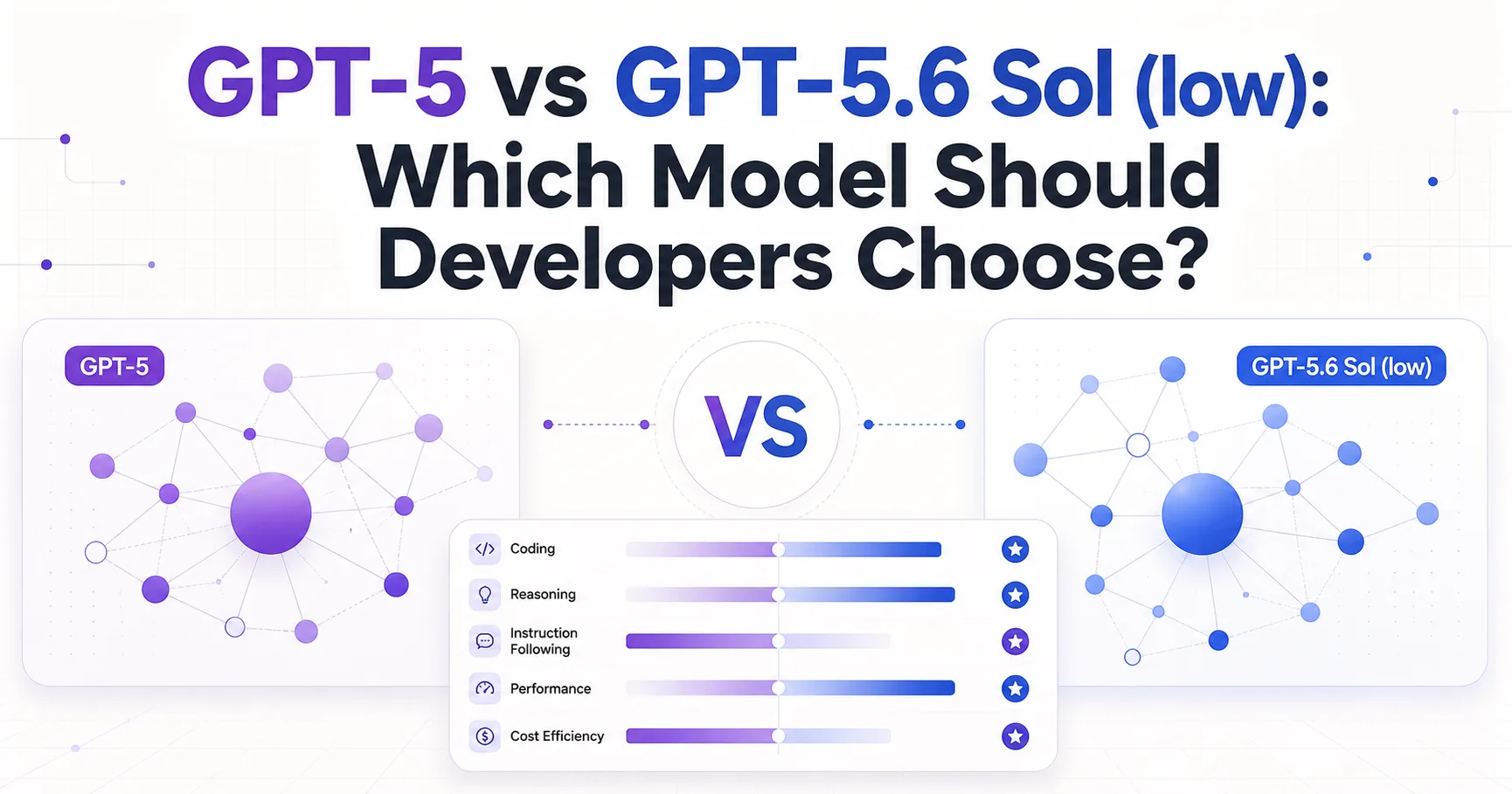
- **Winner overall:** GPT-5.6 Sol (low), with a 69.7 coding index and 49.4 intelligence index - **Cheaper:** GPT-5 at $3.4375 vs $11.25 per 1M blended tokens - **Faster:** GPT-5.6 Sol (low) at 69.917 (median output tokens per second) - **Pick GPT-5.6 Sol (low) when:** coding quality matters more than token cost and the model identity is confirmed in your deployment - **Watch out:** GPT-5.6 Sol (low) has no independently confirmed API entry, context limit, or benchmark coverage
GPT-5 vs GPT-5.6 Sol (low)
GPT-5.6 Sol (low) is the stronger measured coding choice, while GPT-5 remains the safer documented and cheaper choice. Artificial Analysis provides the comparison data.
The practical decision is not simply newer versus older. GPT-5.6 Sol (low) leads the available coding index at 69.7, compared with GPT-5 at 37.8. GPT-5 also costs $3.4375 per 1M blended tokens, compared with $11.25 for GPT-5.6 Sol (low).
That performance lead is meaningful for code generation, repository changes, and multi-step implementation work. The evidence is incomplete, however. Official OpenAI material identifies gpt-5.6-sol, but does not independently confirm gpt-5-6-sol-low as a callable model entry. OpenAI’s model directory therefore supports the family-level positioning more clearly than the exact comparison target.
Executive summary for developers
GPT-5.6 Sol (low) offers the better measured capability profile, but GPT-5 offers materially stronger documentation and deployment certainty.
GPT-5.6 Sol (low) leads GPT-5 on the Artificial Analysis coding index, 69.7 versus 37.8. It also leads on the intelligence index, 49.4 versus 34.7. GPT-5 has the only reported math index, at 94.3, so no cross-model math conclusion is supported by the supplied data.
The gap matters most when a task requires sustained code transformation rather than a short answer. A higher coding index can justify a larger budget if it reduces retries, review cycles, or manual repair. The supplied data does not show task-level pass rates, error types, or total project cost, so that operational conclusion remains directional.
GPT-5 has a documented 400,000-token context window and 128,000-token maximum output, plus text and image input. The GPT-5 model documentation also documents function calling, structured outputs, streaming, and custom tools. The GPT-5.6 Sol material does not confirm equivalent limits or parameters. OpenAI’s model directory describes the family as suited to complex reasoning and coding, but it does not establish those details for the low configuration.
For a production team, this creates a split decision. Choose GPT-5.6 Sol (low) for measured coding strength after confirming access and behavior. Choose GPT-5 when stable API semantics, known limits, and predictable billing matter more than the benchmark lead.
Performance: what the scores mean in real work
GPT-5.6 Sol (low) is the measured performance leader for coding and general intelligence, but the supplied evidence cannot prove equal task quality in every repository.
The coding index difference is large enough to change model selection for implementation-heavy workflows. GPT-5.6 Sol (low) records 69.7, while GPT-5 records 37.8. In practice, that favors the newer model for generating larger changes, interpreting unfamiliar code, and handling several constraints in one request. The index is still an aggregate signal. It does not reveal whether the advantage comes from planning, code accuracy, test behavior, or broader task coverage.
GPT-5 records a 94.3 math index, while GPT-5.6 Sol (low) has no supplied math result. GPT-5 therefore remains the only evidence-backed choice for math-specific comparison, although the missing result prevents a winner declaration. Developers should not convert that absence into a claim that either model is better at mathematical work.
The latency result is a tie at 0.3 seconds. GPT-5.6 Sol (low) has a reported median output speed of 69.917 tokens per second, while GPT-5 has no supplied output-speed value. The newer model therefore has the only direct throughput evidence, but the dataset does not support a complete speed ranking.
Official OpenAI material positions GPT-5 for coding, reasoning, and agentic tasks, with configurable reasoning effort. The developer announcement also reports strong results on software and tool-use evaluations. Those results are not directly comparable with the supplied Artificial Analysis indices, and the developer announcement notes a specific exclusion from its SWE-bench result. That evaluation detail makes benchmark context important.
Community evidence points in a narrower direction. One Reddit user found GPT-5 useful for locating and fixing small bugs, but less complete for full application and UI generation. Comments also mention hallucinations or incorrect edits in complex existing codebases. The Reddit report is anecdotal and uncontrolled, so it should guide testing rather than settle the comparison. No reliable community evidence was supplied for GPT-5.6 Sol (low).
Cost: cheaper tokens can still produce a more expensive workflow
GPT-5 is the clear token-cost choice, while GPT-5.6 Sol (low) may earn its premium if better code reduces repeated work.
GPT-5 costs $3.4375 per 1M blended tokens, compared with $11.25 for GPT-5.6 Sol (low). Its input price is $1.25, compared with $5, and its output price is $10, compared with $30. The price gap is therefore present on both sides of the request, not only on generated output.
The chart should be read as a budget constraint, not as a complete workflow-cost forecast. GPT-5 is attractive for high-volume classification, routine code assistance, short debugging exchanges, and workloads where retries are already rare. GPT-5.6 Sol (low) becomes easier to justify when a failed implementation causes developer review, test repair, or another full request.
The supplied data does not include retry counts, cache-hit rates, prompt sizes, completion sizes, or human review time. It cannot establish which model produces the lower total cost for a real application. A team should therefore run a fixed task set and measure successful outcomes per dollar before making a broad migration.
GPT-5’s official documentation lists input, cached-input, and output prices, while GPT-5.6 Sol’s pricing page lists family-level standard prices. The GPT-5 pricing documentation supports GPT-5’s billing details. The official pricing directory supports the gpt-5.6-sol prices, but does not separately confirm pricing for gpt-5-6-sol-low.
That naming issue is a cost risk. A team that budgets against the family price without confirming the exact low configuration may receive a different model, a different rate, or no callable target. Pricing certainty should be treated as part of the purchase decision.
Recommendation by workload
GPT-5.6 Sol (low) is the best first candidate for coding quality, while GPT-5 is the best default when API certainty and cost control dominate.
Pick GPT-5.6 Sol (low) for repository-level coding, implementation planning, and agent workflows where the measured coding lead can offset higher token spend. Confirm the exact model identifier, endpoint behavior, limits, and price before production use. OpenAI’s model directory confirms the gpt-5.6-sol family, but the supplied research does not confirm the exact low alias.
Pick GPT-5 for high-volume developer assistance, predictable production integration, and teams that need documented context and output limits. The model supports text and image input, structured outputs, function calling, streaming, and custom tools. The GPT-5 documentation provides the clearest implementation contract in the comparison.
Use GPT-5 when a workflow needs direct math evidence, because GPT-5.6 Sol (low) has no supplied math index. Use GPT-5.6 Sol (low) when coding evidence is the priority, because its coding index is 69.7 against GPT-5’s 37.8.
Do not treat GPT-5 as a future-proof fixed-version choice. OpenAI marks gpt-5-2025-08-07 as Deprecated and recommends a newer model in its documentation. The GPT-5 model page makes migration planning necessary for applications pinned to that snapshot.
The safest rollout is a task-based trial. Keep GPT-5 as the documented baseline, test GPT-5.6 Sol (low) on the same coding tasks, and compare successful completion, repair effort, latency, and actual billing. The supplied research does not provide those production measurements.
What the evidence cannot answer yet
GPT-5 has clearer published boundaries, while GPT-5.6 Sol (low) has the larger evidence gap around identity, limits, and failure behavior.
The research does not confirm a context window, maximum output, reasoning parameters, official benchmarks, or independent community testing for the exact low configuration. OpenAI’s model directory and pricing directory describe the broader gpt-5.6-sol family, not every property of gpt-5-6-sol-low.
That uncertainty does not erase the Artificial Analysis result. It changes how confidently the result can be operationalized. Treat GPT-5.6 Sol (low) as a promising candidate requiring validation, and GPT-5 as a documented baseline requiring migration awareness.
Frequently asked questions
Which model should developers choose for coding?
GPT-5.6 Sol (low) is the stronger coding candidate because its Artificial Analysis coding index is 69.7 versus GPT-5 at 37.8, but teams should confirm the exact API alias before production adoption.
Is GPT-5.6 Sol (low) worth its higher price?
GPT-5.6 Sol (low) may be worth the higher price when better implementation quality reduces retries and developer repair, but the supplied data does not measure total workflow cost or human review effort.
Which model is faster?
GPT-5.6 Sol (low) has the only reported median output speed, at 69.917 tokens per second, while both models show 0.3 seconds of reported latency, so a complete speed ranking is unavailable.
Does GPT-5.6 Sol (low) have a confirmed official API model ID?
GPT-5.6 Sol (low) does not have a separately confirmed official API entry in the supplied research; OpenAI documents the family alias gpt-5.6-sol, so deployment teams must verify access directly.
Which model is safer for a production integration?
GPT-5 is safer from a documentation perspective because OpenAI publishes its context, output, modality, tool, and pricing details, although the fixed snapshot gpt-5-2025-08-07 is marked Deprecated.
Sources
- Artificial AnalysisComparison indices, pricing comparison, latency, and output-speed data
- GPT-5 for developersGPT-5 positioning, reasoning configuration, tool support, and official benchmark context
- GPT-5 model documentationGPT-5 API identity, context and output limits, modalities, tools, pricing, and deprecation status
- OpenAI ModelsGPT-5.6 Sol family positioning, model alias evidence, and documented capability scope
- OpenAI PricingGPT-5.6 Sol family pricing and the absence of separately confirmed low-configuration pricing
- Tried GPT-5 Here Are My First ImpressionsAnecdotal GPT-5 coding experience, UI-generation concerns, and complex-codebase failure reports
Published: