
AI model analysis
GPT-5 (high) vs GPT-5.6 Sol Non-reasoning: Which Model Should Developers Choose?
A developer-focused comparison of GPT-5 (high) and GPT-5.6 Sol Non-reasoning across capability, coding, speed, cost, API clarity, and production risk.
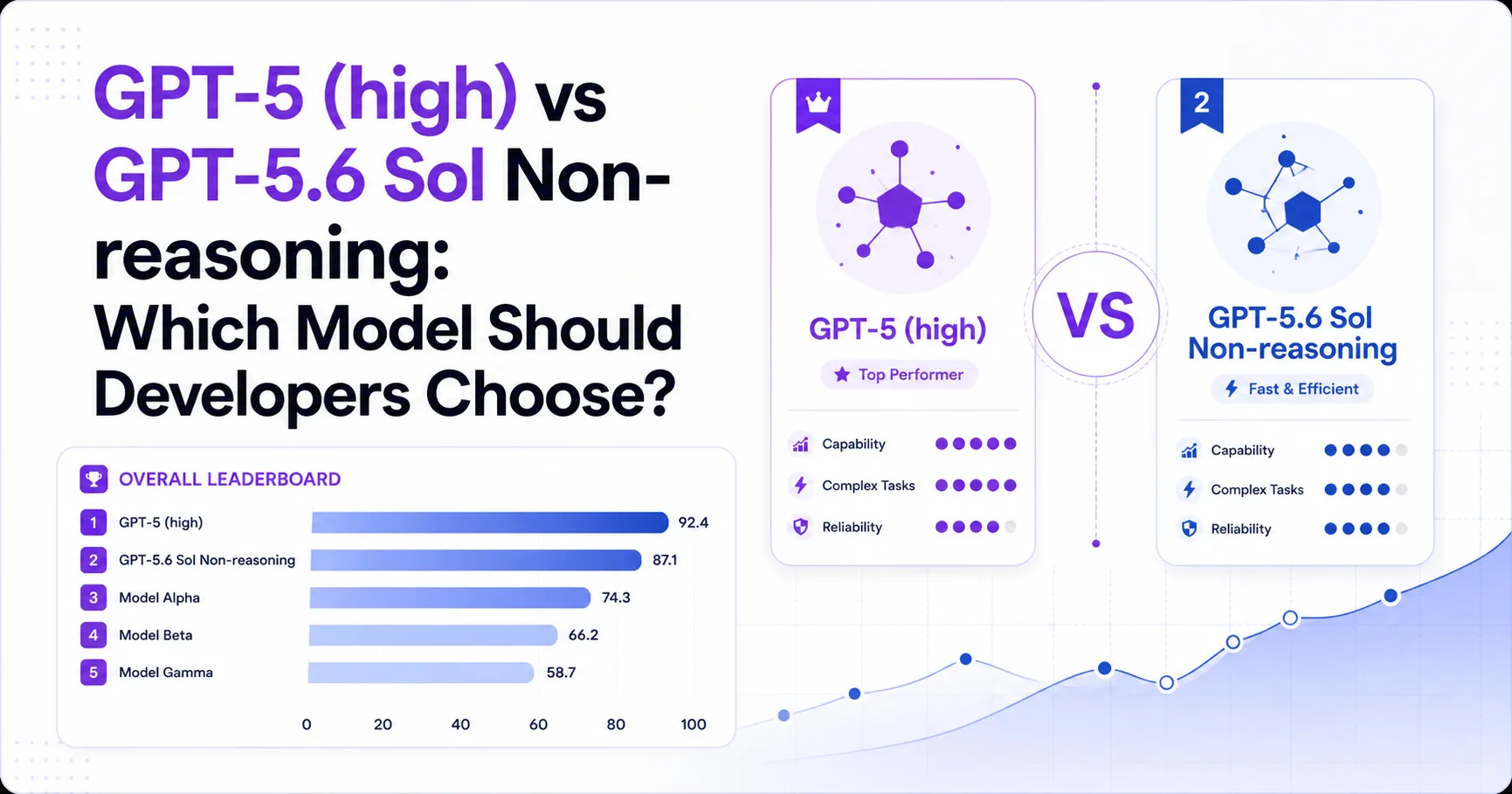
- **Winner overall:** GPT-5.6 Sol (Non-reasoning), with a 65.1 coding index and 41.2 intelligence index versus GPT-5 at 37.8 and 34.7 - **Cheaper:** GPT-5 (high) at $3.4375 vs $11.25 per 1M blended tokens - **Faster:** GPT-5.6 Sol (Non-reasoning) at 69.306 median output tokens per second - **Pick GPT-5 (high) when:** predictable API identity, lower cost, and documented reasoning controls matter more than the higher coding score - **Watch out:** GPT-5.6 Sol (Non-reasoning) lacks model-specific public evidence for context limits, output limits, parameters, and failure modes
GPT-5 (high) vs GPT-5.6 Sol Non-reasoning
GPT-5.6 Sol (Non-reasoning) is the stronger measured coding choice, while GPT-5 (high) is the safer documented choice for cost-sensitive production systems. The Artificial Analysis snapshot gives GPT-5.6 Sol (Non-reasoning) a coding index of 65.1, compared with 37.8 for GPT-5 (high). Its intelligence index is also higher at 41.2 versus 34.7. GPT-5 (high) remains substantially cheaper at $3.4375 per 1M blended tokens, compared with $11.25. The speed evidence favors GPT-5.6 Sol (Non-reasoning), which reports 69.306 median output tokens per second, while no comparable GPT-5 value is provided. Both models show latency of 0.3 seconds in the supplied data.\n\nThe comparison has an important naming problem. OpenAI documents gpt-5 and describes high as a reasoning_effort setting, not a separate gpt-5-high model. The official model directory lists gpt-5.6-sol, but the research brief does not establish that gpt-5.6-sol-non-reasoning is an independently documented public API identifier. Developers should therefore treat the measured label and the callable production identifier as separate questions. Data provided by https://artificialanalysis.ai/
Executive summary for model selection
GPT-5.6 Sol (Non-reasoning) wins the available capability comparison, but GPT-5 (high) offers clearer operational evidence and a lower cost base.\n\n| Decision factor | GPT-5 (high) | GPT-5.6 Sol (Non-reasoning) | Selection meaning |\n|—|—:|—:|—|\n| Coding index | 37.8 | 65.1 | The measured gap favors code generation, refactoring, and implementation work on the newer model. |\n| Intelligence index | 34.7 | 41.2 | The broader measured capability comparison also favors GPT-5.6 Sol. |\n| Math index | 94.3 | Not provided | GPT-5 has evidence here, but no direct winner can be established. |\n| Blended price per 1M tokens | $3.4375 | $11.25 | GPT-5 has the lower listed blended cost. |\n| Latency | 0.3 seconds | 0.3 seconds | The supplied latency result is tied. |\n| Output speed | Not provided | 69.306 tokens per second | The available speed evidence favors GPT-5.6 Sol, but it is not a complete head-to-head measurement. |\n\nOpenAI positions GPT-5 as a reasoning model for coding, reasoning, and agentic tasks in GPT-5 for developers. OpenAI presents GPT-5.6 Sol as a flagship model for complex reasoning and coding in Models. Those descriptions are directional, not equivalent benchmark evidence. The newer model has the stronger supplied scores, yet its public documentation is less specific for the exact non-reasoning variant. GPT-5 has clearer documented controls, including reasoning effort and verbosity, while GPT-5.6 Sol lacks variant-specific detail in the supplied sources.
Performance: what the score gap means in practice
GPT-5.6 Sol (Non-reasoning) is the better first candidate for coding-heavy workflows because its coding index is 65.1 rather than GPT-5’s 37.8. That difference is large enough to change the default choice for repository changes, code synthesis, and implementation tasks. It does not prove that every coding request will be better. Benchmark coverage, prompt design, repository context, tool permissions, and acceptance tests can all change the practical result.\n\nGPT-5.6 Sol also leads the supplied intelligence index, at 41.2 versus 34.7. This supports a broader capability advantage, but it does not establish superiority for every reasoning category. GPT-5 has a math index of 94.3, while no corresponding GPT-5.6 Sol value is supplied. The evidence therefore supports a coding and general-index lead for GPT-5.6 Sol, not a universal capability claim.\n\nSpeed is harder to interpret. GPT-5.6 Sol reports 69.306 median output tokens per second, while GPT-5 has no value in the snapshot. Both have latency of 0.3 seconds. A developer building interactive tools should not equate first-response latency with sustained generation speed. The supplied material does not explain the measurement conditions, token counts, infrastructure, or reasoning settings. It also does not provide controlled user-perceived latency data.\n\nThe official GPT-5 benchmark report includes results for SWE-bench Verified, Aider polyglot, τ²-bench telecom, and Scale MultiChallenge in GPT-5 for developers. The research brief provides no equivalent official benchmark results for GPT-5.6 Sol Non-reasoning. That asymmetry prevents a clean benchmark-to-benchmark conclusion. The Artificial Analysis scores are useful for selection, but they should be validated against the developer’s own task set.
Cost: the cheaper model can still be the expensive choice
GPT-5 (high) is the clear price winner at $3.4375 per 1M blended tokens, compared with $11.25 for GPT-5.6 Sol (Non-reasoning). The input price is $1.25 versus $5, and the output price is $10 versus $30. The price gap matters most for high-volume applications, long responses, repeated agents, and workflows that call the model frequently.\n\nThe price comparison does not determine total application cost. A model with a lower token price can become more expensive if it needs more retries, produces weaker patches, requires additional review, or cannot complete a task without extra tool calls. The supplied data cannot quantify those effects. GPT-5.6 Sol’s higher coding index may reduce human correction or retry work, but the research brief provides no controlled evidence for that operational saving.\n\nThe cost conclusion can also reverse under a quality threshold. If GPT-5.6 Sol completes a repository task in one successful call while GPT-5 requires several attempts, the listed token prices alone will overstate GPT-5’s advantage. Conversely, if the task is simple, stable, and heavily cached, GPT-5’s lower input price and lower blended price may dominate.\n\nDevelopers should evaluate cost per accepted outcome, not cost per token. Track successful task completion, retry rate, review time, output length, tool-call count, and rollback frequency. None of those production metrics is included in the research brief, so the evidence supports a price winner but not a total-cost winner. The official figures for GPT-5 come from GPT-5 model documentation, while GPT-5.6 Sol pricing is listed in Pricing.
Recommendation by developer workload
GPT-5.6 Sol (Non-reasoning) should be the default trial for coding-intensive work, while GPT-5 (high) should remain the default for cost-sensitive and documentation-sensitive deployments.\n\nChoose GPT-5.6 Sol first when the main workload is code generation, repository implementation, refactoring, or an agent that must make meaningful changes. The supplied coding index of 65.1 gives it a strong measured advantage over GPT-5’s 37.8. Its reported output speed of 69.306 tokens per second may also suit interfaces where sustained generation matters. That speed comparison is incomplete because GPT-5 has no supplied value.\n\nChoose GPT-5 (high) first when predictable API semantics, lower spend, or explicit reasoning controls are central requirements. OpenAI documents the gpt-5 alias, the fixed snapshot gpt-5-2025-08-07, reasoning_effort, verbosity controls, function calling, structured outputs, streaming, and custom tools in GPT-5 for developers and GPT-5 model documentation. Its fixed snapshot is marked Deprecated, however, so long-lived deployments still need migration planning.\n\nDo not select GPT-5.6 Sol Non-reasoning solely from its name. The supplied official pages identify gpt-5.6-sol, not the full non-reasoning slug, and do not provide variant-specific context, output, parameter, or failure-mode documentation. Confirm the exact model identifier, endpoint behavior, limits, and billing record before production use.\n\nThe strongest practical approach is a task-based pilot. Use representative coding tickets, require tests or human acceptance, and compare accepted outcomes against spend. The research brief does not provide enough evidence to predict that pilot’s result for a particular codebase.
Evidence boundaries and unresolved risks
GPT-5 (high) has more documented behavior, while GPT-5.6 Sol (Non-reasoning) has more missing evidence around the exact variant. GPT-5’s official documentation states that it accepts text and image input and produces text output, with no audio or video input or output. It also marks fine-tuning and predicted outputs as unsupported. GPT-5.6 Sol’s supplied official material describes general text and image capabilities, but does not assign every statement specifically to the non-reasoning slug.\n\nCommunity evidence does not close the gap. A Reddit author reports that GPT-5 can locate and fix small bugs quickly, but describes less complete results for full applications and interface generation. Comments also mention hallucinations or incorrect modifications in complex existing codebases. The post is a subjective, uncontrolled test, so it should inform test design rather than decide the purchase. The source is Tried GPT-5 Here Are My First Impressions.\n\nNo reliable community material was found for GPT-5.6 Sol Non-reasoning. That absence is not evidence that the model is more stable, faster, or better behaved. It only means the supplied research cannot support a community-consensus claim. The same evidence gap applies to model-specific failure modes, context limits, maximum output, and parameter restrictions for GPT-5.6 Sol Non-reasoning.\n\nThe release dates in the data snapshot are 2025-08-07 for GPT-5 and 2026-07-09 for GPT-5.6 Sol Non-reasoning. Those dates do not by themselves prove lifecycle status. GPT-5’s fixed snapshot is explicitly Deprecated in the supplied documentation, while the brief does not establish whether GPT-5.6 Sol has been superseded. Production selection should therefore include availability checks and migration ownership.
Frequently asked questions
Is GPT-5.6 Sol Non-reasoning better than GPT-5 for coding?
GPT-5.6 Sol Non-reasoning is the better measured coding choice because its Artificial Analysis coding index is 65.1, compared with 37.8 for GPT-5. That result supports a stronger starting hypothesis, not a guarantee for every repository or programming task.
Which model is cheaper for production API usage?
GPT-5 is cheaper for the supplied pricing comparison, at $3.4375 per 1M blended tokens versus $11.25 for GPT-5.6 Sol Non-reasoning. Actual application cost can differ if quality changes retry rates, review work, or tool-call volume.
Is GPT-5.6 Sol Non-reasoning an official public API model name?
The supplied official material does not confirm GPT-5.6 Sol Non-reasoning as an independent public API identifier. The official model directory lists gpt-5.6-sol, so developers should verify the exact callable slug before implementation.
Which model should a developer choose for an agentic coding product?
GPT-5.6 Sol Non-reasoning is the stronger initial candidate for an agentic coding product because its coding index is 65.1 and its reported output speed is 69.306 tokens per second. GPT-5 may be preferable when lower cost and documented controls matter more.
Does GPT-5 have a clear advantage for mathematics?
GPT-5 has a supplied math index of 94.3, but GPT-5.6 Sol Non-reasoning has no corresponding math value in the data snapshot. The available evidence therefore cannot establish a direct mathematics winner.
Sources
- Artificial AnalysisAttribution for the supplied model comparison data and data snapshot.
- GPT-5 for developersGPT-5 positioning, reasoning controls, tool capabilities, and official benchmark context.
- GPT-5 model documentationGPT-5 API identity, lifecycle status, capabilities, limitations, and pricing.
- ModelsGPT-5.6 Sol positioning, model directory status, and general API capability claims.
- PricingGPT-5.6 Sol pricing and listed model naming.
- Tried GPT-5 Here Are My First ImpressionsSubjective community reports about GPT-5 coding, debugging, application generation, and existing-codebase risks.
Published: