
AI model analysis
GPT-5 vs GPT-5.6 Terra: Which OpenAI Model Should Developers Choose?
A developer-focused comparison of GPT-5 and GPT-5.6 Terra across coding quality, reasoning, speed, cost, tooling, lifecycle risk, and production fit.
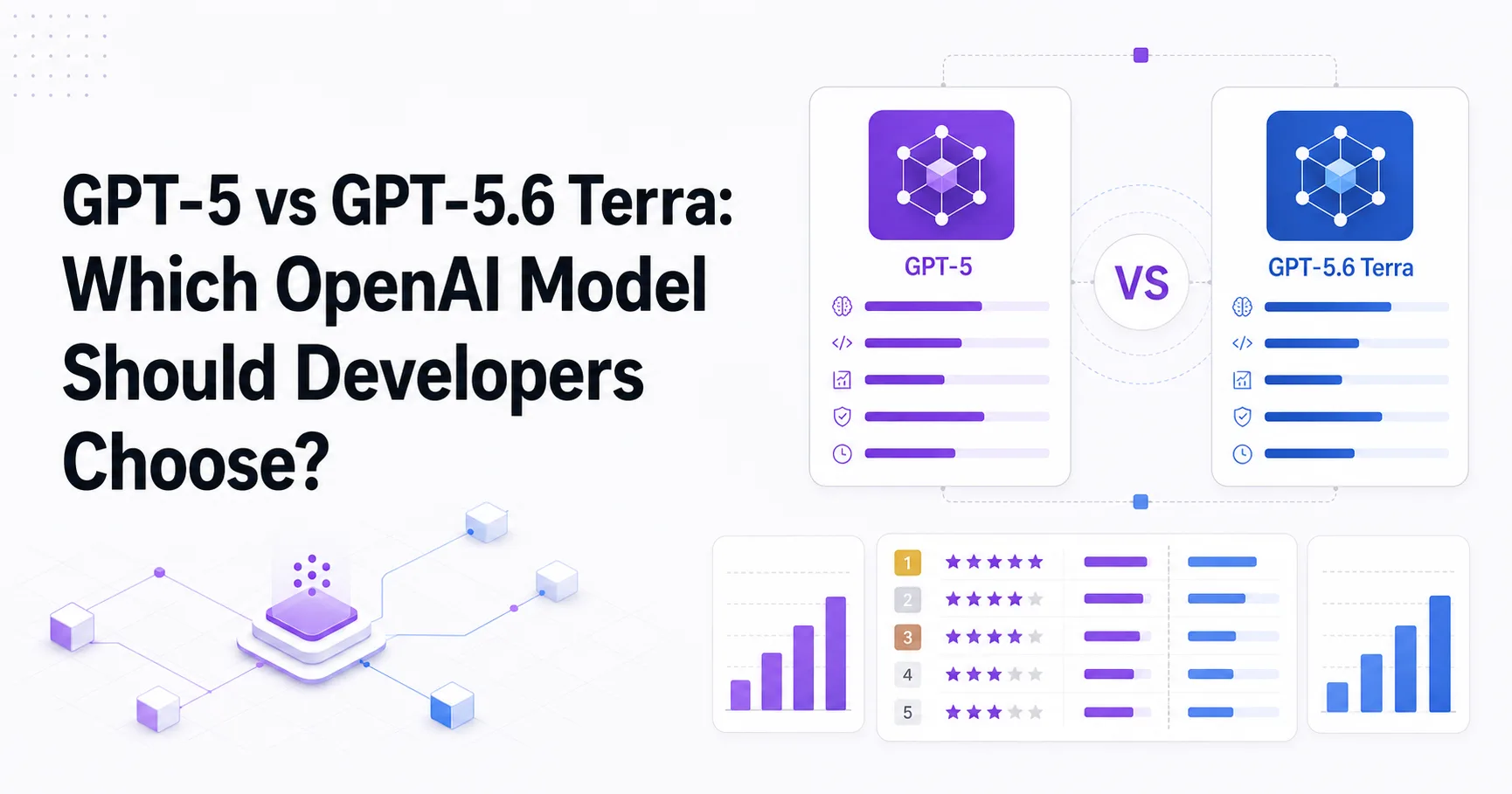
- **Winner overall:** GPT-5.6 Terra (max), with a 76.7 coding index and 55 intelligence index - **Cheaper:** GPT-5 (high) at $3.4375 vs $4.500000000000001 per 1M blended tokens - **Faster:** GPT-5.6 Terra (max) at 144.252 median output tokens per second - **Pick GPT-5 when:** predictable pricing, strong math performance at 94.3, and a lower-cost API matter most - **Watch out:** GPT-5.6 Terra has no published model-specific benchmark or reliable community track record
GPT-5 vs GPT-5.6 Terra
GPT-5.6 Terra is the stronger default for new coding and agentic systems, while GPT-5 remains the cheaper and better-documented choice for constrained workloads. Artificial Analysis reports a coding index of 76.7 for GPT-5.6 Terra (max), compared with 37.8 for GPT-5 (high), and an intelligence index of 55 compared with 34.7. GPT-5 also has a math index of 94.3, while no comparable Terra value is provided.\n\nThe practical choice depends on what your application can afford to leave uncertain. GPT-5.6 Terra is newer, currently callable, and positioned by OpenAI as a model balancing intelligence and cost. GPT-5 is an earlier model with published developer benchmarks, a stable gpt-5 alias, and a lower blended price. However, OpenAI marks the fixed gpt-5-2025-08-07 snapshot as deprecated in the GPT-5 model documentation.\n\nData provided by https://artificialanalysis.ai/
The decision in one view
GPT-5.6 Terra offers the clearer capability advantage for software engineering, but GPT-5 offers the clearer operational and evidentiary baseline.\n\n| Decision factor | GPT-5 (high) | GPT-5.6 Terra (max) | What it means for developers | |—|—:|—:|—| | Coding index | 37.8 | 76.7 | Terra has the stronger signal for code generation and repository work | | Intelligence index | 34.7 | 55 | Terra has the stronger general reasoning signal | | Math index | 94.3 | Not provided | GPT-5 has a documented advantage only because Terra lacks a comparable value | | Blended price per 1M tokens | $3.4375 | $4.500000000000001 | GPT-5 is cheaper for the supplied workload mix | | Input price per 1M tokens | $1.25 | $2 | GPT-5 costs less for large prompts | | Output price per 1M tokens | $10 | $12 | GPT-5 costs less for verbose answers | | Median output speed | Not provided | 144.252 tokens per second | Terra has the only supplied throughput measurement | | Latency | 0.3 seconds | 0.3 seconds | The supplied latency data shows a tie | \nOpenAI describes GPT-5 as a reasoning model for coding, reasoning, and agentic tasks in its GPT-5 developer announcement. OpenAI describes Terra as a general reasoning model intended to balance intelligence and cost in the GPT-5.6 Terra model documentation. Those positions align with the supplied evaluation data, but they do not answer whether Terra wins every production workload. Terra has no public model-specific benchmark result in the supplied research, and GPT-5’s published results were produced under stated evaluation conditions.\n\nThe most important missing evidence is a controlled, side-by-side test using the developer’s own tasks, prompts, tools, and acceptance checks.
Performance: capability gains matter more than equal latency
GPT-5.6 Terra has the stronger measured capability profile, while the supplied latency data does not show a responsiveness advantage.\n\nThe coding-index gap is the most consequential result for developers. A score of 76.7 versus 37.8 suggests a materially different ceiling for code-focused work, especially where the model must understand requirements, modify several files, or recover from failed tool calls. That signal supports Terra for repository agents, code review, test repair, and multi-step implementation. It does not prove that Terra will make fewer edits, pass more of your tests, or produce safer patches. Those outcomes depend on prompt structure, repository quality, tool permissions, and verification loops.\n\nThe intelligence-index result points in the same direction. Terra scores 55 versus GPT-5 at 34.7, so Terra is the stronger candidate for tasks that combine planning, judgment, and execution. The result should still be treated as selection evidence, not a guarantee of production reliability. The research provides no Terra-specific public benchmark breakdown and no reliable community discussion for the exact gpt-5.6-terra model.\n\nGPT-5’s math index of 94.3 is useful evidence for mathematical workloads, but it cannot establish a Terra disadvantage because the corresponding Terra value is absent. This is a case where the evidence is incomplete, not a confirmed win for GPT-5.\n\nOpenAI reports GPT-5 results on SWE-bench Verified, Aider polyglot, τ²-bench telecom, and Scale MultiChallenge in the developer announcement. The announcement also states that one coding evaluation used high reasoning effort. That qualification matters because the data snapshot compares GPT-5 (high) with GPT-5.6 Terra (max), while the underlying public tests are not a unified head-to-head evaluation.\n\nBoth models have a supplied latency value of 0.3 seconds. Terra also has the only supplied median output measurement, 144.252 tokens per second. That makes Terra the only model with a reported throughput signal here, but it does not establish a complete speed ranking. The research contains no reliable community consensus on either model’s real-world speed.
Cost: GPT-5 wins the price comparison, but workload shape can change the result
GPT-5 is cheaper on every supplied standard price measure, but GPT-5.6 Terra can still be the lower-cost system if its capability advantage reduces retries and supervision.\n\nThe direct comparison is straightforward. GPT-5 costs $3.4375 per 1M blended tokens, versus $4.500000000000001 for Terra. GPT-5 also costs $1.25 per 1M input tokens and $10 per 1M output tokens, compared with Terra at $2 and $12. For applications with similar prompt and completion volumes, GPT-5 has the lower model bill.\n\nThat conclusion can reverse at the application level. A model that needs fewer repair cycles, produces more usable patches, or completes a longer workflow without human intervention may cost less overall despite a higher token price. The supplied coding-index difference gives Terra a credible reason to test this hypothesis, but the research does not provide retry rates, task success rates, token consumption by task, or total cost per completed job. Evidence is therefore insufficient to claim that Terra is cheaper in production.\n\nTerra also has a cost boundary that matters for large-context systems. The GPT-5.6 Terra model documentation states that requests above 272K input tokens receive higher input and output pricing. A system that routinely sends large repositories, long histories, or accumulated tool context may experience a sharper cost increase than a short-context workload suggests.\n\nOpenAI’s pricing documentation lists separate Standard, Batch, Flex, and Fast mode prices for Terra. Those modes create additional planning choices, but they do not erase the need to measure total cost per successful task.\n\nGPT-5 is the safer budget choice when prompts are large, outputs are predictable, and the application already meets its quality target. Terra deserves a cost test when failed work is expensive or when stronger coding performance can reduce orchestration overhead.
Recommendation by developer workload
GPT-5.6 Terra should be the first model tested for complex coding agents, while GPT-5 should remain the default for cost-sensitive and math-centered workloads.\n\nChoose GPT-5.6 Terra when the system must understand a large codebase, plan across multiple steps, call tools repeatedly, or produce high-quality code changes with limited supervision. Its 76.7 coding index and 55 intelligence index make it the stronger candidate for these workloads. Terra also supports functions, structured outputs, file search, web search, Code Interpreter, Hosted Shell, Apply Patch, Computer Use, MCP, and other tools listed in the model documentation.\n\nChoose GPT-5 when the primary constraint is predictable spend, when the application already performs well with the older model, or when published benchmark evidence is important to the approval process. GPT-5’s $3.4375 blended price is lower than Terra’s $4.500000000000001, and its documented math index is 94.3. GPT-5 also supports function calling, structured outputs, streaming, and custom tools according to the GPT-5 developer announcement.\n\nTreat model lifecycle as a separate decision from model quality. Terra is presented as current and is not listed in the supplied deprecation documentation. GPT-5 remains callable through its gpt-5 alias, but the fixed snapshot is marked deprecated in the GPT-5 model documentation. Teams that require reproducible behavior should define a migration plan before selecting GPT-5 for a long-lived service.\n\nNeither model is a direct fit for native audio or video input and output. Both are described as accepting text and images and producing text. Terra also has no reliable public community record in the supplied research. GPT-5 has more user reports, but those reports are mixed and uncontrolled. One Reddit report describes fast small-bug fixes but weaker completeness in full application and UI generation. The same report mentions possible hallucinations or incorrect edits in complex existing codebases. These observations justify safeguards, not a universal verdict.\n\nThe final selection should use a private task set with pass-fail checks, tool-call limits, review cost, and total completion cost. The supplied research does not contain that evidence, so no article-level comparison can replace a production-shaped pilot.
Questions to answer before switching
GPT-5.6 Terra is the stronger candidate for a switch when coding quality matters more than the lowest token price.\n\nThe key unresolved issue is not whether Terra has better supplied capability scores. It is whether those scores translate into fewer failed tasks, lower supervision cost, and acceptable behavior in the target codebase. OpenAI provides detailed capability and pricing documentation, but the supplied research does not provide Terra-specific public benchmark results, latency guarantees, or reliable community experience. GPT-5 has more public evidence, yet its fixed snapshot carries deprecation risk.\n\nDevelopers should test both models against the same repository tasks. The test should record successful completion, patch correctness, test outcomes, tool-call count, output length, human review time, and total spend. A short evaluation can also expose whether Terra’s long-context pricing boundary matters for the application’s actual prompts.\n\nThe reasoning models guide adds an operational warning for Terra: reasoning tokens consume the output budget, and an overly low max_output_tokens setting can produce an incomplete response before visible text appears. That behavior should be included in integration tests before deployment.
Frequently asked questions
Is GPT-5.6 Terra better than GPT-5 for coding?
GPT-5.6 Terra is the stronger coding candidate because its supplied coding index is 76.7 versus 37.8 for GPT-5, although private repository testing is still required before treating that gap as a production guarantee. The research does not provide a Terra-specific public benchmark breakdown or task-success rate.
Which model is cheaper for API workloads?
GPT-5 is cheaper on the supplied token prices, costing $3.4375 per 1M blended tokens versus $4.500000000000001 for GPT-5.6 Terra. Terra may still reduce total application cost if its stronger coding capability lowers retries, human review, or failed tool workflows, but the supplied research does not measure those effects.
Is GPT-5.6 Terra faster than GPT-5?
GPT-5.6 Terra has the only supplied median output speed, at 144.252 tokens per second, while both models have a supplied latency value of 0.3 seconds. That evidence supports a reported Terra throughput signal, but it does not establish a complete speed comparison because GPT-5’s median output speed is not provided.
Should developers worry about GPT-5 deprecation?
Developers should treat the fixed GPT-5 snapshot as a lifecycle risk because OpenAI marks gpt-5-2025-08-07 as deprecated, even though the gpt-5 alias remains callable. GPT-5.6 Terra is not listed in the supplied deprecation documentation, but teams should still monitor model changes and maintain a migration path.
Does GPT-5 have a math advantage over GPT-5.6 Terra?
GPT-5 has a documented math index of 94.3, but the supplied data provides no comparable GPT-5.6 Terra math index. GPT-5 therefore has stronger available math evidence, not a proven head-to-head math advantage. A direct evaluation is necessary for mathematical applications.
Sources
- GPT-5 for developersGPT-5 positioning, reasoning parameters, tool calling, custom tools, and official benchmark context
- GPT-5 model documentationGPT-5 alias, snapshot lifecycle, pricing, supported modalities, endpoints, and model limitations
- GPT-5.6 Terra ModelTerra model identity, capabilities, context behavior, modality limits, pricing boundary, and current availability
- ModelsTerra product-line positioning
- PricingTerra Standard, Batch, Flex, and Fast mode pricing
- OpenAI API ChangelogTerra release timing and model-family alias context
- Reasoning modelsReasoning modes, reasoning-token budgeting, context behavior, and incomplete response risk
- DeprecationsChecking whether GPT-5.6 Terra is listed for deprecation
- Tried GPT-5 Here Are My First ImpressionsUncontrolled community observations about GPT-5 debugging, UI generation, and existing-codebase risks
- Artificial AnalysisData attribution for the supplied model comparison snapshot
Published: