
AI model analysis
GPT-5 (high) vs GPT-5 (low): Which Model Should Developers Choose?
A developer-focused comparison of GPT-5 (high) and GPT-5 (low), covering measured capability, API evidence, pricing, version risk, and practical model-selection trade-offs.
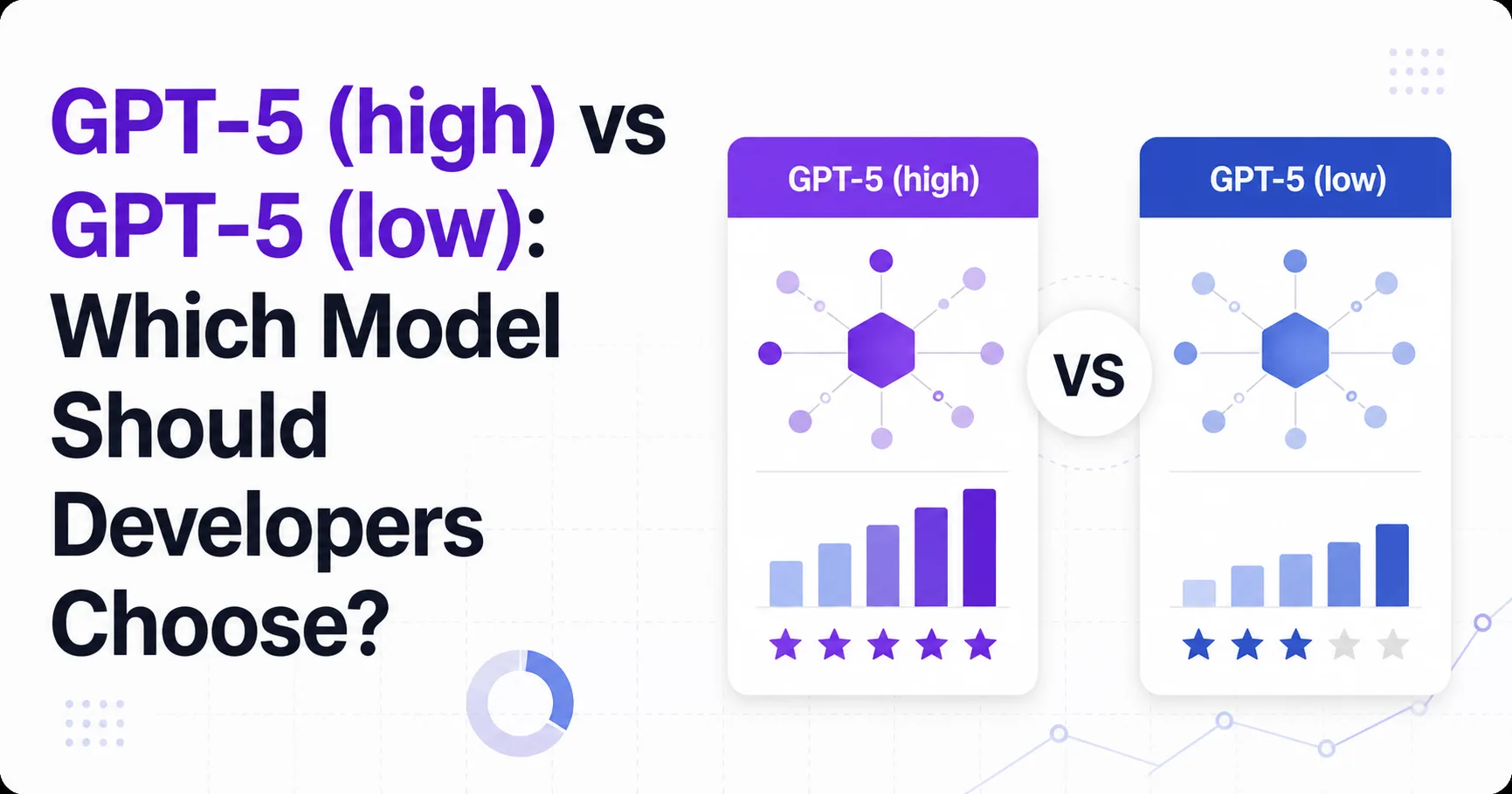
- **Winner overall:** GPT-5 (high), with an Artificial Analysis Intelligence Index of 34.7 vs 31.2 and a Math Index of 94.3 vs 83 - **Cheaper:** Neither model, both at $3.4375 per 1M blended tokens - **Faster:** Neither model, both at 0.3 seconds latency; output speed is unavailable - **Pick GPT-5 (low) when:** You have verified that a lower reasoning setting is available in your own integration and the task does not require the stronger measured math result - **Watch out:** GPT-5 (low) has no confirmed official model listing, price, context limit, or independent community evidence
GPT-5 (high) vs GPT-5 (low)
GPT-5 (high) is the safer developer choice because it has documented API behavior, published benchmarks, and stronger measured general and mathematical performance. The comparison data gives GPT-5 (high) an Artificial Analysis Intelligence Index of 34.7, compared with 31.2 for GPT-5 (low). Its Math Index is 94.3, compared with 83 for GPT-5 (low). Pricing and latency do not create a counterweight: both models are listed at $3.4375 per 1M blended tokens and 0.3 seconds latency.
The larger issue is identity. OpenAI documents gpt-5 and describes high as a reasoning_effort setting, rather than a separate gpt-5-high API model. OpenAI’s developer documentation supports that interpretation. OpenAI’s current model directory does not list gpt-5-low, so the low configuration cannot be treated as a clearly supported public model without additional deployment evidence. The current OpenAI model directory provides no confirmation for that identifier.
For production selection, GPT-5 (high) therefore wins on evidence quality as well as measured capability. GPT-5 (low) may represent a lower reasoning configuration, but the supplied research does not establish its API identity or operational guarantees.
Executive summary for model selection
GPT-5 (high) offers the stronger documented capability profile, while GPT-5 (low) offers no verified price or operational advantage in the supplied evidence. The measured comparison is straightforward: GPT-5 (high) leads the Intelligence Index at 34.7 versus 31.2 and the Math Index at 94.3 versus 83. The coding comparison is incomplete because GPT-5 (low) has no corresponding Coding Index value, while GPT-5 (high) is listed at 37.8.
| Decision factor | GPT-5 (high) | GPT-5 (low) | Selection meaning |
|---|---|---|---|
| Intelligence Index | 34.7 | 31.2 | High is stronger in the supplied comparison |
| Math Index | 94.3 | 83 | High has the clearer measured advantage |
| Coding Index | 37.8 | Not available | The coding comparison cannot be completed |
| Blended price | $3.4375 | $3.4375 | No listed cost advantage |
| Latency | 0.3 seconds | 0.3 seconds | No listed latency advantage |
OpenAI’s documentation gives GPT-5 (high) a stable gpt-5 alias, a fixed snapshot, text and image input, text output, tool calling, structured outputs, streaming, and configurable reasoning effort. The GPT-5 model documentation records those boundaries. The same documentation marks the fixed snapshot as Deprecated and recommends a newer GPT-5.6 model, which makes version governance part of the decision.
The evidence for GPT-5 (low) is materially thinner. The research found no official confirmation of its model alias, context window, output limit, tools, benchmarks, pricing, or community behavior. That gap does not prove poor performance. It does mean developers should not infer a reliable production profile from the label alone.
Performance: what the measured gap means
GPT-5 (high) is the measured performance leader, especially for mathematical and general reasoning work, but the available data cannot establish a complete coding or speed winner. The Math Index gap is substantial in practical terms: GPT-5 (high) records 94.3 while GPT-5 (low) records 83. A developer choosing between them for constraint-heavy transformations, numerical reasoning, or multi-step verification should expect the high configuration to have more evidence behind it.
The Intelligence Index points in the same direction, with GPT-5 (high) at 34.7 and GPT-5 (low) at 31.2. That consistency matters more than either score alone. It suggests that the high configuration has a broader measured advantage, not merely a narrow result in one evaluation category. The figures do not reveal whether every production prompt will improve, so teams should still test their own workloads.
Coding requires more caution. GPT-5 (high) has a Coding Index of 37.8, but GPT-5 (low) has no Coding Index value in the supplied snapshot. The correct conclusion is not that high wins coding by an unknown margin. The correct conclusion is that the coding comparison is incomplete.
Speed also remains unresolved. Both entries show 0.3 seconds latency, while median output tokens per second is unavailable for each model. Equal latency therefore does not establish equal streaming experience, total completion time, or throughput under load. The supplied research also found no reliable community consensus about speed for GPT-5 (low).
Cost: equal listed price, unequal decision risk
GPT-5 (high) and GPT-5 (low) tie on every listed token price, so cost cannot justify choosing the less documented option. Each model is listed at $3.4375 per 1M blended tokens, $1.25 per 1M input tokens, and $10 per 1M output tokens. The page chart should make that parity visible; the important selection question is what the same price buys in evidence and capability.
For workloads dominated by difficult reasoning, a lower-performing configuration can become more expensive operationally even when its token rate is identical. Extra retries, validation passes, manual review, or fallback calls can erase any assumed savings. The supplied data does not provide retry rates, token consumption by task, or production error costs, so that operational claim should remain a planning hypothesis rather than a measured result.
GPT-5 (low) also has no confirmed official price. The displayed comparison price comes from the Artificial Analysis snapshot, not from an official OpenAI listing for gpt-5-low. OpenAI’s current pricing page does not list gpt-5-low, gpt-5, or gpt-5-2025-08-07 in the supplied research. That creates procurement and forecasting uncertainty.
GPT-5 (high) has a documented current price in the model documentation, but its fixed snapshot is marked Deprecated. The GPT-5 model documentation therefore points to a second cost concern: migration work can matter even when per-token prices are equal.
Recommendation by developer scenario
GPT-5 (high) is the default recommendation for production systems that need documented behavior and stronger measured reasoning performance. Choose it for code review, agentic workflows, mathematical validation, structured tool use, and tasks where a weak answer can trigger expensive downstream actions. OpenAI positions GPT-5 for coding, reasoning, and agentic tasks, and documents function calling, structured outputs, streaming, and custom tools. The developer announcement provides that positioning and capability evidence.
GPT-5 (low) is reasonable only as an experimentally verified configuration inside a controlled evaluation. A team may test it for simpler requests, draft generation, or flows where a lower reasoning setting is sufficient. The supplied research does not establish that it is cheaper, faster, more stable, or officially callable. It also does not provide a low-configuration Coding Index, context limit, output limit, tool boundary, or production failure profile.
Version policy changes the recommendation. The fixed GPT-5 snapshot dated 2025-08-07 is marked Deprecated, while the current documentation recommends GPT-5.6. Developers selecting GPT-5 (high) should therefore isolate the model identifier, record the snapshot policy, and maintain a migration path. Developers selecting GPT-5 (low) should first verify that the identifier resolves in their target API and that the behavior corresponds to the intended reasoning setting.
A useful acceptance test should compare task success, validation burden, tool-call correctness, and end-to-end latency on representative prompts. The supplied research cannot answer those workload-specific questions. Until such testing exists, GPT-5 (high) has the stronger case because it combines an official API profile with higher measured Intelligence and Math scores at the same listed comparison price.
Questions to answer before adopting either configuration
GPT-5 (high) has enough documented capability and benchmark evidence for a serious production evaluation, while GPT-5 (low) still requires identity and availability checks. The unresolved questions concern operational reality rather than the headline scores. Developers should verify the exact model identifier, snapshot policy, tool behavior, and workload-level quality before committing an integration.
The strongest evidence favors GPT-5 (high), but the fixed snapshot’s Deprecated status means a technically successful integration can still create future migration work. The low configuration has the opposite problem: it may be useful, yet the supplied research does not identify an official contract that developers can safely depend on.
Frequently asked questions
Is GPT-5 (low) cheaper than GPT-5 (high)?
GPT-5 (low) is not cheaper in the supplied comparison because both models are listed at $3.4375 per 1M blended tokens, $1.25 per 1M input tokens, and $10 per 1M output tokens. OpenAI’s pricing page does not confirm an official price for gpt-5-low, so the comparison price should not be treated as a guaranteed public tariff.
Which model is better for coding?
GPT-5 (high) has the stronger documented coding case, with an Artificial Analysis Coding Index of 37.8 and official positioning for coding tasks. GPT-5 (low) has no Coding Index value in the supplied snapshot, so developers cannot claim a measured coding winner by directly comparing the two configurations.
Which model is faster in production?
Neither model has a proven speed advantage in the supplied data because both show 0.3 seconds latency and median output tokens per second is unavailable for each model. Equal latency does not establish equal streaming throughput, completion time, or behavior under concurrent production load.
Should developers use GPT-5 (low) in a production API?
Developers should use GPT-5 (low) in production only after verifying the identifier, availability, pricing, and behavior in their target API. The supplied research found no official listing, benchmark profile, context limit, output limit, or reliable community evidence for gpt-5-low, so its operational contract remains unconfirmed.
What is the main risk of choosing GPT-5 (high)?
The main risk of choosing GPT-5 (high) is version lifecycle management, because the fixed snapshot dated 2025-08-07 is marked Deprecated and the documentation recommends GPT-5.6. The model also lacks audio and video input and output, which matters for multimodal applications requiring those modalities.
Sources
- GPT-5 for developersGPT-5 positioning, reasoning settings, tool capabilities, and official benchmark context
- GPT-5 model documentationGPT-5 API alias, model limits, modalities, pricing, endpoint support, and Deprecated snapshot status
- Tried GPT-5 Here Are My First Impressions限定的社区编码体验、复杂代码库风险与完整应用生成反馈
- OpenAI Models核查当前官方模型目录及 gpt-5-low 的可用性证据
- OpenAI Pricing核查当前官方定价目录及 gpt-5-low 的价格证据
- Artificial AnalysisData attribution for comparison metrics and pricing snapshot
Published: