
AI model analysis
GPT-5 (high) vs Inkling (xhigh): Which Model Should Developers Choose?
A source-backed comparison of GPT-5 (high) and Inkling (xhigh) for coding, reasoning, latency, pricing, and production risk.
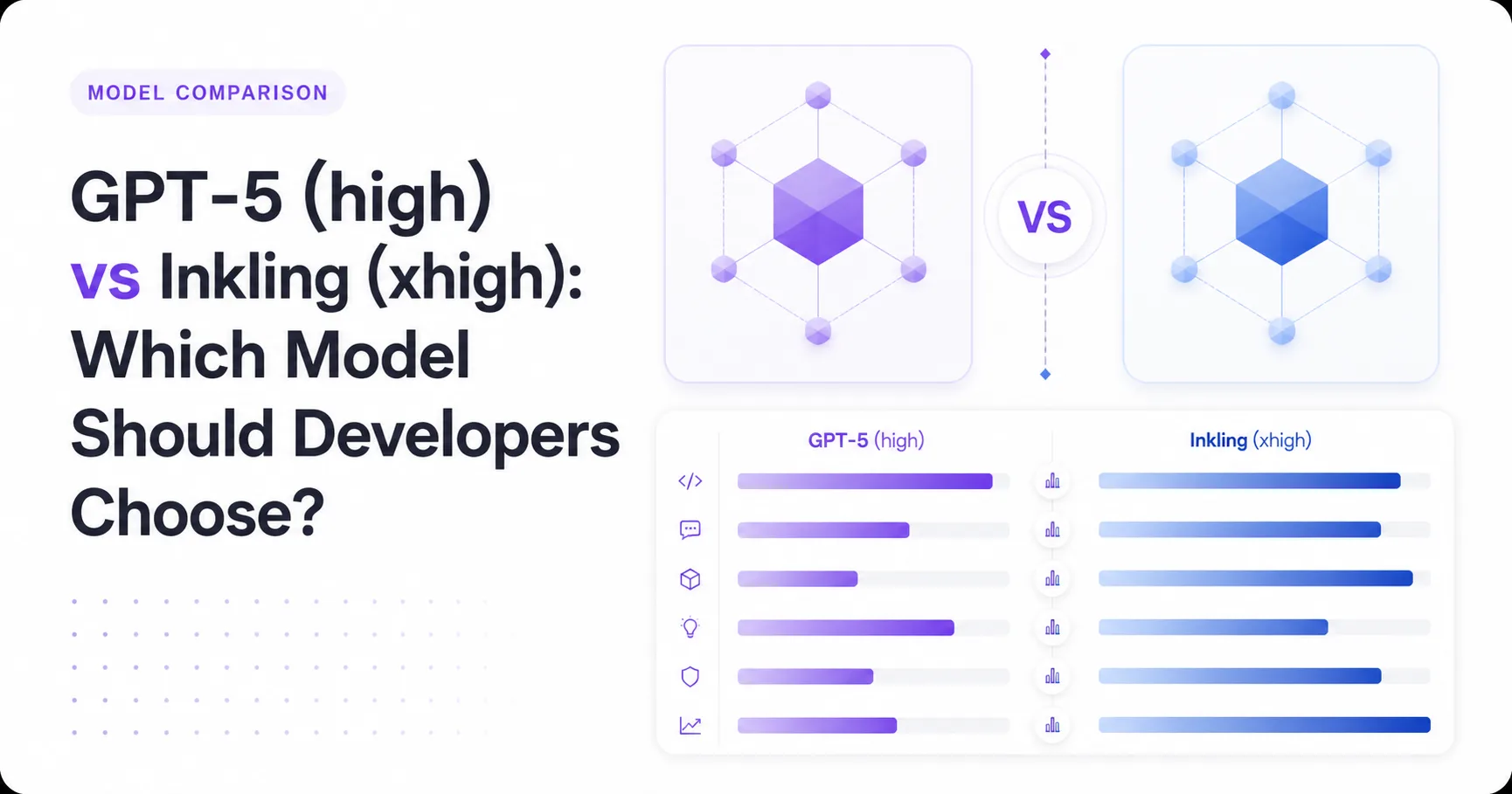
- **Winner overall:** Inkling (xhigh), with an Artificial Analysis Intelligence Index of 40.7 vs GPT-5 at 34.7 and a Coding Index of 52.1 vs 37.8 - **Cheaper:** Inkling (xhigh) at $2.5725000000000002 vs $3.4375 per 1M blended tokens - **Faster:** Inkling (xhigh) at 84.899 (median output tokens per second); GPT-5 has no reported value - **Pick GPT-5 (high) when:** verified OpenAI tooling, documented reasoning controls, image input, or the reported 94.3 math index matters more than model coverage - **Watch out:** Inkling lacks verifiable public documentation, pricing provenance, benchmark methodology, and failure reports
GPT-5 (high) vs Inkling (xhigh)
Inkling (xhigh) leads the available comparison data, but GPT-5 (high) is the safer documented choice for production engineering. Artificial Analysis reports Inkling at 40.7 on its Intelligence Index and 52.1 on its Coding Index, ahead of GPT-5 at 34.7 and 37.8. The same dataset reports Inkling at $2.5725000000000002 per 1M blended tokens, versus $3.4375 for GPT-5.\n\nThat numerical lead does not establish that Inkling is the better deployable model. The research brief contains no verifiable vendor page, developer documentation, pricing page, benchmark report, community discussion, context-window specification, or API description for Inkling. GPT-5 has public documentation, a stable gpt-5 alias, documented tool support, and published limitations. OpenAI’s developer announcement positions GPT-5 for coding, reasoning, and agentic tasks.\n\nThe practical decision is therefore asymmetric. Inkling is the stronger data point for benchmark-led experimentation. GPT-5 is the stronger evidence-backed option for teams that must understand interfaces, controls, lifecycle status, and operating constraints before shipping.
Summary for developers
Inkling (xhigh) wins the measured general and coding indices, while GPT-5 (high) wins the evidence and capability-documentation decision.\n\n| Decision area | GPT-5 (high) | Inkling (xhigh) | What it means |
|—|—:|—:|—|
| Intelligence Index | 34.7 | 40.7 | Inkling has the higher supplied score |
| Coding Index | 37.8 | 52.1 | Inkling has the higher supplied score |
| Math Index | 94.3 | No value supplied | GPT-5 is the only model with a supplied math result |
| Blended price per 1M tokens | $3.4375 | $2.5725000000000002 | Inkling is cheaper under this blend |
| Input price per 1M tokens | $1.25 | $1.87 | GPT-5 is cheaper for input-heavy traffic |
| Output price per 1M tokens | $10 | $4.68 | Inkling is cheaper for output-heavy traffic |
| Latency | 0.3 seconds | 0.3 seconds | The supplied latency values tie |
| Median output speed | No value supplied | 84.899 tokens per second | Only Inkling has a supplied throughput value |
| Public technical evidence | Available | Not found in the brief | GPT-5 is easier to audit before adoption |
\nOpenAI’s model documentation specifies a 400,000-token context window, a 128,000-token maximum output, text and image input, and text output. The documentation also lists function calling, structured outputs, streaming, and the reasoning_effort and verbosity controls. No equivalent evidence is available for Inkling.\n\nThe supplied results answer who scores higher, but not why, under what test conditions Inkling was measured, or whether the two models expose comparable controls. Developers should treat the comparison as a screening signal, not a complete procurement decision.
Performance: what the scores mean in real work
Inkling (xhigh) is the stronger measured coding candidate, but the evidence is incomplete for a production performance verdict. Artificial Analysis reports a Coding Index of 52.1 for Inkling and 37.8 for GPT-5. That gap is large enough to justify an Inkling trial for repository work, code generation, and benchmark-oriented evaluations. It does not prove that Inkling will make fewer regressions, understand a private codebase better, or produce safer patches.\n\nGPT-5 has a different kind of performance evidence. OpenAI reports 74.9% on SWE-bench Verified, 88% on Aider polyglot, 96.7% on τ²-bench telecom, and 69.6% on Scale MultiChallenge. OpenAI states that the SWE-bench result excluded 23 of 500 problems that could not pass reliably on its infrastructure, and that the Aider evaluation used high reasoning effort. Those details make the results more interpretable, but they still do not make them directly equivalent to the Artificial Analysis Coding Index.\n\nThe missing Inkling methodology is the key limitation. The brief provides no official evaluation description, prompt protocol, repository mix, tool setup, or reproducibility information. It also provides no Inkling evidence for math, multimodal input, structured output, or agent tool behavior.\n\nThe supplied latency values are both 0.3 seconds, so latency does not separate the models in this dataset. Inkling alone has a supplied median output speed of 84.899 tokens per second. GPT-5 has no supplied value, so the data cannot establish a speed disadvantage. A developer choosing for interactive coding should measure time to correct patch, test pass rate, review burden, and rollback frequency, because the current material does not answer those operational questions.
Cost: the cheaper model can still cost more
Inkling (xhigh) has the lower blended price, while GPT-5 can be cheaper for input-heavy workloads. Artificial Analysis lists Inkling at $2.5725000000000002 per 1M blended tokens and GPT-5 at $3.4375. Under the supplied 3-to-1 blend, Inkling is the clear price leader.\n\nThe blend can hide the economics of a real application. GPT-5 input costs $1.25 per 1M tokens, compared with $1.87 for Inkling. GPT-5 output costs $10 per 1M tokens, compared with $4.68 for Inkling. A retrieval-heavy system that sends large prompts and returns short answers may therefore favor GPT-5, even though the blended figure favors Inkling. A code-generation or agent workflow that produces long outputs may benefit more from Inkling’s lower output price.\n\nOutput quality changes the cost equation. The supplied data gives Inkling a higher Coding Index, but it does not show whether that score translates into fewer retries, shorter prompts, fewer review cycles, or fewer failed tool calls. Those missing measures can reverse a token-price advantage. A cheaper completion is not cheaper if the application must ask for repeated corrections or route more cases to another model.\n\nGPT-5 also has documented cached-input pricing of $0.125 per 1M tokens in OpenAI’s model documentation. The brief does not provide a comparable cached-input figure for Inkling, so cache-heavy cost comparisons are not supported. Teams should keep the published blended figure as an initial screen, then test total cost per accepted change or successful task.
Recommendation: choose by risk tolerance and workload
GPT-5 (high) is the recommended default for teams that require documented APIs and inspectable production constraints. OpenAI’s developer material documents reasoning_effort, verbosity, function calling, structured outputs, streaming, and custom tools with grammar-constrained output. The model documentation documents the model’s context, output, modality, endpoints, pricing, and limitations. That information supports integration planning, observability design, and failure handling.\n\nInkling (xhigh) is the recommended experiment for teams optimizing measured coding scores, output economics, or reported throughput. Its supplied Coding Index is 52.1, its blended price is $2.5725000000000002 per 1M tokens, and its supplied median output speed is 84.899 tokens per second. Those are meaningful reasons to run a controlled bake-off. They are not enough to approve a production dependency without confirming access, API behavior, retention policy, safety controls, and support.\n\nChoose GPT-5 when the application needs image input, structured tool interactions, documented reasoning controls, or a reported math result. OpenAI documents text and image input but no audio or video input or output, and it lists fine-tuning and predicted outputs as unsupported. OpenAI’s model documentation supports those boundaries.\n\nChoose Inkling when a controlled evaluation confirms that its coding advantage reduces total task cost and review effort. The research brief supplies no evidence about its modality, API, context window, output limit, fine-tuning, tool calling, or failure modes. That absence is the central adoption risk.\n\nOne lifecycle concern applies to GPT-5. OpenAI’s model documentation marks the fixed snapshot gpt-5-2025-08-07 as Deprecated, describes GPT-5 as a previous-generation model, and recommends GPT-5.6. The stable gpt-5 alias remains listed, but teams depending on a fixed snapshot should plan migration review. The brief offers no equivalent lifecycle evidence for Inkling.
Questions to answer before selecting a model
GPT-5 (high) is easier to approve when procurement requires public technical evidence, while Inkling (xhigh) requires validation before its headline metrics can guide a production decision.\n\nThe comparison has an important evidence boundary. GPT-5’s official pages support claims about interfaces, limits, pricing, and published evaluations. The Inkling material contains only the supplied Artificial Analysis values, with no verifiable public source. The questions below separate measurable signals from unresolved adoption risk.
Frequently asked questions
Which model should a developer choose for a new production application?
Developers should choose GPT-5 (high) as the default production candidate when documented interfaces, controls, and lifecycle information matter, while testing Inkling (xhigh) as a benchmark-led alternative before adoption.
Is Inkling (xhigh) actually better at coding?
Inkling (xhigh) scores higher on the supplied Artificial Analysis Coding Index at 52.1 versus GPT-5 (high) at 37.8, but the brief provides no methodology or independent evidence proving better real-world repository outcomes.
Which model is cheaper for API workloads?
Inkling (xhigh) is cheaper under the supplied 3-to-1 blended price at $2.5725000000000002 per 1M tokens versus GPT-5 (high) at $3.4375, but GPT-5 has the lower input price at $1.25 versus $1.87.
Which model is faster for interactive coding?
Inkling (xhigh) is the only model with a supplied median output speed, at 84.899 tokens per second, while both models have a supplied latency of 0.3 seconds and GPT-5 has no reported output-speed value.
Does GPT-5 (high) mean there is a separate gpt-5-high API model?
No, the research brief found no official gpt-5-high API model alias; high refers to GPT-5’s reasoning_effort=high parameter, while gpt-5 is the documented callable alias.
Can either model handle audio and video directly?
GPT-5 supports text and image input with text output, but OpenAI documents no audio or video input or output; the brief provides no modality evidence for Inkling, so its support cannot be confirmed.
What is the biggest risk in choosing Inkling?
The biggest risk is evidence scarcity: the brief contains no verifiable Inkling vendor documentation, API specification, pricing page, benchmark methodology, community discussion, or documented failure-mode analysis.
Sources
- Artificial AnalysisSupplied comparison metrics, pricing values, latency, and output-speed data
- GPT-5 for developersGPT-5 positioning, reasoning parameters, tool capabilities, and OpenAI benchmark results
- GPT-5 model documentationGPT-5 context, output limit, modalities, API availability, pricing, lifecycle status, and unsupported features
- Tried GPT-5 Here Are My First ImpressionsLimited, non-controlled community observations about GPT-5 debugging, application generation, and existing-codebase risks
Published: