
AI model analysis
GPT-5 (high) vs JT-35B-Flash: Which Model Should Developers Choose?
A developer-focused comparison of GPT-5 (high) and JT-35B-Flash across capability evidence, latency, pricing, version risk, and practical model-selection tradeoffs.
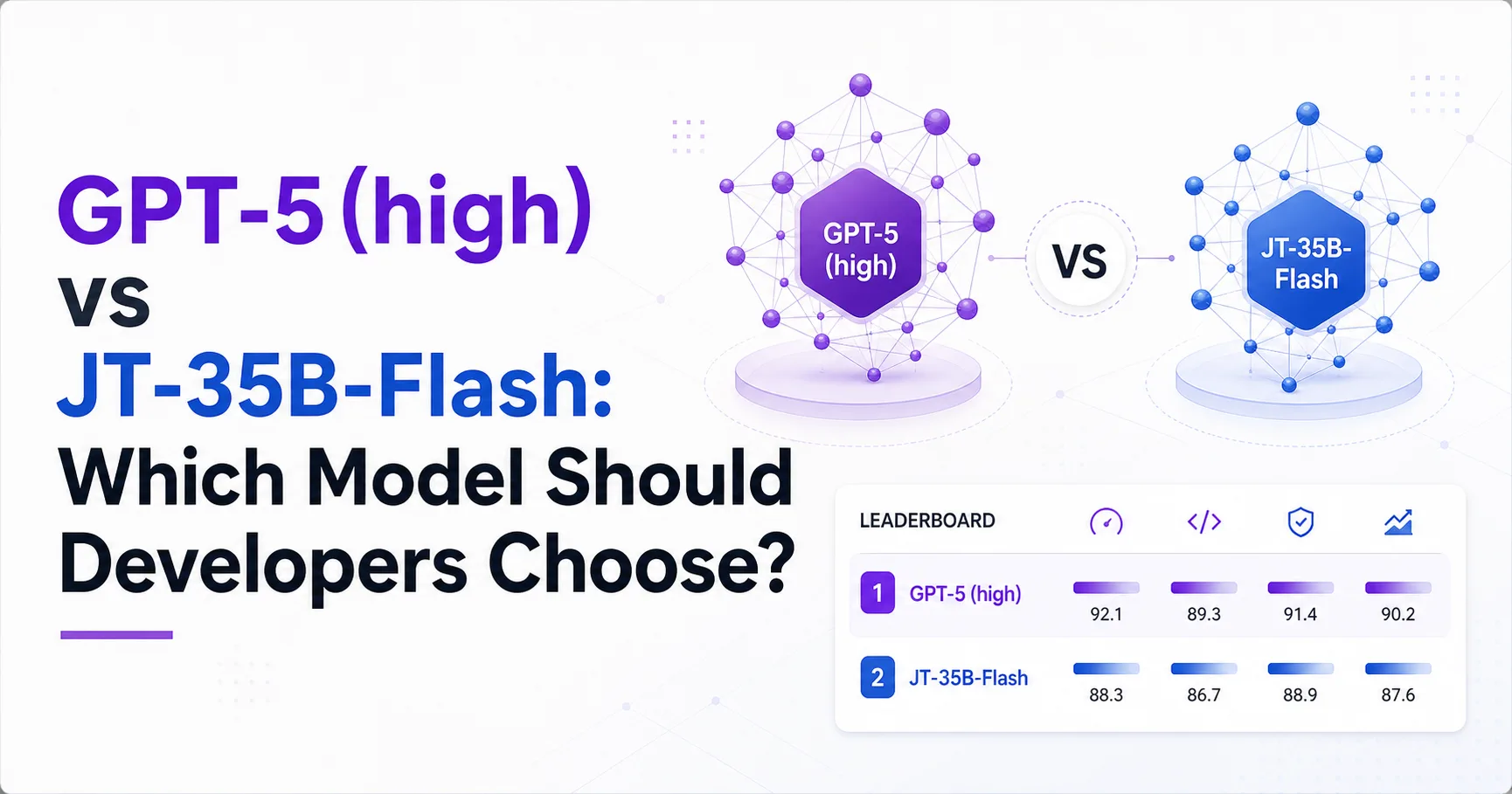
- **Winner overall:** GPT-5 (high), its Artificial Analysis Intelligence Index score is 34.7 vs 28.4 for JT-35B-Flash - **Cheaper:** GPT-5 (high) at $3.4375 vs $15 per 1M blended tokens - **Faster:** GPT-5 (high) and JT-35B-Flash tie at 0.3 seconds (latency) - **Pick GPT-5 (high) when:** coding, mathematical reasoning, tool use, or documented API behavior matters - **Watch out:** JT-35B-Flash has no supplied official documentation or comparable coding and math results
GPT-5 (high) vs JT-35B-Flash
GPT-5 (high) is the safer developer choice because it combines documented reasoning features, stronger available evaluation evidence, and a substantially lower blended price.
GPT-5 is OpenAI’s reasoning model for coding, reasoning, and agentic tasks, with reasoning_effort=high representing a parameter setting rather than a separate gpt-5-high API model. OpenAI describes GPT-5 for developers as supporting function calling, structured outputs, streaming, and custom tools.
JT-35B-Flash cannot be evaluated with the same confidence from the supplied material. The brief provides a release date, pricing, latency, and an Artificial Analysis Intelligence Index score, but it provides no official model page, API documentation, modality description, tool specification, or community evidence. That absence does not prove that JT-35B-Flash lacks those capabilities. It does mean a developer must verify them directly before treating the model as a production substitute.
The comparison therefore has an evidence asymmetry. GPT-5 has documented strengths and documented constraints. JT-35B-Flash has a smaller visible evidence surface, even though its measured release date is later and its listed Intelligence Index score is lower. Data provided by Artificial Analysis supplies the comparable pricing, latency, and evaluation snapshot used in this article.
Executive summary
GPT-5 (high) offers the stronger documented fit for general development work, while JT-35B-Flash remains an evidence-limited option rather than a proven alternative.
| Decision factor | GPT-5 (high) | JT-35B-Flash | What it means |
|---|---|---|---|
| Artificial Analysis Intelligence Index | 34.7 | 28.4 | GPT-5 has the higher comparable score |
| Artificial Analysis Coding Index | 37.8 | Not supplied | Coding evidence favors GPT-5 only on available data |
| Artificial Analysis Math Index | 94.3 | Not supplied | Mathematical reasoning evidence is available only for GPT-5 |
| Blended price per 1M tokens | $3.4375 | $15 | GPT-5 has the lower listed blended cost |
| Latency | 0.3 seconds | 0.3 seconds | The supplied snapshot shows a tie |
| Median output speed | Not supplied | Not supplied | No speed winner can be established |
OpenAI’s model documentation adds important operational context. GPT-5 has a 400,000-token context window, a maximum output of 128,000 tokens, text and image input, and text output. It does not support audio or video input and output, according to that documentation.
The key selection issue is not simply which score is higher. It is whether a team values a documented interface and known constraints, or is willing to validate an insufficiently documented model through its own testing. GPT-5 wins the evidence-backed default. JT-35B-Flash requires a qualification project before adoption.
Performance and practical capability
GPT-5 (high) has the broader performance case because its coding and math results are documented, while JT-35B-Flash has only one supplied comparable evaluation.
The page chart makes the available score gap visible, but it cannot show how much missing evidence should affect a production decision. GPT-5 records 34.7 on the Artificial Analysis Intelligence Index, compared with 28.4 for JT-35B-Flash. That result gives GPT-5 the stronger general capability signal in the supplied snapshot. It does not establish that GPT-5 will win every workflow, because the benchmark does not represent every application pattern.
GPT-5 also has a Coding Index result of 37.8 and a Math Index result of 94.3. JT-35B-Flash has no corresponding coding or math values in the data brief. The correct conclusion is limited: GPT-5 has documented evidence for these dimensions, while JT-35B-Flash cannot be ranked on them from the supplied data. A missing result is not a failed result, but it is a meaningful procurement risk when coding and reasoning are central requirements.
OpenAI reports GPT-5 results of 74.9% on SWE-bench Verified, 88% on Aider polyglot, 96.7% on τ²-bench telecom, and 69.6% on Scale MultiChallenge in its developer announcement. The announcement says the SWE-bench result excluded 23 problems that could not be stably passed on its infrastructure, and that the Aider evaluation used high reasoning effort. Those qualifications make the results useful evidence, not universal guarantees.
The supplied latency is 0.3 seconds for each model, so latency alone does not separate them. Median output tokens per second are unavailable for both models. Claims about which model feels faster during long generation, streaming, or multi-step tool use therefore remain unsupported. Developers should test their own request shapes, tool loops, and output lengths before making a speed-based choice.
Cost and value
GPT-5 (high) is the lower-cost option in the supplied pricing snapshot, but output-heavy workloads can still make absolute spend depend on response behavior.
The chart below this section already compares the listed prices, so the important question is what those prices imply for application economics. GPT-5’s blended price is $3.4375 per 1M tokens, compared with $15 for JT-35B-Flash. GPT-5 also lists $1.25 per 1M input tokens and $10 per 1M output tokens, while JT-35B-Flash lists $10 input and $30 output. On the supplied rates, GPT-5 has the lower price in each reported pricing category.
That advantage matters most for systems that process large prompts, repeat retrieval context, or generate substantial code. It also matters for experimentation, because lower token prices reduce the cost of running evaluations and can make regression testing more practical. The advantage can weaken if GPT-5 requires more reasoning passes, longer prompts, or more retries in a particular workflow. The brief does not provide token consumption, retry rates, cache behavior for JT-35B-Flash, or production success rates, so it cannot determine total cost per completed task.
The practical break-even question is therefore not simply which model has the cheaper token price. It is which model completes an accepted task with fewer failed calls, corrections, and human reviews. GPT-5 has documented tool and structured-output support in OpenAI’s developer material, which can reduce integration uncertainty. JT-35B-Flash could still become attractive in a narrow workload if its actual task success rate is materially better than the available evidence suggests, but the supplied material does not establish that case.
Teams should compare cost per accepted result, not cost per request. They should record input tokens, output tokens, retries, tool-call failures, and review time in a private pilot. Those measurements are necessary because the supplied snapshot does not include them.
Recommendation by workload
GPT-5 (high) should be the default shortlist candidate for developers who need documented coding, reasoning, and agent integration behavior.
Choose GPT-5 when the application needs a known API surface. The GPT-5 model documentation lists the gpt-5 alias, the fixed snapshot gpt-5-2025-08-07, Responses and Chat Completions availability, structured outputs, function calling, streaming, and the model’s text and image boundaries. That information gives an engineering team concrete constraints for architecture, testing, and incident response.
Choose GPT-5 when mathematical or coding work is central. The supplied data includes a Math Index score of 94.3 and a Coding Index score of 37.8 for GPT-5, while JT-35B-Flash has no supplied values for either dimension. The evidence is incomplete for a full head-to-head ranking, but it is sufficient to make GPT-5 the better-supported candidate for these workloads.
Consider JT-35B-Flash only after a controlled qualification exercise. Its Intelligence Index score is 28.4, its listed blended price is $15 per 1M tokens, and its latency is 0.3 seconds. Those facts do not reveal whether it supports the tools, modalities, context limits, safety controls, or deployment guarantees required by a real application. The research brief contains no official or community source for JT-35B-Flash, so capability assumptions would be speculative.
A further GPT-5 risk needs explicit ownership. OpenAI’s documentation marks gpt-5-2025-08-07 as Deprecated and describes GPT-5 as a previous-generation model, with GPT-5.6 recommended. Teams using a fixed snapshot should plan migration testing. Teams using the stable alias should define model-change monitoring and acceptance tests.
The final recommendation is GPT-5 for the initial implementation, paired with a task-level evaluation suite. JT-35B-Flash should remain a candidate for comparison only if its provider can supply verifiable API documentation and the team can demonstrate better completed-task economics in its own workload.
Questions to answer before choosing
GPT-5 (high) is easier to approve today because the supplied evidence answers more implementation questions than it does for JT-35B-Flash.
A model-selection review should treat undocumented capability as an open requirement, not as an implicit feature. The supplied sources establish a clear GPT-5 profile, a lower GPT-5 price, equal listed latency, and a higher comparable Intelligence Index score. They do not establish JT-35B-Flash’s coding ability, math ability, context window, modalities, tool interface, or operational guarantees.
The community evidence is also asymmetric. A Reddit post reports that GPT-5 helped with small bug fixes, while the author found some complete application and UI generation outputs too concise. Comments describe possible hallucinations or incorrect changes in complex existing repositories. The Reddit discussion is anecdotal and lacks a reproducible test method. No reliable Hacker News or X consensus was found for either model, so no stable community speed or reliability conclusion should be drawn.
This uncertainty matters most for teams choosing a model for an existing codebase. GPT-5’s documented capabilities reduce interface risk, but they do not remove the need for repository-level safeguards. JT-35B-Flash’s missing documentation increases the work required before the model can be judged fairly. The strongest next step is a controlled pilot with identical tasks, acceptance tests, tool traces, correction counts, and human review records.
Frequently asked questions
Is GPT-5 (high) faster than JT-35B-Flash?
No speed winner can be established from the supplied data. Both models list 0.3 seconds of latency, while median output tokens per second are unavailable for both. Developers should measure streaming behavior and full task completion time.
Which model is cheaper for API workloads?
GPT-5 (high) is cheaper in every supplied pricing category. Its blended price is $3.4375 per 1M tokens, compared with $15 for JT-35B-Flash, but total task cost still depends on retries and output volume.
Which model is better for coding?
GPT-5 (high) is the better-supported coding choice because it has an Artificial Analysis Coding Index score of 37.8 and documented coding-oriented API positioning. JT-35B-Flash has no supplied comparable coding score.
Should a team use the fixed GPT-5 snapshot?
Teams should use the fixed snapshot only with a migration plan. OpenAI’s model documentation marks gpt-5-2025-08-07 as Deprecated, so production systems need regression tests and an explicit upgrade process.
Can JT-35B-Flash replace GPT-5?
JT-35B-Flash cannot be confirmed as a replacement from the supplied evidence. Its Intelligence Index score is 28.4, but documentation for tools, modalities, context, coding, math, and operational behavior is absent.
Sources
- GPT-5 for developersGPT-5 positioning, reasoning parameters, tool support, structured outputs, custom tools, and official benchmark results
- GPT-5 model documentationGPT-5 context window, output limit, modalities, API aliases, endpoints, pricing, fine-tuning status, and deprecation status
- Tried GPT-5 Here Are My First ImpressionsAnecdotal community reports about bug fixing, application generation, UI detail, hallucinations, and incorrect repository changes
- Artificial AnalysisData attribution for the supplied evaluation, pricing, and latency snapshot
Published: