
AI model analysis
GPT-5 (high) vs KAT Coder Pro V2: Which Model Should Developers Choose?
A developer-focused comparison of GPT-5 (high) and KAT Coder Pro V2 across coding quality, reasoning evidence, speed, pricing, reliability, and product risk.
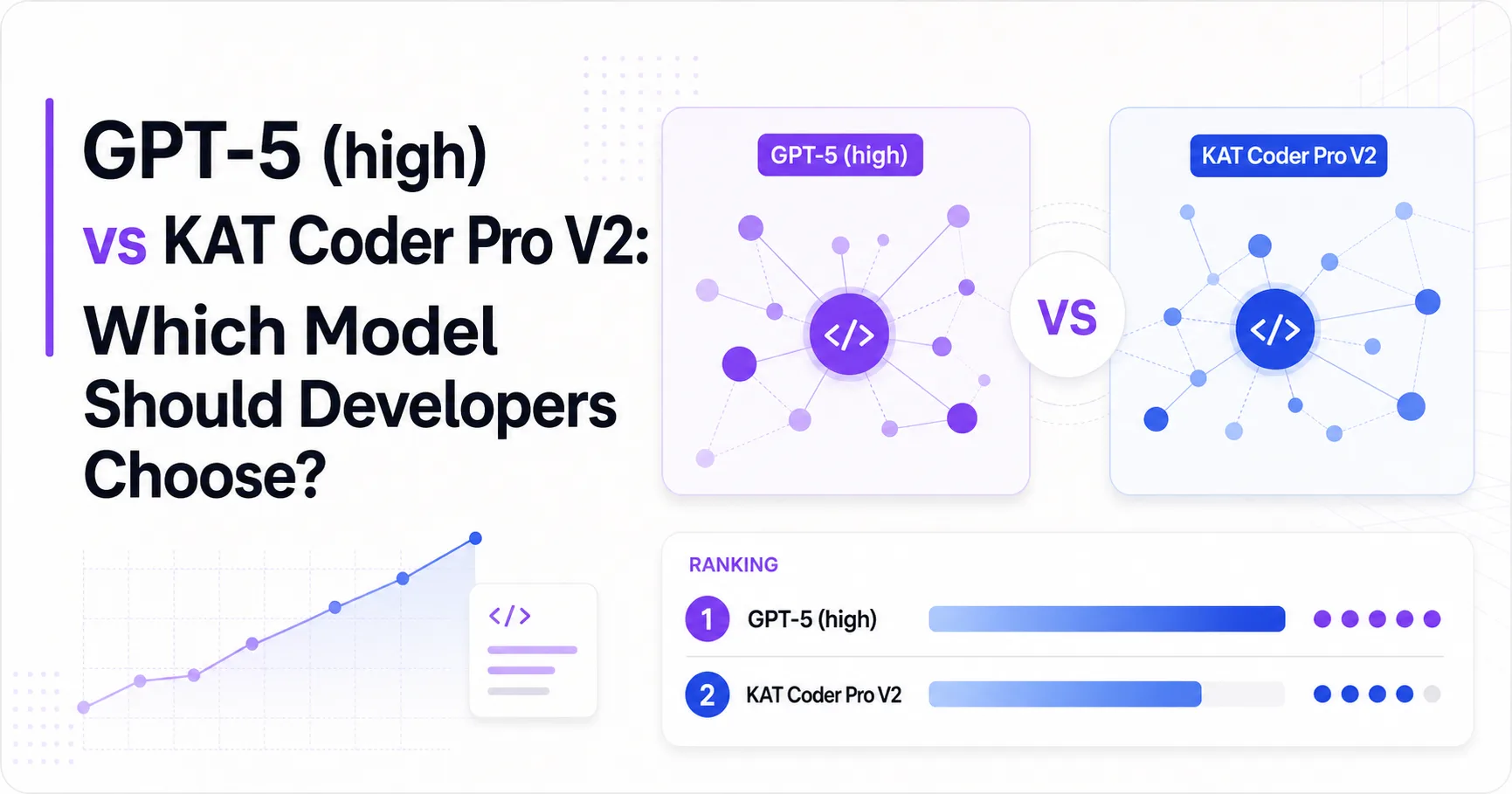
- **Winner overall:** KAT Coder Pro V2, with a 59.5 coding index versus GPT-5 (high) at 37.8 - **Cheaper:** KAT Coder Pro V2 at $0.525 vs $3.4375 per 1M blended tokens - **Faster:** KAT Coder Pro V2 at 108.179 (median output tokens per second) - **Pick GPT-5 (high) when:** you need documented reasoning controls, multimodal input, structured tool use, or stronger evidence on math tasks - **Watch out:** KAT Coder Pro V2 has no verifiable public documentation, pricing page, or community evidence in the supplied research
GPT-5 (high) vs KAT Coder Pro V2
GPT-5 (high) is the safer documented platform choice, while KAT Coder Pro V2 is the stronger measured coding and cost choice. The decision depends on whether your application values public API evidence and integration controls more than coding scores and low operating cost. GPT-5 is documented by OpenAI as a reasoning model for coding, reasoning, and agentic tasks (OpenAI developer announcement). KAT Coder Pro V2 has the higher Artificial Analysis coding index, at 59.5 versus GPT-5 (high) at 37.8. Its blended price is also $0.525 per 1M tokens, compared with GPT-5 (high) at $3.4375. These figures make KAT attractive for coding-heavy workloads, but the supplied research does not verify its API, model availability, context window, failure modes, or vendor support. Data provided by https://artificialanalysis.ai/
Executive summary for model selection
KAT Coder Pro V2 leads the available coding and price data, but GPT-5 (high) leads the evidence quality behind the product decision. The comparison is therefore not a simple capability ranking. It is a tradeoff between measured task performance and documented operational confidence.
| Decision area | GPT-5 (high) | KAT Coder Pro V2 |
|---|---|---|
| Coding index | 37.8 | 59.5 |
| Intelligence index | 34.7 | 33.7 |
| Math index | 94.3 | No supplied result |
| Blended price per 1M tokens | $3.4375 | $0.525 |
| Input price per 1M tokens | $1.25 | $0.3 |
| Output price per 1M tokens | $10 | $1.2 |
| Median output speed | No supplied result | 108.179 tokens per second |
| Latency | 0.3 seconds | 0.3 seconds |
GPT-5 provides a stable gpt-5 alias, a fixed snapshot named gpt-5-2025-08-07, a 400,000-token context window, and a 128,000-token maximum output according to OpenAI model documentation. KAT Coder Pro V2 has no verifiable public source in the supplied research for these integration details. That missing information matters because a high benchmark score cannot establish whether a model can be deployed, monitored, or supported in production.
Performance: what the scores mean in real development
KAT Coder Pro V2 is the stronger measured coding model, while GPT-5 (high) offers broader documented reasoning and tool controls. The coding index gap is substantial in the supplied data: KAT Coder Pro V2 scores 59.5, while GPT-5 (high) scores 37.8. For repository editing, code generation, and coding-agent experiments, that result makes KAT the first candidate to test. It does not prove that KAT will produce safer patches or understand every existing codebase.
GPT-5 has stronger public evidence for developer workflows. OpenAI reports 74.9% on SWE-bench Verified, 88% on Aider polyglot, 96.7% on τ²-bench telecom, and 69.6% on Scale MultiChallenge in its developer announcement. OpenAI also documents function calling, structured outputs, streaming, and custom tools with developer-provided context-free grammar constraints (model documentation). Those controls can matter more than a coding-index lead when the application depends on predictable tool execution or strict output contracts.
GPT-5 also scores 94.3 on the supplied math evaluation, while KAT has no supplied math result. GPT-5 leads the intelligence index narrowly, at 34.7 versus KAT Coder Pro V2 at 33.7. The evidence does not establish that GPT-5 is faster in generation, because no GPT-5 median output speed is supplied. Both models show 0.3 seconds of latency, so the available data does not distinguish their initial-response experience.
The community evidence is asymmetric. A Reddit user reported that GPT-5 was useful for locating and fixing small bugs, while the same post described shorter, less complete results for full applications and possible incorrect changes in complex existing repositories (Reddit first impressions). That is a single uncontrolled account, not a stable consensus. No comparable public community evidence is available for KAT, so claims about its reliability remain unverified.
Cost: when the cheaper model can become more expensive
KAT Coder Pro V2 is the clear price leader, but GPT-5 (high) may justify its premium when failure recovery and integration certainty dominate total cost. KAT costs $0.525 per 1M blended tokens, versus $3.4375 for GPT-5 (high). Its input price is $0.3, compared with $1.25, and its output price is $1.2, compared with $10. The price gap is especially important for agents that produce long patches, explanations, or tool plans.
The charted prices do not show the cost of a bad change. A model with unclear documentation may require more validation, retries, human review, or fallback routing. The supplied research cannot measure those factors for KAT, so it cannot prove that KAT remains cheaper after engineering overhead. GPT-5 also has documented API endpoints and controls, which can reduce the work required to build a dependable integration (OpenAI model documentation).
KAT’s measured output speed of 108.179 tokens per second may improve interactive coding sessions, but GPT-5 has no supplied median output-speed value. Both models have 0.3 seconds of latency, so the available evidence does not show a first-token advantage. A team should therefore separate responsiveness from throughput during its own pilot.
KAT is the rational default for high-volume coding experiments when an accessible, supported endpoint has already been verified. GPT-5 is easier to justify for production systems that need documented behavior, structured outputs, image input, and explicit reasoning-effort controls. The final cost decision should include review time, retries, routing, and migration risk, none of which are quantified in the supplied data.
Recommendation by developer scenario
GPT-5 (high) is the better default for documented production integration, while KAT Coder Pro V2 is the better first experiment for coding-heavy cost-sensitive workloads.
Choose KAT Coder Pro V2 when the primary task is code generation or repository work, the measured coding index is the deciding signal, and your team can verify access and behavior independently. Its 59.5 coding index and $0.525 blended price create a compelling test case. Do not treat the score as proof of production readiness. The supplied research has no verifiable KAT documentation, pricing page, release confirmation, API specification, benchmark methodology, or failure analysis.
Choose GPT-5 (high) when the application needs documented function calling, structured outputs, streaming, custom tools, image input, or adjustable reasoning_effort and verbosity parameters. OpenAI documents these capabilities in the developer announcement and model documentation. GPT-5 is also the only model with a supplied math result, scoring 94.3, and the only model with published benchmark methodology in the research.
Avoid choosing solely from the release dates. The data lists GPT-5 at 2025-08-07 and KAT Coder Pro V2 at 2026-03-27, but the research does not establish equivalent availability or maturity. Also note that OpenAI marks the fixed GPT-5 snapshot gpt-5-2025-08-07 as Deprecated and recommends GPT-5.6 (model documentation). A team selecting GPT-5 should use the documented alias and define a migration plan. A team selecting KAT should first confirm the endpoint, terms, support path, and reproducible evaluation results.
Evidence gaps before committing
KAT Coder Pro V2 remains the largest uncertainty in this comparison because its public deployment and reliability evidence is absent. The research does not confirm a stable alias, current availability, context window, output limit, multimodal support, tool API, fine-tuning options, or official benchmark results. It also contains no reliable community discussion that would establish common failure patterns.
GPT-5 has more documented facts, but its evidence is not complete either. OpenAI documents text and image input with text output, while audio and video input and output are unsupported (model documentation). Fine-tuning and Predicted outputs are also marked unsupported. Community reports suggest useful small-bug debugging but possible under-complete application generation and incorrect changes in complex repositories (Reddit first impressions). Those reports are subjective and uncontrolled.
The missing evidence should change the evaluation plan, not be hidden in the recommendation. Before adoption, compare patch correctness, test preservation, tool-call validity, recovery after failed edits, and behavior on the team’s own repositories. The supplied materials do not provide those results, so no conclusion about real-world reliability can be stated with confidence.
Frequently asked questions
Is KAT Coder Pro V2 better than GPT-5 for coding?
KAT Coder Pro V2 is better on the supplied coding index, scoring 59.5 versus GPT-5 (high) at 37.8, but the evidence does not establish its reliability, API availability, or performance on your repository.
Which model is cheaper for production API usage?
KAT Coder Pro V2 is cheaper on every supplied price measure, including $0.525 per 1M blended tokens versus GPT-5 (high) at $3.4375, although unmeasured review and failure costs may change the total.
Should developers choose GPT-5 for agentic applications?
GPT-5 is the stronger documented choice for agentic applications because OpenAI specifies function calling, structured outputs, streaming, custom tools, and adjustable reasoning controls, while equivalent KAT evidence is unavailable.
Does GPT-5 have stronger reasoning evidence than KAT Coder Pro V2?
GPT-5 has stronger published reasoning evidence because it includes official benchmark results and a supplied math score of 94.3, while KAT Coder Pro V2 has no supplied math result or official benchmark source.
Is GPT-5 still a safe long-term model choice?
GPT-5 is usable through its documented alias, but the fixed snapshot gpt-5-2025-08-07 is marked Deprecated, so production adopters should plan migration and avoid depending on that snapshot indefinitely.
Sources
- GPT-5 for developersGPT-5 positioning, reasoning parameters, tool calling, custom tools, and official benchmark results
- GPT-5 model documentationGPT-5 API alias, snapshot status, context and output limits, modalities, pricing, endpoints, and unsupported features
- Tried GPT-5 Here Are My First ImpressionsSubjective community evidence about debugging, application generation, and complex repository changes
- Artificial AnalysisAttribution for the supplied model indices, pricing data, latency data, and output-speed data
Published: