
AI model analysis
GPT-5 (high) vs Kimi K2.7 Code: Which Model Should Developers Choose?
A developer-focused comparison of GPT-5 (high) and Kimi K2.7 Code across coding quality, broader intelligence, speed, pricing, reliability, and evidence quality.
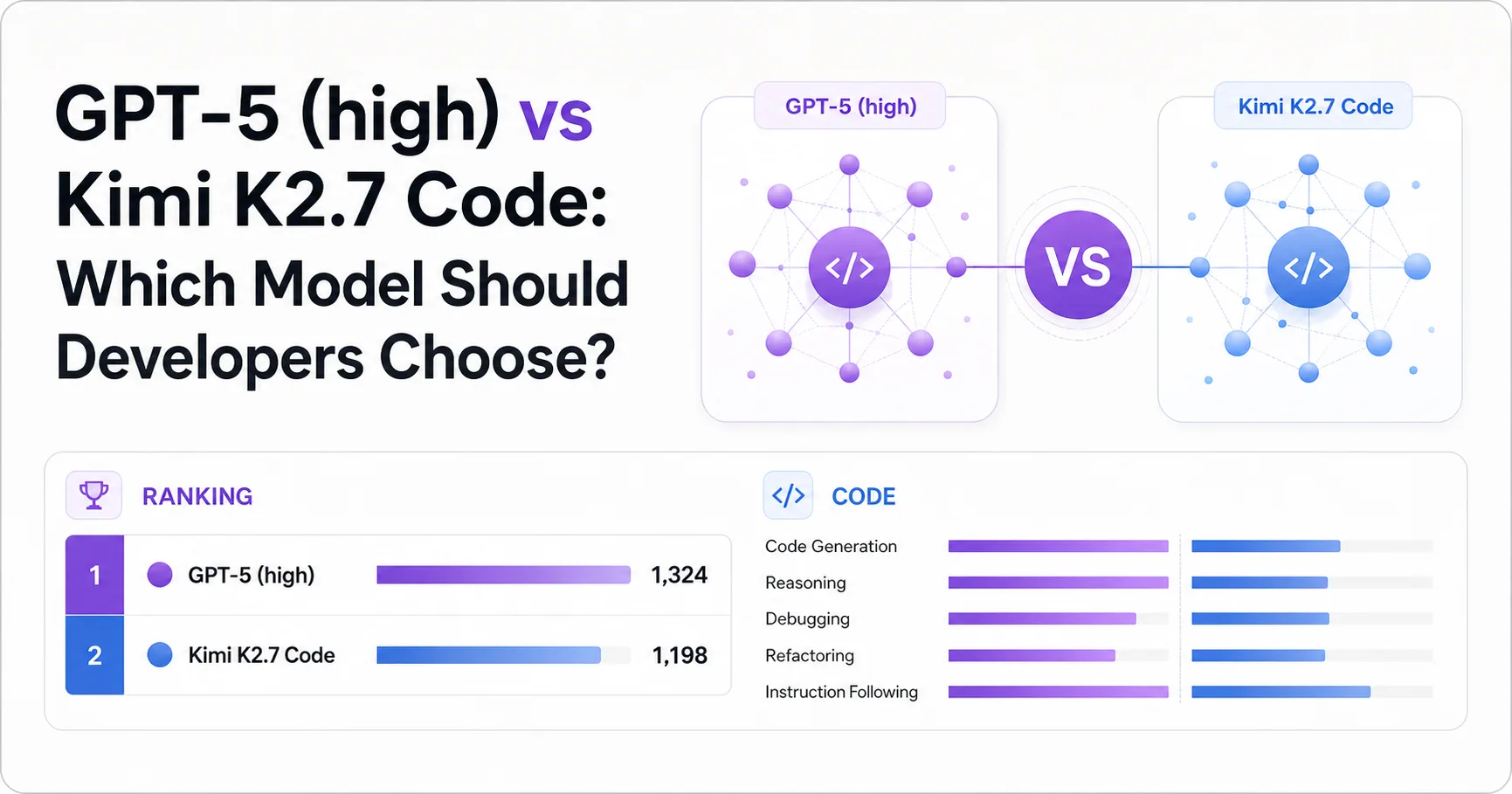
- **Winner overall:** Kimi K2.7 Code, with a 60.8 coding index and 41.9 intelligence index versus GPT-5 (high) at 37.8 and 34.7 - **Cheaper:** Kimi K2.7 Code at $1.7125000000000001 vs $3.4375 per 1M blended tokens - **Faster:** Kimi K2.7 Code at 39.167 median output tokens per second - **Pick GPT-5 (high) when:** you need documented API behavior, a 400,000-token context window, structured tool use, or published reasoning benchmarks - **Watch out:** Kimi K2.7 Code has no verified public documentation in the supplied research, so its operational limits and availability remain uncertain
GPT-5 (high) vs Kimi K2.7 Code
GPT-5 (high) is the safer documented platform choice, while Kimi K2.7 Code is the stronger measured coding and price choice in the supplied snapshot. Artificial Analysis reports Kimi K2.7 Code at 60.8 on its coding index and 41.9 on its intelligence index, compared with GPT-5 (high) at 37.8 and 34.7. The same snapshot lists Kimi K2.7 Code at $1.7125000000000001 per 1M blended tokens, compared with GPT-5 (high) at $3.4375.\n\nThe decision is therefore not simply a model-quality ranking. Kimi leads the available comparative measurements, but the research brief contains no verifiable vendor documentation for Kimi K2.7 Code. GPT-5 has an official API identity, documented limits, published benchmarks, and stated tool behavior. Developers choosing Kimi are accepting a larger evidence gap around deployment risk.\n\nData provided by Artificial Analysis.
Executive summary for developers
GPT-5 (high) offers stronger documented capabilities, but Kimi K2.7 Code leads the available comparative data for coding, general intelligence, and blended token cost.\n\n| Decision factor | GPT-5 (high) | Kimi K2.7 Code | Practical meaning | |—|—:|—:|—| | Coding index | 37.8 | 60.8 | Kimi has the stronger measured coding result in the supplied snapshot. | | Intelligence index | 34.7 | 41.9 | Kimi also leads the broader measured index. | | Math index | 94.3 | No supplied value | GPT-5 has evidence for this dimension, while Kimi cannot be judged here. | | Blended price per 1M tokens | $3.4375 | $1.7125000000000001 | Kimi has the lower blended price. | | Input price per 1M tokens | $1.25 | $0.95 | Kimi is cheaper for input-heavy workloads. | | Output price per 1M tokens | $10 | $4 | Kimi is cheaper for generation-heavy workloads. | | Documented API profile | Available | Not verified in the research | GPT-5 carries lower integration uncertainty. | \nGPT-5 is officially positioned for coding, reasoning, and agentic tasks, with documented support for function calling, structured outputs, streaming, and custom tools. OpenAI’s developer announcement describes those capabilities and its published benchmark methodology. The GPT-5 model documentation documents its context, modalities, pricing, endpoints, and lifecycle status.\n\nThe supplied research found no reliable public source for Kimi K2.7 Code’s context window, output limit, API alias, parameters, modalities, pricing page, or failure modes. That absence does not prove Kimi lacks those capabilities. It means the buyer cannot verify them from the supplied evidence.
Performance: what the measured gap means
Kimi K2.7 Code is the measured performance leader for coding, but GPT-5 (high) remains easier to evaluate for reasoning-heavy production systems.\n\nThe coding-index gap is large enough to affect model selection when the workload is dominated by code generation, code transformation, and repository-level programming tasks. Artificial Analysis places Kimi K2.7 Code at 60.8 and GPT-5 (high) at 37.8. That result supports testing Kimi first for developer tooling, provided the model can be accessed reliably and behaves consistently in the target API.\n\nThe broader intelligence index points in the same direction, with Kimi K2.7 Code at 41.9 and GPT-5 (high) at 34.7. However, the comparison is incomplete. GPT-5 has a supplied math-index result of 94.3, while no Kimi value is available. The missing Kimi math result prevents a complete conclusion about mathematical reasoning or technical analysis.\n\nGPT-5’s official evidence is more detailed. OpenAI reports 74.9% on SWE-bench Verified, 88% on Aider polyglot, 96.7% on τ²-bench telecom, and 69.6% on Scale MultiChallenge. The developer announcement states that SWE-bench excluded 23 of 500 problems that could not be passed reliably on OpenAI’s infrastructure, and that Aider used high reasoning effort. These qualifications matter because benchmark conditions may not match a normal production request.\n\nThe supplied data lists both models at 0.3 seconds of latency. It lists Kimi at 39.167 median output tokens per second, but provides no corresponding GPT-5 output-speed value. Kimi therefore has the observable throughput advantage, while a complete speed comparison remains unavailable.
Cost: when the cheaper model can still cost more
Kimi K2.7 Code is the clear price leader, but its evidence gap can turn a lower token bill into higher integration and operational risk.\n\nThe supplied snapshot lists Kimi K2.7 Code at $1.7125000000000001 per 1M blended tokens, versus GPT-5 (high) at $3.4375. Kimi is also listed at $0.95 per 1M input tokens and $4 per 1M output tokens, compared with GPT-5 at $1.25 and $10. The advantage is especially relevant for applications that generate long answers, patches, or multi-step tool interactions.\n\nToken price is not the whole cost model. The research brief does not verify Kimi’s API availability, context limit, output limit, authentication flow, tool schema, or lifecycle policy. A team may spend more engineering time discovering those details, building compatibility layers, or handling behavior that lacks official documentation. Those costs cannot be quantified from the supplied evidence.\n\nGPT-5 has a documented cache-input price of $0.125 per 1M tokens, along with documented API endpoints and model identifiers in OpenAI’s model documentation. The supplied data brief does not provide an equivalent cached-input price for Kimi, so cache-heavy cost comparisons are not supported.\n\nThe cost conclusion flips when reliability, supportability, or long-lived integration matters more than raw token economics. Kimi is the rational first experiment for a controlled workload. GPT-5 is easier to budget operationally because its interface and limits are publicly described, even though its listed token prices are higher.
Recommendation by workload
Kimi K2.7 Code is the first model to test for cost-sensitive coding workloads, while GPT-5 (high) is the better default where documentation and platform confidence dominate.\n\nChoose Kimi K2.7 Code when the application is primarily code-focused, the workload can be evaluated with task-level tests, and the team can tolerate unresolved questions about API behavior. Its 60.8 coding index, 39.167 median output tokens per second, and $1.7125000000000001 blended price make it the stronger candidate for an evidence-driven trial. The trial should measure patch correctness, regression rate, tool-call validity, and recovery from incomplete instructions.\n\nChoose GPT-5 (high) when the system needs documented agent features, structured output, custom tools, or a large stated context window. OpenAI documents a 400,000-token context window and a maximum output of 128,000 tokens in the GPT-5 model documentation. The developer documentation also describes reasoning-effort controls from minimal through high and verbosity controls from low through high.\n\nGPT-5 is also the safer choice when model governance requires a stable vendor contract and public migration signals. The fixed snapshot gpt-5-2025-08-07 is marked Deprecated, although the gpt-5 alias remains listed. That creates migration work, but it is visible work. The Kimi brief provides no verified lifecycle information, so its migration risk is unknown rather than demonstrably lower.\n\nNeither model should be selected for direct audio or video processing through the GPT-5 API, because the official documentation lists text and image input with text output, without audio or video input or output. No comparable Kimi modality evidence is available.
Questions to resolve before committing
GPT-5 (high) is easier to approve under a documentation-first procurement process, while Kimi K2.7 Code needs direct validation before production commitment.\n\nThe central uncertainty is not whether Kimi’s supplied benchmark values look attractive. They do. The uncertainty is whether those values map to an accessible, stable, documented service that supports the exact developer workflow. The research brief found no reliable public source for Kimi’s API contract, context, output limits, tools, modalities, pricing page, or failure patterns.\n\nGPT-5 also has risks. Its fixed snapshot is marked Deprecated, its output price is higher, and a Reddit report describes shorter, less complete results for full application and UI generation. That report came from one user’s uncontrolled test, so it should guide validation rather than serve as a general benchmark. The same Reddit discussion mentions useful small-bug debugging alongside possible hallucinations or incorrect changes in complex existing codebases.\n\nThe practical next step is a side-by-side pilot using the team’s own repositories and acceptance tests. The supplied research does not establish a universal winner across every developer workload. It supports Kimi as the value and coding-performance candidate, and GPT-5 as the documented integration candidate.
Frequently asked questions
Which model should a developer try first for coding tasks?
Kimi K2.7 Code should be tested first for coding-heavy tasks because the supplied snapshot gives it a 60.8 coding index, but production adoption still requires direct validation of access, tools, and reliability.
Which model is cheaper for typical API usage?
Kimi K2.7 Code is cheaper in the supplied comparison, at $1.7125000000000001 per 1M blended tokens versus GPT-5 (high) at $3.4375, with lower listed input and output prices.
Is GPT-5 (high) a separate API model?
GPT-5 (high) is not identified as a separate official API model in the supplied research; high refers to the reasoning_effort=high setting for the gpt-5 model.
Which model has the better documented API?
GPT-5 (high) has the better documented API because OpenAI publishes its model identifier, context window, output limit, modalities, endpoints, tool features, pricing, and lifecycle status.
Can Kimi K2.7 Code replace GPT-5 for every developer workflow?
The supplied evidence cannot support that conclusion because Kimi has no verified documentation for context, output limits, modalities, API behavior, failure modes, or the math dimension measured for GPT-5.
Does GPT-5 have better speed?
The supplied data does not establish that GPT-5 is faster because both models have 0.3 seconds of listed latency, while only Kimi K2.7 Code has a reported median output speed of 39.167 tokens per second.
Sources
- Artificial AnalysisQuantitative comparison data for coding, intelligence, math, pricing, latency, and output speed.
- GPT-5 for developersGPT-5 positioning, reasoning and verbosity controls, tool capabilities, official benchmarks, and benchmark methodology.
- GPT-5 model documentationGPT-5 context window, output limit, modalities, API identifiers, endpoints, pricing, fine-tuning status, and deprecation status.
- Tried GPT-5 Here Are My First ImpressionsUncontrolled community observations about debugging, application generation, UI completeness, hallucinations, and incorrect code changes.
Published: