
AI model analysis
GPT-5 (high) vs Mi:dm K 2.5 Pro Preview: Which Model Should Developers Choose?
A developer-focused comparison of GPT-5 (high) and Mi:dm K 2.5 Pro Preview, covering reasoning performance, coding signals, pricing evidence, product risk, and selection criteria.
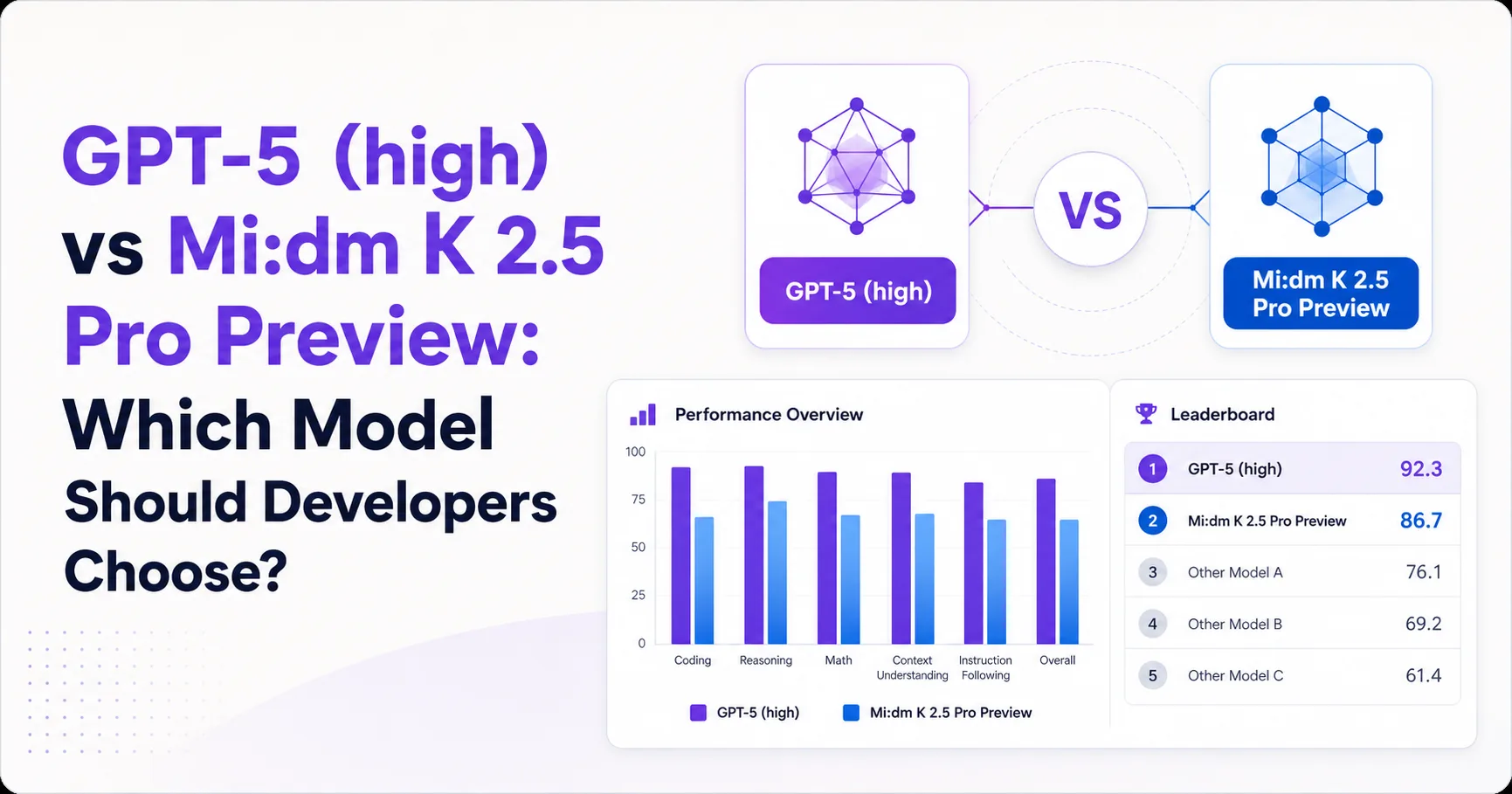
- **Winner overall:** GPT-5 (high), with a 94.3 Artificial Analysis math index and stronger results across every directly comparable evaluation - **Cheaper:** Mi:dm K 2.5 Pro Preview at $0 vs $3.438 per 1M blended tokens - **Faster:** Neither model, because the data brief reports 0 median output tokens per second for both - **Pick GPT-5 (high) when:** You need documented API behavior, tool calling, structured outputs, and stronger coding or reasoning evidence - **Watch out:** Mi:dm K 2.5 Pro Preview has no verified public documentation or pricing evidence, so its apparent $0 cost cannot be treated as a confirmed commercial advantage
GPT-5 (high) is the safer developer choice, while Mi:dm K 2.5 Pro Preview remains an evidence gap.
GPT-5 (high) is the safer developer choice because OpenAI documents its API, capabilities, pricing, and model lifecycle, while Mi:dm K 2.5 Pro Preview has no verified public documentation in the supplied research. OpenAI positions GPT-5 as a reasoning model for coding, reasoning, and agentic tasks in GPT-5 for developers. The documented API model is gpt-5, with reasoning_effort=high as a parameter rather than a separate gpt-5-high model ID, according to GPT-5 model documentation. The data snapshot identifies GPT-5 (high) as released on 2025-08-07 and Mi:dm K 2.5 Pro Preview as released on 2025-12-11. Those dates describe the comparison records, not equivalent levels of public availability. The supplied research found no verified vendor announcement, developer documentation, pricing page, community test, or failure analysis for Mi:dm K 2.5 Pro Preview. Data provided by https://artificialanalysis.ai/ supplies the comparison measurements used in this article.
GPT-5 (high) leads every directly comparable quality measure, but the comparison is asymmetric.
GPT-5 (high) leads every directly comparable quality measure, although the available evidence is much richer for GPT-5 than for Mi:dm K 2.5 Pro Preview.
| Decision area | GPT-5 (high) | Mi:dm K 2.5 Pro Preview | What it means |
|---|---|---|---|
| General intelligence index | 35.3 | No value reported | No complete overall comparison is possible |
| Coding index | 37.8 | No value reported | GPT-5 has the only reported aggregate coding signal |
| Math index | 94.3 | 78.7 | GPT-5 has the stronger reported math result |
| LiveCodeBench | 0.846 | 0.576 | GPT-5 has the stronger coding benchmark result |
| Tool and agent signal, τ² | 0.847953216374269 | 0.494152046783626 | GPT-5 has the stronger reported task-completion signal |
| Blended price per 1M tokens | $3.438 | $0 | Mi:dm appears cheaper in the dataset, but the price is unverified |
GPT-5 also has documented support for function calling, structured outputs, streaming, and custom tools in GPT-5 for developers. The model documentation also describes text and image input with text output, while excluding audio and video input and output in GPT-5 model documentation. Mi:dm K 2.5 Pro Preview cannot be credited with missing capabilities, but it also cannot be rejected for them without documentation. The central selection issue is therefore not simply quality versus price. It is verified deployability versus an unverified possibility.
GPT-5 (high) is the stronger choice for reasoning-heavy development workflows, but benchmark gaps do not guarantee production success.
GPT-5 (high) is the stronger choice for reasoning-heavy development workflows because its reported results are consistently higher on coding, instruction following, and task interaction measures. The largest practical signal is the reported LiveCodeBench result of 0.846 for GPT-5 (high), compared with 0.576 for Mi:dm K 2.5 Pro Preview. That gap suggests a better starting point for code generation and repair tasks, but it does not prove that GPT-5 will make fewer mistakes in every repository.
GPT-5’s reported τ² result is 0.847953216374269, compared with 0.494152046783626 for Mi:dm K 2.5 Pro Preview. For applications that combine planning, tool use, and external actions, this is more relevant than a general knowledge score. GPT-5 also records 0.730612244897959 on IFBench versus 0.45578231292517 for Mi:dm K 2.5 Pro Preview, which indicates a stronger reported ability to follow constrained instructions.
The evidence still has important limits. OpenAI’s published GPT-5 benchmark results include 74.9% on SWE-bench Verified, 88% on Aider polyglot, 96.7% on τ²-bench telecom, and 69.6% on Scale MultiChallenge in GPT-5 for developers. The SWE-bench result excluded 23 of 500 problems that could not run reliably on OpenAI’s infrastructure, and the Aider result used high reasoning effort. The supplied research contains no equivalent official test method for Mi:dm K 2.5 Pro Preview.
A community post reports that GPT-5 helped with small bug fixes but could produce incomplete UI work or incorrect changes in complex existing codebases. That report is a single user’s uncontrolled experience, not a reproducible benchmark, as described in Tried GPT-5 Here Are My First Impressions. Evidence is insufficient to compare real-world speed, stability, or repository safety between the two models because the data brief reports 0 median output tokens per second and 0 latency seconds for both.
Mi:dm K 2.5 Pro Preview looks cheaper, but GPT-5 can be the lower-risk economic choice when reliability matters.
Mi:dm K 2.5 Pro Preview looks cheaper in the dataset, but GPT-5 (high) has the only verified commercial pricing evidence. The data brief lists Mi:dm K 2.5 Pro Preview at $0 for 1M blended tokens, $0 for 1M input tokens, and $0 for 1M output tokens. The supplied research found no public pricing page or documentation that confirms whether those zeros represent free access, missing data, an internal preview, or an unavailable endpoint.
GPT-5 is listed at $3.438 per 1M blended tokens, with input priced at $1.25 per 1M tokens and output priced at $10 per 1M tokens. These prices are documented in GPT-5 model documentation. The cost chart should therefore be read as a verified paid option versus an unverified zero-price record, not as a confirmed free-versus-paid product decision.
The cheaper model can become more expensive when developers must compensate for weaker task completion with retries, human review, routing logic, or migration work. The reported gap on TerminalBench Hard, 0.325757575757576 for GPT-5 (high) versus 0.0303030303030303 for Mi:dm K 2.5 Pro Preview, makes that risk relevant for terminal-driven engineering tasks. However, the brief provides no token volumes, retry rates, engineering labor costs, or production error costs. It is therefore impossible to calculate a real total-cost winner.
Choose Mi:dm K 2.5 Pro Preview on price only after verifying access, billing terms, rate limits, model behavior, and support obligations. Until then, GPT-5 is easier to budget because its price and API identity are documented, even though its output tokens cost more than its input tokens.
GPT-5 (high) should be the default pick, while Mi:dm K 2.5 Pro Preview belongs in a gated validation test.
GPT-5 (high) should be the default pick for developers who need a documented API and the strongest available evidence for coding and reasoning quality. Its API supports function calling, structured outputs, streaming, and custom tools, with reasoning_effort and verbosity controls documented in GPT-5 for developers. Its reported results are stronger on every directly comparable evaluation in the supplied data, including LiveCodeBench, IFBench, τ², and TerminalBench Hard.
Pick GPT-5 (high) for agentic workflows, code repair, constrained output, mathematical reasoning, and products where an undocumented provider would create unacceptable launch risk. The model supports text and image input, but not audio or video input or output, according to GPT-5 model documentation. Its fixed snapshot gpt-5-2025-08-07 is marked Deprecated, so teams that need long-lived reproducibility must plan for model migration rather than assuming the snapshot will remain available.
Test Mi:dm K 2.5 Pro Preview only when its provider can confirm a usable endpoint and commercial terms. The test should use the team’s own representative tasks, including code changes, tool calls, structured responses, long-context work, and failure recovery. The supplied research cannot establish its context window, output limit, API parameters, supported modalities, latency, or failure modes. Treat its reported $0 price as a data point requiring verification, not as a purchasing decision.
The evidence does not justify claiming that GPT-5 is universally better. It justifies a narrower conclusion: GPT-5 is the only option here with documented deployment characteristics and a broad set of comparable quality results. Mi:dm K 2.5 Pro Preview could still be attractive if its access is real and its own production test results meet the application’s needs.
Questions developers should answer before choosing
GPT-5 (high) is easier to evaluate responsibly because its public documentation answers questions that remain unanswered for Mi:dm K 2.5 Pro Preview. The following questions focus on selection risks that the supplied benchmarks and pricing chart cannot resolve alone.
Does “GPT-5 (high)” mean there is a separate API model?
GPT-5 (high) refers to GPT-5 configured with reasoning_effort=high, not a verified standalone gpt-5-high API model. The supplied research found the callable alias gpt-5 and the fixed snapshot gpt-5-2025-08-07 in GPT-5 model documentation.
Is Mi:dm K 2.5 Pro Preview really free?
Mi:dm K 2.5 Pro Preview cannot be confirmed as free because the data brief reports $0 pricing but the research found no verified pricing page, endpoint, or commercial terms. Developers should treat the zero value as unverified until the provider confirms access and billing conditions.
Which model is better for coding?
GPT-5 (high) has the stronger available coding evidence because its reported LiveCodeBench score is 0.846 versus 0.576 for Mi:dm K 2.5 Pro Preview, while GPT-5 also has a reported Artificial Analysis coding index of 37.8. These results do not guarantee success on a specific repository.
Which model is faster?
Neither model can be identified as faster from the supplied data because median output speed is reported as 0 tokens per second and latency is reported as 0 seconds for each model. The research also found no reliable community evidence that establishes a speed difference.
Can GPT-5 process audio or video?
GPT-5 cannot directly process audio or video through the documented API because the model documentation lists text and image input with text output, while audio and video input and output are unsupported. Teams needing those modalities require another component or model.
What is the biggest production risk?
GPT-5’s biggest documented lifecycle risk is that the fixed snapshot gpt-5-2025-08-07 is marked Deprecated, while Mi:dm K 2.5 Pro Preview’s biggest risk is missing evidence about availability, behavior, pricing, and support. The two risks require different validation plans.
Frequently asked questions
Is GPT-5 (high) a separate API model?
GPT-5 (high) is not a verified standalone API model, because “high” describes the reasoning_effort=high setting applied to gpt-5, according to OpenAI’s documentation.
Is Mi:dm K 2.5 Pro Preview free to use?
Mi:dm K 2.5 Pro Preview cannot be confirmed as free, because the $0 values appear in the data snapshot but no verified public pricing page or access terms were found.
Which model should developers choose for coding?
Developers should choose GPT-5 (high) when coding quality and deployment evidence matter most, because its reported LiveCodeBench result is 0.846 versus 0.576 for Mi:dm K 2.5 Pro Preview.
Which model is faster?
Neither model can be identified as faster from the supplied comparison, because both models have reported median output speed of 0 tokens per second and latency of 0 seconds.
Sources
- GPT-5 for developersGPT-5 positioning, release information, reasoning controls, tool calling, structured outputs, custom tools, and official benchmark context.
- GPT-5 model documentationAPI model identity, snapshot status, context and output details, modalities, pricing, endpoints, parameters, and unsupported features.
- Tried GPT-5 Here Are My First ImpressionsUncontrolled community observations about small bug fixes, UI generation, and possible errors in complex existing codebases.
- Artificial AnalysisData attribution for the supplied model comparison snapshot, benchmark values, pricing records, and performance fields.
Published: