
AI model analysis
GPT-5 (high) vs MiMo-V2.5-Pro: Which Model Should Developers Choose?
A developer-focused comparison of GPT-5 (high) and MiMo-V2.5-Pro across coding, reasoning, speed, cost, evidence quality, and production risk.
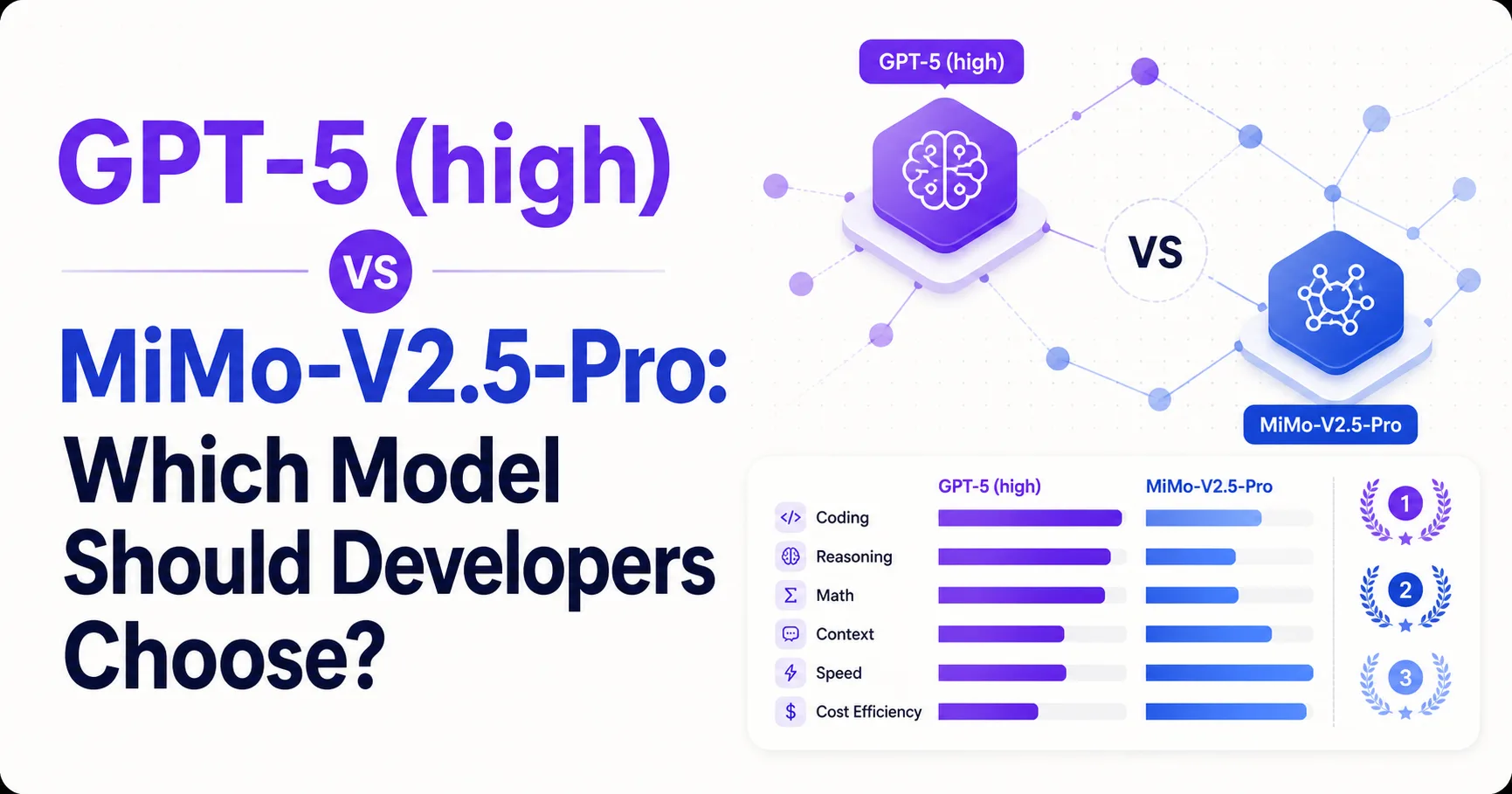
- **Winner overall:** MiMo-V2.5-Pro, with a 60.2 coding index and 42.2 intelligence index versus GPT-5 at 37.8 and 34.7 - **Cheaper:** MiMo-V2.5-Pro at $0.54375 vs $3.4375 per 1M blended tokens - **Faster:** MiMo-V2.5-Pro at 40.904 median output tokens per second, while GPT-5 has no reported value - **Pick GPT-5 when:** verified mathematical reasoning matters, because GPT-5 reports a 94.3 math index and MiMo-V2.5-Pro has no comparable value - **Watch out:** MiMo-V2.5-Pro leads on available indexes, but its documentation, API status, and failure modes are unverified
GPT-5 (high) vs MiMo-V2.5-Pro
MiMo-V2.5-Pro is the stronger value candidate on the available comparison data, while GPT-5 remains the safer documented choice for teams that require verifiable product behavior. MiMo-V2.5-Pro records a 60.2 coding index and a 42.2 intelligence index, compared with 37.8 and 34.7 for GPT-5. Data provided by https://artificialanalysis.ai/
The comparison has an important evidence gap: the research brief contains no verifiable vendor announcement, developer documentation, pricing page, community discussion, or failure analysis for MiMo-V2.5-Pro. GPT-5, by contrast, has public documentation and an official developer announcement. (GPT-5 for developers, GPT-5 model documentation)
This article therefore separates measured leaderboard evidence from production confidence. The data favors MiMo-V2.5-Pro. The documentation favors GPT-5.
Executive summary for developers
MiMo-V2.5-Pro leads the available intelligence and coding indexes, but GPT-5 offers materially stronger evidence for API behavior, controls, and operational constraints. MiMo-V2.5-Pro scores 42.2 on the intelligence index and 60.2 on the coding index, while GPT-5 scores 34.7 and 37.8. Data provided by https://artificialanalysis.ai/
| Decision factor | GPT-5 (high) | MiMo-V2.5-Pro | What it means |
|---|---|---|---|
| Intelligence index | 34.7 | 42.2 | MiMo-V2.5-Pro leads on the available aggregate measure |
| Coding index | 37.8 | 60.2 | MiMo-V2.5-Pro has the larger measured coding advantage |
| Math index | 94.3 | Not reported | GPT-5 is the only model with a comparable math result |
| Blended price per 1M tokens | $3.4375 | $0.54375 | MiMo-V2.5-Pro is the lower-cost option |
| Input price per 1M tokens | $1.25 | $0.435 | MiMo-V2.5-Pro costs less for prompt-heavy workloads |
| Output price per 1M tokens | $10 | $0.87 | Long generated responses are much cheaper with MiMo-V2.5-Pro |
| Latency | 0.3 seconds | 0.3 seconds | The reported latency is tied |
The scores do not establish a universal winner because the briefs do not provide task-level examples, evaluation methodology for MiMo-V2.5-Pro, or a comparable math score. Data provided by https://artificialanalysis.ai/
GPT-5 is explicitly positioned for coding, reasoning, and agentic tasks. Its official materials document function calling, structured outputs, streaming, and custom tools with grammar constraints. (GPT-5 for developers, GPT-5 model documentation)
MiMo-V2.5-Pro may be the better experimental choice for coding-heavy applications, but the research brief cannot confirm how developers access it, which parameters it supports, or whether its observed results are reproducible.
Performance: what the score gap means in practice
MiMo-V2.5-Pro has the stronger measured coding profile, but GPT-5 has the stronger documented reasoning evidence for production engineering decisions. MiMo-V2.5-Pro reaches a 60.2 coding index against GPT-5 at 37.8, while its intelligence index is 42.2 against 34.7. Data provided by https://artificialanalysis.ai/
For developers, the coding gap suggests that MiMo-V2.5-Pro deserves a serious trial for code generation, repository navigation, refactoring, and implementation tasks. It does not prove that MiMo-V2.5-Pro will produce safer patches in a real codebase. The research brief contains no reproducible community tests, no vendor evaluation methodology, and no documented failure modes for that model.
GPT-5 has a different evidence profile. OpenAI reports 74.9% on SWE-bench Verified, 88% on Aider polyglot, 96.7% on τ²-bench telecom, and 69.6% on Scale MultiChallenge. The SWE-bench result excluded 23 issues from 500 because they could not be passed reliably on OpenAI infrastructure, and the Aider result used high reasoning effort. (GPT-5 for developers)
Those results make GPT-5 easier to assess for agent workflows, but they are not directly comparable with the aggregate indexes in the data brief. GPT-5 also reports a 94.3 math index, while MiMo-V2.5-Pro has no math index. Data provided by https://artificialanalysis.ai/
Speed does not decide this comparison. Both models report 0.3 seconds of latency, while only MiMo-V2.5-Pro reports a median output rate of 40.904 tokens per second. That missing GPT-5 value prevents a reliable throughput comparison. Data provided by https://artificialanalysis.ai/
The practical conclusion is conditional: test MiMo-V2.5-Pro first for coding quality, but require task-level validation before trusting its index lead in an existing production repository.
Cost: when the cheaper model can still cost more
MiMo-V2.5-Pro is dramatically cheaper on token pricing, but its lower unit cost only matters if its access, reliability, and correction burden are acceptable. Its blended price is $0.54375 per 1M tokens versus $3.4375 for GPT-5. Data provided by https://artificialanalysis.ai/
The price difference is most consequential for applications that generate substantial output. MiMo-V2.5-Pro lists output at $0.87 per 1M tokens, while GPT-5 lists $10. Data provided by https://artificialanalysis.ai/
That advantage can change in workflows where a weaker or less predictable answer creates review, retry, or repair work. The research brief offers no verified MiMo-V2.5-Pro documentation, so it cannot establish rate limits, uptime expectations, tool-call behavior, context handling, or migration guarantees. Those omissions make total cost of ownership uncertain, even though token pricing is clear in the data brief.
GPT-5 is more expensive, especially for generated output, but its official documentation identifies the callable alias, endpoints, supported controls, and known limitations. GPT-5 supports Chat Completions, Responses, and Batch endpoints, and its documentation states that fine-tuning and predicted outputs are unsupported. (GPT-5 model documentation)
Prompt-heavy workloads also favor MiMo-V2.5-Pro on listed input pricing, at $0.435 per 1M tokens versus $1.25 for GPT-5. Data provided by https://artificialanalysis.ai/
A sensible cost test should measure successful task completion, retry frequency, human review, and repair time. The supplied materials do not contain those measurements, so no evidence-based total-cost winner can be declared beyond listed token prices.
Recommendation by developer scenario
MiMo-V2.5-Pro is the best first candidate for cost-sensitive coding experiments, while GPT-5 is the better choice when documented controls and mathematical evidence reduce operational risk. MiMo-V2.5-Pro leads the available coding index at 60.2 and costs $0.54375 per 1M blended tokens. Data provided by https://artificialanalysis.ai/
Choose MiMo-V2.5-Pro when your priority is high-volume code generation, rapid prototyping, or comparative evaluation against a low token price. Its reported coding and intelligence indexes are higher, its listed output price is $0.87 per 1M tokens, and its reported median output speed is 40.904 tokens per second. Data provided by https://artificialanalysis.ai/
Choose GPT-5 when your team needs an API with publicly documented behavior, structured outputs, function calling, streaming, and custom tools. OpenAI also documents reasoning effort and verbosity controls, which can make application behavior easier to tune and audit. (GPT-5 for developers, GPT-5 model documentation)
Choose GPT-5 for math-sensitive workflows unless MiMo-V2.5-Pro passes your own math evaluation. GPT-5 reports a 94.3 math index, while the MiMo-V2.5-Pro brief provides no comparable result. Data provided by https://artificialanalysis.ai/
Treat GPT-5 snapshot selection carefully. The fixed snapshot gpt-5-2025-08-07 is marked Deprecated, while the stable gpt-5 alias remains listed and the model page recommends GPT-5.6. (GPT-5 model documentation)
Do not make MiMo-V2.5-Pro the default production dependency until access, support, versioning, and failure behavior are verified. The research brief found no reliable source for those questions. That is an evidence limitation, not proof that the model performs poorly.
Questions to answer before production adoption
GPT-5 is easier to approve for production because its public materials document core API behavior, while MiMo-V2.5-Pro still requires basic verification before a responsible launch decision. (GPT-5 for developers, GPT-5 model documentation)
The unresolved questions are practical rather than cosmetic: whether MiMo-V2.5-Pro is directly callable, whether its benchmark advantage survives your workload, whether its output behavior is stable, and whether a supported migration path exists. The supplied research brief does not answer them. Developers should treat those unknowns as explicit acceptance criteria for a side-by-side pilot.
Frequently asked questions
Which model should developers choose for coding?
MiMo-V2.5-Pro is the stronger first coding candidate because its reported coding index is 60.2 versus 37.8 for GPT-5, although developers should validate repository-specific accuracy before production use.
Which model is cheaper for API workloads?
MiMo-V2.5-Pro is cheaper on every listed token price, including $0.54375 per 1M blended tokens versus $3.4375 for GPT-5 and $0.87 output versus $10.
Is GPT-5 faster than MiMo-V2.5-Pro?
The supplied data cannot establish that GPT-5 is faster because both models report 0.3 seconds of latency, while only MiMo-V2.5-Pro reports a median output rate of 40.904 tokens per second.
Which model is better for mathematical reasoning?
GPT-5 is the only model with a reported math index, at 94.3, so it is the defensible choice for math-sensitive work until MiMo-V2.5-Pro receives a comparable evaluation.
Can developers safely deploy MiMo-V2.5-Pro today?
The research brief does not provide enough evidence to answer confidently because it contains no verified vendor documentation, API details, pricing page, community evaluation, or failure analysis for MiMo-V2.5-Pro.
Does GPT-5 (high) name a separate API model?
GPT-5 (high) is not established as a separate API model name in the research brief; high refers to the reasoning_effort=high setting for GPT-5, not a verified standalone alias.
Sources
- Artificial AnalysisAll numeric comparison data, including indexes, pricing, latency, output speed, release dates, and data attribution
- GPT-5 for developersGPT-5 positioning, reasoning controls, verbosity controls, tool calling, custom tools, official benchmark results, and benchmark methodology note
- GPT-5 model documentationGPT-5 API alias, endpoints, model status, pricing, supported modalities, documented controls, and unsupported features
- Tried GPT-5 Here Are My First ImpressionsCommunity reports about GPT-5 debugging, application generation, and possible errors in complex existing codebases
Published: