
AI model analysis
GPT-5 (high) vs MiMo-V2-Omni-0327: Which Model Should Developers Choose?
A developer-focused comparison of GPT-5 (high) and MiMo-V2-Omni-0327 across capability evidence, latency, pricing, version risk, and production suitability.
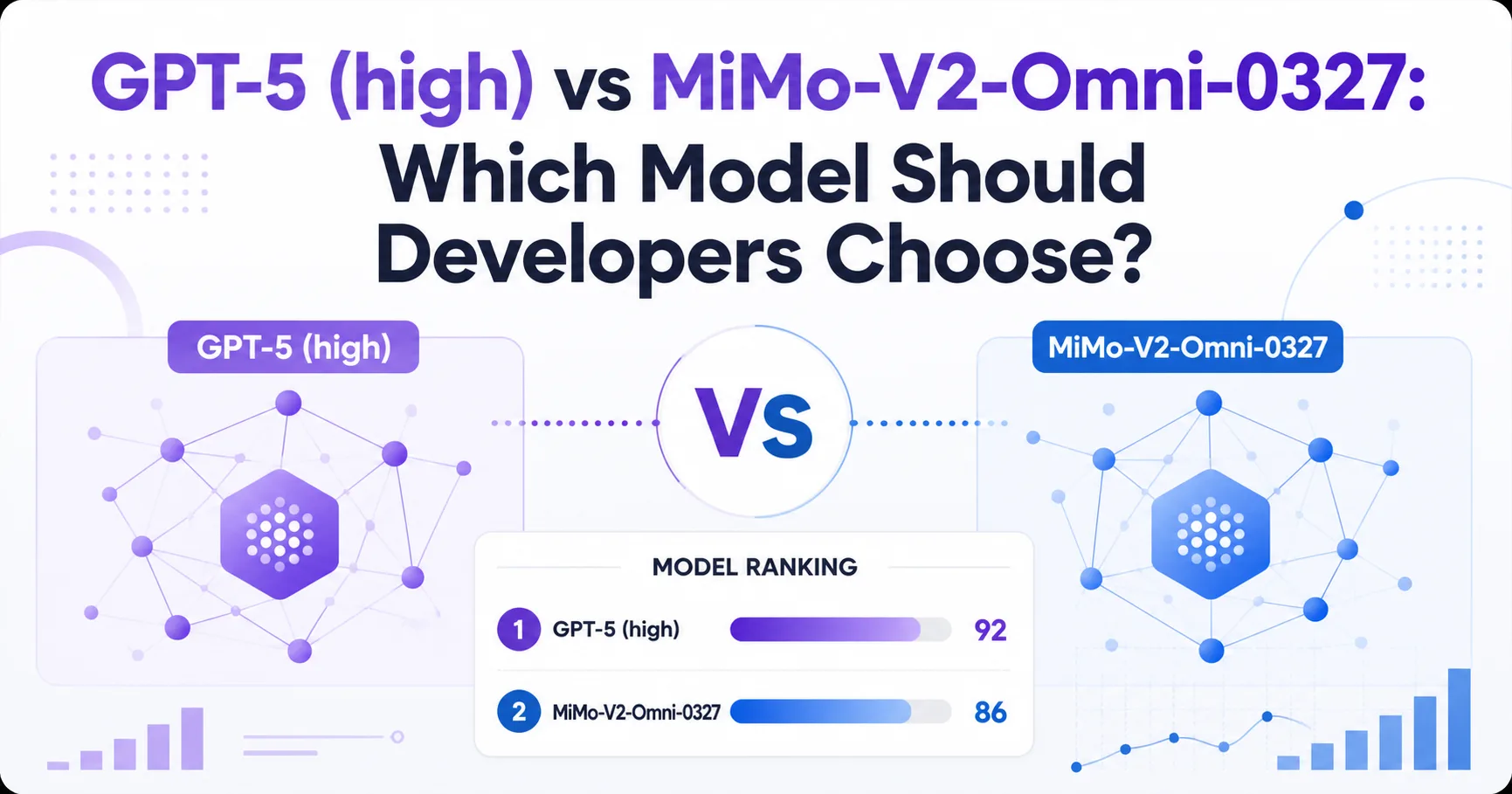
- **Winner overall:** GPT-5 (high), stronger developer evidence with a 37.8 coding index and 94.3 math index, while MiMo-V2-Omni-0327 leads the intelligence index at 36.4 vs 34.7 - **Cheaper:** GPT-5 (high) at $3.4375 vs $15 per 1M blended tokens - **Faster:** GPT-5 (high) and MiMo-V2-Omni-0327 tie at 0.3 seconds latency - **Pick GPT-5 (high) when:** You need documented coding, reasoning, tool-use, and math capabilities with lower operating cost - **Watch out:** MiMo-V2-Omni-0327 has a higher intelligence index at 36.4, but its coding, pricing, API, and limitation evidence is unavailable
GPT-5 (high) vs MiMo-V2-Omni-0327
GPT-5 (high) is the safer developer choice because its capabilities, interfaces, pricing, and limitations are documented, while MiMo-V2-Omni-0327 has only benchmark data available here.
The comparison is therefore asymmetric. GPT-5 has an identifiable API model, documented reasoning controls, documented tool support, and published developer benchmarks. MiMo-V2-Omni-0327 has a release date of 2026-03-27 and an Artificial Analysis intelligence index of 36.4, but the research brief found no verifiable vendor announcement, developer documentation, pricing page, or reliable community discussion.
That does not prove MiMo-V2-Omni-0327 is weaker. It means a developer cannot currently evaluate its operational fit from the supplied evidence. A higher intelligence index may matter for broad reasoning tasks, but it does not answer whether the model can be called reliably, what API contract it exposes, how it handles tools, or how its behavior changes under production load.
The data source should remain visible because the quantitative comparison comes from Artificial Analysis. The qualitative recommendation uses the official GPT-5 material and the evidence gaps around MiMo-V2-Omni-0327.
Executive summary for model selection
GPT-5 (high) offers the stronger documented package for production development, while MiMo-V2-Omni-0327 offers a promising but under-specified intelligence result.
GPT-5 records an Artificial Analysis coding index of 37.8 and a math index of 94.3. MiMo-V2-Omni-0327 records an intelligence index of 36.4, compared with GPT-5 at 34.7. The available data does not provide a MiMo coding index or math index, so no evidence-based winner can be declared for those developer-critical dimensions.
OpenAI describes GPT-5 as a reasoning model for coding, reasoning, and agentic tasks in GPT-5 for developers. Its documentation also covers text and image inputs, text output, function calling, structured outputs, streaming, and custom tools in GPT-5 model documentation. Those details reduce integration uncertainty.
MiMo-V2-Omni-0327 may be attractive for teams testing broad intelligence performance, especially because its intelligence index is higher. Yet the research brief provides no verified API alias, endpoint, context specification, modality description, or failure analysis. Developers should treat that result as a screening signal, not a complete production recommendation.
The central decision is simple: choose GPT-5 for known engineering requirements, and investigate MiMo-V2-Omni-0327 only when your team can independently verify access, behavior, and support.
Performance: what the available scores mean in real work
GPT-5 (high) has the more useful performance profile for developers because coding and math evidence exists, even though MiMo-V2-Omni-0327 leads the available intelligence index.
The intelligence result does not settle the engineering question. MiMo-V2-Omni-0327 scores 36.4 on that index, while GPT-5 scores 34.7. That advantage could indicate stronger general performance within the measured evaluation, but the brief does not identify which tasks produced the result or whether the advantage transfers to repository edits, test generation, tool orchestration, or debugging.
GPT-5 has a coding index of 37.8 and a math index of 94.3. Those values still do not predict every production outcome, but they provide more direct evidence for software work and structured problem solving. OpenAI also reports SWE-bench Verified at 74.9%, Aider polyglot at 88%, τ²-bench telecom at 96.7%, and Scale MultiChallenge at 69.6% in GPT-5 for developers. The SWE-bench result excluded 23 issues from 500 because they were not stable on the evaluation infrastructure, and the Aider result used high reasoning effort.
Latency is a tie at 0.3 seconds for both models. The supplied data has no median output tokens per second for either model, so claims about streaming speed, time to completion, or perceived responsiveness remain unsupported. Developers should test their own prompt lengths, tool loops, and output sizes before treating the latency tie as a user-experience tie.
Cost: why the cheaper model may remain cheaper in production
GPT-5 (high) is the clear cost choice because its blended price is $3.4375 per 1M tokens versus $15 for MiMo-V2-Omni-0327, but workload shape still determines the practical gap.
The displayed price difference is not the whole cost model. GPT-5 charges $1.25 per 1M input tokens and $10 per 1M output tokens. MiMo-V2-Omni-0327 is listed at $10 per 1M input tokens and $30 per 1M output tokens. Output-heavy agent workflows therefore expose a larger economic penalty for MiMo than short classification requests would.
A cheaper token price can become more expensive when a model needs repeated retries, produces unusable tool arguments, misses required fields, or requires a second model to repair its output. The research brief offers no verified MiMo API contract, tool behavior, reliability data, or failure cases, so its effective cost cannot be established beyond the supplied price snapshot. GPT-5 has documented function calling, structured outputs, streaming, and custom tools in GPT-5 model documentation, which makes its integration cost easier to estimate.
The cost conclusion can reverse only under evidence not supplied here. MiMo-V2-Omni-0327 could justify its higher price if it materially reduces retries or solves tasks that GPT-5 cannot handle, but the brief contains no controlled data proving either condition. Teams should measure successful task cost, not token price alone, before approving a more expensive deployment.
Recommendation by developer scenario
GPT-5 (high) is the default recommendation for production coding, agent workflows, and math-heavy development tasks, while MiMo-V2-Omni-0327 belongs in a controlled evaluation track.
Choose GPT-5 when your team needs a documented API model, explicit reasoning controls, structured outputs, function calling, streaming, or custom tools. OpenAI presents those capabilities for developer workflows in GPT-5 for developers, and the model documentation describes the available modalities and endpoint support in GPT-5 model documentation. The lower blended price also makes broad experimentation easier.
Choose MiMo-V2-Omni-0327 only when your team has a verified access path and a task-specific reason to test its intelligence advantage. Its score of 36.4 exceeds GPT-5’s 34.7 on the supplied intelligence index, but no comparable coding or math score is available. No reliable community evidence confirms its debugging behavior, speed experience, or production failure modes.
GPT-5 also carries an important lifecycle caveat. The fixed snapshot gpt-5-2025-08-07 is marked Deprecated in the model documentation, even though the gpt-5 alias remains listed as callable. That creates migration work for teams requiring fixed-version reproducibility. The snapshot was released on 2025-08-07, while MiMo-V2-Omni-0327 is dated 2026-03-27 in the supplied data, so the two entries may represent different lifecycle stages.
The final recommendation is evidence-weighted, not a claim that GPT-5 wins every capability test. MiMo should earn promotion only after API, reliability, modality, and task-level evidence becomes available.
Questions developers should answer before choosing
GPT-5 (high) is easier to approve because the available evidence answers more of the questions that production teams must resolve.
A model comparison is incomplete when one entry has official documentation and the other has only an intelligence score. The missing information is itself a selection risk. Teams should validate access, output contracts, tool execution, error handling, and lifecycle policy before moving MiMo-V2-Omni-0327 beyond an internal trial.
The community evidence does not close that gap. One Reddit post reports that GPT-5 helped with small bug fixes but could produce less complete UI and application implementations; comments also describe possible hallucinations or incorrect modifications in complex existing codebases. The report is an uncontrolled personal test, so it should inform test design rather than serve as a general performance verdict. See Tried GPT-5 Here Are My First Impressions.
No equivalent reliable community evidence was found for MiMo-V2-Omni-0327. Developers should therefore avoid interpreting silence as stability. A short acceptance suite covering repository edits, tool calls, structured output, long-context tasks, and failure recovery will produce more actionable evidence than a single broad index.
Frequently asked questions
Is GPT-5 (high) the overall performance winner?
GPT-5 (high) is the stronger documented developer option, but MiMo-V2-Omni-0327 leads the available intelligence index at 36.4 versus 34.7, so the evidence does not establish an unconditional overall performance winner.
Which model is cheaper for API workloads?
GPT-5 (high) is cheaper on the supplied pricing data, costing $3.4375 per 1M blended tokens versus $15 for MiMo-V2-Omni-0327, with lower input and output prices as well.
Which model should I use for coding?
GPT-5 (high) is the evidence-based coding choice because it has a coding index of 37.8 and published coding evaluations, while the supplied data contains no comparable MiMo-V2-Omni-0327 coding index.
Are the models equally fast?
The supplied data shows a latency tie at 0.3 seconds, but it provides no median output tokens per second for either model, so streaming responsiveness and completion speed remain unproven.
What is the biggest GPT-5 production risk?
GPT-5’s biggest documented production risk is lifecycle management because the fixed snapshot gpt-5-2025-08-07 is marked Deprecated, requiring teams that depend on reproducibility to plan migration.
Should developers deploy MiMo-V2-Omni-0327 now?
Developers should keep MiMo-V2-Omni-0327 in controlled evaluation until its API access, pricing contract, limitations, reliability, and task-level coding performance are independently verified.
Sources
- Artificial AnalysisQuantitative comparison data and attribution
- GPT-5 for developersGPT-5 positioning, reasoning controls, tool capabilities, and official benchmark context
- GPT-5 model documentationGPT-5 API identity, lifecycle status, modalities, pricing, endpoints, and supported features
- Tried GPT-5 Here Are My First ImpressionsUncontrolled community observations about debugging, application generation, and existing-codebase risks
Published: