
AI model analysis
GPT-5 (high) vs MiniMax-M2: Which Model Should Developers Choose?
A developer-focused comparison of GPT-5 (high) and MiniMax-M2 across quality, coding evidence, latency, pricing, reliability, and selection risk.
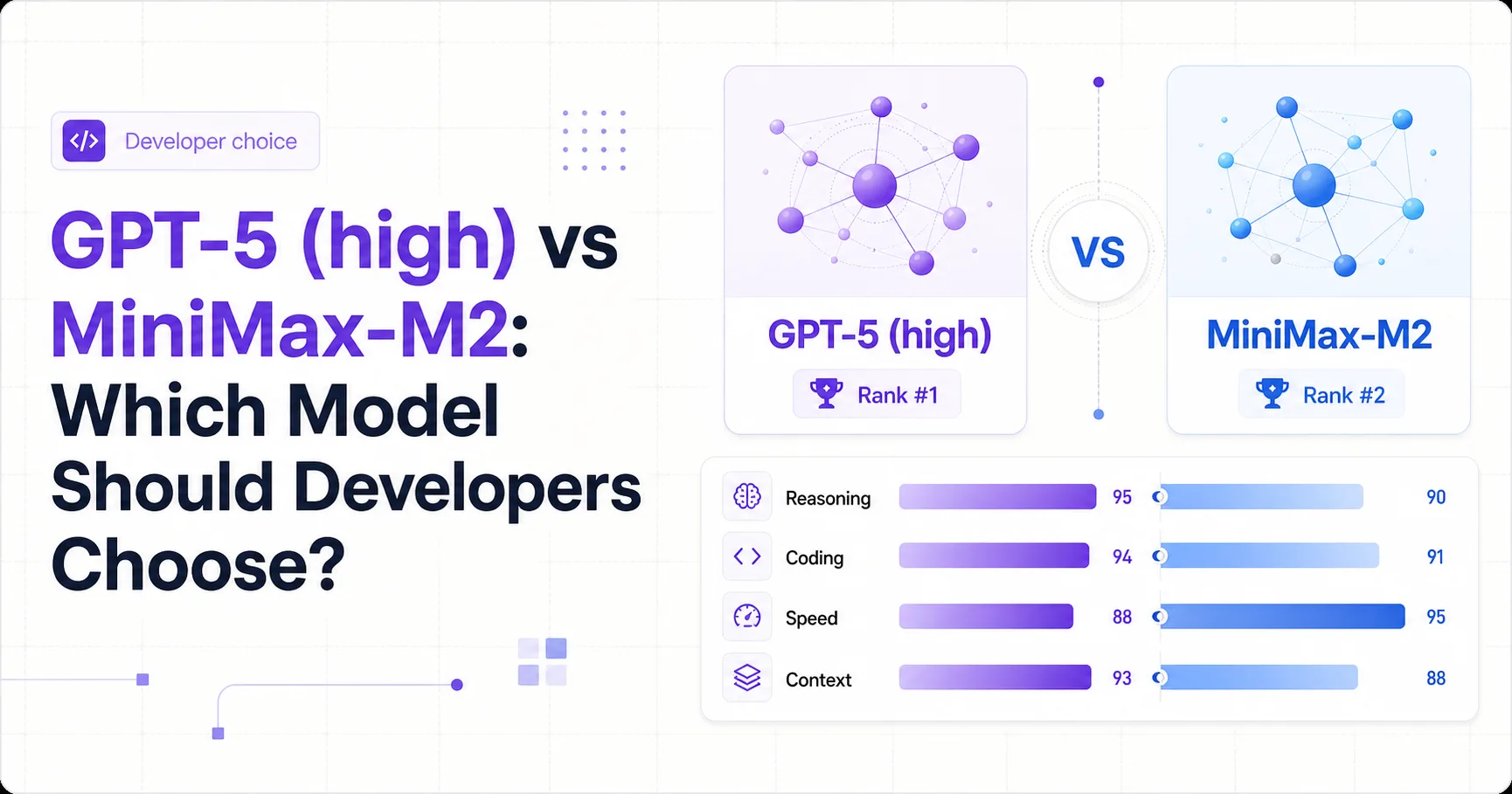
- **Winner overall:** GPT-5 (high), with a 34.7 intelligence index and 94.3 math index, although MiniMax-M2 lacks comparable coding evidence - **Cheaper:** MiniMax-M2 at $0.525 vs $3.4375 per 1M blended tokens - **Faster:** Tie, with both models at 0.3 seconds latency - **Pick GPT-5 (high) when:** reasoning quality, documented tooling, and accountable API behavior matter more than minimum cost - **Watch out:** MiniMax-M2 has a 28.3 intelligence index, but its documentation, availability, and failure modes remain unverified
GPT-5 (high) vs MiniMax-M2
GPT-5 (high) is the safer developer choice because its API behavior, benchmark evidence, and operational limits are documented, while MiniMax-M2 is primarily a low-cost option with major evidence gaps. The comparison data reports a 34.7 intelligence index for GPT-5 (high) and 28.3 for MiniMax-M2. GPT-5 (high) also records a 94.3 math index, compared with 78.3 for MiniMax-M2. Those scores do not prove that GPT-5 (high) wins every production workload, but they provide a stronger quality signal for reasoning-heavy applications.
OpenAI positions GPT-5 as a reasoning model for coding, reasoning, and agentic tasks in its developer announcement. Its model documentation also describes supported endpoints, parameters, modalities, and current pricing. No comparable, verifiable MiniMax-M2 documentation was available in the research material. That asymmetry matters because model selection includes operational confidence, not only benchmark performance.
Data provided by https://artificialanalysis.ai/
Executive summary for developers
GPT-5 (high) offers the stronger evidence-backed quality profile, while MiniMax-M2 offers the stronger price profile. The available comparison shows GPT-5 (high) ahead on the intelligence index by the reported comparison value of 6.400000000000002 points and ahead on the math index by 16 points. The coding comparison cannot identify a winner because MiniMax-M2 has no coding index in the data snapshot.
| Decision factor | GPT-5 (high) | MiniMax-M2 | What it means |
|---|---|---|---|
| General intelligence signal | 34.7 | 28.3 | GPT-5 (high) has the stronger measured result |
| Math signal | 94.3 | 78.3 | GPT-5 (high) is better supported for difficult quantitative reasoning |
| Coding evidence | 37.8 | Not reported | The coding choice cannot be settled from this comparison alone |
| Blended price | $3.4375 | $0.525 | MiniMax-M2 is materially cheaper |
| Latency | 0.3 seconds | 0.3 seconds | The reported latency result is a tie |
The practical conclusion is conditional. GPT-5 (high) is easier to justify for production systems that need documented tool calling, structured outputs, stable API references, and traceable vendor support. MiniMax-M2 may be attractive for cost-sensitive experiments or high-volume workloads, but the research did not verify its context window, output limit, API parameters, modality support, availability, or failure patterns. Developers should treat that missing information as selection risk rather than as evidence of either strength or weakness.
Performance: quality evidence matters more than a tied latency result
GPT-5 (high) has the stronger documented performance case, while the reported latency tie does not resolve task quality or production consistency. Both models show 0.3 seconds latency in the comparison data, so a developer choosing only by the listed latency value has no basis to prefer one model. The snapshot provides no median output speed for either model, which means perceived streaming speed remains unverified.
GPT-5 (high) has a 37.8 coding index and a 94.3 math index in the data brief. MiniMax-M2 has no reported coding index and records 78.3 on the math index. The missing coding value is especially important because the intended audience is developers. A blank comparison is not a loss, but it prevents a reliable conclusion about repository editing, code generation, debugging, or test-writing performance.
OpenAI reports GPT-5 results on SWE-bench Verified, Aider polyglot, τ²-bench telecom, and Scale MultiChallenge in its developer announcement. The same source states that the SWE-bench result excluded 23 problems that could not pass reliably on OpenAI infrastructure, and that the Aider evaluation used high reasoning effort. Those conditions limit direct transfer to every application. They also show that GPT-5 performance depends on evaluation setup and parameter choice.
A Reddit first-impressions report describes GPT-5 as useful for locating and fixing small bugs, while expressing reservations about complete application and UI generation. The report is a single uncontrolled experience, and its comments mention hallucinations or incorrect edits in complex existing codebases. No equivalent MiniMax-M2 community evidence was found. The evidence therefore favors GPT-5 for accountability, not because its failure modes are absent.
Cost: MiniMax-M2 wins the price chart, but cheap output can change the economics
MiniMax-M2 is the clear price winner, but GPT-5 (high) can still be cheaper at the system level when higher-quality answers reduce retries, review, and orchestration work. The data reports a blended price of $0.525 per 1M tokens for MiniMax-M2 and $3.4375 for GPT-5 (high). MiniMax-M2 also costs $0.3 for input and $1.2 for output per 1M tokens, compared with $1.25 for input and $10 for output for GPT-5 (high).
The chart makes the direct price difference obvious. The harder question is how much generated work each request creates. A low-priced model can become more expensive when it needs repeated prompts, manual correction, extra validation calls, or additional agents to compensate for uncertain behavior. The research does not provide retry rates, task completion rates, review effort, or token usage distributions for either model, so no total-cost conclusion can be calculated from the available data.
MiniMax-M2 may be a sensible first candidate for workloads where outputs are short, mistakes are inexpensive, and human review is already part of the process. Examples include exploratory prototypes, low-risk classification, or disposable experiments, provided the model can be accessed reliably. That access assumption is unverified. The research found no authoritative MiniMax-M2 pricing page, stable model alias, availability statement, or vendor documentation.
GPT-5 (high) is easier to budget operationally because OpenAI documents its API model name, pricing, supported endpoints, and configuration options in the model documentation. The same documentation marks the fixed snapshot as Deprecated and recommends a later model, so predictable pricing does not remove migration planning. Cost-sensitive teams should test both models on representative tasks, measuring accepted outputs rather than token spend alone.
Recommendation: choose by evidence tolerance and failure cost
GPT-5 (high) is the recommended default for production development workflows, while MiniMax-M2 deserves a controlled trial where cost dominates and uncertainty is acceptable. GPT-5 (high) has documented function calling, structured outputs, streaming, custom tools, and configurable reasoning effort according to OpenAI’s developer documentation. Its model page documents text and image input, text output, endpoint support, pricing, and unsupported fine-tuning and predicted outputs.
Choose GPT-5 (high) for agentic coding, difficult debugging, mathematical reasoning, and workflows where tool contracts must be explicit. The 94.3 math index and 37.8 coding index strengthen that recommendation, but the coding comparison remains incomplete because MiniMax-M2 has no reported coding score. Developers should also account for the fixed snapshot’s Deprecated status. A system that requires long-term model stability should validate the current alias and define a migration path before launch.
Choose MiniMax-M2 for cost-sensitive pilots, batch-like experimentation, or workloads with inexpensive errors and strong downstream checks. Its $0.525 blended price is compelling, and its reported 0.3 seconds latency does not impose a listed latency disadvantage. The missing evidence is substantial, however. The research could not verify MiniMax-M2’s context window, output limit, API parameters, modalities, benchmark methodology, pricing source, availability, or community failure reports.
The most important unanswered question is not which model is universally better. It is whether MiniMax-M2’s lower price survives real acceptance testing. The supplied material cannot answer that question. Run a small task set covering code edits, tests, tool calls, long-context work, and recovery from errors. Compare accepted results, human correction, retries, and end-to-end latency before committing to either model.
Frequently asked questions
GPT-5 (high) is easier to select with confidence, but MiniMax-M2 remains worth testing when the financial constraint is decisive and the surrounding system can contain errors.
Frequently asked questions
Which model is better overall for developers?
GPT-5 (high) is the better-supported overall choice because it has documented API behavior, a 34.7 intelligence index, a 37.8 coding index, and a 94.3 math index. MiniMax-M2 is cheaper, but its comparable coding evidence and operational documentation are unavailable.
Which model is cheaper to run?
MiniMax-M2 is cheaper to run, with a reported blended price of $0.525 per 1M tokens versus $3.4375 for GPT-5 (high). The final system cost may differ if MiniMax-M2 requires more retries, review, validation, or corrective orchestration.
Is MiniMax-M2 faster than GPT-5 (high)?
Neither model is faster on the supplied latency measure because both are reported at 0.3 seconds. The data brief provides no median output speed for either model, so streaming responsiveness and long-answer throughput remain unverified.
Should a production application use the fixed GPT-5 snapshot?
Production teams should be cautious with the fixed GPT-5 snapshot because OpenAI marks gpt-5-2025-08-07 as Deprecated and recommends a later model. Teams should validate the stable alias and prepare migration tests before depending on that snapshot.
What is the biggest unknown in this comparison?
The biggest unknown is MiniMax-M2’s real production behavior because the research found no verifiable documentation, pricing page, availability statement, benchmark methodology, community testing, or failure-mode evidence for the model.
Sources
- GPT-5 for developersGPT-5 API positioning, reasoning parameters, tool calling, custom tools, official benchmark context, and evaluation conditions
- GPT-5 model documentationGPT-5 model alias, snapshot status, context and output documentation, modalities, endpoints, pricing, and unsupported features
- Tried GPT-5 Here Are My First ImpressionsUncontrolled community observations about debugging, application generation, UI quality, hallucinations, and incorrect edits
- Artificial AnalysisComparison data for intelligence, coding, math, pricing, and latency
Published: