
AI model analysis
GPT-5 (high) vs Muse Spark: Which Model Should Developers Choose?
A developer-focused comparison of GPT-5 (high) and Muse Spark across coding quality, reasoning evidence, latency, pricing, API readiness, and selection risk.
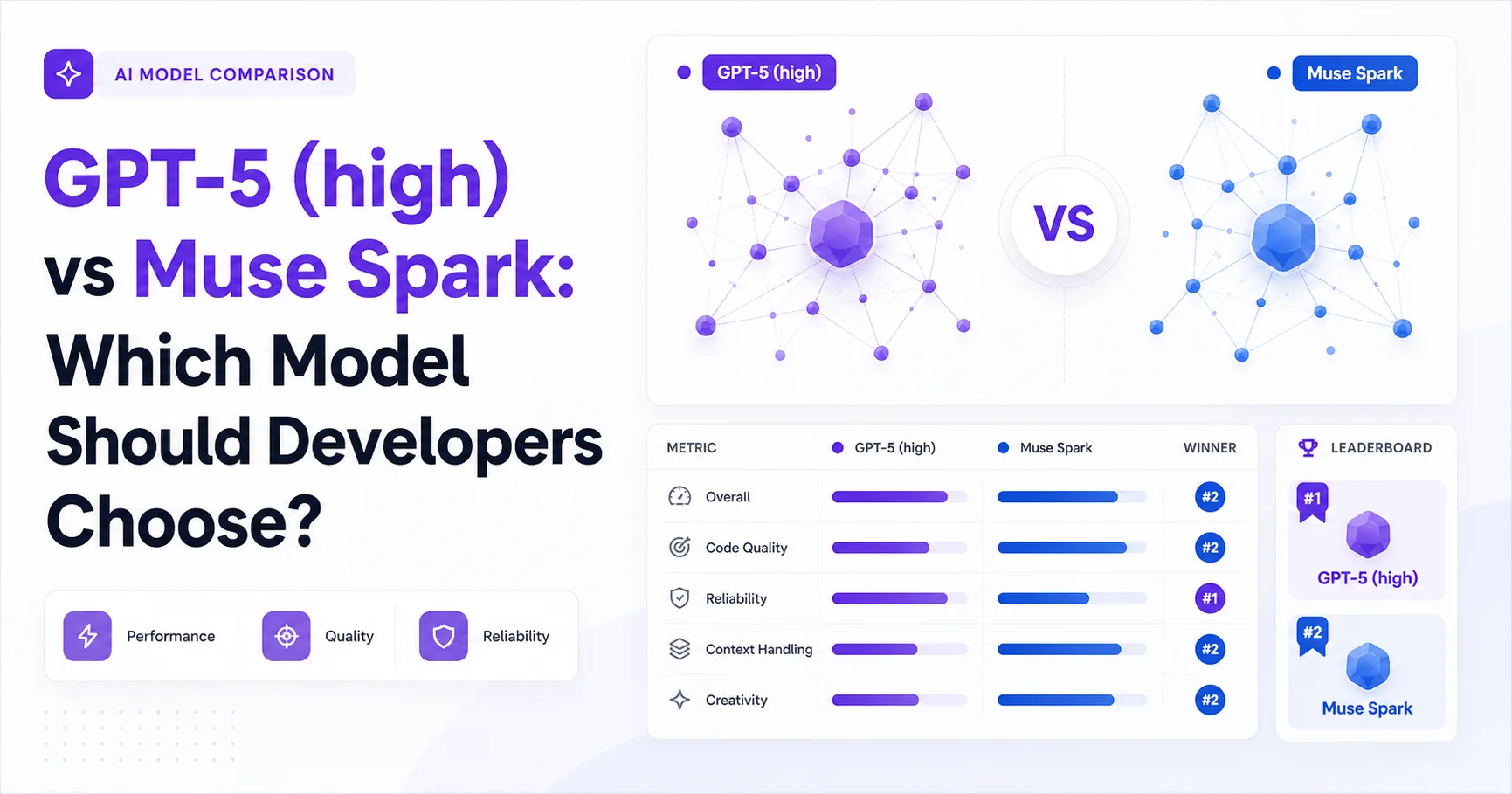
- **Winner overall:** Muse Spark, with a 58.6 coding index and 43.1 intelligence index, but limited public documentation makes the result difficult to operationalize - **Cheaper:** GPT-5 (high) at $3.4375 vs $15 per 1M blended tokens - **Faster:** GPT-5 (high) and Muse Spark tie at 0.3 seconds latency - **Pick GPT-5 (high) when:** you need a documented API, controllable reasoning effort, image input, and an established production path - **Watch out:** Muse Spark has stronger reported coding and intelligence scores, but its public API, throughput, limits, and failure modes remain unverified at 0.3 seconds latency
GPT-5 (high) vs Muse Spark at a glance
GPT-5 (high) is the safer production choice, while Muse Spark has the stronger reported benchmark position but lacks enough public evidence for confident deployment. OpenAI positions GPT-5 as a reasoning model for coding, reasoning, and agentic tasks. OpenAI documents GPT-5 as an API model with text and image input, text output, tool support, and configurable reasoning effort. The comparison data reports Muse Spark at 58.6 on the coding index and 43.1 on the intelligence index. GPT-5 (high) records 37.8 and 34.7 on those same indexes. Those figures make Muse Spark the apparent capability leader in the supplied evaluation snapshot.
The selection problem is operational rather than purely numerical. GPT-5 has a public model page, documented endpoints, a stable alias, pricing, context limits, and published tool behavior. Muse Spark has none of those properties verified in the supplied research. Meta’s public developer overview lists other models and access channels, but does not mention Muse Spark. That absence does not prove Muse Spark is unavailable. It does mean developers cannot yet validate its interface, limits, service terms, or reproducibility from the cited evidence.
The practical difference for model selection
GPT-5 (high) offers verified deployability, whereas Muse Spark offers a stronger measured result with an unverified product surface. GPT-5 reaches 94.3 on the supplied math index, while Muse Spark has no corresponding math value in the data snapshot. That is not evidence that Muse Spark performs worse at mathematics. It is evidence that the comparison is incomplete in that dimension.
Muse Spark’s coding index is 58.6 versus GPT-5 (high) at 37.8. Its intelligence index is 43.1 versus 34.7. If those evaluations match your workload, Muse Spark deserves a controlled technical trial. The gap could matter for code generation, repository navigation, and multi-step implementation. The data does not identify the tasks behind every score, so it cannot establish how much better either model will be on your own stack.
GPT-5’s documented controls are valuable for engineering teams. Developers can select reasoning effort from minimal, low, medium, or high, and can set verbosity to low, medium, or high. The model supports function calling, structured outputs, streaming, and custom tools constrained by a context-free grammar. These controls help teams shape latency, output size, and integration behavior. Muse Spark has no verified equivalent in the research brief.
The strongest conclusion is therefore conditional: Muse Spark may be the better capability bet, but GPT-5 is the better evidence-backed default.
Performance: benchmark lead versus integration confidence
Muse Spark leads the supplied coding and intelligence evaluations, but GPT-5 (high) is easier to test, control, and diagnose in a real developer workflow. The coding index gap is large enough to justify a side-by-side trial if your main workload is code production. A higher score may translate into fewer corrective prompts, better planning, or stronger repository changes. The supplied data cannot identify which of those effects is responsible, so teams should measure task completion, review effort, and regression rate on representative repositories.
GPT-5’s official coding evidence is more specific in some areas. OpenAI reports 74.9% on SWE-bench Verified, 88% on Aider polyglot, 96.7% on τ²-bench telecom, and 69.6% on Scale MultiChallenge. The SWE-bench result excluded 23 of 500 problems that could not pass reliably on OpenAI’s infrastructure, and the Aider result used high reasoning effort. These methodological details are described in OpenAI’s developer announcement. Muse Spark has no comparable official benchmark material in the research brief. The Artificial Analysis coding index is useful as a signal, but it does not resolve this evidence imbalance.
Both models show 0.3 seconds latency in the supplied snapshot. That tie does not establish equal user experience because median output speed is unavailable for both models. Streaming behavior, queueing, time to first token, output length, and tool-call overhead are also unverified for Muse Spark. GPT-5 supports streaming and documented tool calls, which gives developers a known integration path. GPT-5’s model documentation describes these capabilities and its available API surface.
Community evidence is also asymmetric. One Reddit post reports that GPT-5 was useful for small bug fixes but could produce simplified UI work or incorrect changes in complex existing codebases. The post is a subjective, uncontrolled test, not a general benchmark. The original report and its comments are available on Reddit. No reliable public coding experience for Muse Spark was found. The evidence is insufficient to claim that Muse Spark is more stable, faster, or safer in production.
Cost: GPT-5 is cheaper, but workload shape still matters
GPT-5 (high) is the clear cost choice in the supplied pricing snapshot, and Muse Spark would need a substantial quality advantage to justify its premium. GPT-5 costs $3.4375 per 1M blended tokens, compared with $15 for Muse Spark. Its input price is $1.25 per 1M tokens and its output price is $10, while Muse Spark is listed at $10 for input and $30 for output.
The practical effect depends on what your application sends and receives. Output-heavy coding agents expose the output-price difference quickly because plans, patches, explanations, and tool arguments can accumulate over many turns. Input-heavy applications still pay more for Muse Spark because its listed input price is higher. A benchmark lead can reverse the economic result only if it reduces retries, review time, or auxiliary model calls enough to offset the token premium. The supplied data does not measure any of those operational savings.
GPT-5 also lists cached input at $0.125 per 1M tokens. That can matter for agents that repeatedly provide stable repository context, system instructions, or tool schemas. Muse Spark has no verified cached-input price in the research brief. OpenAI’s model documentation provides GPT-5’s current pricing and model details.
The cost comparison has an important qualification. Muse Spark’s public availability, billing unit, rate limits, and pricing terms were not independently verified in the research. The $15 and $30 values come from the supplied data snapshot, so teams should confirm that they represent an accessible production offering before building a business case. The comparison data is attributed to Artificial Analysis.
Recommendation by developer scenario
GPT-5 (high) is the recommended default for teams that need a documented and governable API today. Its public documentation covers the gpt-5 alias, the fixed snapshot gpt-5-2025-08-07, Responses, Chat Completions, Batch, tool calling, structured outputs, streaming, and reasoning controls. OpenAI’s developer announcement explains the model’s intended use for coding and agentic tasks. The model page also documents a 400,000-token context window, a maximum output of 128,000 tokens, image input, and text output. Those limits and modalities are listed in the official model documentation.
Muse Spark is worth selecting for an experiment when coding quality is the primary objective and your team can tolerate discovery risk. Its 58.6 coding index is materially above GPT-5 (high)'s 37.8 in the supplied snapshot. A fair trial should use the same repository tasks, acceptance tests, review rubric, prompt budget, and retry policy. It should also record whether the model can be accessed reliably, whether outputs are reproducible, and whether its cost claims match actual billing.
Choose GPT-5 (high) for structured agent workflows, image-aware developer tools, and systems that need explicit output contracts. Choose Muse Spark only after its API behavior and operational limits are verified. Neither choice should be framed as a universal winner because Muse Spark lacks public evidence for context size, output limits, modalities, parameters, pricing terms, and failure modes.
Version risk further favors caution with GPT-5. The fixed snapshot is marked Deprecated, and OpenAI recommends GPT-5.6. That status appears on the GPT-5 model page. Teams using the stable alias should define migration tests. Teams evaluating Muse Spark should first establish whether a stable alias and replacement policy exist.
What the evidence still cannot answer
GPT-5 (high) has documented limits and behavior, while Muse Spark has major evidence gaps that prevent a complete operational comparison. The research found no reliable public community discussion confirming Muse Spark’s coding experience, speed, or failure patterns. Meta’s developer overview is the relevant official source supplied for checking its public model catalog. It does not mention Muse Spark.
The missing information matters because benchmark scores do not specify deployment conditions. The research does not establish Muse Spark’s context window, maximum output, supported modalities, tool protocol, structured-output behavior, streaming support, rate limits, availability, or versioning. It also does not provide a math evaluation for Muse Spark. GPT-5’s corresponding evidence is stronger, but its fixed snapshot’s Deprecated status creates a separate migration concern.
Developers should treat Muse Spark as an unverified candidate rather than a fully characterized production model. A successful trial can close some gaps, but it cannot replace confirmation of contractual, billing, and availability details. The supplied evidence is sufficient to identify Muse Spark as the benchmark leader and GPT-5 as the documented, lower-cost option. It is insufficient to prove which model will deliver the lower total engineering cost or higher reliability for a specific application.
Frequently asked questions
Is Muse Spark better than GPT-5 for coding?
Muse Spark has the higher supplied coding index at 58.6 versus GPT-5 (high) at 37.8, but the evidence does not show whether that advantage transfers to your repositories, tools, review process, or production reliability.
Which model is cheaper for a developer API?
GPT-5 (high) is cheaper in the supplied snapshot at $3.4375 per 1M blended tokens, with lower listed input and output prices than Muse Spark, although actual total cost also depends on retries and output volume.
Which model should I use for an agent workflow?
GPT-5 (high) is the safer initial choice because its documentation covers reasoning effort, function calling, structured outputs, streaming, custom tools, and API endpoints, while Muse Spark’s corresponding behavior remains unverified.
Does Muse Spark have a larger context window?
The supplied research cannot answer that question because no public Muse Spark documentation verifies its context window or maximum output, while GPT-5 is documented with a 400,000-token context window.
Are the two models equally fast?
The supplied data reports 0.3 seconds latency for both models, but it does not provide median output speed, time to first token, streaming behavior, or tool-call overhead, so equal end-user speed remains unproven.
Is GPT-5 (high) a separate API model?
GPT-5 (high) is not identified as a separate API model alias in the research; high refers to the reasoning_effort setting on gpt-5, while the documented alias is gpt-5.
Sources
- GPT-5 for developersAPI positioning, reasoning controls, tool support, and official benchmark methodology
- GPT-5 model documentationContext window, output limit, modalities, pricing, endpoints, aliases, fine-tuning support, and deprecation status
- Tried GPT-5 Here Are My First ImpressionsSubjective community feedback about bug fixing, UI generation, and changes in existing codebases
- Meta: Get started with LlamaChecking Meta's public model documentation and the absence of Muse Spark from the supplied official overview
- Artificial AnalysisSupplied comparison data for evaluation scores, pricing, and latency
Published: