
AI model analysis
GPT-5 (high) vs Nemotron 3 Ultra 550B A55B: Which Model Should Developers Choose?
A developer-focused comparison of GPT-5 (high) and Nemotron 3 Ultra 550B A55B across measured quality, coding, speed, cost, and production readiness.
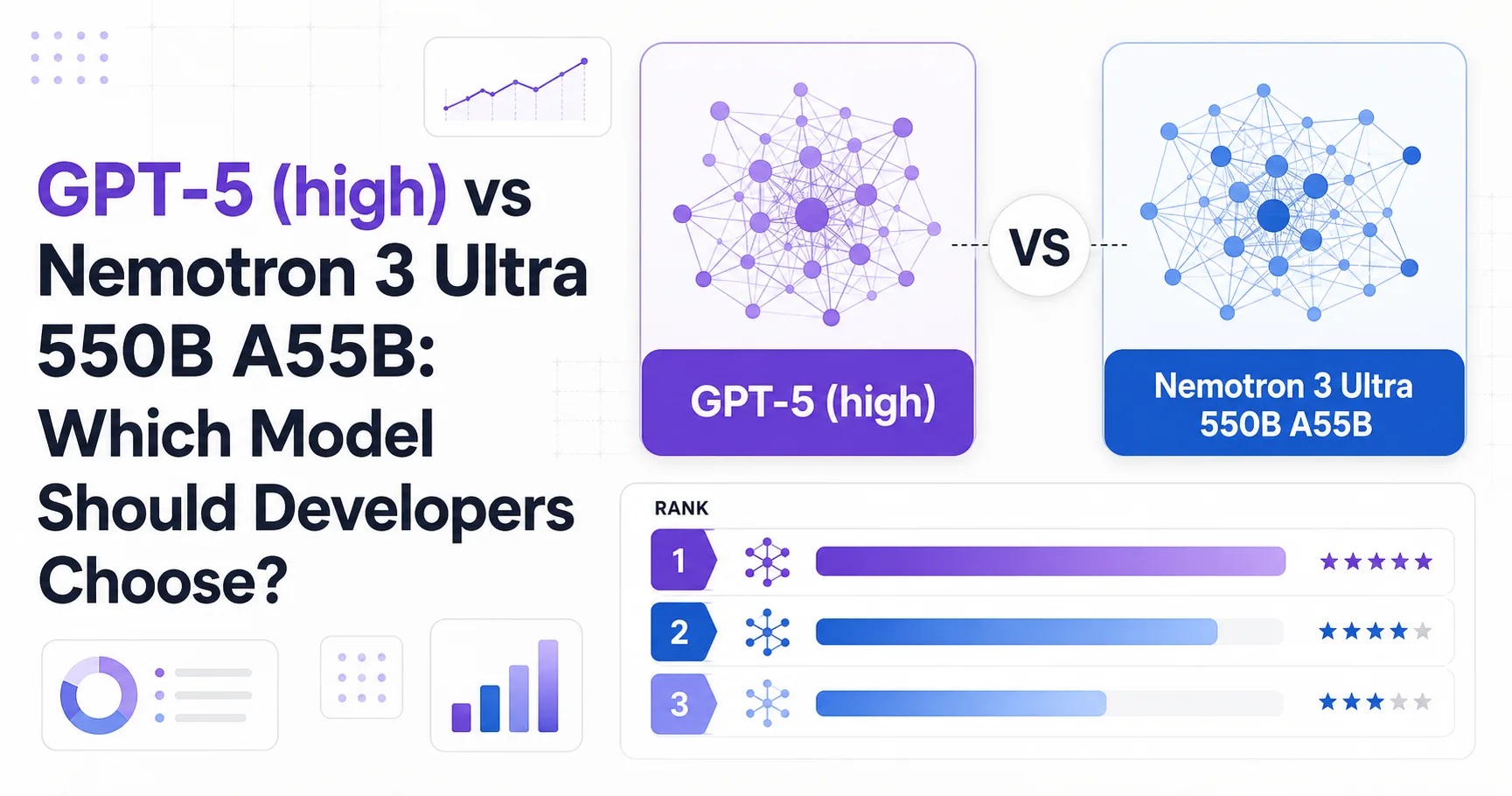
- **Winner overall:** Nemotron 3 Ultra 550B A55B (Reasoning), with a 49.3 coding index and 37.8 intelligence index versus GPT-5 (high) at 37.8 and 34.7 - **Cheaper:** Nemotron 3 Ultra 550B A55B (Reasoning) at $1.1749999999999998 vs $3.4375 per 1M blended tokens - **Faster:** Nemotron 3 Ultra 550B A55B (Reasoning) at 145.677 median output tokens per second - **Pick GPT-5 (high) when:** your application needs documented tools, structured outputs, image input, or a published math index of 94.3 - **Watch out:** Nemotron 3 Ultra 550B A55B has no verified vendor documentation, API identity, limitations, or community test evidence in the supplied research
GPT-5 (high) vs Nemotron 3 Ultra 550B A55B
GPT-5 (high) is the safer documented integration, while Nemotron 3 Ultra 550B A55B (Reasoning) is the stronger measured value proposition. The supplied data gives Nemotron a 49.3 coding index and a 37.8 intelligence index, compared with GPT-5 (high) at 37.8 and 34.7. Nemotron also has the lower blended price, at $1.1749999999999998 versus $3.4375 per 1M blended tokens. Artificial Analysis provides the comparison data.\n\nThe practical decision is therefore not simply a quality ranking. GPT-5 has documented API behavior, tool support, image input, and an official math result of 94.3. Nemotron has a better measured coding and intelligence position, plus a reported output speed of 145.677 median output tokens per second. However, the research brief contains no verified official documentation or community evidence for Nemotron. Developers must treat its apparent advantage as promising but operationally unverified.
Executive summary for developers
Nemotron 3 Ultra 550B A55B (Reasoning) leads the supplied comparable evaluations, but GPT-5 (high) offers substantially stronger evidence for production integration.\n\nNemotron leads the Artificial Analysis coding index at 49.3, while GPT-5 reaches 37.8. It also leads the intelligence index at 37.8, compared with GPT-5 at 34.7. Those results favor Nemotron for coding-heavy workloads, especially where output quality and token economics dominate the decision. Artificial Analysis is the stated provider of these measurements.\n\nThe comparison is incomplete because Nemotron has no supplied score for the math index. GPT-5 records 94.3 on that index, but the absence of a Nemotron result does not prove that GPT-5 is better at mathematics. It only means the available evidence cannot establish a winner for that capability.\n\nGPT-5 is easier to evaluate as a product. OpenAI’s developer announcement documents reasoning controls, verbosity controls, function calling, structured outputs, streaming, and custom tools. The model documentation documents text and image input, text output, API endpoints, pricing, and model status. The same documentation marks the fixed snapshot as Deprecated and recommends GPT-5.6, creating a lifecycle concern for teams that require a fixed version.\n\nNemotron’s measured edge should attract teams willing to validate the serving path themselves. GPT-5’s documented surface should attract teams that value known integration behavior more than an unverified benchmark lead.
Performance: what the chart cannot tell you
Nemotron 3 Ultra 550B A55B (Reasoning) has the stronger measured coding profile, but the evidence does not establish how reliably that advantage transfers to production repositories.\n\nThe coding index gap favors Nemotron, which records 49.3 against GPT-5’s 37.8. For developers, that gap suggests Nemotron may deserve first evaluation for code generation, repair, and transformation tasks. It does not identify which repository types benefit, how much review is required, or whether the score reflects the same prompting and serving conditions. The data brief provides no task-level breakdown. Artificial Analysis supplies the index values, but the research brief contains no independent Nemotron test method.\n\nGPT-5 has a documented coding and agentic-task positioning from OpenAI’s developer announcement. OpenAI reports a SWE-bench Verified result of 74.9%, an Aider polyglot result of 88%, a tau-squared-bench telecom result of 96.7%, and a Scale MultiChallenge result of 69.6%. The announcement states that the Aider evaluation used high reasoning effort and that the SWE-bench result excluded 23 problems that could not run reliably on OpenAI’s infrastructure. Those qualifications matter because benchmark labels do not automatically describe an application’s review burden or failure recovery.\n\nNemotron reports 145.677 median output tokens per second in the supplied data, while GPT-5 has no reported median output speed. Both models show 0.3 seconds of latency. The speed comparison is therefore asymmetric. Nemotron has a useful throughput measurement, but the absence of a GPT-5 throughput value prevents a complete head-to-head conclusion.\n\nFor complex existing codebases, the research brief reports anecdotal GPT-5 concerns about hallucinations and incorrect modifications, based on an uncontrolled Reddit post. It offers no equivalent Nemotron evidence. The correct conclusion is not that Nemotron is safer. The correct conclusion is that comparative failure behavior remains unknown.
Cost: the lower token price is not the whole decision
Nemotron 3 Ultra 550B A55B (Reasoning) is materially cheaper on the supplied token prices, but its cost advantage depends on verified access, quality, and review effort.\n\nNemotron’s blended price is $1.1749999999999998 per 1M blended tokens, compared with GPT-5’s $3.4375. Its input price is $0.675 per 1M tokens, compared with $1.25 for GPT-5. Its output price is $2.675, compared with $10 for GPT-5. Artificial Analysis provides these values. The largest practical difference is on output, which matters for agents, code generation, long explanations, and workflows that produce substantial artifacts.\n\nA cheaper output token can still become the more expensive choice if the model requires more retries, heavier human review, or additional orchestration. The supplied research does not provide retry rates, acceptance rates, infrastructure charges, or verified Nemotron production pricing. It also does not provide a comparable GPT-5 median output speed. Cost per token is therefore a screening signal, not a full cost-of-completion measure.\n\nGPT-5’s documented API pricing and cache input pricing appear in OpenAI’s model documentation. The documentation lists GPT-5 input at $1.25 per 1M tokens, cached input at $0.125 per 1M tokens, and output at $10 per 1M tokens. Cached input can change the economics of applications that repeatedly send stable instructions or large reusable context, but the data brief does not provide a workload-specific cache ratio.\n\nNemotron is the rational first candidate for a cost-sensitive coding evaluation. GPT-5 remains rational when its documented features reduce engineering work, or when its measured math result of 94.3 fits a high-value reasoning path. The available evidence cannot quantify either model’s total cost of a successful task.
Recommendation by application profile
Nemotron 3 Ultra 550B A55B (Reasoning) should be the first model tested for coding throughput, while GPT-5 (high) should be the first model tested for documented agent integration.\n\nChoose Nemotron when the primary workload is code production and the team can run a direct acceptance evaluation. Its 49.3 coding index is higher than GPT-5’s 37.8, its intelligence index is 37.8 versus 34.7, and its blended price is $1.1749999999999998 versus $3.4375 per 1M blended tokens. Those advantages make it attractive for code drafting, repetitive transformations, and high-volume internal tooling. They remain conditional because the research brief contains no verified vendor documentation, stable API alias, official pricing page, context window, output limit, or failure report for Nemotron.\n\nChoose GPT-5 when integration requirements are explicit and documented behavior matters. OpenAI’s developer announcement describes function calling, structured outputs, streaming, custom tools, reasoning effort, and verbosity controls. OpenAI’s model documentation describes image input and text output, as well as supported API surfaces. Those capabilities fit agents that must return controlled structures, call application functions, or inspect images.\n\nGPT-5 also deserves priority for a math-sensitive workflow because its supplied math index is 94.3. Nemotron has no corresponding math value in the data brief, so developers should not describe GPT-5 as the proven math winner without a direct comparable test.\n\nTreat GPT-5’s fixed snapshot status as a deployment risk. The documentation marks gpt-5-2025-08-07 as Deprecated and recommends GPT-5.6. Teams choosing GPT-5 should test alias behavior, snapshot migration, and regression tolerance before committing to a long-lived integration.\n\nThe most defensible selection process is staged: benchmark Nemotron on representative coding tasks, validate its access and operational contract, then compare accepted-task cost against GPT-5. The supplied material supports this process, but it does not support a universal production winner.
Questions to answer before adoption
GPT-5 (high) is the easier model to qualify from documentation, while Nemotron 3 Ultra 550B A55B (Reasoning) requires a larger evidence-gathering step.\n\nThe research brief gives GPT-5 official product material and a small amount of uncontrolled community feedback. It gives Nemotron no verified official or community sources. That asymmetry should shape the evaluation plan. A team can compare measured quality and token prices immediately, but it cannot infer Nemotron’s API stability, context behavior, output limits, or failure modes from the supplied material.\n\nThe central unanswered question is whether Nemotron’s coding lead remains visible after repository-specific prompting, tool orchestration, retries, and human review. The second unanswered question is whether GPT-5’s documented integration surface offsets its higher output price. Neither question is answered directly by the two briefs. Developers should make those unknowns explicit acceptance criteria before selecting a default model.
Frequently asked questions
Which model is better for coding?
Nemotron 3 Ultra 550B A55B (Reasoning) is the measured coding leader, with a 49.3 coding index versus GPT-5 (high) at 37.8. The supplied research does not prove that the advantage survives repository-specific testing, review, or retries.
Which model is cheaper for production workloads?
Nemotron 3 Ultra 550B A55B (Reasoning) is cheaper on the supplied prices, at $1.1749999999999998 per 1M blended tokens versus GPT-5 (high) at $3.4375. Total task cost remains unverified.
Is GPT-5 (high) a separate API model?
GPT-5 (high) is not identified as a separate official API model in the supplied research. The official material describes high as the reasoning_effort=high setting for GPT-5, while the stable alias is gpt-5.
Does GPT-5 have a proven mathematics advantage?
GPT-5 (high) has a supplied Artificial Analysis math index of 94.3, while Nemotron 3 Ultra 550B A55B has no corresponding value. That makes GPT-5 the only measured option here, not a proven comparative winner.
Which model is safer for a long-lived integration?
GPT-5 (high) has the stronger documentation and integration evidence, but its fixed snapshot gpt-5-2025-08-07 is marked Deprecated. Nemotron’s lifecycle safety cannot be assessed because the supplied research has no verified product documentation.
Sources
- Artificial AnalysisAll comparison data, including evaluation indexes, prices, latency, and output speed.
- GPT-5 for developersGPT-5 API positioning, reasoning and verbosity controls, tool support, custom tools, and official benchmark context.
- GPT-5 model documentationGPT-5 model alias, lifecycle status, API surfaces, modalities, pricing, and supported features.
- Tried GPT-5 Here Are My First ImpressionsUncontrolled community observations about GPT-5 debugging, application generation, and possible incorrect modifications.
Published: