
AI model analysis
GPT-5 (high) vs Qwen3.6 27B (Reasoning): Which Model Should Developers Choose?
GPT-5 offers documented reasoning, tooling, and mathematical performance, while Qwen3.6 27B leads the available coding and cost metrics but lacks verifiable public documentation.
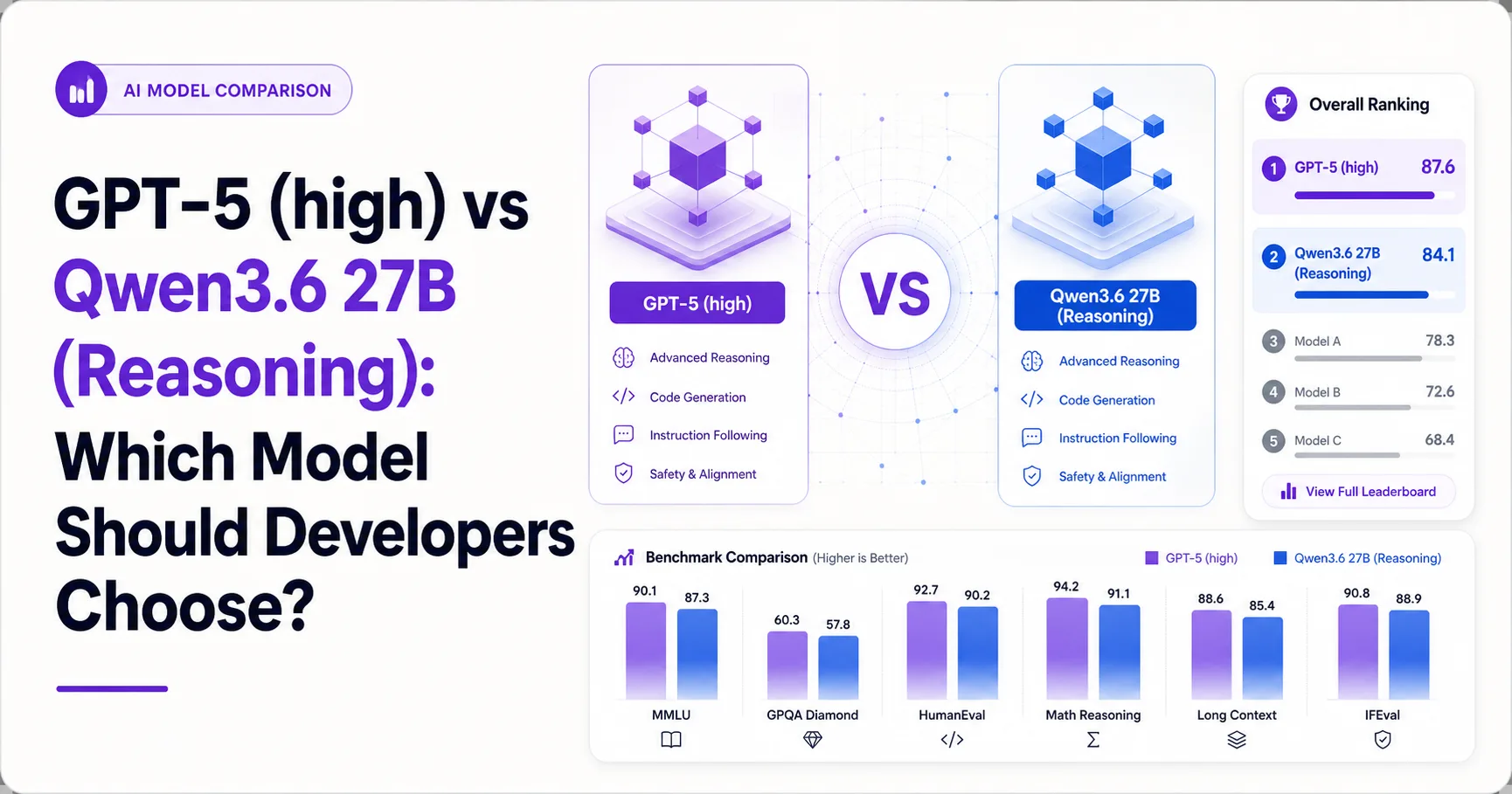
- **Winner overall:** Qwen3.6 27B (Reasoning), with a 53.7 coding index and 37.1 intelligence index versus 37.8 and 34.7 for GPT-5 (high) - **Cheaper:** Qwen3.6 27B (Reasoning) at $1.35 vs $3.4375 per 1M blended tokens - **Faster:** Qwen3.6 27B (Reasoning) at 57.366 median output tokens per second, while GPT-5 has no reported value - **Pick GPT-5 (high) when:** mathematical reasoning, documented APIs, structured tool use, or accountable production integration matters most - **Watch out:** Qwen3.6 27B (Reasoning) has no verified public documentation, pricing page, or math score in the supplied research
GPT-5 (high) vs Qwen3.6 27B (Reasoning)
Qwen3.6 27B (Reasoning) is the stronger value candidate on the available comparison data, but GPT-5 (high) is the safer documented choice for production engineering.
The available Artificial Analysis data gives Qwen3.6 27B (Reasoning) the higher coding index at 53.7, compared with 37.8 for GPT-5 (high). Qwen3.6 27B (Reasoning) also leads the intelligence index at 37.1 versus 34.7. GPT-5 (high) has the only reported math index, at 94.3, so the comparison does not establish a math winner.
GPT-5 has a clear public product surface. OpenAI describes it as a reasoning model for coding, reasoning, and agentic tasks in its developer announcement. Its model documentation also identifies supported endpoints, parameters, tool capabilities, and current pricing.
Qwen3.6 27B (Reasoning) has no verified vendor documentation, public API reference, pricing page, or community testing source in the supplied research. That gap changes the buying decision. The benchmark data makes Qwen attractive, but it does not establish how developers can access, configure, monitor, or support it.
The decision depends on evidence quality as much as model quality
Qwen3.6 27B (Reasoning) leads the measurable developer-facing scores, while GPT-5 (high) leads documentation, feature transparency, and mathematical evidence.
| Decision factor | GPT-5 (high) | Qwen3.6 27B (Reasoning) | Practical meaning |
|---|---|---|---|
| Coding index | 37.8 | 53.7 | Qwen has the stronger available coding result |
| Intelligence index | 34.7 | 37.1 | Qwen has a smaller available advantage |
| Math index | 94.3 | Not reported | GPT-5 is the only model with supplied math evidence |
| Blended price per 1M tokens | $3.4375 | $1.35 | Qwen has the lower reported blended price |
| Input price per 1M tokens | $1.25 | $0.6 | Qwen is cheaper for input-heavy workloads |
| Output price per 1M tokens | $10 | $3.6 | Qwen is cheaper when responses are long |
| Latency | 0.3 seconds | 0.3 seconds | The supplied latency result is tied |
| Median output speed | Not reported | 57.366 tokens per second | Qwen has the only supplied throughput result |
These figures come from Artificial Analysis, and they support a narrow conclusion: Qwen is the better measured value option in this snapshot. They do not prove that Qwen is easier to deploy or more reliable in a real codebase.
GPT-5’s public materials provide additional operational detail. The developer announcement describes reasoning effort, verbosity, structured outputs, function calling, streaming, and custom tools. The model documentation records GPT-5’s input modalities, endpoint availability, and model status.
The central uncertainty is asymmetric. GPT-5 has documented capabilities and limitations, while Qwen3.6 27B has stronger supplied scores but no corroborating public product evidence. Developers should treat that asymmetry as a selection risk, not as proof that either model will perform better in every application.
Performance: Qwen leads coding evidence, GPT-5 preserves a math advantage that cannot be compared
Qwen3.6 27B (Reasoning) is the better-supported performer for coding in the supplied benchmark snapshot, but GPT-5 (high) remains the only candidate with reported mathematical evidence.
The coding gap is large enough to affect model selection. Qwen3.6 27B (Reasoning) records a coding index of 53.7, while GPT-5 (high) records 37.8. That result favors Qwen for software-generation workflows, code transformation, and programming evaluation tasks represented by the index. It does not guarantee better results for a specific language, repository, framework, or test suite.
The intelligence index points in the same direction, though the difference is smaller. Qwen3.6 27B (Reasoning) scores 37.1, compared with 34.7 for GPT-5 (high). A modest lead on a broad index should not outweigh deployment evidence when a workflow has strict correctness, security, or regression requirements.
GPT-5 has a reported math index of 94.3, but Qwen3.6 27B has no math value in the supplied data. The correct conclusion is not that GPT-5 wins mathematics. The evidence only shows that GPT-5 has a documented result and Qwen does not.
The official GPT-5 developer material reports results across coding, reasoning, agentic interaction, and software engineering evaluations. It also explains that at least one coding evaluation used high reasoning effort, so configuration can affect how the result maps to an application.
The supplied research contains no verified Qwen documentation, reproducible test method, or community report. Developers therefore cannot determine whether Qwen’s coding lead reflects broad task coverage, a particular serving configuration, or a benchmark-specific advantage. The chart shows the measured gap, but not its cause.
Cost: Qwen is cheaper, but workload shape and missing deployment evidence can reverse the decision
Qwen3.6 27B (Reasoning) is the lower-cost option across the supplied token prices, especially for workloads that generate substantial output.
The blended price is $1.35 per 1M tokens for Qwen3.6 27B (Reasoning), compared with $3.4375 for GPT-5 (high). Qwen’s input price is $0.6 versus $1.25, and its output price is $3.6 versus $10. Those differences make Qwen the natural first candidate for high-volume coding assistance, batch generation, and applications where response length is material.
Price alone does not define total cost. A cheaper model can become more expensive if it needs additional retries, manual review, routing logic, or post-processing. The supplied research does not provide error rates, production reliability, retry counts, infrastructure costs, or support costs for either model. No break-even calculation is therefore justified from the available evidence.
The latency result is tied at 0.3 seconds in the supplied comparison. Qwen3.6 27B also has the only reported median output speed, at 57.366 tokens per second. GPT-5 has no supplied throughput value, so the data cannot establish a complete responsiveness advantage.
GPT-5’s model documentation provides a public price reference and identifies the available model alias and endpoints. Qwen3.6 27B has no verified pricing or access documentation in the research, despite the comparison data containing price values. Developers should verify the serving source, billing unit, rate limits, and availability before treating the Qwen price as an immediately purchasable production offer.
For a cost-sensitive pilot, Qwen deserves priority. For a production budget, the correct comparison is effective cost per accepted result, and that value remains unknown.
Recommendation: choose Qwen for measured coding value, GPT-5 for documented risk control
Qwen3.6 27B (Reasoning) should be the first pilot for coding-heavy workloads, while GPT-5 (high) should be the default for workflows requiring documented behavior and mathematical evidence.
Pick Qwen3.6 27B (Reasoning) when the main objective is reducing token spend or improving coding benchmark performance. Its coding index is 53.7, its intelligence index is 37.1, and its blended price is $1.35 per 1M tokens. Those results make it compelling for code drafting, repository assistance, and developer tools that can tolerate an evaluation phase before production adoption.
Pick GPT-5 (high) when the workflow needs a public API contract, explicit tool-use features, structured output support, or a documented mathematical result. OpenAI presents GPT-5 as a model for coding, reasoning, and agentic tasks in the developer announcement. The model documentation documents function calling, structured outputs, streaming, configurable reasoning effort, and model limitations.
GPT-5 also has a meaningful lifecycle caveat. The stable alias remains listed, but the fixed snapshot gpt-5-2025-08-07 is marked Deprecated in the model documentation, which creates migration work for applications pinned to that snapshot.
Qwen has a different risk profile. The supplied research has no verified public source for its API, context behavior, configuration, pricing, release status, or failure modes. That makes Qwen’s benchmark advantage promising but operationally unproven.
The practical selection path is a controlled pilot using the target repository, test suite, tool schema, and response acceptance rules. Compare accepted outputs, repair effort, and actual billed usage. The supplied materials do not contain those measurements, so neither model can be declared universally best.
Questions developers should answer before switching models
GPT-5 (high) is easier to evaluate from public documentation, while Qwen3.6 27B (Reasoning) requires access and behavior checks before adoption.
The available sources support a clear price and benchmark comparison, but they do not answer several operational questions. Developers should validate those unknowns in the exact environment where the selected model will run. The only supplied community evidence for GPT-5 comes from a non-controlled Reddit discussion, which reported useful small debugging results alongside concerns about complex existing codebases and simplified application output. See the Reddit discussion for the original account.
Data provided by https://artificialanalysis.ai/
Frequently asked questions
Is Qwen3.6 27B (Reasoning) better than GPT-5 (high) for coding?
Qwen3.6 27B (Reasoning) has the stronger supplied coding evidence, with a 53.7 coding index versus 37.8 for GPT-5 (high), but the result does not prove superiority for every repository or programming task.
Which model is cheaper for production applications?
Qwen3.6 27B (Reasoning) is cheaper at the supplied token prices, including $1.35 per 1M blended tokens, but missing reliability and deployment data prevents a complete effective-cost comparison.
Should developers use GPT-5 for mathematical workloads?
GPT-5 (high) is the safer evidence-based choice for mathematical workloads because the supplied data reports a 94.3 math index, while Qwen3.6 27B has no reported math result.
Does GPT-5 have better production documentation than Qwen3.6 27B?
GPT-5 has substantially stronger documented production evidence because OpenAI publishes model, endpoint, parameter, tooling, pricing, and limitation details, while the supplied research found no verified public Qwen documentation.
Is Qwen3.6 27B faster than GPT-5?
Qwen3.6 27B (Reasoning) has the only supplied output-speed value, at 57.366 median output tokens per second, while both models show 0.3 seconds of reported latency.
Sources
- Artificial AnalysisThe supplied comparison data, benchmark indices, prices, latency, and output-speed measurements.
- GPT-5 for developersGPT-5 positioning, reasoning configuration, tool capabilities, and official benchmark context.
- GPT-5 model documentationGPT-5 model alias, status, pricing, endpoints, modalities, parameters, supported features, and limitations.
- Tried GPT-5 Here Are My First ImpressionsUncontrolled community observations about debugging, application generation, and complex existing codebases.
Published: