
AI model analysis
GPT-5 (high) vs Qwen3.7 Plus: Which Model Should Developers Choose?
A developer-focused comparison of GPT-5 (high) and Qwen3.7 Plus across capability evidence, coding performance, speed, cost, operational risk, and model-selection fit.
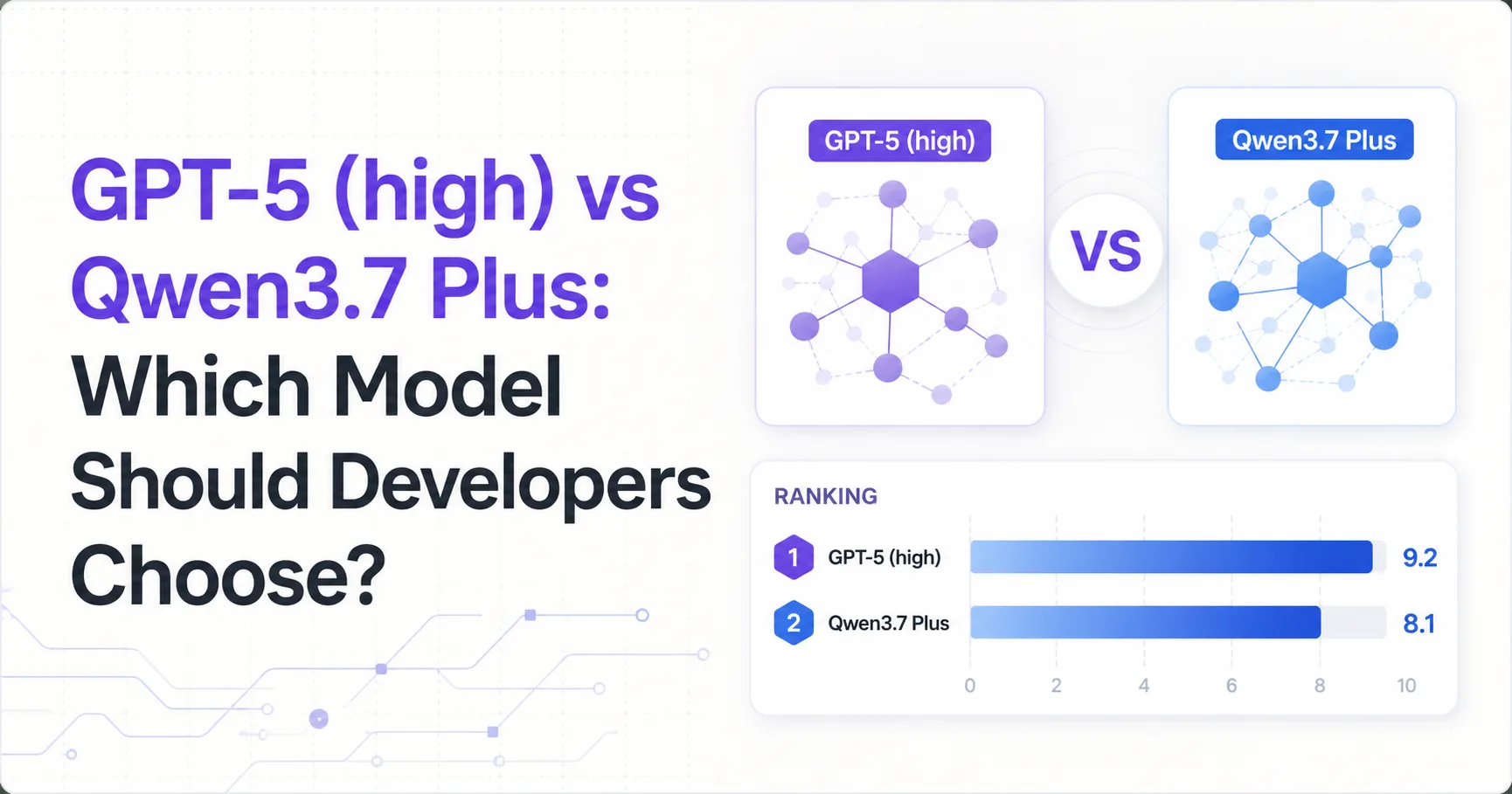
- **Winner overall:** Qwen3.7 Plus, with a 55.9 coding index and 39 intelligence index versus GPT-5 (high) at 37.8 and 34.7 - **Cheaper:** Qwen3.7 Plus at $0.7 vs $3.4375 per 1M blended tokens - **Faster:** Qwen3.7 Plus at 52.107 median output tokens per second, while GPT-5 (high) has no reported value - **Pick GPT-5 (high) when:** You need documented reasoning controls, multimodal text-and-image input, structured outputs, and official benchmark evidence - **Watch out:** Qwen3.7 Plus has no verifiable official documentation, pricing page, or community evidence in the supplied research
GPT-5 (high) vs Qwen3.7 Plus
GPT-5 (high) is the safer documented integration, while Qwen3.7 Plus is the stronger apparent value for coding-heavy workloads.
The supplied data gives Qwen3.7 Plus the higher Artificial Analysis coding index at 55.9, compared with 37.8 for GPT-5 (high). Qwen3.7 Plus also leads the intelligence index, with 39 versus 34.7. Those results make Qwen3.7 Plus the numerical leader on the shared evaluation fields.
The evidence quality is uneven, however. OpenAI documents GPT-5 as a reasoning model for coding, reasoning, and agentic tasks in GPT-5 for developers. The GPT-5 model documentation documents its API identity, context limits, modalities, pricing, tools, and lifecycle status. The supplied research found no verifiable official documentation, pricing page, or community discussion for Qwen3.7 Plus.
That distinction changes the selection decision. Qwen3.7 Plus looks attractive if measured coding output, speed, and token economics dominate. GPT-5 (high) is easier to evaluate operationally because its behavior and integration surface are documented. The comparison cannot establish whether Qwen3.7 Plus supports the same tools, modalities, reliability guarantees, or deployment options.
Executive summary for developers
Qwen3.7 Plus wins the supplied shared scores and pricing comparison, but GPT-5 (high) wins on documented product evidence.
| Decision area | Better-supported conclusion |
|---|---|
| Coding evaluation | Qwen3.7 Plus leads at 55.9 versus 37.8 |
| General intelligence evaluation | Qwen3.7 Plus leads at 39 versus 34.7 |
| Math evaluation | GPT-5 (high) has a reported 94.3; Qwen3.7 Plus has no supplied value |
| Blended token cost | Qwen3.7 Plus is listed at $0.7 versus $3.4375 per 1M blended tokens |
| Output speed | Qwen3.7 Plus reports 52.107 median output tokens per second; GPT-5 (high) has no supplied value |
| Request latency | The supplied data reports 0.3 seconds for each model |
| API evidence | GPT-5 (high) has official documentation; Qwen3.7 Plus has none in the supplied research |
GPT-5 (high) supports text and image input with text output, plus function calling, structured outputs, streaming, and custom tools, according to the GPT-5 model documentation. It also exposes reasoning_effort and verbosity controls through the documented API surface, as described in GPT-5 for developers.
Qwen3.7 Plus may be the better first candidate for a coding assistant, batch transformation service, or cost-sensitive application. That conclusion remains provisional because the research contains no verified Qwen3.7 Plus API contract, benchmark methodology, or production reliability evidence.
Performance: what the shared data means in practice
Qwen3.7 Plus has the stronger measured coding signal, but GPT-5 (high) has the stronger documented reasoning and tool-use story.
The coding-index gap is material enough to influence a first-pass shortlist. Qwen3.7 Plus reaches 55.9, while GPT-5 (high) reaches 37.8. A higher coding index could translate into fewer repair iterations, better code completion, or more useful first drafts. The supplied data does not identify which tasks produced the gap, so it cannot prove that Qwen3.7 Plus will outperform GPT-5 (high) on a specific repository, language, framework, or agent workflow.
Qwen3.7 Plus also reports 52.107 median output tokens per second. GPT-5 (high) has no corresponding supplied output-speed value, so the comparison cannot establish a measured speed winner. Equal reported latency at 0.3 seconds suggests similar request-start responsiveness in this dataset, but it says nothing about total completion time for long outputs.
GPT-5 (high) has a separate advantage in public evaluation context. OpenAI reports 74.9% on SWE-bench Verified, 88% on Aider polyglot, 96.7% on τ²-bench telecom, and 69.6% on Scale MultiChallenge in GPT-5 for developers. OpenAI states that the SWE-bench result excluded 23 of 500 problems that could not be passed reliably on its infrastructure, and that Aider used high reasoning effort. Those qualifications matter when mapping a headline score to production behavior.
GPT-5 (high) also has a reported math index of 94.3, while Qwen3.7 Plus has no supplied math value. That is an evidence gap, not a Qwen defeat. Developers should test both models on representative tasks before treating the coding index as a universal quality ranking.
Cost: the cheaper model can still be the wrong economy
Qwen3.7 Plus is dramatically cheaper in the supplied pricing snapshot, but workload shape and integration uncertainty determine the real bill.
Qwen3.7 Plus is listed at $0.7 per 1M blended tokens, compared with $3.4375 for GPT-5 (high). Its input price is $0.4 per 1M tokens and its output price is $1.6, while GPT-5 (high) is listed at $1.25 input and $10 output. The largest practical difference appears on output-heavy workflows, such as coding agents that generate patches, explanations, tests, and tool-call arguments.
The blended figure assumes the data brief’s 3-to-1 input-to-output mix. A different mix can change the ranking’s economic meaning. Output-heavy workloads expose GPT-5 (high)’s higher listed output price more strongly. Input-heavy workloads reduce that contrast, although Qwen3.7 Plus remains cheaper in the supplied input values.
Token price is also only one component of total cost. A model that needs more retries, stricter validation, longer prompts, or additional review can consume the apparent savings. The research reports community comments that GPT-5 can be useful for small debugging and modification tasks, but may hallucinate or make incorrect changes in complex existing codebases; those comments came from an uncontrolled Reddit discussion in Tried GPT-5 Here Are My First Impressions. No equivalent Qwen3.7 Plus evidence was found.
Because Qwen3.7 Plus lacks a verified pricing source in the research, its listed price should be treated as a supplied comparison value rather than a confirmed procurement quote. Confirm billing terms, quotas, caching, hosting, and availability before committing.
Recommendation by developer scenario
GPT-5 (high) is the better default for documented, tool-driven applications, while Qwen3.7 Plus is the better test candidate for low-cost coding workloads.
Choose GPT-5 (high) when the application needs a known API contract and explicit control over reasoning effort. The model supports minimal, low, medium, and high reasoning settings, along with low, medium, and high verbosity settings, according to GPT-5 for developers. Those controls can help developers trade response depth against latency and cost within one documented model family.
GPT-5 (high) is also a stronger fit for workflows that inspect screenshots or other images. The GPT-5 model documentation lists text and image input with text output. It supports function calling, structured outputs, streaming, and custom tools, which makes it suitable for agent orchestration when those interfaces match the application’s requirements.
Choose Qwen3.7 Plus first when coding score, reported generation speed, and token price are the main screening criteria. Its 55.9 coding index, 52.107 median output tokens per second, and $0.7 blended price create a compelling test hypothesis. The supplied research does not show whether that advantage survives repository-specific evaluation, tool use, long-context work, or failure recovery.
Do not select either model solely from the headline comparison. Run a small acceptance set containing repository edits, tests, structured outputs, image-grounded tasks, long responses, and adversarial inputs. Measure successful task completion, repair count, review time, and total tokens. The evidence is insufficient to recommend Qwen3.7 Plus for production without first confirming its API, lifecycle, and support details.
One lifecycle warning applies to GPT-5 (high). OpenAI marks the fixed snapshot gpt-5-2025-08-07 as Deprecated and recommends GPT-5.6 in the GPT-5 model documentation. An application that requires the fixed snapshot should include a migration review before launch.
Questions to answer before adopting either model
GPT-5 (high) is easier to validate before adoption because the supplied research includes official product documentation and explicit limitations.
Developers should treat Qwen3.7 Plus as an evidence-limited candidate rather than as a fully characterized production platform. The supplied research found no verifiable official announcement, developer documentation, pricing page, stable alias, replacement version, limitation list, or community test for Qwen3.7 Plus.
The most important unanswered questions concern operational fit. The available material does not establish Qwen3.7 Plus’s supported modalities, tool-calling format, structured-output behavior, context limits, lifecycle policy, or production support. These missing facts can matter more than a favorable benchmark index.
GPT-5 (high) also has clear boundaries. The GPT-5 model documentation states that audio and video input and output are unsupported, and that fine-tuning and predicted outputs are unsupported. A team requiring those capabilities should exclude GPT-5 (high) unless the architecture supplies another model.
Community evidence should remain directional. The Reddit post reports favorable experiences with small bug fixes, but criticism of simplified full-application and UI generation, plus possible incorrect changes in complex repositories, came from one uncontrolled test and comments in Tried GPT-5 Here Are My First Impressions. The research found no comparable Qwen3.7 Plus community evidence.
Frequently asked questions
Is Qwen3.7 Plus better than GPT-5 (high) for coding?
Qwen3.7 Plus has the higher supplied coding index at 55.9 versus 37.8, but the evidence does not identify the tested tasks or verify its API, so repository-specific testing is still required.
Which model costs less for production API usage?
Qwen3.7 Plus has the lower supplied blended price at $0.7 per 1M tokens versus $3.4375 for GPT-5 (high), but retries, validation, output volume, and unverified commercial terms can change total cost.
Which model is faster for developer applications?
Qwen3.7 Plus reports 52.107 median output tokens per second, while GPT-5 (high) has no supplied output-speed value; both models show 0.3 seconds latency in the supplied data.
Should developers use GPT-5 (high) or gpt-5-high as the API model name?
Developers should use the documented gpt-5 alias or the documented fixed snapshot, because the research found no official gpt-5-high API model; high refers to reasoning_effort=high.
Does GPT-5 (high) support image, audio, and video input?
GPT-5 (high) supports image input and text output, but the supplied official documentation says it does not support audio or video input and output, so multimodal scope is limited.
Is GPT-5 (high) safe for a long-lived production integration?
GPT-5 (high) has the stronger documentation base, but the fixed snapshot gpt-5-2025-08-07 is marked Deprecated and should be included in a migration review before long-term adoption.
Sources
- GPT-5 for developersGPT-5 API positioning, reasoning and verbosity controls, tool support, official benchmarks, and benchmark qualifications
- GPT-5 model documentationGPT-5 model alias, snapshot, context and output limits, modalities, API endpoints, pricing, unsupported features, and deprecation status
- Tried GPT-5 Here Are My First ImpressionsUncontrolled community observations about debugging, application generation, UI detail, and complex-codebase failure risk
Published: