
AI model analysis
GPT-5 (high) vs Qwen3 Max Thinking: Which Model Should Developers Choose?
A developer-focused comparison of GPT-5 (high) and Qwen3 Max Thinking across evidence, capability, latency, pricing, and production risk.
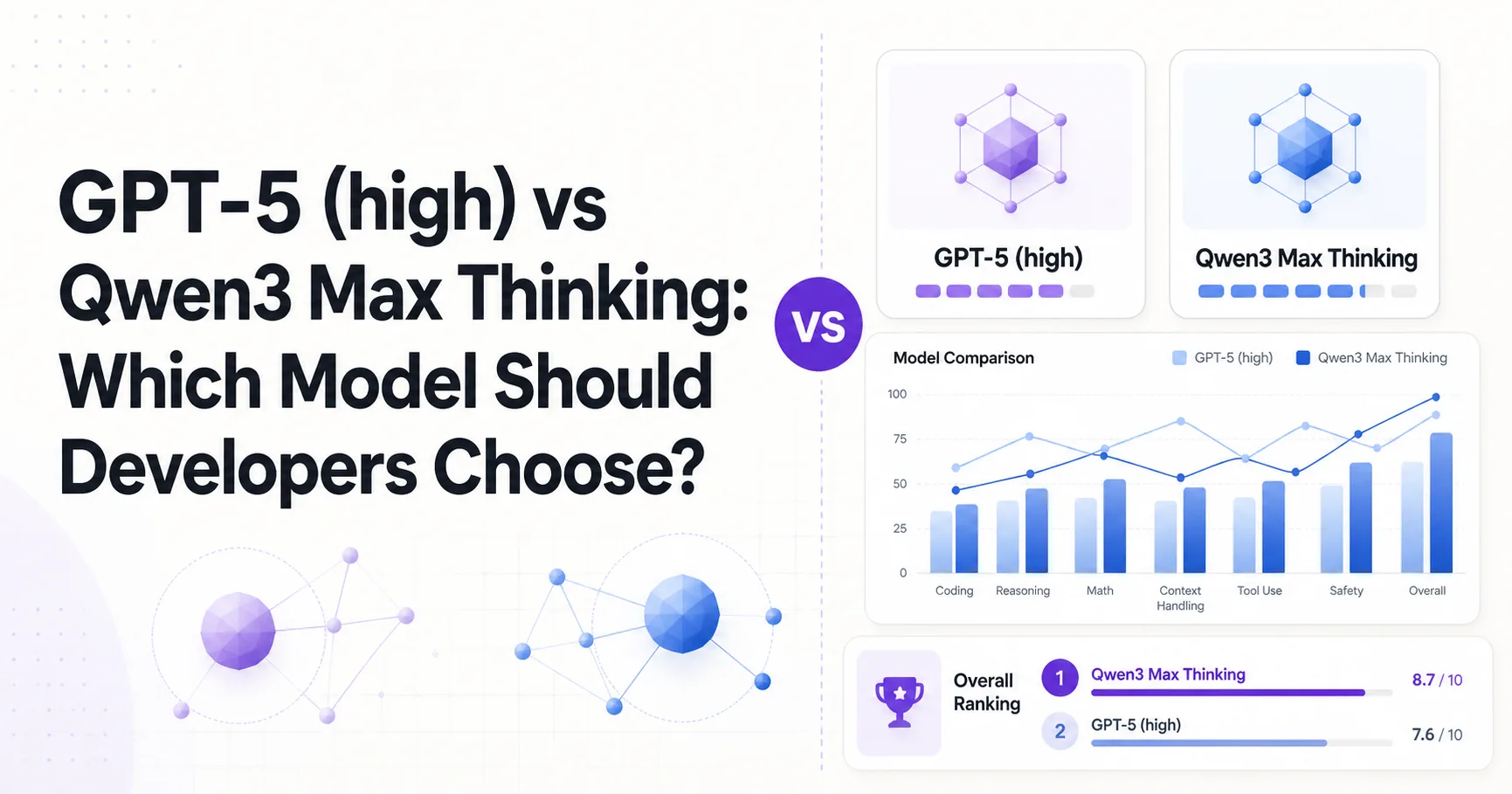
- **Winner overall:** GPT-5 (high), the only model with verified public documentation and a higher Artificial Analysis Intelligence Index at 34.7 vs 31.7 - **Cheaper:** GPT-5 (high) at $3.4375 vs $15 per 1M blended tokens - **Faster:** Neither model, both report 0.3 seconds latency; output speed is unavailable - **Pick GPT-5 (high) when:** You need documented APIs, coding support, tool calling, and predictable pricing - **Watch out:** Qwen3 Max Thinking has no usable evidence in this brief for context, reliability, API access, or failure modes
GPT-5 (high) vs Qwen3 Max Thinking
GPT-5 (high) is the safer developer choice because GPT-5 has verifiable API documentation, public evaluation evidence, and a lower blended price, while Qwen3 Max Thinking remains undocumented in the supplied research. OpenAI describes GPT-5 as a reasoning model for coding, reasoning, and agentic tasks. The supplied data brief gives GPT-5 an Artificial Analysis Intelligence Index of 34.7, compared with 31.7 for Qwen3 Max Thinking. The comparison is incomplete, however, because Qwen3 Max Thinking has no verified coding, math, latency-throughput, context, or API evidence in the research material. Developers should therefore read this as a decision under asymmetric evidence, rather than a fully controlled model shootout.
The label “GPT-5 (high)” also needs careful interpretation. The research found no independent API model named gpt-5-high. Instead, “high” refers to GPT-5’s reasoning_effort=high setting, as described in GPT-5 for developers. That distinction matters for implementation, billing, migration, and reproducibility. Qwen3 Max Thinking may still be attractive for teams with direct access and internal test results, but the supplied material does not establish those conditions.
Executive summary
GPT-5 (high) leads the documented comparison on general intelligence, price, and developer readiness. The Artificial Analysis Intelligence Index records 34.7 for GPT-5 and 31.7 for Qwen3 Max Thinking. That gap is meaningful for a general-purpose selection, but it is not enough to claim superiority on coding or mathematics because the data brief reports no Qwen3 Max Thinking scores for those indexes.
GPT-5 also costs $3.4375 per 1M blended tokens, while Qwen3 Max Thinking costs $15. GPT-5 input tokens are priced at $1.25 per 1M, versus $10 for Qwen3 Max Thinking. GPT-5 output tokens cost $10 per 1M, versus $30 for Qwen3 Max Thinking. These prices make GPT-5 the stronger default for high-volume applications, unless Qwen3 Max Thinking produces materially fewer retries, shorter outputs, or better task completion in the buyer’s own workload.
The largest difference is not a benchmark score. It is the quality of the available evidence. GPT-5’s model documentation specifies its API identity, supported endpoints, modalities, pricing, and current lifecycle status. The research provides no comparable source for Qwen3 Max Thinking. That absence should lower confidence in any strong Qwen-specific claim.
Performance: what the scores mean for real development work
GPT-5 (high) is the only model with documented coding and mathematics evidence, so GPT-5 is the more defensible choice for engineering workflows with measurable technical requirements. The data brief reports a GPT-5 Artificial Analysis Coding Index of 37.8 and Math Index of 94.3. Qwen3 Max Thinking has no corresponding coding or math value in the supplied data. The missing value is not a poor result. It is an evidence gap.
For repository maintenance, the practical implication is straightforward. GPT-5 can be evaluated against a known public baseline and configured through documented reasoning controls. OpenAI’s developer material describes function calling, structured outputs, streaming, and custom tools with grammar constraints. Those features support code agents that need machine-readable actions and controlled tool interfaces. The research does not confirm equivalent capabilities for Qwen3 Max Thinking.
The latency result does not identify a winner. Both models report 0.3 seconds latency, while median output tokens per second is unavailable for both. A developer cannot infer streaming feel, total completion time, or long-answer throughput from the available latency value alone. The result may change in production because prompt length, reasoning configuration, queueing, tool calls, and output size are not supplied.
GPT-5’s documented limits also shape task fit. The model documentation says GPT-5 accepts text and image input and produces text output, but does not support audio or video input or output. The same documentation marks fine-tuning and predicted outputs as unsupported. Qwen3 Max Thinking has no verified limitation profile in the research, so its suitability for those requirements is unknown rather than established.
Cost: when the cheaper model may still cost more
GPT-5 (high) is the lower-cost option on every reported pricing measure, but GPT-5 is not automatically cheaper for a completed user outcome. The blended price is $3.4375 per 1M tokens for GPT-5 and $15 for Qwen3 Max Thinking. GPT-5’s lower input and output rates also reduce the direct cost of large prompts and generated code.
The chart makes the price gap clear, but it cannot show rework. A model with a higher token price can be economically rational if it completes a task in fewer attempts, avoids failed tool calls, or produces code that requires less review. The supplied research does not measure any of those factors for Qwen3 Max Thinking. It also does not provide a task-success rate that would allow a reliable break-even analysis.
GPT-5’s cost advantage is strongest in workloads with repeated context, large repositories, or substantial generated output, provided the model’s first-pass quality is acceptable. GPT-5 output is priced at $10 per 1M tokens, so verbose agent loops can still become expensive even with a low blended rate. Developers should control reasoning settings, output length, retries, and tool-call frequency during their own pilot.
Qwen3 Max Thinking could be justified by a private benchmark or a workload-specific completion advantage, but neither is present here. The correct conclusion is that GPT-5 has the better known price-performance case. The evidence does not prove Qwen3 Max Thinking has a worse total cost of ownership.
Evidence quality and production risk
GPT-5 has a lower production-evidence risk because its public documentation supports concrete implementation checks, while Qwen3 Max Thinking cannot be verified from the supplied sources. GPT-5’s documentation lists gpt-5 as a callable alias and identifies supported API endpoints. It also marks the fixed snapshot gpt-5-2025-08-07 as Deprecated and recommends GPT-5.6, according to the research brief.
That lifecycle detail creates a split decision. GPT-5 is documented and currently priced, yet a team depending on the fixed snapshot must plan for migration. The stable alias may reduce operational friction, but an alias can change over time. Teams that require strict reproducibility should pin versions, monitor deprecation notices, and keep regression tests around critical prompts.
Community evidence is mixed and weakly controlled. One Reddit author reported that GPT-5 handled small bug diagnosis and fixes quickly, while complete application and interface generation appeared too brief and under-detailed. Comments also described possible hallucinations or incorrect edits in complex existing repositories. The Reddit discussion is useful as a risk signal, not as a benchmark. The research found no reliable community consensus for Qwen3 Max Thinking.
Qwen3 Max Thinking therefore carries a different risk: unknowns. The supplied material cannot confirm its API availability, stable alias, context window, output limit, modalities, pricing beyond the data brief, community behavior, or failure patterns. Unknown capability is not evidence of weakness, but it is a real procurement and integration risk.
Recommendation by developer scenario
GPT-5 (high) is the default recommendation for teams that need a documented API, structured tool use, and predictable operating cost. The recommendation follows from the verified evidence, not from an assumption that missing Qwen3 Max Thinking data represents failure.
Choose GPT-5 (high) for coding agents, repository debugging, structured automation, and general reasoning workloads where integration reliability matters. GPT-5’s documented function calling, structured outputs, streaming, and custom tools make it easier to define an execution contract. Its reported Intelligence Index of 34.7 also exceeds Qwen3 Max Thinking’s 31.7 in the supplied comparison.
Consider Qwen3 Max Thinking only when your team already has direct, legitimate access and can run a representative private evaluation. Test repository edits, tool-call correctness, retry frequency, review effort, long-context behavior, and end-to-end completion cost. The supplied research cannot answer those questions for Qwen3 Max Thinking.
Do not select GPT-5 solely because it has a published benchmark. Do not select Qwen3 Max Thinking solely because its name suggests a specialized reasoning mode. For either model, define acceptance tests around the real workload. For GPT-5, include migration checks because the fixed snapshot is marked Deprecated. For Qwen3 Max Thinking, treat documentation discovery and operational verification as entry criteria.
The final choice is GPT-5 (high) for a documented, lower-cost default. Qwen3 Max Thinking remains a conditional option whose upside cannot be assessed confidently from the available evidence.
FAQ before choosing a model
GPT-5 (high) answers the main selection questions more reliably because the supplied evidence documents its API behavior, while Qwen3 Max Thinking remains largely unverified.
Frequently asked questions
Is GPT-5 (high) a separate API model from GPT-5?
No, GPT-5 (high) is not established as a separate API model ID in the supplied research. “High” refers to the reasoning_effort=high parameter for GPT-5, while the documented callable alias is gpt-5. Teams should verify the exact model and parameter combination in their implementation rather than creating a nonexistent gpt-5-high dependency.
Which model is cheaper for production workloads?
GPT-5 (high) is cheaper on every reported direct pricing measure. GPT-5 costs $3.4375 per 1M blended tokens, compared with $15 for Qwen3 Max Thinking. Input pricing is $1.25 versus $10, and output pricing is $10 versus $30. Total cost can still depend on retries, review, and task completion, which the supplied research does not measure.
Which model is faster?
Neither model is proven faster from the supplied data. Both GPT-5 (high) and Qwen3 Max Thinking report 0.3 seconds latency, while median output tokens per second is unavailable for both. That comparison cannot establish streaming responsiveness, total completion time, or performance during tool-heavy agent workflows.
Is Qwen3 Max Thinking better for coding?
The supplied evidence cannot establish that Qwen3 Max Thinking is better for coding. The data brief reports a GPT-5 Coding Index of 37.8 but provides no Qwen3 Max Thinking coding value. The research also contains no verified Qwen3 Max Thinking documentation, coding benchmark, or reliable community test, so a workload-specific evaluation is required.
Should a team use the deprecated GPT-5 snapshot?
Teams should avoid treating the fixed GPT-5 snapshot as a permanent dependency because the supplied OpenAI documentation marks gpt-5-2025-08-07 as Deprecated. GPT-5 remains documented as a callable alias, but production users should pin versions where necessary, monitor lifecycle changes, and maintain regression tests before migration.
Sources
- GPT-5 for developersGPT-5 positioning, reasoning controls, tool calling, structured outputs, custom tools, and official evaluation context
- GPT-5 model documentationGPT-5 API alias, endpoints, pricing, lifecycle status, modalities, supported features, and limitations
- Tried GPT-5 Here Are My First ImpressionsUncontrolled community observations about debugging, application generation, and complex repository edits
Published: