
AI model analysis
Inkling (xhigh) vs o3: A Developer Model Selection Guide
A source-aware comparison of Inkling (xhigh) and o3 for developers choosing between lower cost, faster output, stronger measured intelligence, and uncertain availability.
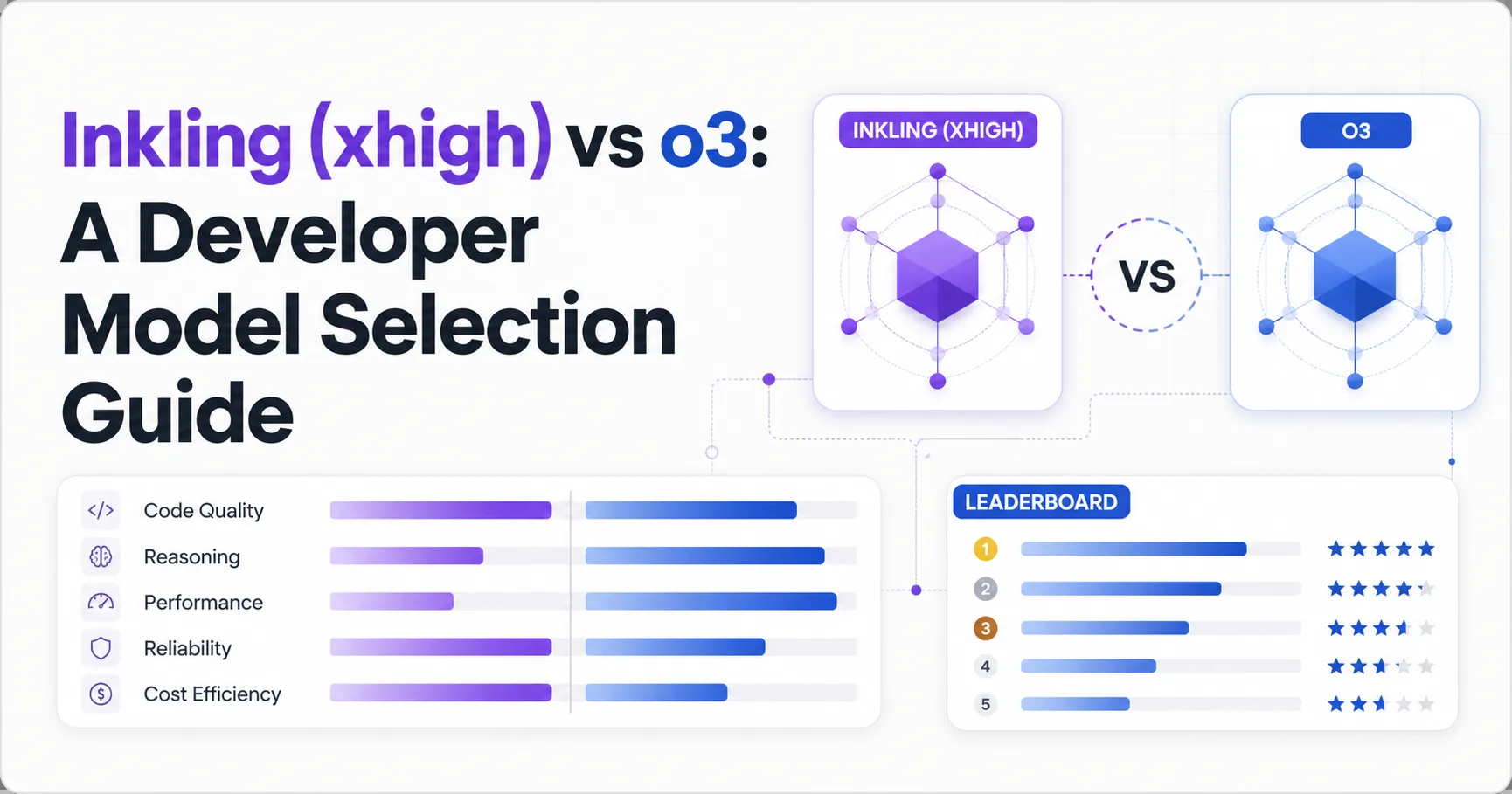
- **Winner overall:** Inkling (xhigh), with a 40.7 intelligence index versus o3 at 30.4 and a lower blended price of $2.5725000000000002 per 1M tokens - **Cheaper:** Inkling (xhigh) at $2.5725000000000002 vs $3.5 per 1M blended tokens - **Faster:** o3 at 128.056 median output tokens per second - **Pick o3 when:** higher measured math performance matters, with an Artificial Analysis math index of 88.3 - **Watch out:** availability and support remain uncertain for both models, while the measured coding comparison has no o3 score
Inkling (xhigh) vs o3 for developers
Inkling (xhigh) is the stronger measured value choice, while o3 is the faster model with a documented math result.
The available data does not support a universal winner. Inkling (xhigh) records an Artificial Analysis Intelligence Index of 40.7, compared with 30.4 for o3. Inkling (xhigh) also has a lower blended price, at $2.5725000000000002 per 1M tokens versus $3.5 for o3. o3 produces output at 128.056 median tokens per second, compared with 84.899 for Inkling (xhigh). Both models show 0.3 seconds of latency in the supplied snapshot.
The comparison is incomplete in important ways. Inkling (xhigh) has a measured coding index of 52.1, but no corresponding o3 coding value appears in the data. o3 has a math index of 88.3, but no corresponding Inkling (xhigh) math value appears. Neither model has a supplied context-window value.
The availability question is also unresolved. The current OpenAI model directory does not list o3 among the supplied current models, and no verifiable official source was provided for Inkling (xhigh). Data provided by https://artificialanalysis.ai/ supplies the quantitative snapshot used here.
Executive summary
Inkling (xhigh) offers the better measured balance of intelligence and cost, but o3 remains more attractive for speed and documented mathematical performance.
For a developer building a general-purpose application, Inkling (xhigh) has the clearer numeric case. Its intelligence index is 40.7, while o3 reaches 30.4. Its blended price is $2.5725000000000002 per 1M tokens, lower than o3 at $3.5. The price gap is especially visible on generated output, where Inkling (xhigh) costs $4.68 per 1M output tokens and o3 costs $8.
That conclusion has a material evidence limit. The intelligence index does not establish that Inkling (xhigh) will produce better code, mathematical proofs, tool calls, or production answers for a specific workload. The supplied data gives Inkling (xhigh) a coding index of 52.1, but it gives o3 no coding score. It gives o3 a math index of 88.3, but it gives Inkling (xhigh) no math score. The missing pairwise results prevent a clean capability ranking.
The product-status evidence also points in different directions. The OpenAI model directory presents newer frontier models and does not list o3 in the provided material. The OpenAI pricing page does not provide a current o3 price in the supplied official text. The data snapshot still contains o3 pricing and performance values, so developers should treat the snapshot as measurement evidence, not proof of present API availability.
A practical shortlist therefore depends on the risk a team can accept. Choose Inkling (xhigh) for measured intelligence per dollar when access is confirmed. Choose o3 when output speed or the documented math signal matters more than current catalog visibility.
Performance: speed is clear, capability coverage is not
o3 is the faster measured generator, while Inkling (xhigh) has the only supplied coding score and the higher supplied intelligence score.
The speed difference matters most in interactive products. o3 reaches 128.056 median output tokens per second, compared with 84.899 for Inkling (xhigh). A faster stream can make long answers feel more responsive and can reduce the time a user watches a result unfold. It does not automatically make a complete workflow faster. Tool calls, retries, queueing, validation, and application-side processing can dominate the experience.
The equal latency value changes the interpretation. Both models have 0.3 seconds in the supplied snapshot. That suggests the first response delay is not the deciding metric in this comparison. The distinction appears during generation, where o3 streams faster. For short responses, that advantage may be less visible than it is for long outputs.
Capability evidence is asymmetric. Inkling (xhigh) has an Artificial Analysis Coding Index of 52.1, but o3 has no coding value in the supplied comparison. o3 has an Artificial Analysis Math Index of 88.3, but Inkling (xhigh) has no math value. The Artificial Analysis data source therefore supports targeted signals, not a complete head-to-head capability verdict.
The qualitative performance question is unanswered. No verifiable community discussions were supplied for either model, so there is no sourced basis for claims about debugging style, instruction following, refusal behavior, tool use, or real-world coding reliability. Developers should test representative prompts before treating either index as a release decision.
Cost: Inkling (xhigh) wins the visible price comparison
Inkling (xhigh) is cheaper across the supplied blended, input, and output price measures, but workload shape determines whether the saving survives production use.
The blended comparison favors Inkling (xhigh) at $2.5725000000000002 per 1M tokens versus $3.5 for o3. Input pricing is close, with Inkling (xhigh) at $1.87 per 1M input tokens and o3 at $2. Output pricing is more separated, with Inkling (xhigh) at $4.68 per 1M output tokens and o3 at $8. The Artificial Analysis data source supplies these values.
The output difference is important for applications that generate long explanations, code patches, reports, or structured content. A cheaper output token can make a model with longer answers more affordable. The reverse can happen if a cheaper model needs more retries, produces more invalid tool calls, or requires a second model to repair its output. The supplied materials do not measure those failure rates, so the total-cost conclusion remains conditional.
The lower blended price also does not settle procurement. The OpenAI API pricing page does not list o3 in the provided current pricing material. The official source therefore cannot confirm a live o3 price from the supplied evidence, even though the data snapshot reports $3.5. Inkling (xhigh) has an even larger availability gap because the research brief found no verifiable vendor page, developer documentation, or pricing page.
Teams should separate measured unit economics from callable production economics. Inkling (xhigh) is the price winner in the snapshot. The cheaper choice becomes the more expensive choice if access is unstable or quality controls add enough operational work. The brief provides no direct evidence for that scenario, so it should be tested rather than assumed.
Recommendation by developer workload
Inkling (xhigh) is the default pick for cost-sensitive general workloads, while o3 is the specialist pick for speed-sensitive or math-oriented workloads.
Pick Inkling (xhigh) when the application needs a measured intelligence advantage at lower token cost. The supplied intelligence index is 40.7 for Inkling (xhigh) and 30.4 for o3. The blended price also favors Inkling (xhigh), and its output price is $4.68 per 1M tokens compared with $8 for o3. This combination is attractive for assistants, content transformation, analysis, and other workloads where response quality and token volume matter together.
Pick o3 when output streaming speed is a visible product requirement. Its median output rate is 128.056 tokens per second, compared with 84.899 for Inkling (xhigh). Choose it also when mathematical performance is the primary screening criterion, because o3 has the supplied math index of 88.3. That recommendation is based on a one-sided measurement. Inkling (xhigh) has no supplied math score, so the data cannot prove that o3 beats it on a complete mathematical comparison.
Do not make either model the production default solely from current status evidence. The OpenAI model directory does not list o3 in the provided current catalog material. The research brief found no verifiable official source for Inkling (xhigh), including a stable alias, API endpoint, context window, or support policy.
A responsible selection gate is therefore simple: confirm that the chosen model can be called under the intended account, run representative coding and math tasks, measure retries and tool errors, then compare end-to-end cost. The supplied evidence supports Inkling (xhigh) as the numeric default and o3 as the speed and math alternative. It does not support claims about reliability, context limits, or long-term availability.
FAQ before you choose
Inkling (xhigh) is the more economical measured option, but the evidence is not complete enough to remove a workload-specific validation step.
The main unresolved issues are availability, capability coverage, and operational behavior. No supplied source confirms Inkling (xhigh)'s official API, context window, output limit, or failure modes. The official OpenAI pages supplied for this comparison do not list o3 in the current model directory or provide a current o3 price in the provided pricing text. The data snapshot still reports o3 performance and pricing, so developers should reconcile catalog access with measured data before launch.
The comparison also contains non-overlapping evaluations. Inkling (xhigh) has a coding index of 52.1, while o3 has a math index of 88.3. Those values answer different questions. They should not be combined into a single capability score. Both models have 0.3 seconds of latency in the snapshot, but their median output speeds differ.
No reliable community evidence was supplied. Claims about coding feel, reasoning style, instruction following, or failure patterns would exceed the research brief. A small evaluation set built from real application prompts is necessary before choosing a long-lived default.
Frequently asked questions
Which model should a developer choose by default?
Inkling (xhigh) is the better default candidate when measured intelligence and token cost matter most, because its intelligence index is 40.7 versus o3 at 30.4 and its blended price is $2.5725000000000002 versus $3.5 per 1M tokens. Developers should confirm access and test real prompts first.
Is o3 better for coding?
The supplied evidence cannot establish that o3 is better for coding, because Inkling (xhigh) has a coding index of 52.1 while no corresponding o3 coding value appears. The research brief also provides no verified coding discussions or failure analysis, so a production coding decision requires representative repository tasks.
Why choose o3 if Inkling (xhigh) is cheaper?
o3 is worth considering when generation speed or mathematical performance is more important than unit price. Its median output speed is 128.056 tokens per second, and its supplied math index is 88.3. Those advantages remain workload-specific because the brief does not provide matching Inkling (xhigh) math evidence.
Is o3 currently available through the OpenAI API?
The supplied evidence does not confirm current o3 availability. The current OpenAI model directory does not list o3 in the provided material, and the research brief found no official statement about a stable alias, endpoint, or successor. Teams must verify access directly before adopting it.
What is the main risk of choosing Inkling (xhigh)?
The main risk is evidence and availability uncertainty rather than a measured price disadvantage. No verifiable official page, developer documentation, pricing page, context window, API parameter list, or community test was supplied for Inkling (xhigh), so its production behavior cannot be inferred from the numeric snapshot alone.
Sources
- Artificial AnalysisQuantitative model measurements, pricing values, latency, output speed, and evaluation indexes.
- OpenAI ModelsCurrent model directory visibility, product-line positioning, and the absence of supplied o3 availability details.
- OpenAI API PricingCurrent official pricing-page evidence and the absence of a supplied o3 price listing.
Published: