
AI model analysis
KAT Coder Pro V2 vs o3: Which Model Should Developers Choose?
A developer-focused comparison of KAT Coder Pro V2 and o3 across coding evidence, general intelligence, speed, latency, cost, and availability risk.
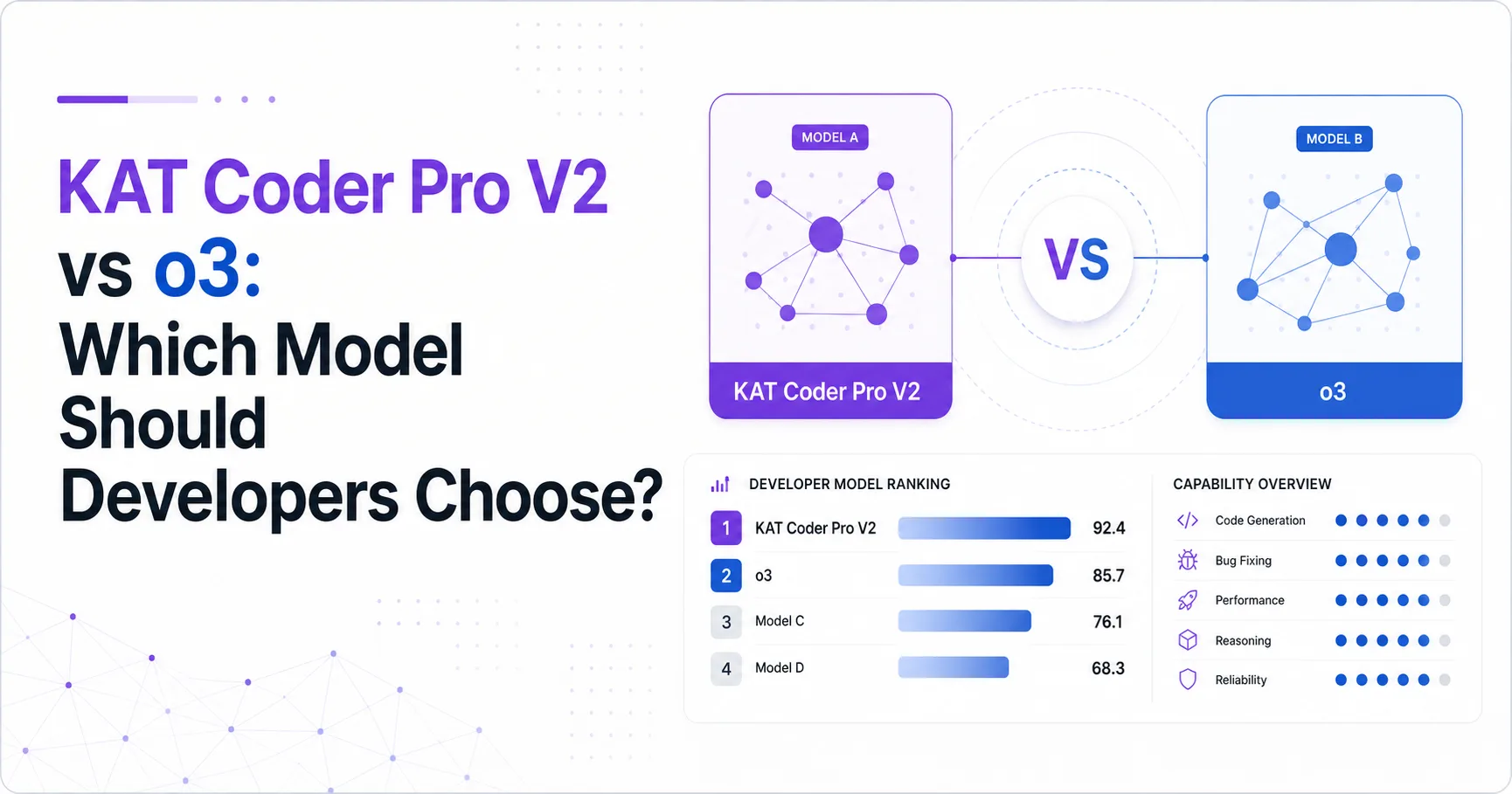
- **Winner overall:** KAT Coder Pro V2, lower blended cost at $0.525 and a higher Intelligence Index at 33.7 - **Cheaper:** KAT Coder Pro V2 at $0.525 vs $3.5 per 1M blended tokens - **Faster:** o3 at 128.056 median output tokens per second - **Pick KAT Coder Pro V2 when:** coding throughput and predictable token cost matter more than math evidence - **Watch out:** both models show 0.3 seconds latency, but KAT Coder Pro V2 has no comparable Math Index and o3 has no comparable Coding Index
KAT Coder Pro V2 vs o3: The Short Answer
KAT Coder Pro V2 is the stronger default for cost-sensitive coding workloads, while o3 remains the more defensible choice when demonstrated mathematical reasoning matters. The available comparison data gives KAT Coder Pro V2 an Artificial Analysis Intelligence Index of 33.7, compared with 30.4 for o3. That advantage is modest, so it should not be treated as proof that KAT Coder Pro V2 is better at every reasoning task. The evidence is asymmetric: KAT Coder Pro V2 has an Artificial Analysis Coding Index of 59.5, while o3 has an Artificial Analysis Math Index of 88.3. Neither model has a directly comparable score in the other category.
KAT Coder Pro V2 is also substantially cheaper in the supplied pricing snapshot. Its blended price is $0.525 per 1M tokens, compared with $3.5 for o3. Its input price is $0.3, compared with $2, and its output price is $1.2, compared with $8. That pricing gap changes the economics of large codebase analysis, automated review, and iterative agent workflows.
The central qualification is availability. No verifiable vendor documentation, stable alias, or current API endpoint was found for KAT Coder Pro V2. OpenAI’s current model directory also does not list o3 among the models shown in the supplied research. Treat the data comparison as a capability and cost signal, not as confirmation that either model is currently safe to deploy.
Executive Summary for Developers
KAT Coder Pro V2 offers the better measured value for developers, but o3 has the clearer evidence advantage for mathematical workloads. The supplied benchmark snapshot places KAT Coder Pro V2 ahead on the general Artificial Analysis Intelligence Index, with 33.7 versus 30.4. That result supports a cautiously favorable view of KAT Coder Pro V2 for broad assistant and coding workflows, although the gap is not large enough to replace task-specific testing.
The coding comparison cannot establish a winner because the snapshot reports 59.5 for KAT Coder Pro V2 and no comparable Coding Index value for o3. The math comparison has the same limitation in reverse: o3 is reported at 88.3, while KAT Coder Pro V2 has no comparable Math Index value. A developer selecting between them therefore faces an evidence boundary, not a complete leaderboard.
The practical split is straightforward. KAT Coder Pro V2 is the candidate for high-volume code generation, repository navigation, and review pipelines where token prices dominate total cost. o3 is the candidate for workloads that require a documented mathematical signal, provided the model can still be accessed through the intended API path. The supplied official OpenAI pricing page does not list current o3 pricing, so the snapshot price should be validated before procurement.
Data provided by https://artificialanalysis.ai/
Performance: Speed Is Not the Same as Task Quality
o3 produces output faster, while KAT Coder Pro V2 offers the only direct coding score in the supplied snapshot. o3 reaches a median output speed of 128.056 tokens per second, compared with 108.179 for KAT Coder Pro V2. Both models show 0.3 seconds of latency. For interactive applications, that means the initial response timing is indistinguishable in this dataset, while longer streamed responses may complete sooner with o3.
The speed difference matters most when users read responses as they arrive or when an agent emits substantial code, explanations, or tool instructions. It matters less for short completions, queued batch work, or workflows dominated by retrieval, tool execution, test runs, or human review. A faster model can also increase spend if its output is longer or if the application encourages more extensive responses.
The coding evidence favors KAT Coder Pro V2 only in the narrow sense that it has a reported Coding Index of 59.5 and o3 does not have a reported comparable value. That missing value prevents a fair coding quality conclusion. Similarly, o3’s Math Index of 88.3 is meaningful evidence for mathematical capability, but it does not prove superior software engineering performance. The available official OpenAI model documentation does not provide an o3 benchmark or detailed failure profile in the supplied research.
Developers should test repository-level editing, test repair, API integration, and mathematical planning separately. The evidence supports different hypotheses for these tasks, not one universal performance ranking.
Cost: The Cheap Model Can Still Become Expensive
KAT Coder Pro V2 has the lower token price, but workload shape determines whether that advantage becomes a lower system bill. Its blended price is $0.525 per 1M tokens, versus $3.5 for o3. Input is priced at $0.3 for KAT Coder Pro V2 and $2 for o3. Output is priced at $1.2 and $8 respectively. The output gap is especially important for coding agents that repeatedly generate patches, test explanations, or long file summaries.
The blended figure is useful for a rough comparison, but it assumes the supplied 3 to 1 input-to-output mix. A workload with unusually high output consumption will be more sensitive to output pricing. A workload with large repository context and short answers will be more sensitive to input pricing. Prompt caching, retries, tool calls, and rejected patches can also change the effective cost, and the supplied data does not quantify those factors.
The cheaper model can become more expensive when it requires additional attempts, produces patches that fail tests, or lacks the context and interface guarantees needed by the application. The reverse is also possible: o3’s higher price may be justified if its mathematical reasoning reduces failed iterations in a specialized workflow. The available snapshot does not report retry rates, pass rates, output length, or production success costs.
The official OpenAI API pricing page does not list current o3 pricing in the supplied research. Procurement teams should therefore treat $3.5 and the related o3 prices as snapshot values requiring verification, not as a confirmed current commercial offer.
Recommendation: Choose by Evidence, Then Validate Access
KAT Coder Pro V2 is the best first candidate for high-volume developer automation, while o3 is the better investigation target for math-heavy reasoning. Choose KAT Coder Pro V2 when the product needs affordable code assistance, frequent repository interactions, or large volumes of generated output. Its measured Intelligence Index is 33.7, its Coding Index is 59.5, and its blended price is $0.525 per 1M tokens. Those values create a strong value proposition for experiments where usage volume matters.
Choose o3 when mathematical reasoning is central and the reported Math Index of 88.3 matches the task’s needs. Its output speed of 128.056 tokens per second may also suit interfaces where users benefit from faster streaming. The recommendation is conditional because the supplied official OpenAI material does not confirm o3’s current endpoint, stable alias, or current price. The OpenAI model directory should be checked during implementation, and the OpenAI pricing documentation should be checked before budgeting.
Do not select either model solely from the missing cross-category scores. KAT Coder Pro V2’s Coding Index cannot be compared directly with o3’s absent Coding Index. o3’s Math Index cannot be compared directly with KAT Coder Pro V2’s absent Math Index. Build a small acceptance set around the actual application: bug localization, multi-file edits, test repair, structured output, mathematical constraints, and refusal behavior.
The largest unresolved risk is not the measured score. It is deployability. No verifiable public source was found for KAT Coder Pro V2’s API access, context window, output limit, parameters, or failure modes. The provided research also lacks confirmation that o3 remains directly callable. A model that cannot be reliably accessed is not a production option, regardless of its benchmark position.
Questions to Answer Before Choosing
Developers should resolve access, evaluation coverage, and billing assumptions before treating the comparison as a production decision. The available evidence is useful for narrowing the shortlist, but it does not establish complete operational readiness for either model.
The most important unanswered question concerns KAT Coder Pro V2’s interface. The research found no verifiable official release announcement, developer documentation, pricing page, stable alias, or community testing record. The second concerns o3’s current status. The supplied OpenAI model directory does not list it, and the supplied pricing page does not provide current o3 pricing. These gaps make independent smoke testing a prerequisite.
The comparison also lacks several measures that developers normally need: context window, output limit, tool behavior, structured output reliability, coding pass rate, failure patterns, and production availability. No numeric estimate should be inferred for any of those properties. The safest conclusion is therefore conditional: KAT Coder Pro V2 appears more economical and has direct coding evidence, while o3 has direct math evidence and higher output speed. Access validation and task-specific tests must decide the final deployment choice.
Frequently asked questions
Is KAT Coder Pro V2 better than o3 for coding?
KAT Coder Pro V2 is the more evidence-supported coding candidate because the snapshot reports a Coding Index of 59.5, while no comparable o3 Coding Index is provided. That missing o3 value prevents a definitive quality ranking.
Is o3 better for mathematical reasoning?
o3 is the more evidence-supported choice for mathematical reasoning because the snapshot reports a Math Index of 88.3, while KAT Coder Pro V2 has no comparable Math Index. The result does not establish superiority for coding.
Which model is cheaper for API workloads?
KAT Coder Pro V2 is cheaper in the supplied pricing snapshot, costing $0.525 per 1M blended tokens compared with $3.5 for o3. Actual savings depend on input-output mix, retries, and successful task completion.
Which model responds faster?
o3 has the higher measured median output speed at 128.056 tokens per second, compared with 108.179 for KAT Coder Pro V2. Both models report 0.3 seconds latency, so initial response timing is tied in this dataset.
Can developers safely deploy either model today?
The supplied research does not establish that either model is safe to deploy without additional validation. KAT Coder Pro V2 lacks verifiable access documentation, while the supplied OpenAI directory does not list o3 as a current model.
What should a team test before selecting one?
A team should test repository navigation, multi-file editing, test repair, structured output, mathematical constraints, retry behavior, and access stability. The supplied materials do not provide production pass rates or failure-mode evidence for these tasks.
Sources
- OpenAI ModelsVerifying the current model directory, o3 visibility, product positioning, API availability evidence, and the absence of supplied official o3 benchmark or limitation details.
- OpenAI API PricingChecking whether the current official pricing page lists o3 pricing and qualifying the supplied o3 pricing snapshot.
- Artificial AnalysisAttributing the supplied benchmark, speed, latency, release, and pricing snapshot data.
Published: