
AI model analysis
Kimi K2.5 (Reasoning) vs o3: Which Model Should Developers Choose?
A developer-focused comparison of Kimi K2.5 (Reasoning) and o3 covering measured capability, pricing, availability evidence, and the risks of choosing a model with incomplete documentation.
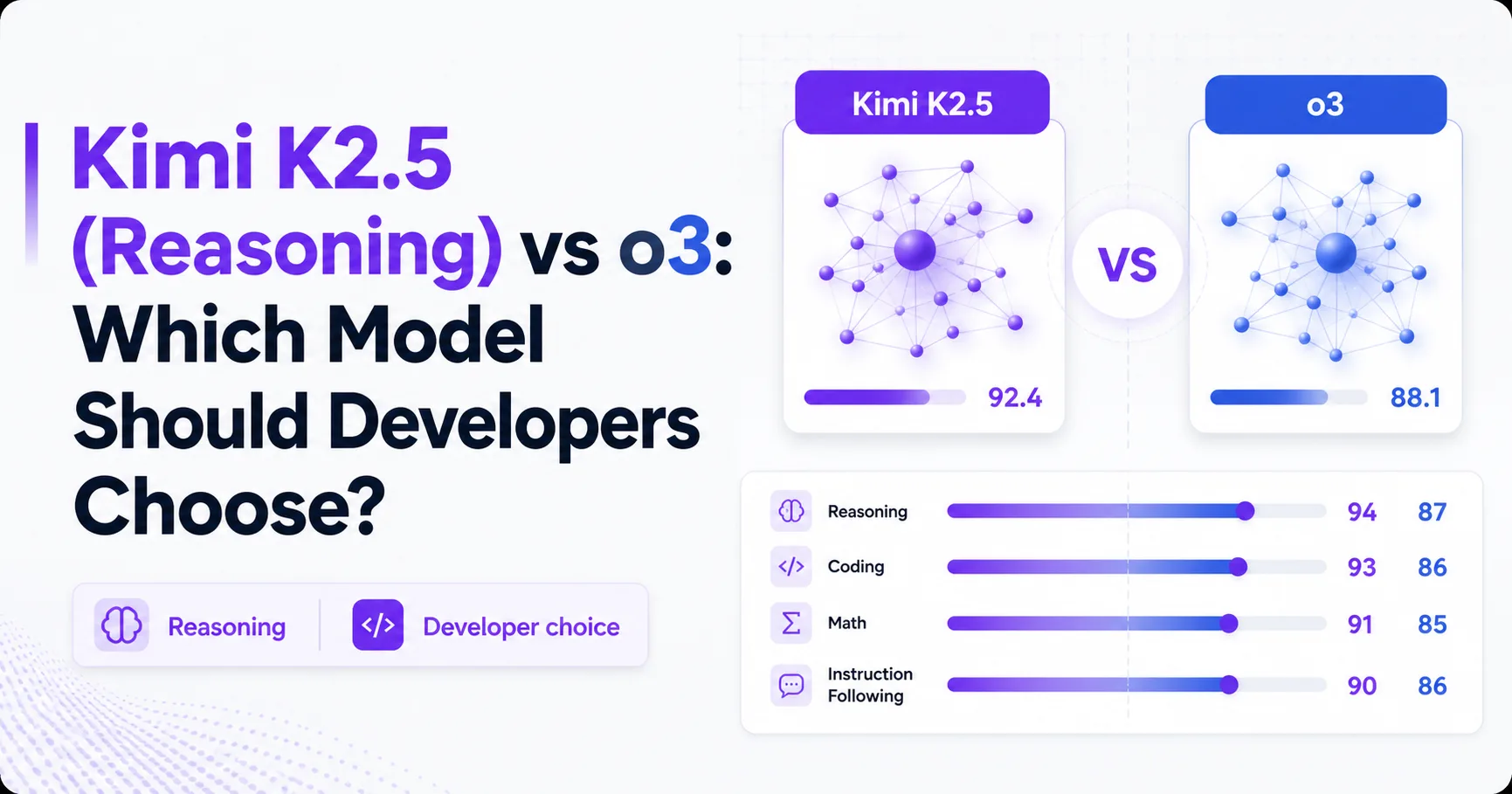
- **Winner overall:** Kimi K2.5 (Reasoning), with a 35.4 Artificial Analysis Intelligence Index versus o3 at 30.4, plus the lower blended price - **Cheaper:** Kimi K2.5 (Reasoning) at $1.2000000000000002 vs $3.5 per 1M blended tokens - **Faster:** o3 at 128.056 median output tokens per second, while Kimi K2.5 (Reasoning) has no reported value - **Pick o3 when:** your workload specifically needs the available 88.3 Artificial Analysis Math Index signal - **Watch out:** neither model has a reported context window, and the supplied research does not establish current API availability for either model
Kimi K2.5 (Reasoning) vs o3
Kimi K2.5 (Reasoning) is the stronger default on the supplied evidence because it leads the general intelligence index and costs less, while o3 has the only reported math and output-speed results.
This comparison is designed for developers choosing a model for production APIs, evaluation pipelines, coding assistants, or reasoning-heavy features. The evidence has an important asymmetry. Kimi K2.5 (Reasoning) has no verified official announcement, developer documentation, pricing page, or community test material in the research brief. o3 has official OpenAI pages that establish what appears in the current model catalog and pricing catalog, but those pages do not currently document o3 itself. The measured values come from the supplied data brief. Data provided by
The practical decision is therefore not simply capability versus cost. It is measured capability versus operational certainty. Kimi K2.5 (Reasoning) has the better general score and lower listed prices, but the research does not confirm a stable API identity, context window, output limit, or supported endpoint. o3 has a strong math signal and a reported speed, but its current commercial status is unclear.
Executive summary for developers
Kimi K2.5 (Reasoning) is the better evidence-based value pick, while o3 remains a targeted option for math-heavy workloads with a documented performance signal.
| Decision factor | Kimi K2.5 (Reasoning) | o3 |
|---|---|---|
| Release date in the data brief | 2026-01-27 | 2025-04-16 |
| Artificial Analysis Intelligence Index | 35.4 | 30.4 |
| Artificial Analysis Coding Index | 46.8 | Not reported |
| Artificial Analysis Math Index | Not reported | 88.3 |
| Blended price per 1M tokens | $1.2000000000000002 | $3.5 |
| Input price per 1M tokens | $0.6 | $2 |
| Output price per 1M tokens | $3 | $8 |
| Median output speed | Not reported | 128.056 tokens per second |
| Latency | 0.3 seconds | 0.3 seconds |
| Context window | Not reported | Not reported |
The table supports a clear cost and broad-score conclusion, but it does not support a complete production ranking. Kimi K2.5 (Reasoning) has a coding index of 46.8, yet o3 has no corresponding coding value in the supplied data. o3 has a math index of 88.3, yet Kimi K2.5 (Reasoning) has no corresponding math value. Those missing cells prevent a fair claim that one model is universally better for coding or mathematics.
Operational evidence is also incomplete. The research found no reliable public community discussions for Kimi K2.5 (Reasoning). For o3, the research likewise found no verified Reddit, Hacker News, or X material with confirmed post URLs and testing methods. The OpenAI model directory lists current GPT-5.6 models and other specialized models, but the supplied research says it does not list o3 or explain whether o3 remains directly callable. That uncertainty matters as much as the score for a new integration.
Performance: what the measured gap means
Kimi K2.5 (Reasoning) leads the available general intelligence measurement, but o3 is the only model with reported math and output-speed evidence, so the performance verdict depends on task type.
The broadest comparable result favors Kimi K2.5 (Reasoning), which records 35.4 on the Artificial Analysis Intelligence Index against 30.4 for o3. That result supports using Kimi K2.5 (Reasoning) as the first candidate for mixed reasoning workloads when the task distribution is not dominated by formal mathematics. It does not prove better code generation, planning, factuality, or reliability in every application. The index is one aggregate signal, not a substitute for a task-specific evaluation.
Coding selection is unresolved. Kimi K2.5 (Reasoning) has a reported Artificial Analysis Coding Index of 46.8, while o3 has no coding value in the data brief. A developer should read that as asymmetric evidence, not as a coding win for Kimi K2.5 (Reasoning). The missing o3 result means the supplied material cannot establish the size or direction of the coding difference.
Math selection points toward o3, but only conditionally. o3 is associated with an Artificial Analysis Math Index of 88.3, while Kimi K2.5 (Reasoning) has no reported math value. That makes o3 the safer evidence-backed candidate for a math-centered workload, but the brief does not identify the benchmark composition, task distribution, or deployment conditions. The result should trigger a validation set, not an unconditional production decision.
Latency is tied at 0.3 seconds in the supplied data. o3 additionally has a median output speed of 128.056 tokens per second, while Kimi K2.5 (Reasoning) has no reported speed value. This means o3 has the clearer streaming-performance case, but it does not establish that o3 will finish a real request sooner. Total completion time also depends on output length, queueing, retries, and service availability, none of which the research brief verifies.
The research supplies no verified failure cases, behavior profile, or community testing methodology for either model. Developers therefore have evidence for comparative indexes, latency, and o3 output speed, but not for long-context behavior, tool use, instruction following, or production resilience.
Cost: the list-price advantage has conditions
Kimi K2.5 (Reasoning) is the clear listed-price winner, but its lower cost only creates production value if developers can verify access, compatibility, and service continuity.
The supplied data lists Kimi K2.5 (Reasoning) at $1.2000000000000002 per 1M blended tokens, compared with $3.5 for o3. Kimi K2.5 (Reasoning) is also listed at $0.6 per 1M input tokens and $3 per 1M output tokens, while o3 is listed at $2 and $8. The chart below this section already exposes those figures. The decision-relevant point is the pricing structure: output-heavy reasoning workloads amplify the practical impact of the output-rate difference.
A cheaper token is not automatically a cheaper feature. If Kimi K2.5 (Reasoning) requires more retries, extra verification calls, manual fallback handling, or a less compatible integration path, the application can spend more per successful result even when its token rate is lower. The supplied research does not provide retry rates, failure rates, uptime, rate limits, or API compatibility evidence for Kimi K2.5 (Reasoning), so this total-cost question remains unanswered.
The same issue applies to o3 in a different way. The OpenAI API pricing page does not list o3 in the supplied research, so the data brief’s o3 prices should be treated as the comparison dataset rather than confirmation of a current official offer. The research also does not establish whether o3 has Standard, Batch, Flex, or Fast mode pricing today.
Input-heavy classification, retrieval, and routing workloads may benefit most from Kimi K2.5 (Reasoning)'s lower input rate. Long generated answers and multi-step reasoning make output pricing more important. However, neither model has a reported context window, and the research does not verify output limits. Developers should measure cost per accepted answer on representative prompts before treating the listed token prices as the final budget forecast.
Recommendation by developer scenario
Kimi K2.5 (Reasoning) should be the first benchmark candidate for broad reasoning and cost-sensitive applications, while o3 should remain a focused candidate for math-heavy or speed-sensitive tests.
Choose Kimi K2.5 (Reasoning) first when the product needs a general reasoning model and the team can tolerate integration uncertainty during evaluation. Its 35.4 Artificial Analysis Intelligence Index is higher than o3’s 30.4, and its listed blended price is lower. The combination is attractive for assistants, structured analysis, and workflows where every request must stay within a tight token budget. The supplied evidence does not confirm that Kimi K2.5 (Reasoning) is currently available through a stable API, so this recommendation is for the evaluation queue, not automatic production adoption.
Choose o3 first when formal mathematics is central to the product and the team values a reported speed signal. The 88.3 Artificial Analysis Math Index is the only supplied math result, and o3 has the only reported median output speed at 128.056 tokens per second. That evidence makes o3 worth testing for theorem-style tasks, quantitative reasoning, and interactive responses. It does not show that o3 is currently callable through a stable endpoint. The OpenAI model directory does not provide that confirmation in the supplied research.
Do not select either model solely for coding superiority. Kimi K2.5 (Reasoning) has a coding score of 46.8, but the data brief gives no o3 coding score. Run the same repository tasks, patch-generation tasks, test-writing tasks, and review tasks against both models before deciding.
A sensible evaluation sequence is small and measurable: first verify that each model can be called under the intended account and endpoint, then test representative prompts, then record accepted-result cost and completion behavior. The research brief does not supply context limits, output limits, API parameters, stable aliases, failure modes, or community-tested behavior for either model. Those are decision-critical unknowns, not details to infer from benchmark numbers.
Before you commit
o3 has stronger evidence for math and output speed, while Kimi K2.5 (Reasoning) has stronger evidence for broad score and price, so deployment should follow a short verification gate.
The first gate is availability. The second is task fit. The third is cost per successful result. The supplied official OpenAI pages clarify the current catalog and pricing presentation, but they do not document o3’s current endpoint or price listing. Kimi K2.5 (Reasoning) has no verified official product or API source in the research brief. Developers should preserve a fallback path until those unknowns are resolved.
Frequently asked questions
Which model is the better overall choice for developers?
Kimi K2.5 (Reasoning) is the better overall evidence-based choice because it leads the supplied general intelligence index and has the lower listed blended price, although API availability remains unverified.
Is Kimi K2.5 (Reasoning) cheaper than o3 for production workloads?
Kimi K2.5 (Reasoning) is cheaper on the supplied token prices, but production cost cannot be confirmed without retry, failure, rate-limit, compatibility, and successful-answer measurements.
Should developers choose o3 for coding?
Developers should not choose o3 for coding based on the supplied evidence alone because o3 has no reported coding index, while Kimi K2.5 (Reasoning) has a coding index of 46.8.
Should developers choose o3 for mathematics?
Developers should test o3 first for mathematics because o3 has the supplied Artificial Analysis Math Index of 88.3, while Kimi K2.5 (Reasoning) has no reported math result.
Which model is faster?
o3 has the clearer speed evidence because its median output speed is reported as 128.056 tokens per second, while both models have the same supplied latency of 0.3 seconds.
Are either model's context limits confirmed?
Neither model has a reported context window in the supplied data brief, and the research materials do not provide a verified official context limit for either model.
Sources
- Artificial AnalysisAttribution for the supplied model metrics, pricing data, latency values, release dates, and evaluation indexes.
- OpenAI ModelsChecking the current OpenAI model catalog, model visibility, product positioning, and whether the supplied research confirms o3 availability or stable aliases.
- OpenAI API PricingChecking the current OpenAI pricing catalog and whether the supplied research confirms a current official o3 price listing.
Published: