
AI model analysis
Kimi K2.6 vs o3: Which Model Should Developers Choose?
A data-grounded comparison of Kimi K2.6 and o3 for developer model selection, covering capability evidence, speed, cost, availability, and uncertainty.
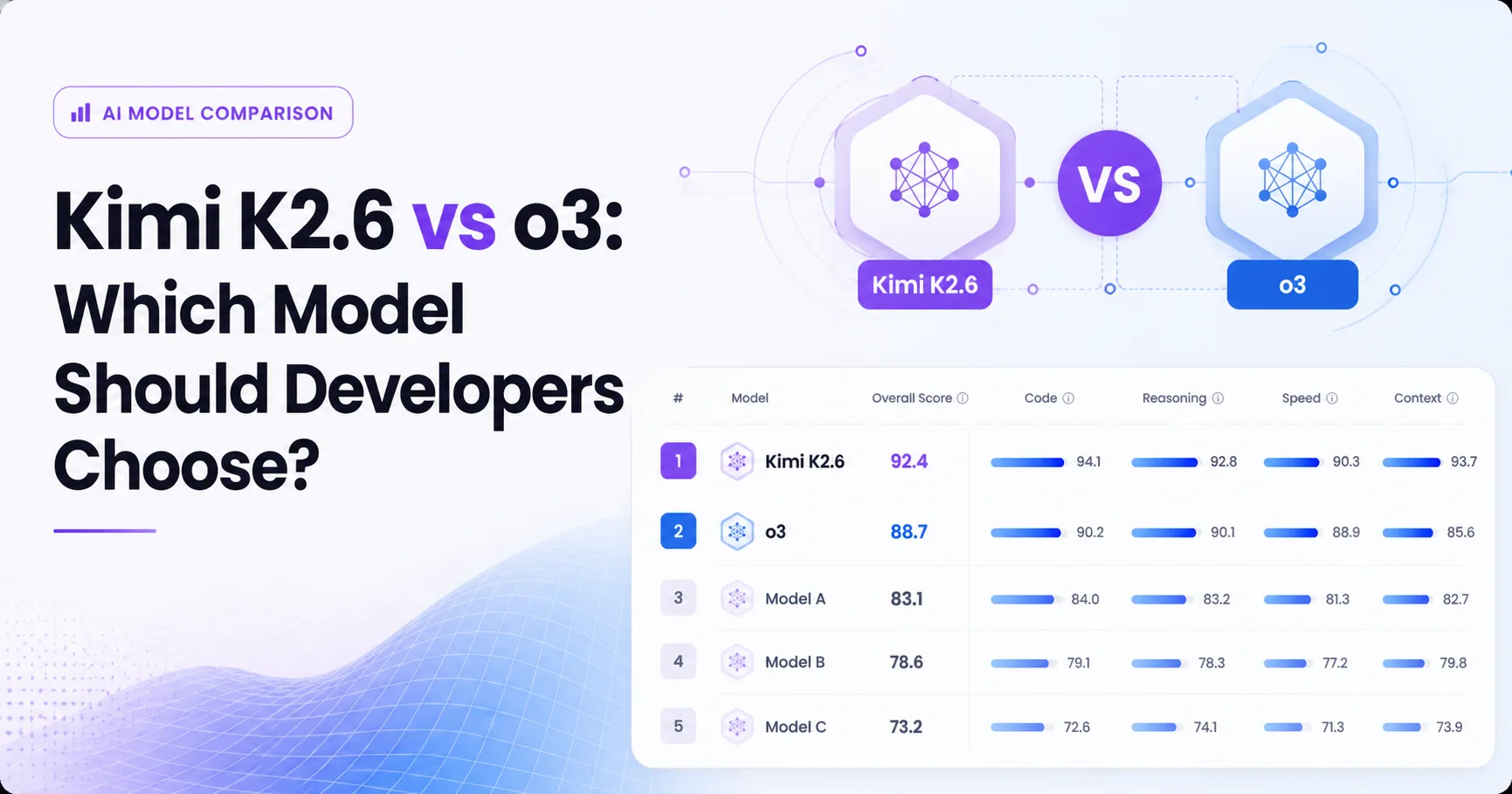
- **Winner overall:** Kimi K2.6, with an Artificial Analysis Intelligence Index of 44.2 versus o3 at 30.4, although the evidence does not establish a universal winner. - **Cheaper:** Kimi K2.6 at $1.7125 vs $3.5 per 1M blended tokens - **Faster:** o3 at 128.056 median output tokens per second, while Kimi K2.6 has no reported value - **Pick Kimi K2.6 when:** lower API cost and the reported general intelligence score matter more than verified reasoning or availability details - **Watch out:** Kimi K2.6 has no verifiable official documentation or community testing in the supplied research, while o3 is absent from the current OpenAI model directory
Kimi K2.6 vs o3
Kimi K2.6 is the stronger value candidate in the supplied dataset, but o3 remains the only model here with a reported output-speed measurement. The available evidence does not support a clean production recommendation without validating access, reliability, and task fit first. Artificial Analysis reports Kimi K2.6 at 44.2 on its Intelligence Index and o3 at 30.4. The same dataset lists Kimi K2.6 at $1.7125 per 1M blended tokens, compared with $3.5 for o3. It also reports o3 at 128.056 median output tokens per second, while no corresponding Kimi K2.6 value is available. Data provided by https://artificialanalysis.ai/
Executive summary for developers
Kimi K2.6 offers the better measured general capability and lower listed cost, while o3 offers the better documented performance signal for generation speed. Artificial Analysis reports Kimi K2.6 at 44.2 on the Intelligence Index, compared with 30.4 for o3. That result gives Kimi K2.6 the clearest advantage in the supplied cross-model evidence. It does not prove that Kimi K2.6 is better for every engineering task, because the supplied comparison does not report a directly comparable coding score for o3 or a math score for Kimi K2.6.
The cost difference is substantial for workloads with similar token volumes. Kimi K2.6 is listed at $0.95 per 1M input tokens and $4 per 1M output tokens. o3 is listed at $2 per 1M input tokens and $8 per 1M output tokens. The blended comparison is $1.7125 for Kimi K2.6 versus $3.5 for o3. Those figures favor Kimi K2.6 for high-volume generation, but price alone cannot establish lower total engineering cost.
The official evidence is uneven. No verifiable official announcement, developer documentation, pricing page, or community test source was supplied for Kimi K2.6. The current OpenAI model directory lists newer GPT-5.6 models and does not list o3 in the supplied research. The OpenAI pricing page also does not list current o3 prices. Therefore, the data snapshot and current official availability evidence describe different decision layers, and neither model has a fully verified production profile here.
Performance: what the scores mean in real development work
Kimi K2.6 has the stronger reported general capability signal, but the supplied benchmarks cannot identify a universal coding or reasoning winner. Artificial Analysis reports a 44.2 Intelligence Index for Kimi K2.6 and 30.4 for o3. The reported spread is useful as a directional signal for broad task performance, such as planning, explanation, transformation, and mixed development workflows. It is not a substitute for tests built around your repository, tool calls, error tolerance, and required output format.
The evidence becomes less decisive when the task is specialized. Kimi K2.6 has a reported Coding Index of 61.8, but the supplied comparison has no o3 Coding Index. o3 has a reported Math Index of 88.3, but Kimi K2.6 has no corresponding math value. These are separate measurements, so they should not be treated as a head-to-head victory. The missing values are an important limitation for developers choosing between coding agents, verification systems, or mathematical reasoning workloads.
o3 has a reported median output speed of 128.056 tokens per second, while Kimi K2.6 has no reported median output-speed value. That makes o3 the only model with a usable speed signal in this comparison. Both models have a listed latency of 0.3 seconds in the dataset. The practical effect depends on response length and workflow design. A fast model can improve interactive coding sessions, but speed matters less when the dominant delay comes from retrieval, tool execution, tests, or human review.
The research brief supplies no verifiable community posts for either model. Coding ergonomics, refusal behavior, instruction following, and failure patterns therefore remain unresolved. Developers should treat the measured scores as selection inputs, not as proof of production behavior.
Cost: lower token prices do not guarantee lower project cost
Kimi K2.6 is the cheaper model on every supplied token-price measure, but o3 can still be economically preferable when its speed or task success reduces downstream work. Artificial Analysis lists Kimi K2.6 at $1.7125 per 1M blended tokens, compared with $3.5 for o3. Input pricing is $0.95 for Kimi K2.6 and $2 for o3 per 1M tokens. Output pricing is $4 for Kimi K2.6 and $8 for o3 per 1M tokens.
The price advantage is most meaningful for workloads that generate large volumes of similar responses, including drafting, classification, transformation, and routine code assistance. It becomes less decisive when a cheaper response requires more retries, larger prompts, manual correction, or additional validation calls. The supplied research does not provide success rates, retry rates, context limits, or tool-use costs for either model, so it cannot establish total cost per completed task.
o3’s reported median output speed of 128.056 tokens per second may matter for interactive workflows, especially when users wait on visible completions. However, the available data does not show whether that speed produces better throughput after tool calls, failed attempts, or review. Both models have a listed latency of 0.3 seconds, so the comparison does not show a latency-based cost advantage.
The official pricing evidence introduces another risk. The supplied OpenAI pricing page does not list current o3 pricing, while the dataset reports an o3 price. Developers should verify the actual account-level price and endpoint before committing a budget forecast. Kimi K2.6 also lacks a verifiable official pricing source in the research brief, so its listed price requires the same operational validation.
Recommendation by deployment scenario
Kimi K2.6 is the better first candidate for cost-sensitive general development workflows, while o3 deserves a controlled trial for speed-sensitive or math-heavy tasks. The recommendation follows the supplied measurements, not a claim that either model is universally superior. Artificial Analysis reports the higher Intelligence Index for Kimi K2.6 at 44.2 versus 30.4 for o3. It also reports Kimi K2.6’s Coding Index at 61.8, but no comparable o3 coding result.
Choose Kimi K2.6 first when your primary constraint is token spend and your workload needs broad assistance across explanation, code generation, rewriting, and structured output. Its listed blended price of $1.7125 per 1M tokens is lower than o3’s $3.5. The choice still depends on confirming that Kimi K2.6 is reachable through a stable endpoint and meets your data-handling requirements. The research brief provides no verifiable official documentation for those questions.
Test o3 first when response speed is central to the user experience or when mathematical reasoning is a major part of the workload. The dataset reports o3 at 128.056 median output tokens per second and gives it a Math Index of 88.3. Those signals justify a focused evaluation, but they do not demonstrate better repository-level coding or lower total task cost.
Do not make a final procurement decision from the supplied evidence alone. The OpenAI model directory does not list o3 in the current directory described by the research brief, and no official Kimi K2.6 source was supplied. Validate endpoint availability, version stability, context behavior, tool calling, and representative task success before migration or launch. These are evidence gaps, not confirmed failures.
Questions to answer before choosing
Kimi K2.6 should be evaluated first for broad, cost-sensitive workloads, but the evidence leaves key production questions unanswered. The supplied research contains no verifiable community test material for either model, so developers should avoid treating anecdotal behavior as established fact. Artificial Analysis supplies the comparative dataset, while the OpenAI model directory and OpenAI pricing page supply the available official OpenAI references. The final choice should follow a representative evaluation that measures completed-task quality, retries, tool interactions, and operational availability.
Frequently asked questions
Is Kimi K2.6 better than o3 for coding?
Kimi K2.6 has the stronger available coding signal, because the dataset reports a Coding Index of 61.8, while no comparable o3 coding result is supplied. That evidence does not prove better repository-level performance.
Which model is cheaper for API workloads?
Kimi K2.6 is cheaper on the supplied pricing measures, including $1.7125 versus $3.5 per 1M blended tokens, $0.95 versus $2 for input tokens, and $4 versus $8 for output tokens.
Which model is faster for interactive applications?
o3 is the only model with a reported median output speed, at 128.056 tokens per second, while Kimi K2.6 has no supplied value. Both models have a listed latency of 0.3 seconds.
Is o3 still available through the OpenAI API?
The supplied research does not establish current o3 availability, a stable alias, or a supported endpoint. The current OpenAI model directory described in the brief does not list o3, so developers must verify access directly.
Can developers trust the listed prices for production planning?
Developers should treat the listed prices as comparison data rather than confirmed current procurement rates. The supplied OpenAI pricing page does not list o3, and no verifiable official Kimi K2.6 pricing page was provided.
Sources
- Artificial AnalysisComparative intelligence, coding, math, speed, latency, release date, and token-pricing data
- OpenAI ModelsCurrent model-directory visibility, product-line positioning, and the supplied evidence about o3 availability and aliases
- OpenAI API PricingThe supplied evidence about current OpenAI pricing visibility and the absence of a listed o3 price
Published: